
Intel AX210 Tri-Band
4.8Editor score
Tri-band Wi-Fi 6E performance
Bluetooth 5.3 connectivity
MU-MIMO and OFDMA support
Windows 10 and 11 support
Our M2 WiFi Cards guide compares ten internal adapters for speed, radio bands, Bluetooth, compatibility, drivers, and setup across Windows and Linux systems.
M2 WiFi Cards provide a practical way to add modern wireless connectivity and Bluetooth to a compatible laptop, desktop, or mini PC. The right adapter depends on your M.2 slot, processor platform, operating system, router, and desired Wi-Fi generation, so form factor alone is not enough to determine compatibility.
We compared the ten featured adapters by wireless standard, supported frequency bands, theoretical throughput, Bluetooth version, platform restrictions, included components, and installation considerations. The list covers AX1800 dual-band Wi-Fi 6 cards, tri-band Wi-Fi 6E modules, and Wi-Fi 7 options for both Intel and AMD systems.
Each review explains the card's strongest benefits, limitations, and ideal user, while the comparison table makes the technical differences easier to scan. Product listings, stock levels, and system configurations can change, so verify the card's dimensions, keying, antenna connectors, and operating-system requirements before purchasing.
4.8Editor score

5.0Editor score

4.6Editor score
This side-by-side comparison highlights the ten cards by wireless generation, frequency support, Bluetooth version, platform fit, and key installation requirement.

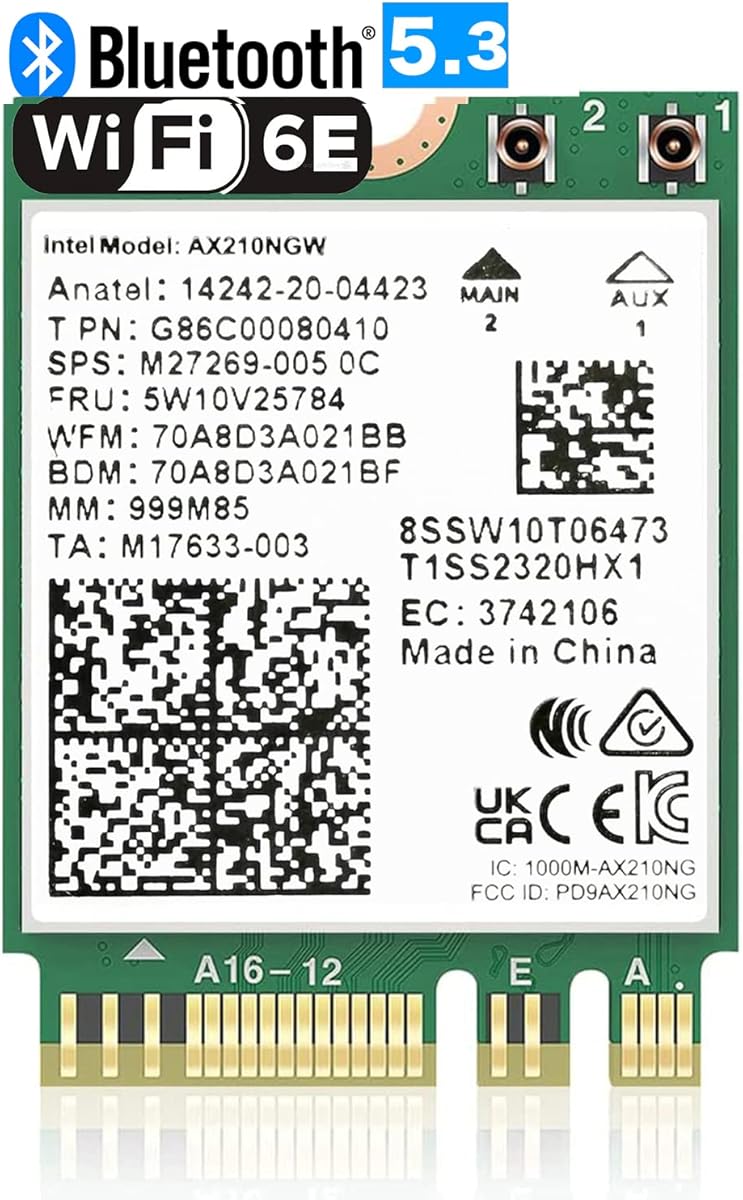



The AX210NGW DTK is a tri-band Wi-Fi 6E M.2 2230 adapter built around the Intel AX210 platform, and it holds a 4.5 rating among buyers. Its distinguishing advantage is not the module alone but the complete installation package, which includes two 5dBi antennas, 11-inch RF cables, and low-profile brackets for desktop or laptop-style mounting arrangements.
We may earn a commission when you buy through this link, at no additional cost to you.
The AX210 module supports 2.4GHz, 5GHz, and 6GHz operation, with listed maximum rates of 574Mbps, 2400Mbps, and 2400Mbps respectively. OFDMA, MU-MIMO, and Target Wake Time help the card handle crowded networks more efficiently and reduce unnecessary laptop wake-ups, while Bluetooth 5.3 expands its value for headsets, keyboards, mice, and other wireless accessories.
The included antennas can make this kit particularly useful in a desktop placed away from a wall or in a metal enclosure where the small card's built-in antenna would perform poorly. The trade-off is that external antenna placement requires deliberate setup; simply attaching the module and leaving the cables poorly routed may not produce the strongest signal. Users also need a compatible Wi-Fi 6E router to benefit from the 6GHz band.
This is an attractive choice for someone who wants a straightforward internal upgrade without sourcing antennas and brackets separately. It suits builders comfortable opening a laptop or desktop, as well as users who understand that an M.2 Wi-Fi card needs matching antennas and system support. For those who want both Wi-Fi 6E and a thoughtfully supplied installation kit, it is a well-rounded recommendation.
The two external antennas and extended RF cables allow the radio to sit inside the chassis while the antennas remain in clearer line of sight. This flexibility can be valuable in compact desktops, although users should experiment with antenna position and keep the cables away from sources of severe interference.
Support for all three principal bands gives the card flexibility across 2.4GHz, 5GHz, and 6GHz networks. The 6GHz band is particularly useful for reducing congestion when a compatible Wi-Fi 6E router is available, although the older bands remain important for range and compatibility.
We may earn a commission when you buy through this link, at no additional cost to you.
The OKN AX210 NGW is a 4.6-rated M.2 2230 module aimed at users upgrading a compatible Windows laptop or desktop to Wi-Fi 6E. It combines tri-band wireless with Bluetooth 5.3 and carries the AX210's modern feature set, including MU-MIMO, OFDMA, 1024-QAM, and support for 160MHz channels.
We may earn a commission when you buy through this link, at no additional cost to you.
Its listed maximum throughput is 574Mbps at 2.4GHz, 2400Mbps at 5GHz, and 2400Mbps at 6GHz. That aggregate figure gives the card headroom for high-speed local networks, while the 2.4GHz band extends reach and the 6GHz band can offer cleaner, lower-congestion channels. WPA, WPA2, and WPA3 support helps provide a modern security foundation.
The module is intended for 64-bit Windows 10 and Windows 11 systems and can work with Intel CPUs and newer AMD CPUs, but the hardware still has to have a suitable M.2 E-key slot and working antennas. No external antenna kit is listed, so buyers relying on the card's onboard antennas must accept their placement. Drivers are obtained by searching for AX210 on Intel's website.
This card is a strong fit for a standard laptop replacement where the original wireless hardware is faulty, outdated, or limited to an older band. It may be especially useful for a compatible Windows 11 system that should benefit from 6GHz and Bluetooth 5.3. It is less appealing for builders who require a complete desktop antenna kit or need broad Linux support listed explicitly.
MU-MIMO, OFDMA, 1024-QAM, and 160MHz channel support give the AX210 a capable feature set for modern wireless networks. These technologies help improve efficiency when several devices share a connection, though real performance still depends on the router and local radio conditions.
Intel's AX210 driver is widely available through Intel's support process, which makes the card approachable for Windows users. Installation still requires matching the module to the laptop's slot and antenna arrangement, and having drivers ready before removal of the existing card can simplify the upgrade.
We may earn a commission when you buy through this link, at no additional cost to you.
The Intel AX210 Tri-Band is a compact network card for notebooks, carrying one of the strongest ratings in this collection at 4.8. Its core appeal is the familiar Intel AX210 combination of Wi-Fi 6E and Bluetooth 5.3 in a small module that can restore or modernize wireless connectivity in a compatible laptop.
We may earn a commission when you buy through this link, at no additional cost to you.
Tri-band operation allows the card to work across 2.4GHz, 5GHz, and 6GHz networks, giving users access to the cleaner 6GHz spectrum when the router supports it. The AX210 platform is also associated with features such as MU-MIMO, OFDMA, 1024-QAM, and 160MHz channel support, all of which help a modern router serve busy wireless environments more efficiently.
The supplied information is concise and does not list included antennas, cables, or brackets, so buyers should not assume this is a full desktop installation kit. A notebook typically already has antennas and cables, but the replacement module must still match the original card's form factor, keying, connector arrangement, and supported platform. Bluetooth 5.3 also makes the module useful for pairing common accessories.
This is a particularly compelling option for someone replacing a failed or outdated notebook card while already having compatible antenna hardware. Its high user rating and AX210-based feature set make it an attractive general-purpose choice, but the purchase should be confirmed against the laptop's requirements. For owners of a modern 64-bit Windows notebook with an AX210-compatible slot, it is an easy recommendation.
A bare internal module works well in a notebook that already includes the necessary antennas and internal cable routing. It avoids the complexity of choosing external antennas while still providing a current wireless and Bluetooth platform for compatible machines.
The 4.8 rating indicates strong owner satisfaction, although ratings should not be treated as a substitute for checking compatibility. Slot layout, antenna connectors, operating system, and processor generation remain the essential details to verify before buying.
We may earn a commission when you buy through this link, at no additional cost to you.
The Intel BE200 NGW is a Wi-Fi 7 M.2 E-key adapter for relatively modern Intel-based systems, and it earns a 4.6 rating. It is positioned as a high-speed upgrade with tri-band operation, Bluetooth 5.4, and a listed maximum aggregate throughput of 8774Mbps across 2.4GHz, 5GHz, and 6GHz.
We may earn a commission when you buy through this link, at no additional cost to you.
The card's band maximums are 574Mbps at 2.4GHz, 2400Mbps at 5GHz, and 5800Mbps at 6GHz. That makes it especially relevant to owners of compatible Wi-Fi 7 routers and systems capable of taking advantage of high-speed 6GHz links. Bluetooth 5.4, based on Bluetooth 5.3, adds support for LE enhancements, greater host-controller key length, and an LE channel hierarchy function.
Compatibility is the defining constraint. The product supports Windows 11 and Windows 10 in 64-bit mode and Linux, but it is limited to Intel 12th-generation and newer processors and does not support AMD. The M.2 E-key interface must also be available and must not be a CNViO2 slot. Drivers must be installed by searching for BE200NGW on Intel's website.
This is a strong recommendation for an owner of a qualifying recent Intel PC who wants the newest wireless generation and has a Wi-Fi 7 router. It is less suitable for an AMD build, an older processor, or someone whose main goal is compatibility with a basic Wi-Fi 6 network. For the right platform, the BE200 offers a compelling path to faster, low-latency wireless connectivity.
The BE200's most significant advantage is its 6GHz throughput potential, which is much higher than the 6GHz maximum listed for AX210-based cards. Actual performance still depends on a compatible Wi-Fi 7 router, signal conditions, bandwidth configuration, and the other equipment on the network.
The processor and interface restrictions make compatibility checking essential. A system with an M.2 slot may still lack the required antenna routing or use a special slot architecture, so the case design and manufacturer documentation should be reviewed before purchase.
We may earn a commission when you buy through this link, at no additional cost to you.
The EDUP MT7925 BE6500 is a Wi-Fi 7 module for users who want a tri-band option across both Intel and AMD platforms. Its 4.4 rating reflects a capable alternative to the more restrictive Intel BE200, and the MT7925 chipset supports up to 6.5Gbps of combined theoretical throughput across the 2.4GHz, 5GHz, and 6GHz bands.
We may earn a commission when you buy through this link, at no additional cost to you.
Multi-Link Operation is a notable Wi-Fi 7 feature intended to maintain stable, responsive connections by using multiple links intelligently. The card also supports Bluetooth 5.4 and can connect as many as seven Bluetooth devices at once, making it useful for keyboards, mice, headsets, and other accessories. WPA3 is supported alongside WPA and WPA2.
Compatibility is broader concerning processor brands, but the slot still has to meet the M.2 2230 A/E-key requirement. The card is not compatible with CNViO2-protocol slots or Mini PCI Express slots. It supports Windows 11 in 64-bit mode and Linux with kernel 6.7 or later, and EDUP directs buyers to its own driver page for the EPMT7925BE module.
This is a strong fit for a compatible AMD or Intel laptop that has a standard M.2 2230 A/E-key wireless slot and a desire for Wi-Fi 7. It is less convenient for Linux users with older kernels or systems whose wireless slot uses a restricted architecture. The user should also disable the computer's built-in Bluetooth before using the module to avoid conflicts.
Supporting both Intel and AMD makes this card attractive to buyers who do not want to tie their upgrade to one processor family. The trade-off is that compatibility still depends on the exact slot, operating system, kernel version, and antenna arrangement.
MLO can help preserve responsiveness and throughput in demanding wireless environments by coordinating multiple links. The practical benefit depends on router support and network configuration, so it should be treated as a forward-looking capability rather than a guarantee in every setting.
We may earn a commission when you buy through this link, at no additional cost to you.
The EDUP Intel AX210 is a 4.8-rated Wi-Fi 6E card designed as a straightforward internal upgrade for compatible laptops. Built around the Intel AX210 NGW chipset, it combines tri-band networking, Bluetooth 5.3, and the current AX210 feature set in the widely used M.2 2230 form factor.
We may earn a commission when you buy through this link, at no additional cost to you.
The listed maximum rate reaches 5400Mbps by combining 574Mbps at 2.4GHz with 2400Mbps at both 5GHz and 6GHz. MU-MIMO, OFDMA, 160MHz bandwidth, and 1024-QAM support make it suitable for modern busy networks, while Bluetooth 5.3 improves the connection options available for everyday wireless peripherals.
The main limitation is installation hardware: the product is a module rather than a complete antenna kit, and it is not compatible with CNViO2 protocol slots or Mini PCI Express. It supports Windows 10 and Windows 11 in 64-bit mode, with Wi-Fi and Bluetooth drivers available from Intel. The seller also adds a one-year warranty and lifetime technical support.
For a compatible Windows notebook owner, this is a compelling balance of modern features, a strong user rating, and a relatively accessible upgrade path. It is especially helpful when the original card has failed or when Bluetooth needs modernization. Buyers should verify the slot type, antenna connectors, and physical clearance before ordering, but for a standard AX210-compatible installation, it is an easy recommendation.
The AX210 chipset is a well-established choice for tri-band client devices and combines a broad feature set with straightforward Intel driver support. It remains a sensible middle ground for users who want 6GHz capability without moving to a more restrictive Wi-Fi 7 platform.
Bluetooth 5.3 can provide lower latency, improved interference handling, and better energy efficiency compared with older Bluetooth versions. The card can serve wireless keyboards, mice, headsets, speakers, and similar devices, but the computer's built-in Bluetooth may need to be disabled first if it causes conflicts.
We may earn a commission when you buy through this link, at no additional cost to you.
The Intel Wireless-AC 9560 is a dual-band Wi-Fi 5 adapter with a 4.4 rating. It is included in this guide as a practical, established option for systems that need a reliable M.2 2230 replacement but do not require Wi-Fi 6E or Wi-Fi 7, and it pairs Wi-Fi with Bluetooth 5.1.
We may earn a commission when you buy through this link, at no additional cost to you.
The 9560 supports 802.11ac Wave 2 and can deliver up to 1.73Gbps when using a 160MHz channel. MU-MIMO allows multiple devices to receive data simultaneously, improving efficiency on a compatible network, while WPA3 encryption support helps modernize security. Its dual-band operation covers both 2.4GHz and 5GHz, which remain broadly supported by routers and access points.
Compared with the AX210, AX411, and BE200 options in this list, the 9560 lacks the 6GHz band and carries an older Bluetooth 5.1 radio. That makes it most attractive for an older or budget-conscious system with a matching slot, rather than a new high-end installation. Compatibility is described as best with Intel Core processors, so users should confirm platform support.
The 9560 is a sensible choice for a compatible laptop with a failed dual-band card, a home network limited to 5GHz, or a user who prioritizes a known Intel platform over the newest standard. It is not the right option when access to cleaner 6GHz spectrum or newer Bluetooth capabilities is important. For its intended role, it remains a functional and well-understood option.
The 9560 remains relevant where a system, router, or driver environment is better suited to a mature Wi-Fi 5 module. Its 160MHz capability can provide strong 5GHz performance when both the access point and local conditions support it.
Adding Bluetooth 5.1 through the same M.2 module can be useful for peripherals without requiring a separate internal adapter. It remains less advanced than Bluetooth 5.3 and 5.4 alternatives, but it can still provide a functional upgrade over systems without Bluetooth.
We may earn a commission when you buy through this link, at no additional cost to you.
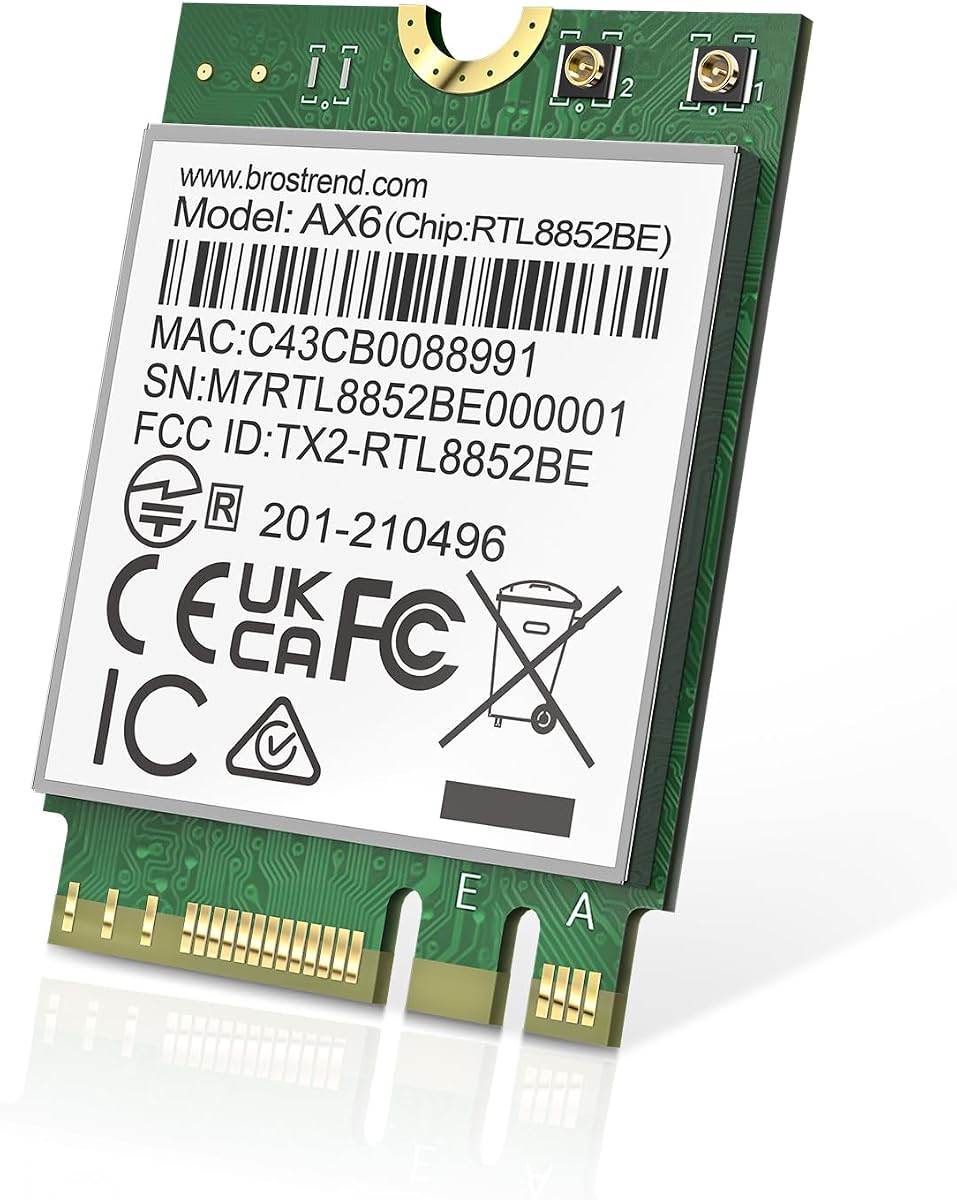
The BrosTrend AX1800 is a dual-band Wi-Fi 6 M.2 2230 card with a 4.4 rating. It offers a simpler upgrade path than the tri-band and Wi-Fi 7 products in the guide, combining a maximum 1800Mbps rate with Bluetooth 5.2 for systems that mainly use 2.4GHz and 5GHz networks.
We may earn a commission when you buy through this link, at no additional cost to you.
The listed maximum is 1201Mbps on the 5GHz band and 574Mbps on 2.4GHz. UL and DL MU-MIMO, OFDMA, and 1024-QAM support help the card manage streaming, browsing, and gaming across a modern Wi-Fi 6 router. Its Bluetooth 5.2 implementation also allows common wireless accessories to connect without a separate adapter.
The module uses the familiar 22mm-by-30mm M.2 2230 shape with Key A and Key E slots, making it straightforward to compare with many laptop replacements. Windows 10 and Windows 11 are supported, along with Linux systems using kernel 6.5 or later, although the manufacturer does not provide Linux expertise support. Drivers should be obtained from BrosTrend's official website.
This card makes the most sense for a compatible laptop or desktop that needs affordable, modern dual-band Wi-Fi and Bluetooth without requiring 6GHz. It is a straightforward choice for standard home and office networks, while users planning to buy a Wi-Fi 6E or Wi-Fi 7 router should consider a card capable of using the newer band.
The AX1800 concentrates on the widely used 2.4GHz and 5GHz bands, making it a dependable option for conventional routers. It delivers the principal benefits of Wi-Fi 6 without requiring 6GHz availability, which can simplify installation and network configuration.
The standard 2230 Key A/E layout fits many compatible laptops and compact desktops, but physical size alone is not enough to confirm compatibility. Antenna connectors, BIOS support, and the operating system should all be checked before removing an existing card.
We may earn a commission when you buy through this link, at no additional cost to you.
The Intel Killer BE200 is a Wi-Fi 7 M.2 PCIe Key E adapter aimed particularly at gaming and latency-sensitive use, with a 4.6 rating. It provides tri-band 802.11be operation and a listed maximum throughput of 5.8Gbps, making it a natural fit for a recent Intel gaming system with suitable wireless hardware.
We may earn a commission when you buy through this link, at no additional cost to you.
Across 2.4GHz, 5GHz, and 6GHz, the card is presented as a low-latency solution that can take advantage of a compatible Wi-Fi 7 router. Bluetooth 5.4 provides a modern short-range radio for controllers, headsets, keyboards, and other devices. The product is supplied as a single card rather than a full desktop antenna kit.
Its restrictions are significant: Windows 11 in 64-bit mode is required, the system must have an available M.2 PCIe Key E slot, and AMD platforms are unsupported. The card also needs working antennas and a router capable of Wi-Fi 7 to realize its highest potential. As with every advertised maximum, distance, equipment, configuration, and local network conditions affect actual results.
This is a recommended choice for an owner of a compatible Intel gaming PC who wants to prepare for Wi-Fi 7 and values low-latency wireless performance. It is less appropriate for an AMD system, a computer running an older Windows version, or a home network limited to Wi-Fi 6. Checking the manufacturer's hardware list before opening the case is essential.
The Killer BE200's design emphasizes responsive wireless performance, which is valuable for online games where input delay and connection stability matter. Real-world latency also depends on the router, internet service, server distance, and competing network traffic, so no adapter can remove every source of delay.
Owners of a compatible Wi-Fi 7 router can take advantage of the card's 6GHz capability, while users on older routers will still benefit from its tri-band and Bluetooth support. Checking the system and router generation together avoids paying for capability that cannot be used immediately.
We may earn a commission when you buy through this link, at no additional cost to you.
The Intel Killer AX411.NGWG.NVX is a tri-band Wi-Fi 6E and Bluetooth 5.3 combo adapter with a perfect 5.0 rating. It is positioned for modern laptops, mini PCs, motherboards, and server-oriented installations that need flexible access to the 2.4GHz, 5GHz, and 6GHz bands without moving to Wi-Fi 7.
We may earn a commission when you buy through this link, at no additional cost to you.
Its listed maximum speed is up to 3Gbps, while OFDMA, MU-MIMO, 1024-QAM, and WPA3 support provide a capable contemporary feature set. Intel Killer Optimization is intended to prioritize gaming, streaming, and real-time applications, potentially reducing the effect of competing traffic. Bluetooth 5.3 adds stable, energy-efficient connections for peripherals and includes BLE support.
The M.2 2230 Key E format is widely used, but the card is not automatically compatible with every similarly sized slot. Antenna connectors, system allowlists, BIOS support, and physical space all need confirmation. Windows 10 and Windows 11 are supported with Intel drivers, making the card especially approachable for mainstream PC upgrades, although Linux availability is not stated.
This is an excellent general-purpose recommendation for a compatible system seeking current Wi-Fi 6E, reliable Bluetooth, and intelligent traffic handling. It is especially attractive for users who want the 6GHz band without the stricter platform requirements of the featured Wi-Fi 7 cards. With the highest rating in the collection and broad daily-use features, it stands out as an especially balanced choice.
Killer Optimization is designed to recognize latency-sensitive applications and allocate network attention accordingly. This can be useful on busy networks, although the router, operating system integration, and current software support all influence how consistently the feature performs.
Access to 2.4GHz, 5GHz, and 6GHz gives the card a useful balance of range, familiar high-speed networking, and cleaner modern spectrum. The practical result depends on router configuration, but users are not locked into a single band when their local network offers several options.
We may earn a commission when you buy through this link, at no additional cost to you.
Choosing an M2 WiFi card involves matching wireless capabilities to your hardware, network, and operating system. The most important checks are physical compatibility, supported standards, and the availability of a suitable wireless router.
Most products in this guide use the M.2 2230 format, but a laptop can still be incompatible if it uses a different key, has insufficient clearance, or connects its antennas differently. Confirm the physical dimensions, Key A or Key E layout, mounting screw position, and antenna connectors before purchasing. A card that looks nearly identical may not fit or connect to the laptop's internal wireless system.
In short, match the card's exact shape, keying, connectors, and system requirements rather than relying on the general M.2 label.
The Intel BE200 options have particularly strict restrictions, including requirements for Intel 12th-generation or newer processors and the exclusion of AMD systems. The AX210 and AX411 families also benefit from checking the computer manufacturer's supported wireless hardware list. Some platforms use CNViO2 slots, which are not interchangeable with ordinary M.2 E-key wireless cards.
In short, check the processor, BIOS, motherboard, or laptop support list before ordering any internal wireless module.
Wi-Fi 6E adds the 6GHz band to the 2.4GHz and 5GHz bands found in dual-band Wi-Fi 6 products. That third band can provide cleaner, higher-capacity connections when your router supports Wi-Fi 6E, but the equipment on both ends must be compatible. Wi-Fi 7 adds further throughput potential and Multi-Link Operation, making it most useful with matching Wi-Fi 7 infrastructure.
In short, match the card to the router you own or will buy, because advanced client hardware cannot create 6GHz or Wi-Fi 7 service by itself.
The 2.4GHz band offers the greatest reach but is often more crowded, while 5GHz offers higher throughput and is widely supported. The 6GHz band can provide very clean spectrum and short, high-capacity coverage. Tri-band cards give the most flexibility, whereas dual-band cards such as the BrosTrend AX1800 remain appropriate for conventional networks and older hardware.
In short, use tri-band for flexibility and future access to 6GHz, but choose dual-band when your router and device do not support the newer band.
Every featured M.2 combo module also includes Bluetooth, ranging from Bluetooth 5.1 in the 9560 to Bluetooth 5.4 in the Wi-Fi 7 cards. Newer versions can improve energy efficiency, interference handling, and connection stability, but peripheral range and performance also depend on the paired device. If the computer already has Bluetooth, disable it before enabling the new adapter to avoid duplicate-device conflicts.
In short, prioritize a recent Bluetooth version for accessories, but confirm the adapter's Bluetooth is actually needed and does not conflict with built-in hardware.
M.2 cards generally rely on external antennas connected by small RF cables, especially in laptops. The AX210NGW DTK includes two 5dBi antennas, 11-inch cables, and low-profile brackets, making it easier to install in a desktop. Other cards may require compatible antennas and cables to be sourced separately. Desktop users should position antennas away from metal obstructions and experiment with placement.
In short, make sure the package or your system provides suitable antennas, and plan their placement before completing the installation.
Most of the list explicitly supports 64-bit Windows 10 or Windows 11, and several cards also support Linux. Requirements differ: the EDUP MT7925 lists Linux kernel 6.7 or later, while the BrosTrend AX1800 requires kernel 6.5 or later. Drivers are generally downloaded from Intel for AX210, AX411, and BE200 products, while other sellers may provide their own download pages.
In short, verify both the supported operating system and the available driver source before removing the existing adapter.
The listed throughput figures are theoretical maxima under suitable conditions, not guaranteed file-transfer speeds. A card with a higher maximum may still be limited by the router, internet connection, channel width, distance, interference, processing performance, and number of active devices. The 6GHz component often determines the major difference between AX210-class and Wi-Fi 7 cards.
In short, use maximum speed as a comparison point, while judging real-world performance by the network and hardware you actually own.
Before installing the card, shut down the computer, disconnect its power source, and consult the device manual for opening instructions. Confirm that the M.2 slot supports the card's keying, that the required antenna connectors match, and that the operating system and processor are supported. Download the appropriate Wi-Fi and Bluetooth drivers in advance so they are available after the existing adapter is removed.
Install the new module according to the computer manufacturer's procedure, secure it at the correct angle, and reconnect the internal antenna cables without forcing the connectors. In a desktop, attach the appropriate external antennas and place them in open locations away from metal. Reassemble the system, boot Windows or Linux, install the drivers, and allow the operating system to detect the new network hardware.
After installation, connect to a Wi-Fi network and test the available bands, then pair the desired Bluetooth accessories. If the old wireless adapter remains enabled, disable it in the operating system's device manager or network settings to avoid conflicts. For long-term care, keep antennas unobstructed, update drivers through the official source, use current WPA2 or WPA3-protected networks, and remove the card properly before servicing the computer.
No. Although many wireless adapters use the M.2 2230 form factor, laptops may use different keying, connector layouts, BIOS restrictions, or proprietary interfaces such as CNViO2. Check the service manual, supported hardware list, processor type, and antenna connectors before purchasing. A physical fit alone does not guarantee that the card will function correctly.
A matching router is needed to realize the full benefit of the newer band or standard. An AX210, AX411, or BE200 can connect to many older Wi-Fi routers, but the 6GHz band will not become available unless the router offers Wi-Fi 6E or Wi-Fi 7 operation. A Wi-Fi 7 card is most compelling when the rest of the network can support it.
The featured Intel BE200 products explicitly do not support AMD processors, and the BE200NGW additionally states that only Intel 12th-generation and newer CPUs are supported. AMD owners should instead consider a compatible standard M.2 2230 module such as the EDUP MT7925, after confirming slot, operating system, and antenna compatibility.
The computer's built-in Bluetooth radio may still be enabled, causing the operating system to see two competing adapters. Disable the original Bluetooth device, then enable the new adapter and install its Bluetooth driver. Also confirm that the correct antenna cables and keying arrangement are in place, as the Wi-Fi and Bluetooth portions of an M.2 module are closely integrated.
It depends on the package. The AX210NGW DTK explicitly includes two 5dBi antennas, 11-inch RF cables, and low-profile brackets. Other listings focus on the module itself, so compatible antennas and cables may already be present in the computer or need to be obtained separately. Desktop builders should confirm these accessories before installation.
AX210 and AX411 are Wi-Fi 6E options that support the 6GHz band and Bluetooth 5.3, while BE200 is a Wi-Fi 7 card with Bluetooth 5.4 and substantially higher theoretical 6GHz throughput. BE200 also carries stricter platform requirements, including Intel 12th-generation-or-newer hardware for the featured NGW version. All three generally require appropriate drivers and antenna support.
Several products in the list support Linux, but the minimum kernel version differs. The EDUP MT7925 requires Linux kernel 6.7 or later, and the BrosTrend AX1800 supports kernel 6.5 or later with built-in support. The Intel BE200NGW also lists Linux compatibility. Confirm the exact card, kernel, driver, and Bluetooth stack before making a purchase for a Linux-only system.
Choose a dual-band card if your router only supports 2.4GHz and 5GHz or your computer has limited upgrade options. A tri-band card gives you access to 6GHz, which can provide cleaner and faster links with compatible infrastructure. It also adds Bluetooth 5.3 or 5.4 in this product group, but the computer must physically and logically support the module.
The Intel Killer AX411 stands out as the strongest all-around pick because it combines a 5.0 rating, tri-band Wi-Fi 6E, Bluetooth 5.3, and useful traffic-prioritization features. The EDUP Intel AX210 is a strong value-oriented alternative, while the Intel BE200 NGW leads the premium Wi-Fi 7 choices when a recent Intel system and matching router are available.
Prioritize compatibility before every other consideration. Verify the card's physical form factor, keying, antenna connectors, processor support, operating system, and wireless router before ordering. From there, choose Wi-Fi 6E for a practical balance of modern features and 6GHz access, Wi-Fi 7 for newer high-speed hardware, or dual-band Wi-Fi 6 for a simpler and broadly compatible upgrade.
Finally, recheck the current product listing, included accessories, driver instructions, and system requirements at the time of purchase. Hardware support lists and available configurations can change, and drivers should always come from Intel or the card manufacturer's official source. With those checks completed, the right M.2 WiFi card can provide a substantial improvement in speed, flexibility, and everyday wireless convenience.