
VEVOR 4-Color Rotating Screen Press
4.2Editor score
Four-color, one-station workflow
360-degree rotating print platform
Double-layer positioning stops
The best printers for screen printing guide compares manual presses, all-in-one kits, and inkjet printers for apparel, crafts, documents, and professional
Screen printing rewards precise registration, dependable ink handling, and equipment that fits the scale of your projects. A compact manual press can handle a single-color design, while a multi-color rotary system supports layered artwork and repeat orders. Inkjet printers serve a different purpose by producing artwork, transfer films, labels, and other graphics.
This guide compares ten products spanning manual screen-printing presses, a complete beginner kit, and multifunction inkjet printers. We evaluated the supplied specifications, supported print sizes, station count, rotation, included accessories, connectivity, and intended applications. The list includes entry-level options as well as machines suitable for broader home-office and creative workflows.
Each review explains what makes the product distinct, where it fits, and which trade-offs buyers should consider. The first three products are direct screen-printing systems, while the remaining choices support design preparation, transfer-film creation, signage, or general printing. Product details and availability can change, so confirm current specifications and seller information before purchasing.
4.2Editor score

3.9Editor score

4.2Editor score
The comparison separates purpose-built screen-printing equipment from inkjet models used to prepare artwork or produce finished graphics, making it easier to identify the right tool for your workflow.




The VEVOR Screen Printing Machine 1 Color 1 Station Silk Screen Printing Press is a straightforward manual press for creators who want to print one color at a time. It carries a 4.2 rating, making it one of the stronger-rated options in this diverse list. Its supported printing area is 21.2 by 17.7 inches, or 54 by 45 centimeters, giving it enough capacity for common apparel and craft projects without requiring a large production machine.
We may earn a commission when you buy through this link, at no additional cost to you.
A major strength is the compact, rationalized frame design. The description notes independent metal bearings for stable operation and accurate positioning, while the small footprint is particularly useful for limited workspaces or occasional printing. Position stops beneath the arms use a double-layer design to reduce deviation between impressions. The steel construction is also intended to resist wear and corrosion, making this press look more purpose-built than a basic tabletop frame.
The limitation is inherent to its one-color, one-station format. Multi-color artwork can be created by attaching different screens and rotating them, but that process is slower and depends more heavily on operator technique. There is no listed heated drying platform, and the system does not automate exposure, ink curing, or screen registration. Buyers should also account for the learning curve involved in setting up the frame and keeping the substrate flat.
This VEVOR press is best for beginners, home studios, and small businesses that need a capable entry point into screen printing. Choose it when your primary requirements are a reasonably sized printing area, a compact manual press, and dependable positioning features without the added bulk of a four-color carousel. It is less suitable for operators who need fast color changes or fully automated production.
The space-conscious design makes this press practical for craft rooms, garages, and shared workspaces. Its smaller footprint simplifies storage, although users should still allow enough clearance to swing the arms and rotate any attached screens.
Double-layer positioning stops help keep the screen aligned from one pull to the next. This is particularly useful for simple designs where a small shift can visibly interrupt lettering or fine linework.
We may earn a commission when you buy through this link, at no additional cost to you.
The VEVOR four-color, one-station screen printing press is the most purpose-built multi-color option in this guide. It has a 4.2 rating and expands on the basic manual-press format with a 360-degree rotating fuselage. That design allows different screens to be attached around the platform, making it better suited to layered artwork than the single-color alternative in the same line.
We may earn a commission when you buy through this link, at no additional cost to you.
The central platform rotates smoothly to bring each color screen into working position. Independent metal bearings support stable operation and accurate positioning, while the double-layer pallet and position stops help limit registration drift. The same 21.2-by-17.7-inch printing area as the one-color model keeps the system compact enough for a dedicated small-production workspace. It can be secured to a workbench for additional stability during repeated pulls.
This is still a manual press, so four-color capability does not mean fully automated registration or high-volume output. Operators need to prepare separate screens, manage ink changes, rotate the platform correctly, and allow appropriate curing between passes. The steel body is designed for resistance to wear and corrosion, but the lack of a listed heated platen means external drying or curing equipment may be useful for some materials.
The four-color VEVOR press is the strongest recommendation for small businesses, serious DIY artists, and screen-printing enthusiasts who regularly create multicolor garments or crafts. It gives more workflow flexibility than a one-color press while preserving a relatively compact format. Buyers should ensure they have a stable workbench and a clear process for screen preparation, ink application, and curing.
A 360-degree carousel reduces the need to dismantle and reposition a screen between colors. The operator can rotate the attached screens into position, which is especially convenient for designs that need two or more carefully aligned layers.
Securing the fuselage to a suitable workbench can reduce movement under repeated printing pressure. This is important for operators seeking the consistency of a dedicated production area rather than a casual tabletop setup.
We may earn a commission when you buy through this link, at no additional cost to you.
The Ecoofor Screen Printing Kit is a complete entry package rather than a powered press. Its 63-piece inventory includes the tools needed to move through core screen-printing tasks, and the supplied 3.9 rating reflects its value as a broad starter set. It is particularly attractive to beginners who would otherwise need to source frames, exposure equipment, ink, coating tools, and cleanup supplies separately.
We may earn a commission when you buy through this link, at no additional cost to you.
The kit contains three wooden screen frames, six fabric inks, 15 A4 inkjet transparency films, a 50-watt LED UV exposure unit, a photo-emulsion kit, a stripper, and a sponge brush. It also includes a scoop coater, squeegee, measuring cups, acrylic sheet, masking tape, gloves, mixing sticks, scraper, ink knife, screwdriver, butterfly clamps, wooden board, plastic cups, and an instruction manual. The UV lamp is designed to provide even lighting for curing emulsion and creating sharper screen images.
The package is not a substitute for a heavy-duty manual carousel, and the 3.9 rating is lower than the ratings of several purpose-built presses. The listed film quantity is modest, and users may need additional ink, emulsion, paper, or screens once they become familiar with the process. Learning curve also matters because screen preparation, exposure, washing, coating, and curing each require careful technique.
Despite those limits, this kit is our Editor's Choice for new screen-printing hobbyists and gift buyers because it offers the most coherent starting package in the guide. It is also useful for testing whether screen printing fits your interests before investing in a larger press. Experienced printers wanting production equipment should look toward a manual carousel, while this kit rewards those who value a guided, all-in-one introduction.
The inclusion of screens, inks, exposure equipment, coating tools, and cleanup supplies removes much of the initial shopping burden. That makes the kit easier to evaluate as a complete learning package rather than a partial starter bundle.
The 50-watt LED UV light provides a dedicated way to cure photo emulsion. Its bracket and even lighting are intended to support sharper screen results, though exposure timing must still be established for the particular film and emulsion combination.
We may earn a commission when you buy through this link, at no additional cost to you.
The Epson EcoTank ET-4800 is a wireless color all-in-one inkjet printer rather than a traditional screen-printing machine. Its 3.8 rating is the lowest among the ten products, but its cartridge-free tank system and sharp Micro Piezo output make it useful when the screen-printing workflow begins with digital artwork. It can also handle ordinary documents, photos, graphics, copies, and scans.
We may earn a commission when you buy through this link, at no additional cost to you.
High-capacity refillable tanks reduce dependence on small replacement cartridges, while EcoFit bottles simplify refilling. The printer uses heat-free Micro Piezo technology to produce sharp text and detailed color photos on a variety of paper types. A high-resolution flatbed scanner and color display extend its role beyond printing, giving a screen-printing hobbyist a way to digitize artwork or copy reference material.
It is important to distinguish this workflow from applying screen-printing ink. The ET-4800 produces conventional inkjet output, which can serve as digital source material, but it does not place ink through a mesh screen onto fabric. It also lacks the larger paper capacity and automatic document feeder emphasized in some competing all-in-one models. Users focused on high-volume office output may need to compare those workflow features before committing.
Choose the ET-4800 when you need a dedicated, refillable inkjet printer for artwork, templates, labels, and general creative output alongside screen printing. It is not the right choice for someone expecting it to print shirts directly. For screen-printing hobbyists, its strongest value is as a reliable companion machine for design preparation rather than as the printing press itself.
The high-capacity EcoTank design is well suited to users who repeatedly prepare digital graphics or print reference images. Refill bottles and heat-free Micro Piezo printing make the machine a practical creative-workhorse around a screen-printing setup.
A flatbed scanner lets users bring sketches, printed references, and existing artwork into a digital workflow. That is useful before separating colors, preparing transparency output, or sizing designs for screens.
We may earn a commission when you buy through this link, at no additional cost to you.
The Caydo Screen Printer is a manual one-color, one-station press designed around accessible garment alignment and straightforward setup. It shares the 4.2 rating held by the leading VEVOR presses, although its construction and feature set differ. The main selling point is the combination of a hinged screen frame, a grooved base, and a centerline that helps keep clothing flat and properly positioned.
We may earn a commission when you buy through this link, at no additional cost to you.
The unique hinge allows a wooden frame to lift and hover, making it easier to place or remove a screen and position the garment beneath it. The base groove accommodates non-printing portions of clothing, while the centerline provides a reference for accurate placement. The press accommodates frames measuring 10 by 14 inches, 8 by 12 inches, or 6 by 10 inches, giving users several options for artwork and substrate sizes.
Its durable wood structure is positioned as an approachable alternative to larger metal presses. The tradeoff is that wood should be protected from moisture, warping, and impact, especially in changing workshop conditions. As with other manual single-color presses, multicolor work requires additional screens and a registration process that is not automated. The absence of a heated drying area may also slow some production schedules.
The Caydo press is a good fit for beginners, DIY shirt decorators, and artists who prioritize garment alignment over multicolor capacity. It may also appeal to users who prefer the lighter visual character of a wooden setup and already understand how to prepare screens. It is best for single-color projects and repeatable placements rather than large-format or high-volume production.
The centerline and base groove help keep garments aligned over the printing area. For shirts and similar soft substrates, this can reduce the guesswork involved in centering a design.
Support for 10-by-14-inch, 8-by-12-inch, and 6-by-10-inch frames lets users choose an area that suits the project. The versatility is useful for lettering, logos, labels, and smaller textile pieces.
We may earn a commission when you buy through this link, at no additional cost to you.
The HP Envy Photo 7975 is a wireless color inkjet all-in-one built primarily for home photos, documents, homework, office work, and creative projects. It earns a 4.0 rating and includes print, scan, copy, automatic two-sided printing, a separate photo tray, an automatic document feeder, and mobile connectivity. Within a screen-printing workflow, its value lies in generating artwork, proofs, labels, and photographic references.
We may earn a commission when you buy through this link, at no additional cost to you.
Photo quality is a central strength. The dedicated tray supports more appropriate handling of photo paper, while the supplied information highlights borderless photos and advanced photo features. A large color touchscreen helps users navigate jobs, and HP AI is described as formatting web pages and emails to remove unwanted content. Wireless printing and mobile support also make it convenient to move designs from a phone, tablet, or computer to the printer.
This model is not a screen-printing press and cannot apply screen-printing ink to a mesh or garment. Its stated color speed of up to 10 pages per minute and black speed of up to 15 pages per minute position it as a convenient home multifunction device, not a high-volume production machine. The overlapping photo and document capabilities should be considered alongside the automatic feeder and touchscreen when deciding whether the feature set matches your routine.
For a screen-printing hobbyist who also produces digital art or photo prints, the Envy Photo 7975 is a versatile companion machine. It is better suited to home creators than to a dedicated garment studio. Those seeking direct manual screen-printing capability should choose one of the carousel presses or the Ecoofor starter kit instead.
A separate photo tray supports a workflow that mixes digital photography with screen-printing. It is useful for producing reference images, color proofs, package artwork, and personalized printed pieces.
Mobile printing and the large touchscreen simplify direct output from compatible devices. These features help reduce friction when checking a design or moving between creative tools and final prints.
We may earn a commission when you buy through this link, at no additional cost to you.
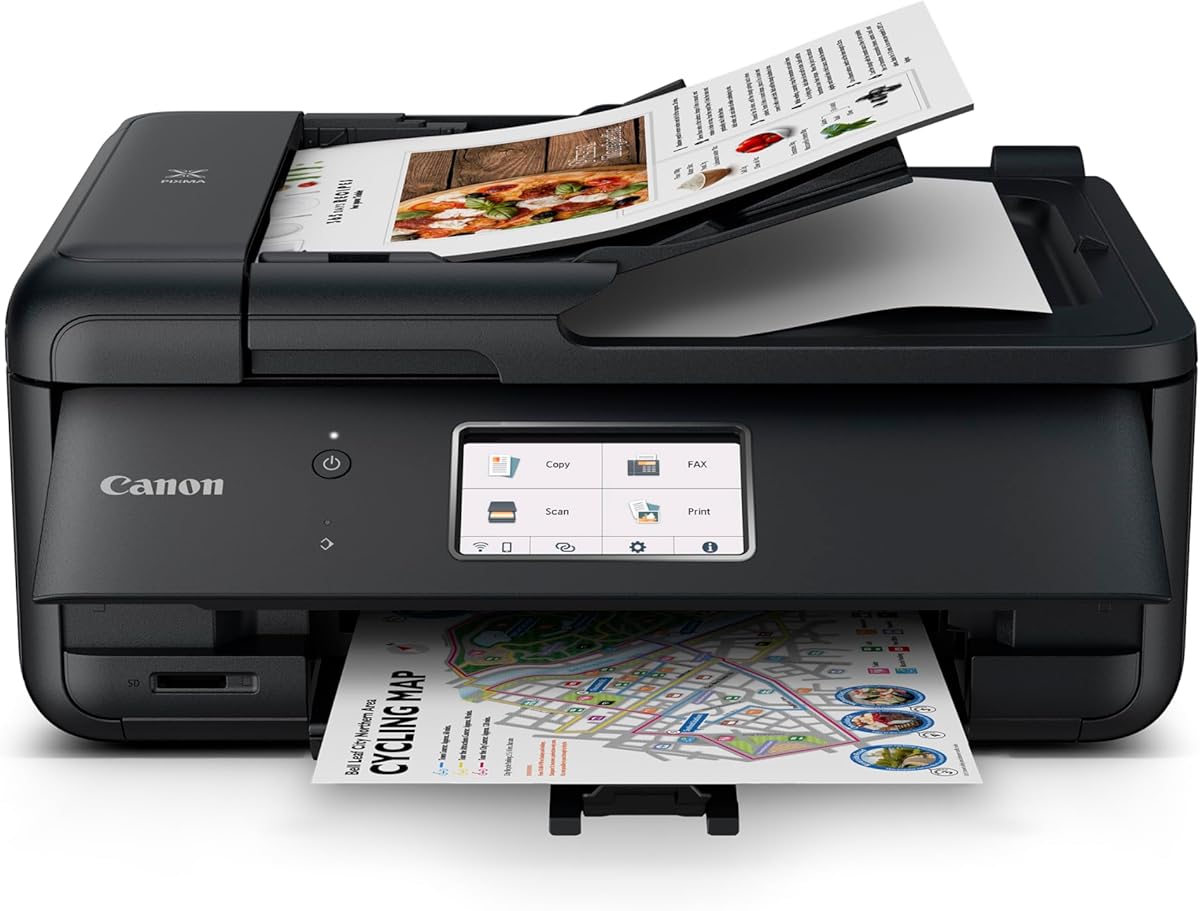
The Canon PIXMA TR8620a is a wireless inkjet all-in-one aimed at home offices, document workflows, and photo printing. Its 4.0 rating reflects a balanced feature set that includes printing, copying, scanning, and faxing. In a screen-printing context, it can produce digital artwork, business materials, product mockups, and reference prints, but it does not perform traditional screen printing.
We may earn a commission when you buy through this link, at no additional cost to you.
The automatic document feeder and 200-sheet capacity—split between a 100-sheet cassette and 100-sheet rear feed—make this model more office-oriented than many photo-focused alternatives. It supports automatic two-sided printing and a listed 1,000-page duty cycle. Speed is listed at 15 pages per minute in black and 10 in color, providing a useful indication of its general productivity range.
Its standout convenience is the connection to Alexa for low-ink notifications and optional smart reordering. Users must enroll in the relevant service, and smart reordering should be considered carefully for people who prefer to manage supplies manually. The printer also supports AirPrint, Android printing, voice controls, and a microSD slot. It remains a conventional inkjet output device, not a screen or garment printing system.
The TR8620a is best for a screen-printing hobbyist whose broader studio needs strong document, copy, scan, and fax functions. It makes sense for home-office users who want one machine to cover several daily tasks. Buyers focused on direct ink-through-screen printing should instead consider the manual presses, while this Canon is most valuable as an organizational and design-output tool.
Combining printing, scanning, copying, faxing, and an automatic document feeder reduces the need for separate office equipment. This is particularly helpful for a home studio that also handles invoices, order sheets, and reference documents.
Alexa can notify users when ink is running low and can assist with reordering when the service is enabled. This adds convenience for busy workflows, although enrollment and supply preferences remain under the user's control.
We may earn a commission when you buy through this link, at no additional cost to you.
The Epson WorkForce Pro WF-7840 is a wireless wide-format all-in-one built to handle larger documents, posters, artwork, and office output. With a 3.9 rating, it fills an important gap in this list by printing up to 13 by 19 inches. That makes it a strong supporting printer for creators who need larger digital artwork than a standard-letter inkjet can produce.
We may earn a commission when you buy through this link, at no additional cost to you.
Print, copy, scan, and fax functions are combined in one machine, while the 500-sheet paper capacity supports relatively busy office workflows. PrecisionCore Heat-Free technology is designed to produce output quickly, and DURABrite Ultra ink is formulated to dry quickly for smudge-resistant results. Wireless connectivity includes Epson's own apps, Apple AirPrint, Android printing, and Mopria Print Service.
Wide-format capability brings a tradeoff in physical and workflow demands. The machine and its supported media need more space than a compact home model, and users must plan sheet handling carefully. It also does not deposit screen-printing ink directly through a mesh. Its most relevant role in a screen-printing studio is producing oversized proofs, signage concepts, packaging artwork, or design references.
The WF-7840 is a good match for a small business that combines screen printing with signs, posters, banners, or other large-format work. It may be excessive for someone who only prints small designs and ordinary documents. If wide-format output is an occasional need, this model offers a versatile combination of production capacity and multifunction convenience.
The 13-by-19-inch maximum size supports posters, display boards, large proofs, and packaging concepts. It is especially useful when a screen-printing business wants digital output beyond standard document sizes.
A 500-sheet capacity helps reduce the frequency of paper replenishment during larger jobs. Combined with wireless and mobile printing options, it suits a shared creative environment where several people may produce reference output.
We may earn a commission when you buy through this link, at no additional cost to you.
The Epson EcoTank ET-2800 is a compact wireless all-in-one designed for home documents, photos, and creative artwork. It carries a 4.0 rating and uses high-capacity, refillable ink tanks instead of relying on a series of small cartridges. The machine can print up to 10 ISO pages per minute in color and includes scanning and copying through a high-resolution flatbed.
We may earn a commission when you buy through this link, at no additional cost to you.
Micro Piezo Heat-Free technology produces sharp text and detailed color photos on virtually any paper type, according to the supplied description. The cartridge-free design also helps reduce cartridge waste, and the refill bottles are designed for convenient filling. These qualities make the ET-2800 a sensible digital-output companion for a screen-printing hobbyist who prepares artwork, prints labels, or creates color references.
It is important to consider the distinction between inkjet output and screen-printing ink. The EcoTank system is convenient for artwork and proofing, but it does not produce the raised, opaque, or textured deposit created by pulling ink through a screen. It also lacks an automatic document feeder, so multipage scanning requires placing pages individually on the flatbed. Users with heavy administrative workloads may prefer a model designed for automated document handling.
The ET-2800 works best for a home screen-printing setup that needs a straightforward, refillable printer alongside a manual press. It is particularly suitable for producing digital templates, transfer references, labels, and proof sheets. It is not a substitute for direct screen printing, and buyers who need office automation or large-format output should compare the other inkjet models in this guide.
The high-capacity tank system is designed to reduce cartridge replacement frequency. It is especially attractive for creators who produce many digital designs, color proofs, or decorated labels around their screen-printing projects.
A wireless all-in-one with scanning and copying consolidates several basic creative functions in a relatively compact footprint. That makes it easier to place near a manual press or dedicated work area.
We may earn a commission when you buy through this link, at no additional cost to you.
The Epson EcoTank ET-2803 is a wireless color all-in-one with refillable ink tanks, a high-resolution flatbed scanner, a color display, and strong connectivity features. It has a 4.2 rating, matching the best-rated products in the guide. Although it cannot perform traditional screen printing, it is a capable digital companion for artwork preparation, photo printing, document output, and copies.
We may earn a commission when you buy through this link, at no additional cost to you.
Micro Piezo Heat-Free technology produces sharp text and color photos, while high-capacity EcoFit bottles simplify refilling. The printer supports wireless connectivity, AirPrint, and the Epson Smart Panel app, and it also offers hands-free voice-activated printing. Those features are useful for moving between a computer, phone, or other compatible device while preparing designs and printing final reference images.
The primary limitation is category fit. This model does not print screen-printing ink through a mesh and cannot produce a garment print by itself. Users who require direct screen printing should select a carousel press or the Ecoofor kit. For digital use, the ET-2803 is well suited to home offices and creative rooms, though its standard media range is narrower than the wide-format Epson WF-7840.
Epson recommends genuine ink to maintain optimal print quality and performance, and the supplied information notes that non-genuine ink could cause damage not covered by the limited warranty. With that consideration in mind, the ET-2803 is a strong choice for a screen-printing hobbyist who wants a highly rated, connected printer for design preparation, proofs, and everyday creative output.
AirPrint, the Epson Smart Panel app, and wireless support make it straightforward to send images and documents from compatible mobile devices and computers. This is useful for viewing or approving artwork before screen preparation.
The integrated scanner, copier, and color display reduce the need for separate devices around a home studio. The high-capacity tanks also align well with creators who produce frequent color output.
We may earn a commission when you buy through this link, at no additional cost to you.
The right choice depends on whether you want to pull ink directly through a screen or use an inkjet printer to create artwork and supporting output. Consider production method, project size, color count, available space, and the accessories you already own.
A screen-printing press is designed to place ink through a prepared mesh onto fabric, paper, wood, glass, metal, plastics, leather, or another compatible flat material. A manual carousel provides physical arms and positioning stops, while a complete kit includes the screens, exposure equipment, ink, and coating tools used to prepare artwork. An inkjet printer does not deposit screen-printing ink, but it can create digital artwork, proofs, transfer films, labels, and other useful output.
Decide which stage of the workflow is missing. If you already own screens and a press, a capable inkjet may be the better investment. If you want to print on garments and have never prepared a screen, a beginner kit or manual press is the more relevant starting point.
Single-color machines simplify setup and are ideal for logos, text, names, and one-color patterns. A four-color, one-station press adds a rotating platform so multiple screens can be attached and moved into working position. Remember that a four-color configuration does not eliminate registration work, screen preparation, ink changes, or drying between layers.
Match the color capacity to the designs you expect to print regularly. If most artwork is monochromatic, paying for added carousel complexity may not improve your workflow. If layered graphics are common, a rotating press can save time by keeping screens organized around the platform.
The maximum printing area determines which garments and flat products can be handled in a single pull. The VEVOR presses support areas up to 21.2 by 17.7 inches, while the Caydo press accommodates listed frames of 10 by 14 inches, 8 by 12 inches, and 6 by 10 inches. The Ecoofor kit includes three wooden frame sizes for smaller learning projects.
Choose an area that comfortably fits the largest item you expect to print without forcing a large machine into a small workspace. Allow room around the machine for screen movement, carousel rotation, loading garments, and storing accessories.
Consistent placement depends on repeatable screen alignment, stable garment positioning, and careful ink control. Position stops, double-layer pallets, centerlines, and base grooves all help reduce movement between impressions. These features cannot replace a sound setup, but they make alignment more repeatable than a bare frame with no guides.
Look for systems that keep the screen, substrate, and print area in a predictable relationship. If working mostly with shirts, a centerline and garment groove may be especially valuable. Multi-color users should prioritize a rotating platform and dependable stops under each arm.
Manual presses need enough clearance to operate safely and comfortably. Compact models can fit into a garage, craft room, or shared studio, but larger systems may require a sturdy workbench. Wide-format inkjets also demand space for media handling and a large output path. Screen-printing kits are comparatively portable, although the included frames, lamp, and accessories require organized storage.
Measure the available area before buying, including storage for screens, ink, squeegees, and curing equipment. Check whether the press can be fixed to a workbench, as suggested for the four-color VEVOR model, and ensure the surface is stable enough for repeated use.
A complete starter kit can provide better immediate value than assembling a system one item at a time. The Ecoofor package includes 63 components, including frames, UV exposure equipment, fabric inks, films, coaters, squeegees, measuring tools, clamps, and cleanup supplies. By contrast, a press may be sold as a machine without screens, ink, photo emulsion, or exposure equipment.
Calculate what you already have and what can be reused. Experienced screen printers may only need a better press, while first-time buyers often benefit from a guided kit. Ongoing needs can include replacement ink, emulsion, film, cleanup materials, and additional screen sizes.
For an inkjet companion printer, consider connectivity, paper handling, scanning, and maximum media size alongside color quality. The Epson ET-4800 and ET-2803 emphasize refillable tanks, while the Canon TR8620a provides office functions and an automatic document feeder. The Epson WF-7840 supports output up to 13 by 19 inches for large-format artwork. HP's Envy Photo 7975 focuses on photo features, mobile printing, and a dedicated photo tray.
Choose the features that remove friction from your actual work. A screen-printing hobbyist may value sharp artwork and wireless control, while a home office may need automatic two-sided printing, a document feeder, and larger paper capacity.
Manual screen printing rewards practice in screen preparation, ink consistency, pull pressure, angle, and curing. Multi-color designs add alignment challenges, while inkjet printers require familiarity with paper settings, ink handling, and color management. A higher customer rating can provide a useful signal, but it does not remove the need to learn the selected process.
Be realistic about the time required to produce clean results. Choose a smaller setup for occasional projects and a more capable carousel for regular multicolor work. For the inkjet side, begin with everyday artwork and build toward more demanding media after confirming how the machine handles your preferred papers.
Prepare the workspace before operating a manual press. Clean and dry the base, confirm that the screen is securely attached, and check that positioning stops or alignment guides are free of ink and debris. Flatten the garment over the printing area and use the centerline or base groove, if available, to center the design. For inkjet companions, select the correct media setting and allow the machine to establish a stable wireless connection before loading artwork.
For direct screen printing, use properly prepared screens, apply an even coat of ink, and pull with consistent pressure and angle. Avoid forcing the squeegee, and keep the screen and substrate from shifting. When using a rotating carousel, move only after the current screen and substrate are properly positioned, and keep ink from entering the bearing areas. For UV exposure kits, use the supplied exposure unit within a controlled setup and determine the correct exposure time for the emulsion and film combination.
Clean the system promptly after use. Remove excess ink from the screen and squeegee, wash frames and tools with the appropriate cleaner, and let wooden components dry fully before storage. Keep bearings and moving joints free from hardened residue, and protect the press from moisture, impact, and prolonged direct sunlight. For inkjet machines, use the recommended genuine inks, wipe the exterior with a soft cloth, and follow the manufacturer's guidance for printhead and paper-path maintenance.
A conventional inkjet printer cannot deposit screen-printing ink through a mesh and is not a substitute for a manual carousel press. Inkjets are useful for digital artwork, proofs, transfer films, labels, and other supporting graphics. Direct garment printing requires a system specifically designed for that method.
It introduces additional steps because each color may require a separate screen, accurate alignment, and another pass. The rotating platform makes the screens easier to access, but registration and ink changes still require practice. Beginners should begin with simple artwork and practice single-color pulls before attempting a layered design.
Look for a package that includes the items needed for a complete first project, such as screens, exposure equipment, emulsion-related supplies, ink, coating tools, and cleanup materials. The Ecoofor kit covers those categories with 63 components. Also consider the included frame sizes, written guidance, and whether you may need additional supplies later.
Many manual presses can print on multiple flat materials, including clothing, paper, wood, glass, plastics, leather, and metals, provided the surface is flat and accepts screen-printing ink. The ink and curing method may need to change by substrate. Test on the intended material before completing a full production run.
Only if your workflow regularly requires oversized digital artwork, posters, signage, or packaging designs. For ordinary garment artwork and small reference images, a standard-letter all-in-one can be sufficient. The Epson WF-7840 is most attractive when large-format output and a 500-sheet paper capacity justify the larger footprint.
A press is a mechanical machine used to pull ink through an attached screen, while a kit supplies the materials and tools used to prepare and perform screen printing. A kit may include a UV exposure unit, frames, inks, films, coaters, squeegees, and cleanup supplies, but it does not necessarily include a heavy-duty press. Some starter setups use simple frames and manual coating methods.
Registration is essential whenever color layers or a centered composition must land consistently. Position stops, double-layer pallets, centerlines, and base grooves help reduce deviation, but stable setup and operator technique remain important. Check alignment before printing an entire batch, especially with fine text or tightly spaced colors.
The supplied Epson information specifically recommends genuine ink to support optimal quality and performance and notes that non-genuine ink could cause damage not covered by the limited warranty. Following the manufacturer's guidance is the safest approach, especially when the printer supports a primary screen-printing design workflow.
The best choice depends on the part of the workflow you need. The VEVOR four-color rotating press is the leading option for direct multicolor screen printing, while the one-color VEVOR press provides a more compact and economical route into manual garment printing. The Ecoofor 63-piece kit is the strongest all-in-one choice for beginners who want exposure tools, frames, inks, and accessories in one package.
The remaining products serve complementary roles rather than competing as direct screen-printing presses. The Canon TR8620a prioritizes office functions, the Epson WF-7840 handles large-format output, and the HP Envy Photo 7975 emphasizes photos and mobile convenience. The EcoTank models provide refillable, wireless color printing for digital artwork and general creative output. Prioritize direct screen-printing capability when you want ink on garments, then choose the color count, area, stability, and included supplies that match your actual projects.
Before buying, confirm the current specifications, package contents, compatibility, and seller information. Product configurations and promotional details can change, and screen-printing results also depend on screen preparation, ink, curing, substrate, and technique. Taking time to match the machine to your design workload will produce a more satisfying and consistent workflow.