
Bingfu FM and AM Loop Antenna Set
4.3Editor score
Combined FM and AM
75-ohm unbalanced design
Includes matching AM loop
Designed for indoor receivers
A replacement AM/FM radio antenna can restore station reception, reduce interference, and give an aging receiver a more reliable connection to broadcast signals. The right model depends on the equipment, connector, frequency coverage, installation environment, and whether you need indoor or vehicle mounting.
We compared all ten antennas across radio-band support, impedance, cable length, mounting method, connector compatibility, and practical placement. The list covers home stereo systems, component receivers, televisions, motorcycles, cars, boats, and other compatible radio equipment, so readers can match the antenna to their exact setup.
Each review identifies the product's strongest feature, useful trade-offs, and ideal buyer, while the comparison table summarizes the major differences. Product availability and configurations can change, so confirm the connector and radio-band requirements before ordering.
4.3Editor score

4.3Editor score
4.1Editor score
As an Amazon Associate we earn from qualifying purchases.
The comparison below highlights each antenna's radio coverage, connection method, mounting approach, and most practical receiver application, making it easier to identify the correct replacement before buying.


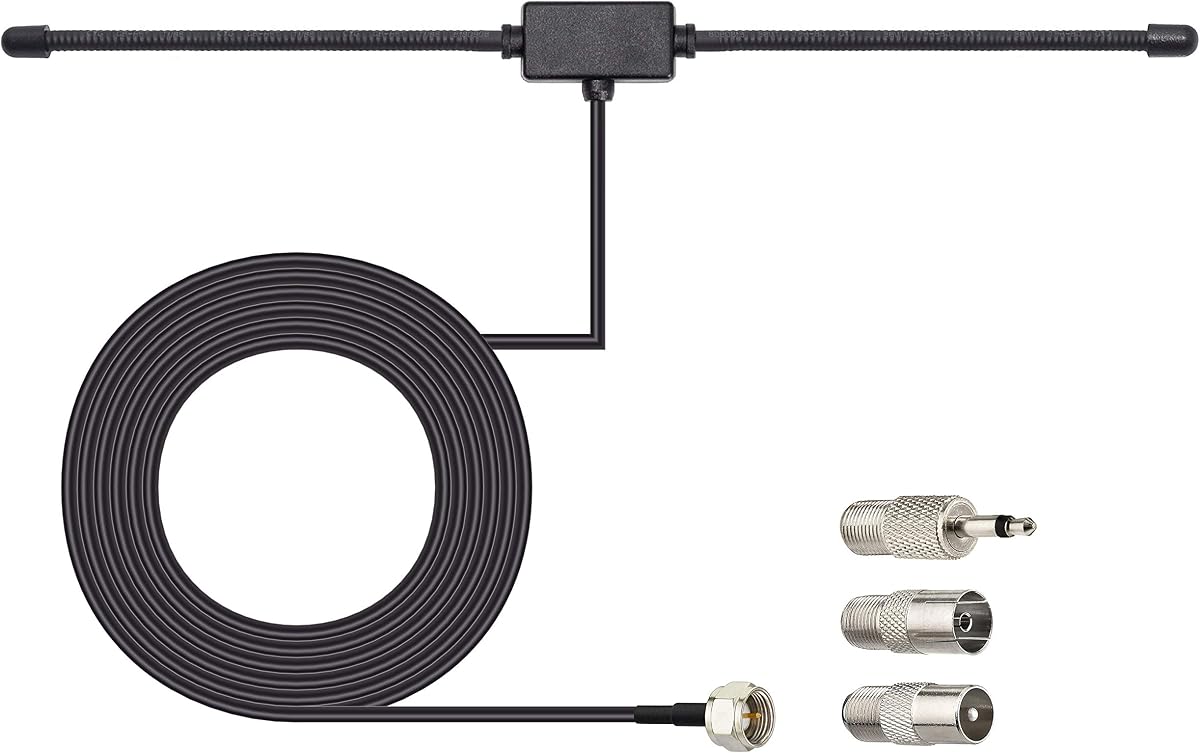
This Bingfu indoor dipole antenna has a 4.1 rating and stands out for its ten-foot coaxial lead, generous adapter selection, and simple adhesive mounting. It is intended for FM reception on home stereo receivers, music systems, AV equipment, and home theater components with compatible antenna connections.
We may earn a commission when you buy through this link, at no additional cost to you.
Its main advantage is installation flexibility. The extended cable lets the user position the dipole farther from the receiver than a short telescopic antenna, while the included TV female, 3.5mm audio, and TV male adapters expand compatibility with common home audio connections. Adhesive wall mounting also keeps the setup relatively unobtrusive.
The trade-off is that this is an FM-only solution. Owners of a receiver that also relies on a dedicated AM antenna will need to address that band separately. Reception can still vary with building materials, nearby electronics, interference, and placement, so the antenna should be installed away from equipment that may disrupt the signal.
This is a strong choice for a home FM setup needing a longer routed cable and multiple connection options. It is particularly useful for receivers in entertainment centers where moving the antenna to a window or higher location is difficult.
The ten-foot coaxial cable provides more routing freedom than a compact telescopic antenna, allowing the dipole to sit away from the receiver and nearer a window when practical.
Three included adapters cover several common interfaces, but the receiver's socket should still be compared with the supplied connectors before installation.
We may earn a commission when you buy through this link, at no additional cost to you.
This compact AM/FM antenna carries a 4.0 rating and focuses on discreet vehicle installations. Its small housing can be placed around a windshield or another suitable surface, while the adhesive label mounting makes it easier to reposition the antenna while searching for a stronger signal.
We may earn a commission when you buy through this link, at no additional cost to you.
Its ten-foot cable provides ample reach from the antenna to a vehicle radio connection, and the low-profile body suits cars, motorcycles, street rods, classic vehicles, boats, campers, and golf carts. Unlike a visually exposed mast, it can remain relatively inconspicuous after installation.
The product information gives fewer connector details than some competing antennas, which is an important consideration for anyone with a specialized radio interface. Vehicle electrical systems, glass placement, body materials, and nearby structures can also influence the result, so the mounting location should be selected carefully.
It is best for a vehicle owner who values a hidden appearance and needs both AM and FM rather than a home-only FM antenna. Verify the radio's connector and confirm that the selected mounting surface is suitable before purchase.
The slim housing avoids the conspicuous look of a traditional mast and is intended to blend into a vehicle's interior or glass-mounted arrangement.
Adhesive label mounting allows the antenna to be moved between candidate positions, which is useful when comparing reception around different windows and body panels.
We may earn a commission when you buy through this link, at no additional cost to you.
This Bingfu patch antenna has a 4.0 rating and provides explicit AM/FM frequency coverage with a ten-foot cable. It is designed for vehicle stereos, trucks, SUVs, marine radio receivers, and conventional in-dash head units that accept a DIN plug.
We may earn a commission when you buy through this link, at no additional cost to you.
The specified bands are FM 80MHz to 108MHz and AM 520KHz to 1710KHz. Its adhesive windshield installation avoids a visible external mast, while the long lead makes routing from the windshield to an in-dash receiver more manageable.
Compatibility is the decisive factor. The listed vehicle brands include Sony, Pioneer, Alpine, Pyle, and Jensen, but naming familiar brands does not guarantee that every model uses the same plug. A DIN connector also differs from the F-type and bare-wire terminals used by many home receiver antennas.
This is a sensible pick for a car or marine stereo with a DIN antenna socket. It combines both standard broadcast bands, a long installation lead, and a discreet patch design, provided the connector matches.
Stated AM and FM ranges make this antenna suitable for users who want both bands from a single vehicle installation.
The DIN plug and ten-foot lead suit many aftermarket and compatible factory-style stereo arrangements, subject to physical connector verification.
We may earn a commission when you buy through this link, at no additional cost to you.
This telescopic Bingfu antenna has a 4.1 rating and offers a compact, adjustable alternative for indoor FM reception. Its length can extend from 20cm to 115cm, allowing the user to tune the antenna's position and extension to suit a shelf, cabinet, or nearby window.
We may earn a commission when you buy through this link, at no additional cost to you.
The antenna uses a 75-ohm unbalanced design with an F-type plug interface. Three adapters are included for common home audio arrangements, and the stated compatibility includes Yamaha, JVC, Sherwood, Pioneer, Panasonic, Onkyo, Sony, and Bose indoor systems.
Because the product focuses on FM, it does not solve AM antenna needs. Its telescopic form also requires room for extension, and the best reception may depend on keeping the antenna away from power supplies, computers, speakers, and other electronics. The correct adapter must be selected carefully.
It is a good match for a user who values a compact, adjustable FM antenna and has a compatible indoor receiver. Its straightforward installation and broad home-system positioning make it less demanding than a permanently mounted dipole.
Extending the antenna farther from the receiver can improve practical positioning, while shorter settings help reduce visual and physical clutter.
A plug-in telescopic format is especially convenient for owners who want an inexpensive replacement without routing a long cable around furniture.
We may earn a commission when you buy through this link, at no additional cost to you.
This four-piece antenna set has a 4.3 rating and stands out for offering several foldable stainless steel and brass antennas in one package. Each unit has four sections and extends to 37cm, or 14.6 inches, giving users a few options for radio receivers, televisions, and other compatible equipment.
We may earn a commission when you buy through this link, at no additional cost to you.
The included quantity makes the set useful for households with multiple devices, as a damaged or lost antenna can be replaced without another purchase. The metal construction should also appeal to users who prefer a sturdier feel compared with a thin wire antenna.
Compatibility information is less specific than that of the dedicated home and vehicle products. Buyers must examine the antenna socket on the receiver, because the listing says the antennas can screw or plug into the socket but does not enumerate connector formats. The antennas also use short telescopic sections rather than a routed cable, which may limit placement flexibility.
This set is best for maintaining several compatible radio or television devices, or for keeping a compact backup antenna available. It is less ideal when the receiver requires a particular long lead or a nonstandard connector.
Four included units allow simultaneous use at multiple compatible devices or provide spares for future replacement needs.
The folding stainless steel and brass sections provide a durable, space-saving alternative to permanently exposed wire antennas.
We may earn a commission when you buy through this link, at no additional cost to you.
This magnetic-base antenna has a 3.8 rating and centers on a simple premise: attach it to a metal surface, route its cable to the receiver, and reposition it when reception improves. The three-meter coaxial lead provides ample freedom for placement around an entertainment center.
We may earn a commission when you buy through this link, at no additional cost to you.
Its magnetic base is more adaptable than adhesive mounting because the antenna can be moved as conditions or reception change. The product is aimed at indoor tuners, AV systems, home theater receivers, and stereo receivers from brands including Pioneer, Onkyo, Yamaha, and Marantz.
The listed 3.8 rating is the lowest among these picks, so buyers should set realistic expectations. It is FM-only, it requires a metallic mounting surface, and the supplied information does not establish performance beyond the stated compatibility. Placement advice recommends using the antenna vertically on a metal object.
This antenna is most appropriate for someone who wants to experiment with placement without cutting adhesive or permanently routing a dipole. Confirm the receiver socket, select the correct adapter, and ensure the magnetic base has a suitable metal surface.
The magnetic base can be moved to different metallic surfaces, making it easy to compare positions near windows, shelves, and entertainment equipment.
A three-meter lead offers more separation between the receiver and antenna than a short telescopic replacement, which can help with placement.
We may earn a commission when you buy through this link, at no additional cost to you.
This combined antenna set has a 4.3 rating and is a complete indoor solution because it includes both a 75-ohm FM antenna and a GND AM loop. It is intended for home radio tuners, AV receivers, home theater equipment, stereo receivers, Bluetooth music systems, and speaker selectors.
We may earn a commission when you buy through this link, at no additional cost to you.
The FM antenna uses an F-type plug connection, while the AM loop uses a two-pin bare-wire terminal. Including both components means a user does not need to source separate antennas for the two standard broadcast bands. The product is also compatible with many receivers from Pioneer, Onkyo, Yamaha, Marantz, and other familiar home audio brands.
Its main limitation is that installation involves two separate connections rather than one combined plug. The receiver's F-type socket and AM terminal arrangement must match, and the loose-wire AM connection needs to be secured correctly for reliable reception.
This is a strong recommendation for a home receiver whose original antennas are missing or deteriorated and whose owner wants both FM and AM support. It combines two purpose-specific antennas in one package without relying on a single compromise design.
Separate FM and AM elements give each band a more appropriate connection than a universal replacement expected to handle every frequency equally.
The package contains both antennas, reducing the need to locate separate replacements for an FM aerial and an AM loop.
We may earn a commission when you buy through this link, at no additional cost to you.
This Bingfu dipole and AM loop set has a 4.3 rating and offers the most balanced combination for a typical home stereo receiver. It includes a 75-ohm FM dipole plus an AM loop, providing dedicated hardware for both standard broadcast bands in one package.
We may earn a commission when you buy through this link, at no additional cost to you.
Its stated compatibility includes indoor HD radio receivers, AV receivers, home theater systems, Bluetooth receivers, home stereo power systems, and music systems using an F-type female antenna socket. The FM element plugs into the antenna port, while the AM loop connects to its designated terminals.
The product does not remove the need to identify the receiver's connection layout. If the back panel differs from the specified F-type female socket and AM terminal arrangement, compatibility may be limited. Placement also remains important because nearby electronics, building materials, and interference can affect reception.
This is the most versatile choice in the roundup for a home setup that receives both FM and AM and uses the stated connection format. It combines a straightforward installation, broad equipment support, and dedicated antennas rather than relying on one element for both bands.
Using a dipole for FM and a loop for AM reflects the different reception characteristics of the two broadcast bands and gives the receiver appropriate antenna types.
The antenna pair is listed for a wide variety of stereo and theater receivers, including systems from Pioneer, Onkyo, Yamaha, Marantz, Panasonic, Sangean, and Sherwood.
We may earn a commission when you buy through this link, at no additional cost to you.
This portable FM coax and AM loop set has a 4.1 rating and covers both standard broadcast bands in a compact package. The FM section uses a 75-ohm coaxial cable with an F-type male plug and measures 4.9 feet, while the AM section uses a two-pin bare-wire connection.
We may earn a commission when you buy through this link, at no additional cost to you.
Its portable format makes it suitable for homes, garages, basements, attics, and offices where users may want to move the antenna or compare different receiver locations. The fold-out base on the AM loop supports placement, and both antennas install directly at the back of the receiver.
The shorter FM lead gives less placement freedom than the ten-foot dipole or three-meter magnetic antenna. The F-type male plug must also match the receiver's socket, and the AM bare wires should be attached to the correct terminals. Product claims about improved station availability depend on installation and local reception conditions.
This pair is a practical option for users who want dedicated FM and AM antennas without a permanent mounting arrangement. It is especially attractive for small spaces, secondary systems, and listeners who may relocate the receiver.
The short coax and fold-out AM loop are easy to arrange in offices, garages, bedrooms, and other locations where long routing is undesirable.
Each band has its own antenna element, allowing the receiver to use connections designed for its broadcast requirements.
We may earn a commission when you buy through this link, at no additional cost to you.
This Ancable T-shape dipole has the highest rating in the roundup at 4.5 and focuses on a straightforward FM replacement for receivers with clip or terminal connections. Its 300-ohm design, spade terminals, and 5.9-foot coaxial cable make it visually simple and easy to introduce to a home system.
We may earn a commission when you buy through this link, at no additional cost to you.
The dipole wire can be extended away from the receiver, which is useful for improving placement in a home, office, garage, or basement. Its T-shaped format allows the two arms to spread in different directions instead of keeping all of the antenna in one compact location.
It is FM-only, and the receiver must accept the specified clip or terminal arrangement. Installation involves attaching the spade terminals correctly, so buyers should not expect a single universal plug. As with the other antennas, reception varies with nearby electronics, building materials, terrain, and interference.
This antenna is recommended for a home FM receiver with a compatible 300-ohm terminal socket. It is a simple, highly rated option for anyone who wants an uncomplicated dipole without a complex mounting system.
Stretching the arms away from the receiver allows the user to place the antenna more freely and can improve its practical positioning.
The spade terminal design suits receivers designed for a 300-ohm dipole and remains visually unobtrusive compared with a larger antenna assembly.
We may earn a commission when you buy through this link, at no additional cost to you.
The most important choices are radio-band coverage, connector type, impedance, mounting method, and the physical location of the receiver. Review those requirements before comparing appearance or included accessories.
Start by determining whether the receiver needs FM only or both AM and FM. FM-focused products may include a telescopic mast, coaxial dipole, magnetic base, or adhesive patch, while dual-band packages add a dedicated AM loop. A combined FM and AM set is more convenient when the receiver exposes separate antenna connections, whereas an FM-only product is sufficient for systems that do not receive AM broadcasts.
Choose broad band coverage when the equipment specifies AM and FM operation, but do not assume every listed antenna supports every receiver.
The connector must physically and electrically match the antenna socket. Common arrangements in this category include F-type plugs and female sockets, DIN plugs for vehicle radios, two-pin bare-wire AM terminals, spade terminals for 300-ohm FM antennas, and adapters for 3.5mm or TV-style connections. Check the receiver's rear panel and manual rather than relying only on the brand name, because models within the same brand can use different interfaces.
Match connector type first, then impedance, to avoid buying a cable that cannot be attached correctly.
FM antenna impedance helps determine how the antenna is intended to connect to the receiver. Several indoor options use a 75-ohm unbalanced F-type arrangement, while the Ancable dipole uses a 300-ohm design intended for a compatible clip or terminal socket. These systems are not automatically interchangeable even when both are described as FM antennas.
Use the impedance and connection format specified by the receiver, especially when buying without included adapters.
Adhesive mounting offers a low-profile installation but can be difficult to reposition after the cable is routed. A magnetic base can be moved between metallic surfaces and is convenient for testing positions. Telescopic antennas require space for extension but avoid permanent mounting, while a remote dipole offers more separation from the receiver. Choose the method that fits the available surface and the user's willingness to adjust the antenna.
If reception is marginal, a flexible method is usually more valuable than a permanently fixed placement.
Cable length determines how far the antenna can be placed from the receiver. Products with three-meter or ten-foot leads provide meaningful routing flexibility for finding a window or less obstructed area. Shorter four- to six-foot options are easier to manage in compact spaces but may not allow the antenna to escape interference close to the equipment.
Choose enough cable for a deliberate installation without creating awkward loops or snagging hazards.
Indoor antennas perform best when placed away from computers, power supplies, LED lighting, and other electronics. Higher positions and windows can be helpful, but exterior weather, metal screens, wiring, and structural materials can change results. Vehicle installations face different obstacles, including windshield glass, roof coatings, body panels, and changing vehicle orientation.
Plan for repositioning after installation because broadcast reception is rarely determined by the antenna model alone.
Home stereo owners should prioritize a receiver-specific connector, appropriate impedance, and enough cable to reach a favorable indoor position. Car and marine users should favor adhesive patch or hidden antennas designed for vehicle head units and verify the DIN or other plug. Television, phone, and general radio users should inspect the socket because multi-purpose telescopic sets can support several equipment categories only when the attachment fits.
Match the antenna to the actual device rather than choosing based only on a broad use-case label.
Adapters can make a compact antenna usable with more than one receiver interface, and multi-antenna packages can be helpful for spare equipment. AM loops with fold-out bases add placement support, while long cables require suitable connectors and secure routing. Included accessories do not guarantee universal compatibility, so they should supplement rather than replace connector verification.
Prioritize a correct connector, then regard adapters and extra antennas as helpful additions.
Before installation, switch off and unplug the receiver or vehicle head unit. Identify the FM socket, AM terminals, or vehicle-specific antenna connector, compare them with the supplied plug or leads, and select the correct adapter if needed. Never force an incompatible connector onto a socket.
Connect the antenna with all fittings finger-tight, and secure bare-wire terminals to the correct posts. Route the cable without sharp bends, sharp metal edges, or pinching. For indoor models, extend the dipole or position the base vertically and move it away from electronics. Vehicle antennas should be attached to a clean, secure surface and routed so the cable cannot interfere with controls or safety systems.
Power-cycle the receiver after connecting the antenna, then scan available stations. If reception is weak, move the antenna incrementally, rotate a telescopic section, or adjust the dipole's orientation. Clean adhesive surfaces before mounting, inspect connectors for looseness, and avoid repeatedly twisting bare wires, which can cause breakage.
Look at the antenna socket or terminals on the back of the receiver and compare them with the connector shown in the product information. F-type, DIN, spade, 3.5mm, and two-pin bare-wire arrangements are not interchangeable. If the manual identifies the socket type, use that information and avoid buying solely based on the receiver brand.
No. An FM antenna is designed to receive the FM broadcast band and cannot replace a dedicated AM loop on a receiver that accepts one. Choose a combined FM and AM package if both bands matter. Installing the correct AM loop in a suitable position can improve AM stability independently of the FM antenna.
No. A suitable antenna can improve signal pickup and reduce problems caused by weak or damaged original hardware, but it cannot eliminate every source of poor reception. Distance from transmitters, terrain, buildings, nearby electronics, wiring, and interference all affect results. Placement may be as important as the antenna itself.
Start away from computers, televisions, power supplies, dimmer switches, and densely packed entertainment equipment. A higher position or a location near a window may provide a clearer path to broadcast signals. If reception remains inconsistent, move the antenna a small distance at a time and rescan stations after each change.
They can be a practical solution when the antenna is mounted cleanly, securely, and on an appropriate surface. Windshield glass, roof finishes, body panels, and vehicle design can all affect reception, so no placement is ideal for every vehicle. Test several locations before finalizing the installation and route the cable away from moving controls.
That depends on the receiver. Some home tuners accept an F-type plug directly, while others use a female socket, 3.5mm connector, or TV-style terminal. Several products include adapters, but the included pieces do not guarantee every configuration. Confirm both the physical connector and the antenna's impedance before installation.
Yes, use gentle hand pressure so the connection is secure without damaging the threads, plug, or receiver socket. Avoid excessive force and pliers, particularly with small F-type fittings. If reception is unstable, disconnect and inspect the connector for corrosion, looseness, or a partially seated plug before replacing it.
A dipole is primarily used for FM reception and consists of two extending arms around a feed point. An AM loop is designed for the AM band and usually connects through two bare-wire terminals. Receivers supporting both bands commonly use one of each, so a combined package is generally more appropriate than a single universal element.
The Bingfu dipole and AM loop set is the strongest all-around option for a compatible home receiver, while the separate FM and AM loop set is an equally capable premium-style choice for indoor systems. For FM-only needs with maximum placement flexibility, the adhesive dipole antenna and telescopic model cover different installation preferences.
Prioritize exact connector compatibility, required radio bands, impedance, and the ability to place the antenna in a sensible location. Vehicle users should choose a hidden or patch antenna matched to the head unit, while home users should consider a dedicated AM loop whenever the receiver supports AM. Avoid buying until every physical connection has been checked.
Product configurations and current listings can change, so confirm the supplied parts, compatibility notes, and available options before ordering. With the correct connection and careful placement, a replacement antenna can provide a meaningful improvement over missing, damaged, or poorly positioned original equipment.