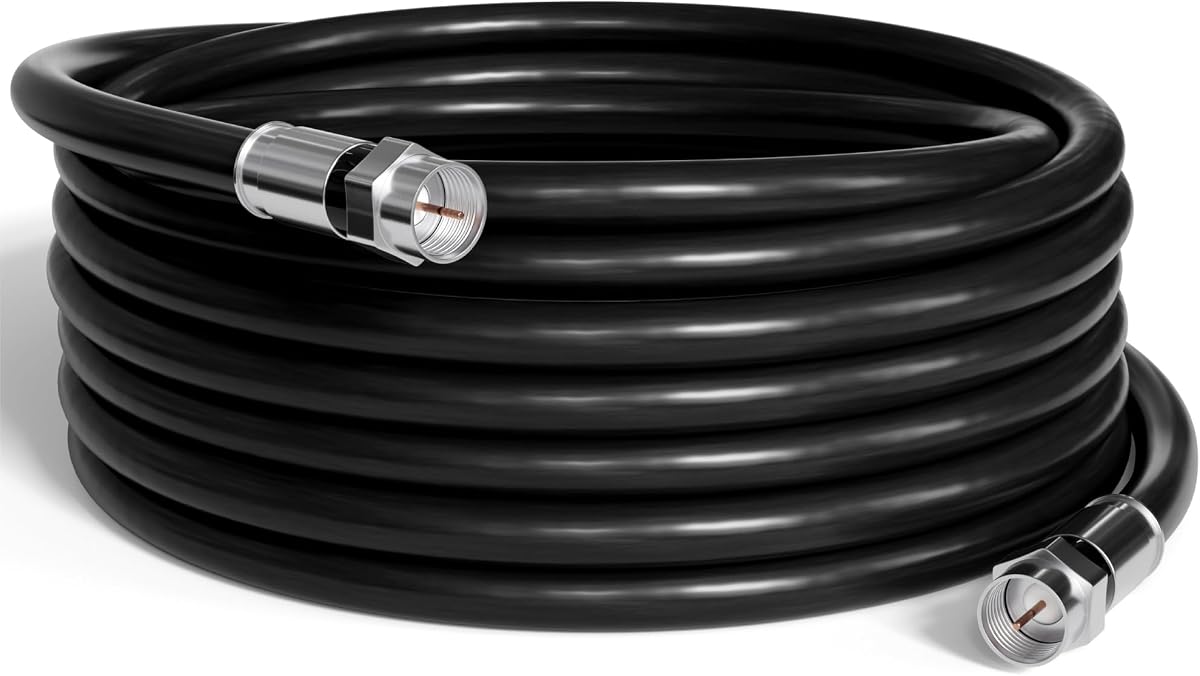
THE CIMPLE CO 100 FT RG6 Coaxial Cable
4.7Editor score
Extended 100-foot installation length
Dual shielding for signal protection
Weather-ready compression connectors
Our 2026 expert guide compares the best coaxial cable for antenna options for TV reception, weather resistance, shielding, length, and easy installation.
Choosing coaxial cable for antenna installations requires balancing signal integrity, shielding, weather resistance, connector quality, and available run length. A cable that suits an indoor television setup may not be appropriate for an outdoor rooftop antenna, patio receiver, or long connection through walls and attics.
We compared all ten products using the supplied specifications, emphasizing cable type, shielding design, impedance, frequency range, connector construction, included accessories, and intended antenna applications. The list covers RG6 television cables, one specialty RG8X radio-frequency cable, and options suited to indoor, outdoor, or mixed installations.
Each review explains the product's strongest features, limitations, and best-fit installation, while the comparison table provides a quick side-by-side view. Product listings, configurations, and current market conditions can change, so confirm the selected length and connector type before ordering.
4.7Editor score

4.7Editor score

4.7Editor score
This side-by-side comparison highlights the most important differences among the ten cables, including application, shielding, length, connector design, and installation features.


The G-PLUG 50FT RG6 Coaxial Cable Extender is our strongest all-around choice for antenna installations. It carries a 4.7 rating and combines a 50-foot length, 75-ohm RG6 construction, triple shielding, and weather-resistant connections in a broadly useful package.
We may earn a commission when you buy through this link, at no additional cost to you.
Its three-layer shielding is designed to limit electromagnetic and radio-frequency interference, making it sensible where television equipment, routers, nearby wiring, or other electronics may introduce noise. The preinstalled corrosion-resistant F-type compression connectors create stable connections, while the rubber-sealed design and durable PVC jacket support use in humid or exposed locations.
The supplied female-to-female coupler allows another compatible cable to be connected when the antenna-to-television distance exceeds the included run. Although every extra joint introduces another potential interruption point, this is still a practical feature when routing around obstructions. The fixed 50-foot length means buyers should measure first rather than assume it will reach.
This cable is best for households connecting an indoor or outdoor television antenna to a receiver, modem, or television. It also suits satellite and broadband arrangements within the stated compatibility. For a balanced combination of reach, shielding, weather protection, and included accessories, it is the most versatile option in the group.
Triple shielding helps preserve signal quality in installations near consumer electronics, power wiring, or other sources of interference. That makes this option useful for users who want more protection than a basic unshielded or lightly shielded lead.
The included F81 coupler provides a way to extend the installation when one cable does not reach the television or receiver. Buyers should keep connections dry, secure, and firmly finger-tightened.
We may earn a commission when you buy through this link, at no additional cost to you.
The energeaster 50FT RG6 is a strong alternative for antenna users who prioritize shielding and moisture protection. It has a 4.7 rating and offers 75-ohm impedance, triple-layer shielding, compression F-type connectors, and a 50-foot cable with an attached female coupler.
We may earn a commission when you buy through this link, at no additional cost to you.
The shielding combines foil, braid, and foil layers to reduce RFI and EMI, which is valuable in a home theater or installation area containing many potential interference sources. Rubber O-rings at the connector joints help block moisture, dust, and corrosion, while the stated construction is intended for indoor and outdoor arrangements.
The supplied information says the cable supports 4K HDR video, Dolby Digital audio, and high-speed internet. It is designed to be flexible enough for caravan televisions, antennas, cable television, satellite, broadband, and related equipment, making it more broadly applicable than its compact title may suggest.
This is a good pick for a 50-foot antenna run that needs strong shielding and dependable connector sealing. The main limitation is that the featured configuration is fixed at 50 feet. Measure the complete route, including turns, service loops, and wall entries, before purchasing.
Foil, braid, and foil shielding create a layered barrier against common forms of interference. This is especially useful near routers, entertainment equipment, and densely wired media areas.
Rubber O-rings help protect the connector interfaces from moisture and dirt. The sealed ends remain a better choice for exposed antenna locations than bare, screw-on fittings.
We may earn a commission when you buy through this link, at no additional cost to you.
Nixsto stands out for offering the broadest selection of cable lengths in this roundup. The listing includes 1.5, 3, 6, 10, 15, 20, 30, 40, 50, 60, 75, and 100-foot options, making it easier to match an antenna run without adding unnecessary slack.
We may earn a commission when you buy through this link, at no additional cost to you.
The cable uses a 75-ohm copper-plated conductor, gold-plated F-connectors, and built-in O-ring seals intended to resist moisture. A water-resistant black PVC jacket suits indoor antennas, basement connections, satellite dishes, and coastal environments where humidity may be a concern.
The supplied specifications also identify compatibility with smart televisions, HDTV, CATV, cable boxes, Wi-Fi modems, satellite receivers, AM/FM radios, digital antennas, set-top boxes, splitters, and streaming devices. A brass female-to-female extender is included to help lengthen a run when necessary.
Nixsto is best for buyers who value precise cable-length selection and a discreet installation. Buyers should still confirm the connector format and selected variation on the product listing. Its flexibility makes it particularly useful for short indoor connections, long outdoor runs, and tidy routing around furniture.
A wide range of lengths helps reduce excess cable, which can clutter an installation and create unnecessary routing. Short runs can be easier to conceal behind a television stand, while longer options accommodate outdoor antenna locations.
Gold-plated F-connectors with O-ring seals help maintain stable connections in humid environments. The black water-resistant jacket complements the sealing features without adding bulk to the cable.
We may earn a commission when you buy through this link, at no additional cost to you.
This 50-foot RG6 coaxial cable combines a weather-resistant television cable with several installation accessories. It has a 4.7 rating and supports a broad mix of antenna, television, satellite, broadband, router, and cable-box connections.
We may earn a commission when you buy through this link, at no additional cost to you.
Its triple-shielded 18AWG RG6 construction combines foil and braiding to help reduce EMI and RFI interference. The stated transmission support extends to 3GHz, and waterproof boots, internal waterproofing, corrosion-resistant threaded connectors, and a UV-resistant wall-rated PVC jacket suit both indoor and outdoor routing.
Included items include an F81 female coupler, a right-angle F adapter, cable clips, and cable ties. These accessories can simplify a complete installation, although some users may not need every component. The right-angle adapter is particularly useful where space behind a television or receiver is limited.
This cable is a good fit for installers who want a complete RG6 package rather than only a cable and connectors. It is also a strong candidate for outdoor television antenna runs because the jacket and connection hardware are designed to withstand moisture, sunlight, and temperature-related wear.
Cable clips, ties, a coupler, and a right-angle adapter make it easier to organize an antenna installation. These extras are helpful when the cable follows a wall, passes behind equipment, or needs to reach around a tight corner.
The UV-resistant PVC jacket and waterproof connector boots are designed for outdoor use. Sealed connection points are especially important where an antenna lead is exposed to rain or persistent humidity.
We may earn a commission when you buy through this link, at no additional cost to you.
The 10FT RG6 Coaxial Cable is a compact option for short antenna connections. It carries a 4.7 rating and combines an 18AWG conductor, 75-ohm impedance, and shielding made from 60% braided aluminum and 100% aluminum foil.
We may earn a commission when you buy through this link, at no additional cost to you.
Its stated frequency range extends from 2.3MHz to 3.0GHz, allowing use with televisions, modems, air antennas, satellite dishes, and various data services. The outer layer is described as moisture resistant and capable of withstanding sunlight, making it suitable for indoor walls and outdoor antenna extension installations.
The main trade-off is length. Ten feet is convenient for an indoor antenna positioned near a television or a short extension where excess cable would be awkward. It is less suitable for routing from a distant rooftop, attic, or exterior antenna position to a receiver deep inside a home.
This cable is best for compact installations that do not require a long run. Its shielding and broad frequency support make it a capable short-distance option, but accurate measurement is essential. If the antenna needs more than a modest lead, one of the 50- or 100-foot options will be more practical.
A short cable can reduce clutter behind televisions and media cabinets. It also makes accidental disconnections less likely because there is less cable exposed to movement and snag.
Combined foil and braided aluminum shielding helps protect the signal in crowded equipment zones. This makes the cable appropriate for indoor antennas installed near routers, game consoles, and audio-video components.
We may earn a commission when you buy through this link, at no additional cost to you.
The GE 33600 RG6 is a straightforward option for users who value simple installation over extensive technical specifications. It has a 4.6 rating and comes as a ready-to-use 50-foot black RG6 cable with screw-on F-type connectors.
We may earn a commission when you buy through this link, at no additional cost to you.
Its main appeal is convenience. Because the connectors are already fitted and require no special tools, the cable can move from an antenna or provider outlet to a television or receiver with little setup. That makes it useful for standard residential television antenna connections and straightforward extension tasks.
Compared with the other selections, the supplied description provides fewer details about shielding, jacket weather resistance, conductor gauge, and frequency performance. As a result, it is harder to judge its suitability for demanding outdoor runs or areas with heavy electromagnetic interference without consulting additional manufacturer information.
The GE 33600 is best for uncomplicated home antenna installations where easy handling and immediate readiness matter. It can also serve as a general RG6 connection for compatible equipment. Buyers with exposed outdoor connectors, long routing requirements, or severe interference concerns may prefer a product with more explicit shielding and weather-sealing details.
Screw-on F-type connectors remove the need for compression tools during installation. This simplifies setup for beginners and makes the cable convenient for temporary or movable connections.
The supplied 50-foot length offers enough reach for many indoor and outdoor antenna arrangements. Its ready-to-use format also reduces the chance of mismatched or improperly fitted connectors.
We may earn a commission when you buy through this link, at no additional cost to you.
The GE RG6 Coaxial Cable with F-Type Connectors is our premium selection because it combines quad shielding with a solid-center conductor, corrosion-resistant gold-plated compression connectors, and a flame-retardant jacket suitable for in-wall installation.
We may earn a commission when you buy through this link, at no additional cost to you.
Its 4.7 rating reflects a well-rounded specification set for antenna use. The cable supports digital transmission up to 3GHz and is intended to maximize transfer speed while shielding against interference. It can connect televisions, antennas, cable modems, and satellite equipment indoors or outdoors.
Compression connectors provide a convenient screw-on connection without requiring tools, while the gold plating helps resist corrosion and maintain reliable contact. Its flame-retardant construction is useful for long-term in-wall installations involving home security, internet, or home theater systems, although local building requirements should always be considered.
This is the best option for buyers who want the most extensive shielding in the roundup and plan a demanding installation. It suits long digital television runs, exterior antennas, and structured wiring. The key limitation is that the featured cable is 50 feet, so users needing more reach should confirm compatible connectors or an appropriate extension before ordering.
Quad shielding provides an additional protection layer compared with dual- or triple-shielded alternatives. It is particularly attractive for installations near dense electronics, shared walls, or external antenna feeds.
The flame-retardant cable and corrosion-resistant compression connectors are well suited to structured home wiring. Properly installed connections can support a clean, permanent television or network installation.
We may earn a commission when you buy through this link, at no additional cost to you.
The RG8X Coaxial Cable is the specialist radio-frequency option in this guide. It carries a 4.6 rating and is designed for 50-ohm RF systems rather than conventional 75-ohm television antennas, using PL259 male connectors at both ends.
We may earn a commission when you buy through this link, at no additional cost to you.
Its 17AWG pure copper conductor is thicker than the center conductor used in most RG6 cables in the list. Combined with double shielding, the construction is intended to reduce leakage, interference, and signal loss in high-powered CB, ham radio, antenna analyzer, tuner, dummy load, SWR meter, and transceiver installations.
The molded nickel-plated brass PL259 connectors feature gold-plated center pins and are rated for frequencies up to 300MHz. A strong, flexible PVC jacket is described as waterproof and suitable for indoor or outdoor use, which is valuable for vehicle-mounted and exposed radio installations.
This cable is not a substitute for RG6 at an over-the-air television antenna because its impedance and connector type differ. It is best for radio operators and technicians working with compatible 50-ohm UHF equipment. For CB radio, ham radio, Jeep Wrangler installations, or antenna analysis, its low-loss design is the defining benefit.
The 50-ohm RG8X construction matches common CB and amateur-radio equipment better than standard 75-ohm television cable. That makes it a purposeful choice for high-powered radio installations.
A thick pure copper center conductor and double shielding help preserve radio-frequency signals over the 50-foot run. Molded connectors and a flexible jacket support both permanent and mobile-style uses.
We may earn a commission when you buy through this link, at no additional cost to you.
THE CIMPLE CO's 100-foot RG6 cable is the best-budget pick for users who need a long run from an outdoor or distant television antenna. It has a 4.7 rating and combines a 100-foot length with a 75-ohm solid 18AWG center conductor.
We may earn a commission when you buy through this link, at no additional cost to you.
The cable is engineered for indoor and outdoor use, with a PVC outer jacket, aluminum braiding, added shielding, and precision-machined weathertight compression connectors. Double O-ring fittings help protect the connection from weather damage, which is important when the run is exposed to rain or humidity.
Its stated specifications include a sweep to 3.0GHz and support for signals down to 2.3MHz. It works with cable modems, televisions, satellite receivers, radios, HD antennas, free-to-air antennas, over-the-air antennas, wireless antennas, CATV, and other coax systems.
This is an excellent budget-oriented choice for larger homes, rooftop antennas, attics, and installations that need substantial reach without joining multiple standard RG6 runs. Keep in mind that a very long lead can introduce more total loss and more opportunities for a poor connection, so proper routing and secure fittings remain important.
A single 100-foot cable can simplify installations that would otherwise require multiple cables and a coupler. Fewer connections may also reduce opportunities for signal loss at joined interfaces.
Double O-ring compression connectors and a durable PVC jacket support outdoor use. Keeping entry points sealed helps protect the antenna feed where rain, moisture, and temperature changes are most likely to cause trouble.
We may earn a commission when you buy through this link, at no additional cost to you.
THE CIMPLE CO 50 FT Outdoor RG6 is a balanced choice for users who want a moderately long cable with explicitly outdoor-oriented construction. It has a 4.7 rating and uses a solid 18AWG center conductor within a 75-ohm RG6 design.
We may earn a commission when you buy through this link, at no additional cost to you.
The cable includes a PVC outer jacket, UV-coated and weather-stabilized connectors, rubber weather boots, and double O-ring compression fittings. These details make it a credible choice for outdoor television antennas, satellite antennas, CATV equipment, and interior runs that may pass near exterior connections.
Its stated swept frequency range reaches 3.0GHz and extends down to 2.3MHz, supporting digital and analog signals. Compatibility includes televisions, cable modems, satellite receivers, radios, HD antennas, free-to-air antennas, over-the-air antennas, wireless antennas, and other coax-based systems.
This cable works well when 50 feet is sufficient and the connection may experience changing weather. It is easier to conceal and manage than a 100-foot cable, which can be an advantage in many homes. For very distant antennas, the 100-foot version provides more reach, while users in severe interference zones may want additional shielding.
UV-coated connectors, weather boots, and double O-ring compression fittings provide several layers of environmental protection. These features are useful for exposed television and satellite antenna connections.
A swept 3.0GHz design supports modern digital television and broadband signals. The same cable can accommodate several coax-equipped devices when the connector and impedance requirements match.
We may earn a commission when you buy through this link, at no additional cost to you.
The right antenna cable depends on the signal system, route length, installation environment, connector format, and expected interference. These factors determine whether a basic RG6 lead or a heavier shielded or specialty RF cable is the better fit.
Most over-the-air television antennas, HD antennas, cable modems, and satellite receivers use 75-ohm RG6 terminated with F-type connectors. The selected cable should match that impedance and connector format exactly. A 50-ohm RG8X cable with PL259 fittings, such as the specialty radio option in this guide, serves a different purpose and should not be selected merely because it offers a longer or heavier-looking jacket.
Measure from the antenna output to the television, receiver, modem, or splitter rather than estimating by room dimensions. Include vertical drops, wall routes, bends, service loops, and the distance needed to keep connectors away from standing water. A 50-foot cable may be ideal for a straightforward patio installation, while an attic-to-den receiver or roof-mounted antenna may need 75 or 100 feet.
Shielding helps prevent electromagnetic and radio-frequency interference from reaching the antenna signal. Dual shielding is a common general-purpose configuration, while triple- and quad-shielded constructions provide additional barriers. Homes with adjacent wireless equipment, dense media systems, shared walls, or nearby power infrastructure may benefit from heavier shielding, provided the connectors remain secure and properly fitted.
Indoor television antenna cables need less weather protection than leads mounted outdoors. Exterior cables benefit from a weather-resistant PVC jacket, sealed connector boots, and O-ring compression fittings. Satellite dishes, rooftop antennas, patio receivers, and damp attic installations should all use connectors designed to resist moisture and corrosion. Even outdoor-rated cable should be routed so that connectors do not sit where water can collect.
F-type screw-on fittings are the standard for television antenna connections, but compression fittings and included adapters can affect ease of installation. Screw-on connectors are convenient and require no special tool, while compression connectors are commonly associated with a more secure, weather-sealed termination. Check whether a right-angle adapter, female coupler, or other accessory is needed before completing the order.
Modern television and broadband installations benefit from 75-ohm cables designed to carry high-frequency signals without excessive loss. Several choices in this guide state support to 3.0GHz, while others specify a 2.3MHz-to-3.0GHz range. Radio-frequency equipment may instead require 50-ohm RG8X with PL259 connectors. Impedance and connector differences cannot be ignored because an unsuitable cable may not mate correctly or may not be intended for the target system.
A female-to-female coupler can extend a run when the available length is insufficient, while a right-angle adapter may make a tight connection behind a television easier. Cable clips and ties help keep long antenna leads against a wall, through an attic, or along an exterior route. Accessories are useful when they complete the installation, but buyers should avoid creating unnecessary joints that add complexity and potential signal loss.
A cable that is too long is difficult to conceal and may create excess loops, while one that is too short cannot reach without an awkward extension. Flexible, tangle-resistant construction is valuable around furniture and inside entertainment cabinets. Outdoor cables must also withstand sunlight, moisture, and temperature changes, while in-wall cables should have the appropriate safety rating. The best length is the shortest practical run that still allows serviceable connections.
Begin by disconnecting any existing antenna lead and identifying the antenna output, television or receiver input, and any required splitter or coupler. Connect the cable to the antenna first, route it with gentle bends, and avoid crushing it beneath doors, furniture, roofing materials, or tight service loops. Do not sharply kink the cable or pull on the connector to move the attached equipment.
Attach the F-type connector by hand and tighten it evenly until secure. Do not overtighten, especially on screw-on fittings, because excessive force can damage the threaded port on a television, receiver, or antenna. For compression fittings, use the appropriate tool and follow the manufacturer's instructions. Keep exterior connectors above locations where water can collect, and use weather-compatible seals where the cable enters a wall or outdoor enclosure.
For maintenance, gently wipe the connector faces and check for corrosion, moisture, dirt, or a loose fit. Keep indoor connections away from heating appliances, direct sunlight, and moving parts. If reception changes, test the antenna and source with a known-good short cable before blaming a long run. Disconnect the cable rather than sharply bending it during storage, and inspect outdoor jacket damage or UV degradation periodically.
A 75-ohm RG6 cable with F-type connectors is the standard choice for most over-the-air and HD television antennas. It is also widely compatible with cable modems, satellite receivers, splitters, and similar equipment. Choose a shielded, outdoor-capable version when the cable will be exposed to weather or routed through damp spaces.
No. A longer cable only helps when it allows the antenna to reach a better location or connects equipment that otherwise cannot be reached. Excessively long runs can introduce more signal loss and make routing harder. Select the shortest practical length that supports a good antenna position and a secure connection.
Quad shielding can provide greater protection from interference, but it is not automatically better in every installation. Connector quality, conductor construction, cable condition, antenna placement, and interference levels all affect performance. Quad shielding is most useful in electronics-heavy areas or exposed runs where additional protection is worthwhile.
Generally, an RG8X cable should not replace RG6 in a standard television installation because it commonly uses 50-ohm impedance and PL259 connectors rather than 75-ohm F-type fittings. It is intended for compatible CB, ham radio, antenna analyzer, tuner, and other RF systems. Check both the equipment impedance and connector format before adapting or substituting it.
Use a cable with a weather-resistant jacket and sealed compression connectors, then position the connector so it cannot sit in water. Avoid pinching the cable, leave enough movement around the connection, and check the seals during routine maintenance. Even a weather-rated cable should enter the building through a protected opening rather than a persistently damp location.
A coupler is useful when a single cable cannot reach from the antenna to the receiver. Several products in this guide include a female-to-female coupler, allowing another compatible cable to be joined. Each additional connection can introduce loss or become a failure point, so a single correctly sized cable is preferable when practical.
The 75-ohm rating describes the cable's characteristic impedance. Television antennas, television inputs, cable modems, and many residential coaxial systems are designed around 75-ohm components. Using a compatible cable reduces reflection and helps maintain consistent signal transfer across the intended frequency range.
Check that every connector is firmly attached, clean, free of corrosion, and connected to the correct input. Inspect the cable for kinks, cuts, crushed sections, or damaged weather seals, and compare the antenna placement if reception is inconsistent. Testing with a short known-good cable can help determine whether the problem lies in the antenna position or the installed run.
The G-PLUG 50FT RG6 is the strongest general choice because it combines triple shielding, 75-ohm RG6 construction, weather-resistant compression connectors, and a useful extension coupler. THE CIMPLE CO's 100-foot model is a strong budget-oriented choice for longer outdoor runs, while the GE 50-foot quad-shielded cable offers the most extensive shielding in the group.
For most television antenna installations, start with 75-ohm RG6 and F-type connectors, then choose the length based on a careful measurement of the entire route. Outdoors, prioritize sealed fittings, a weather-resistant jacket, and protected connector placement. In electronics-heavy locations, extra shielding can be beneficial, but secure connectors and sensible antenna positioning remain essential.
Before ordering, verify the selected length, connector orientation, impedance, included accessories, and environmental rating. Product configurations and current listings can change, so checking the latest product details helps ensure the cable matches your antenna, receiver, and installation conditions.