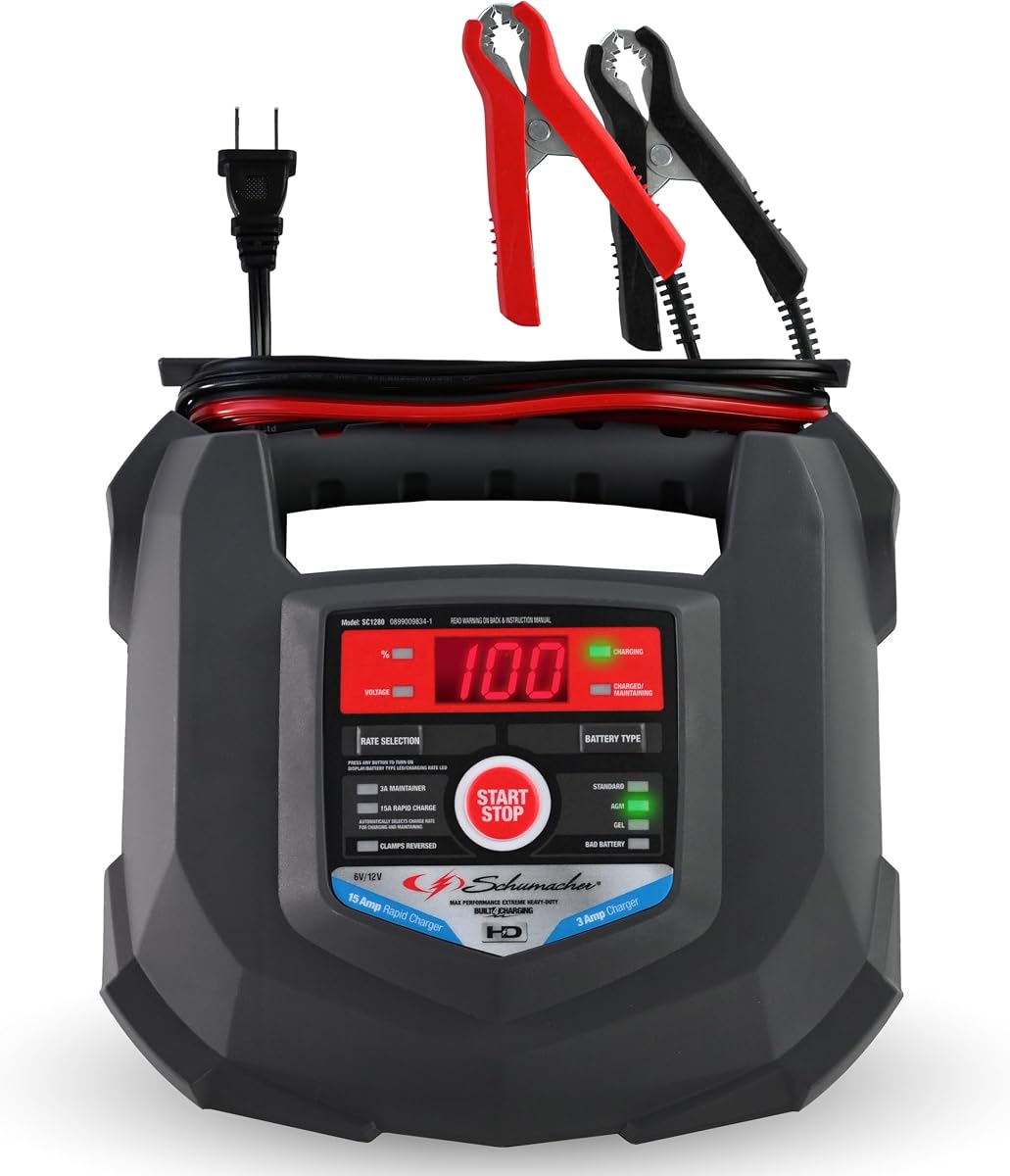
Schumacher SC1280 Charger
4.6Editor score
Supports 6V and 12V
Handles multiple battery types
15-amp rapid charging output
Our Marine Battery Chargers guide compares ten top models for bank count, charging power, battery compatibility, waterproofing, and maintenance features, with
Marine battery chargers look similar from a distance, but the details that matter on a boat can be substantial. Bank count, charging current, battery chemistry, recovery features, temperature compensation, and sealed construction all influence whether a charger can support a starter bank, house bank, or both safely in demanding marine conditions.
This guide compares ten onboard and multifunction marine-capable chargers using the specifications and customer ratings provided for each product. The list covers two-, three-, and four-bank models, low-current maintenance units, and higher-output onboard chargers for lead-acid, AGM, gel, calcium, and lithium-ion battery systems.
Each review identifies the charger that stands out within its category, while the buying guide explains how to match output, controls, protection, and installation needs to a particular boat. Ratings and technical information reflect the supplied listings, and prices can change over time, so readers should verify current availability and cost before purchasing.
4.6Editor score

4.7Editor score
4.8Editor score
The comparison below places the ten chargers side by side, focusing on bank configuration, total and per-bank output, supported battery types, waterproofing, diagnostics, and maintenance functions.


The NOCO GENPRO10X2 earns the Editor's Choice position because it combines serious onboard output with a compact, fully sealed design and flexible battery controls. Its 4.7 rating reflects strong customer satisfaction, while the 20-amp total rating gives owners a useful balance between charging capability and manageable size. It is especially well suited to boats with separate starter and house banks.
We may earn a commission when you buy through this link, at no additional cost to you.
Each of its two banks can be set independently for 12V flooded or lead-acid batteries, 12V AGM, 12V lithium, or 12V repair mode. An integrated thermal sensor adjusts charging for ambient conditions, and the charger can work with batteries down to 1 volt or be forced to begin charging a fully discharged battery. The mounting system permits installation in any orientation, including upside down, while anti-vibration backing helps isolate movement and noise.
The main limitation is bank count. Boats with two house banks in addition to a starter bank may need a three- or four-bank unit. The product information also lists a general 12V lithium mode rather than a dedicated LiFePO4 selection, so owners should confirm compatibility with the exact battery label and the charger's instructions. Despite those points, the combination of sealed construction, recovery tools, and independent controls is exceptionally versatile.
Choose the GENPRO10X2 when you want a rugged onboard charger for one or two 12V banks and value flexible installation over maximum number of simultaneously serviced batteries. It is the most balanced recommendation in this guide for typical marine use, particularly for owners who need both maintenance and recovery functions in a permanently installed unit.
The ability to select a charging mode separately for each bank prevents the charger from treating starter, AGM, and lithium batteries as if they were identical. That control is valuable on mixed systems where starting load and house-bank demand operate differently throughout the day.
The IP68 enclosure, vibration-isolating backing, and orientation-free mounting system make this model suitable for fixed onboard placement. A complete kit includes long DC leads, eyelet terminals, an AC cable, and mounting hardware.
We may earn a commission when you buy through this link, at no additional cost to you.
This 10X3 charger is built for boats that need more than two battery banks while retaining 10 amps of output per bank. Its 4.5 rating indicates a generally favorable customer response. The three-bank design can support a typical arrangement of one starter battery and two house batteries, although actual charging speed still depends on battery condition, capacity, and the number of loads operating.
We may earn a commission when you buy through this link, at no additional cost to you.
Each bank offers SLA/AGM, lithium, and calcium charging modes, and the user can select the appropriate setting independently for each connected battery. A thermal sensor adjusts output as ambient temperature changes. The charger also includes automatic repair, a five-grid power display, and diagnostics for overvoltage, a bad battery, excessive temperature, and reverse connection. These protections can make troubleshooting faster than relying on a simple power light.
Its fully sealed IP68 construction supports permanent 24/7 onboard use, but the listing does not provide the same clarity about extreme operating temperatures as some competing descriptions. The included accessories are extensive, covering three battery clips, three connectors, spare fuses, mounting screws, a bag, and a manual. Buyers should follow the warning to use the charger in a well-ventilated area and carefully read the supplied instructions.
This is a practical choice for three-bank boats whose batteries use the listed 12V lead-acid or lithium chemistry. It offers more current than the 15-amp three-bank alternatives and a more specialized onboard design than general garage chargers. Its exact per-bank performance and repair behavior should be confirmed in the manual before installation.
The charger distributes its advertised 30 amps across three independently controlled 10-amp outputs. This arrangement is useful for larger marine systems that need simultaneous service without turning to a much higher-output four-bank model.
Rather than communicating only through a basic status light, the unit identifies overvoltage, reverse connection, overheating, and potentially faulty batteries. Those alerts can help an owner distinguish a charging problem from a wiring or battery problem.
We may earn a commission when you buy through this link, at no additional cost to you.
The ProMariner ProSport HD combines a 20-amp three-bank format with intelligent allocation of available current. Its 4.5 rating places it among the stronger customer-rated choices in this list. The design is especially interesting for boats where one battery may need more attention than the others, because unused output from a lightly loaded bank can be directed where it is needed.
We may earn a commission when you buy through this link, at no additional cost to you.
ProMariner Digital Technology controls the charging process, while Distributed-On-Demand Technology moves available amps to one battery or a combination of batteries. A heavy-duty heat sink uses upper, lower, and rear surfaces for cooling, helping the charger maintain rated constant current during its two charge modes. The expanded LED display communicates completion through a fuel-gauge-style indicator and a four-color multistage status bar.
The supplied information does not detail individual chemistry settings or a dedicated deep-recovery function, so buyers with mixed battery types should verify compatibility and operating controls before installation. The listing also notes that this model replaces an earlier ProSport 20 Plus design, which can be useful when comparing generations. As with all waterproof units, the value depends on correct placement and secure connections.
The ProSport HD is a strong match for owners seeking a three-bank charger with intelligent current allocation and clear status feedback. It may be especially suitable for boats with uneven battery-bank demand, provided its battery-type menu supports the batteries in the system and its 20-amp total output matches the required charging pace.
Distributed-On-Demand Technology is the defining feature. Instead of leaving available capacity unused when one bank is nearly full, the charger can redirect current toward a bank that remains in greater need.
The extruded heat sink spreads heat across three exterior surfaces. That thermal strategy supports the charger's goal of delivering consistent current during multi-stage charging in a hot, enclosed engine compartment.
We may earn a commission when you buy through this link, at no additional cost to you.
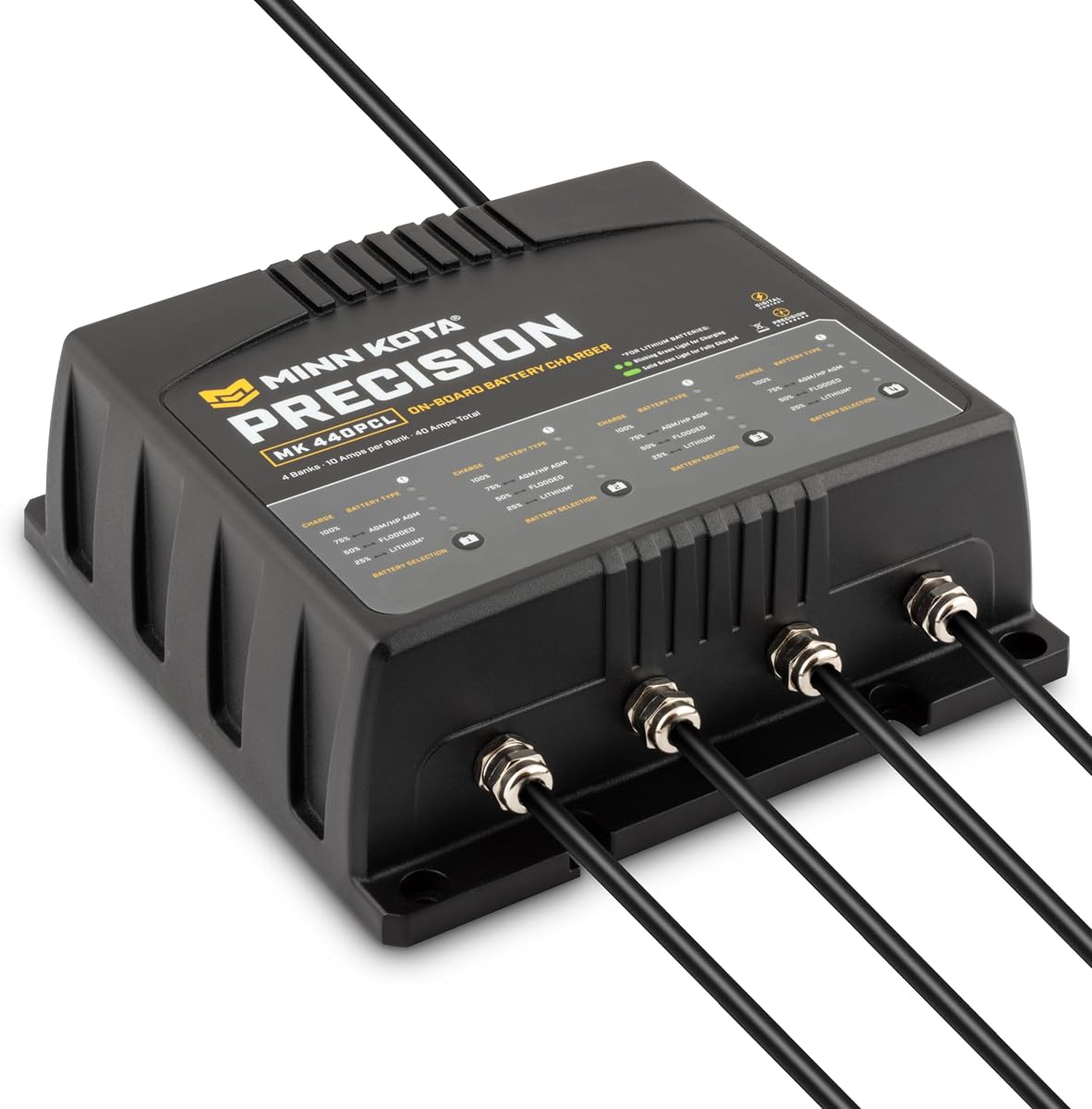
The Minn Kota Precision MK-440PCL is the most technically comprehensive premium option in this roundup. Its 4.8 rating is among the highest listed, and four independently configured banks give it unusual flexibility for boats with multiple battery types. Ten amps per bank provides 40 amps of total charging capacity without requiring a single, high-current output.
We may earn a commission when you buy through this link, at no additional cost to you.
Owners can assign 12V AGM, flooded lead-acid, gel, or lithium LiFePO4 settings to each bank. A microprocessor manages voltage and current through the charging cycle, while automatic temperature compensation adjusts for ambient changes and low-line voltage. The equalization and maintenance feature is designed to clean and protect flooded batteries, with a push-button option for a more rigorous cleaning cycle.
The 10-amp limit for each bank means the charger may take longer to replenish several large house batteries simultaneously than a unit with higher per-bank current. It also relies on automatic maintenance rather than clearly documented forced-charging behavior for a battery at zero volts. LED indicators communicate stage, maintenance status, errors, and full-charge completion, providing useful feedback without requiring a separate display.
This Minn Kota model is the premium recommendation for a boat with three or four distinct battery banks, especially one combining flooded batteries with AGM or LiFePO4 systems. The independent selection, equalization support, and four-bank flexibility justify considering it when the installation has more demanding topology than a two-bank charger can handle.
Per-bank chemistry selection is especially helpful on modern boats that combine a flooded starter battery with AGM house banks or LiFePO4 additions. Each battery receives a charging profile chosen for its type rather than sharing a compromise setting.
Automatic maintenance and a push-button equalization cycle offer additional care for flooded batteries. These features extend the charger's utility beyond simply restoring a depleted battery, although correct battery-specific procedures remain essential.
We may earn a commission when you buy through this link, at no additional cost to you.
The Schumacher SC1280 is the budget-oriented selection for boaters who want one charger for both a boat and other vehicles or stored equipment. Its 4.6 rating reflects solid customer reception, while the 15-amp output gives it more recovery capability than a small maintenance-only unit. Automatic voltage detection allows it to operate with either 6V or 12V batteries.
We may earn a commission when you buy through this link, at no additional cost to you.
The four-in-one design can charge, maintain, test, and restore batteries. It supports standard, AGM, gel, and deep-cycle batteries, making it a useful general-purpose tool for cars, motorcycles, ATVs, trucks, SUVs, and boats. Microprocessor control handles the process, while multi-stage algorithms and smart trickle charging allow it to remain connected without the same urgency as a high-output onboard charger.
The principal drawback is installation. This is not a two-, three-, or four-bank marine charger, and the supplied information does not claim waterproof onboard housing. It is better suited to a garage, dock workspace with suitable protection, or a temporary recovery setup than a permanently exposed engine compartment. The desulfation feature also should not be treated as a guarantee that every severely damaged battery can be restored.
Buy the SC1280 when your priority is flexibility and value rather than simultaneous onboard bank management. It is a strong first charger for a smaller boat with one house battery, or for an owner who wants to maintain batteries across several vehicles without purchasing separate devices for every voltage and chemistry.
The SC1280 broadens its appeal by supporting 6V and 12V batteries and several common chemistries. That makes it more adaptable than a charger dedicated to a single 12V marine installation.
Smart trickle charging and automatic voltage detection help the unit transition into a maintaining role. This is valuable for seasonal boats, motorcycles, and other equipment that can sit unused before needing reliable starting power.
We may earn a commission when you buy through this link, at no additional cost to you.
The 5X3 15A charger combines a strong 4.8 rating with a useful three-bank layout. It delivers five amps to each of three channels for 15 amps total, making it better suited to smaller house batteries and routine maintenance than to rapid recovery of several large banks. Its sealed IP68 enclosure and 24/7 onboard capability are the principal marine advantages.
We may earn a commission when you buy through this link, at no additional cost to you.
Each battery can be assigned an SLA/AGM, lithium, or calcium mode independently. The charger includes automatic repair, temperature compensation, a five-stage power display, and diagnostic warnings for overvoltage, bad batteries, excessive temperature, and reverse connection. These protections make it more informative than a basic maintainer and more purposeful than a general automotive smart charger.
The central trade-off is charging speed. At five amps per bank, a large deep-cycle house battery may require a substantial amount of time to replace a significant discharge, especially while other loads remain active. This model therefore works best when the goal is dependable topping up and maintenance across multiple modestly sized batteries rather than rapid reconditioning after a deeply depleted bank.
Consider the 5X3 when you have three 12V batteries but do not need high per-bank amperage. It is a compelling compact maintenance option with a high customer rating, independent mode controls, automatic repair, and sealed construction. Boats with larger batteries should examine whether the 10-amp-per-bank alternatives better match their recovery time and electrical load.
The three-channel architecture allows a starter battery and two house batteries to be maintained at once. Five amps per bank is a sensible balance for smaller batteries that spend much of their time at a moderate state of charge.
The automatic repair function and status grid reduce the need to guess why a battery is not accepting a normal charge. Diagnostic indicators highlight common setup or battery faults before they become harder to diagnose.
We may earn a commission when you buy through this link, at no additional cost to you.
The NOCO GENIUS2D is a compact onboard maintainer rather than a high-output battery charger. Its 4.6 rating indicates a favorable response, and its 2-amp output is appropriate for maintaining a smaller battery over long periods. The direct-mount format is designed for simple installation near the battery with a snap-fit bracket and self-tapping screws.
We may earn a commission when you buy through this link, at no additional cost to you.
It supports 12V lead-acid batteries, including AGM, gel, SLA, VRLA, flooded, maintenance-free, deep-cycle, marine, and RV types. An integrated thermal sensor adjusts the charge in hot or cold conditions. The charger can begin from a one-volt battery or enter Force Mode for a battery at zero volts, while precision pulse charging is designed to address sulfation and acid stratification.
Its 2-amp ceiling is the defining limitation. It cannot deliver the rapid recovery expected from a 15-, 20-, or 30-amp charger, and a single output means it will not service starter and house banks simultaneously. It also does not list lithium support. While the maintainer can remain connected indefinitely, that safe long-term behavior should not be confused with fast battery recovery.
Choose the GENIUS2D for a single 12V lead-acid battery that needs dependable maintenance, especially a smaller boat battery or a seasonal-use setup where space is limited. It is less appropriate for multi-bank systems, lithium installations, or recovering a deeply discharged large house bank.
The snap-fit bracket and included screws allow the charger to be fixed near the battery without the larger footprint of a multi-bank unit. This makes it practical for a small compartment or a single-bank electrical system.
The smart charger continually monitors the battery and is designed to remain connected safely for maintenance. Force Mode and low-voltage recovery add flexibility when a battery has been neglected for an extended period.
We may earn a commission when you buy through this link, at no additional cost to you.
This three-bank charger delivers 30 amps total, allocating 10 amps to each independent output. Its 4.6 rating indicates a solid customer reception, while the nine-stage charging process and broad chemistry support make it suitable for boats that combine marine, starting, and deep-cycle batteries. It is also explicitly designed for 24/7 onboard charging.
We may earn a commission when you buy through this link, at no additional cost to you.
SLA/AGM, lithium, and calcium modes cover several common battery families, and the listing names LiFePO4 compatibility. Automatic temperature compensation adjusts the charging stages to battery status and ambient conditions. For extremely low batteries between zero and one volt, a slow recovery process can take one to two hours, while holding the mode button for five seconds initiates manual forced charging.
The specifications do not explain whether all three banks can use every listed chemistry simultaneously, nor do they clarify the exact behavior of the nine stages for each type. Owners should therefore confirm that the desired combination is permitted by the manual before connecting mixed batteries. The extended recovery process for nearly depleted batteries also requires patience and appropriate supervision.
This is a compelling option for a three-bank 12V system needing higher current than the 15-amp models and broad chemistry coverage. Its automatic repair, diagnostics, forced charging, and IP68 housing make it well rounded. Confirm the detailed operating menu and wiring requirements before treating it as a drop-in replacement for an existing charger.
Support for SLA, AGM, lithium, calcium, deep-cycle, and specifically LiFePO4 batteries broadens the installable equipment base. Users should still match the selected mode to the battery manufacturer's recommended charging profile.
A manually activated forced-charge function can initiate charging when a battery is too depleted for normal detection. The listed zero-to-one-volt recovery process is gradual, so adequate time and correct battery setup are essential.
We may earn a commission when you buy through this link, at no additional cost to you.
The WAVLINK 3-Bank 15A holds the highest customer rating in this roundup at 4.9, making it an especially compelling maintenance-focused choice. It uses three independent 5-amp channels for 15 amps total and supports batteries from 15Ah to 150Ah. The independent design suits boats with separate starter and house banks that need simultaneous attention.
We may earn a commission when you buy through this link, at no additional cost to you.
Compatible chemistries include SLA, AGM, flooded, maintenance-free, calcium, and LiFePO4 lithium. Multistage logic adjusts current and voltage to battery status, while the repair function is designed to reduce sulfation and restore capacity. A 72-hour timer limits excessive charging, and Full Auto Stop cuts charging once the batteries reach full voltage.
Reverse-polarity, overheat, overvoltage, overcurrent, and short-circuit safeguards provide broad electrical protection. The stated operating range is minus 4 to 104 degrees Fahrenheit, with a wider storage range, and the IP68 housing is designed for dust, moisture, vibration, and salt-laden environments. As with the other 15-amp three-bank models, five amps per channel is modest for large batteries that need a rapid recovery.
Select this charger when a high customer rating, independent channels, comprehensive chemistry support, and automatic stopping are priorities. It is well suited to routine maintenance and desulfation-oriented care across three banks, while owners needing faster recovery should consider a model with 10 amps per bank.
Full Auto Stop is intended to prevent continued charging after a battery reaches full voltage, while the 72-hour timer limits unusually long sessions. Together, they add safeguards around unattended maintenance.
Multiple electrical safeguards help contain common connection and electrical faults. The sealed housing, vibration resistance, and stated environmental tolerance suit the moisture and movement encountered in fixed onboard use.
We may earn a commission when you buy through this link, at no additional cost to you.
The Minn Kota MK 330D is a three-bank, 30-amp onboard charger with a 4.7 rating. It combines digital control with automatic multi-stage charging, giving each bank the potential to receive controlled voltage and current throughout the charge. It is a logical option for boats with a starter battery and multiple house banks.
We may earn a commission when you buy through this link, at no additional cost to you.
Automatic temperature compensation adjusts for ambient temperature changes, helping charging remain accurate in hot engine compartments and cool conditions. LED indicators communicate the active charge stage, maintenance mode, errors, and full-charge completion. The waterproof housing is also designed to resist shock and vibration, which addresses the movement and impacts associated with a working boat.
The listing explicitly states that gel batteries are not compatible, an important qualification for buyers with that battery type. It also does not provide a detailed list of supported modes, so owners should verify chemistry settings in the manual. As with the MK-440PCL, the ten-amp-per-bank output is useful, but actual recovery time still depends on battery size and the number of connected loads.
Choose the MK 330D for a three-bank system that benefits from digital control, automatic thermal adjustment, and clear status indication. It is particularly appropriate when all installed batteries fall within its supported chemistry list and higher per-bank output is needed for larger house banks.
The charger's sensors adjust the charging process as ambient conditions change. This is especially helpful in marine compartments where temperature can shift substantially and affect battery chemistry.
Integrated LEDs show charging stages, maintenance, errors, and completion. That information allows an owner to confirm system status without adding another display to an already crowded dashboard.
We may earn a commission when you buy through this link, at no additional cost to you.
A useful marine battery charger must fit the boat's electrical architecture as closely as the battery itself. Start with bank count and required current, then consider chemistry, environmental protection, recovery functions, and installation details.
Count every battery or battery bank that must remain charged, including the starter battery, each house bank, and any dedicated navigation or accessory bank. A two-bank charger suits a straightforward starter-and-house arrangement, while three-bank and four-bank models cover larger electrical systems. Independent controls matter when banks use different chemistries or have different capacity requirements, because a common mode can leave one battery receiving an inappropriate charging profile.
Total output is not the only number to consider. A 15-amp charger with three 5-amp banks and a 30-amp charger with three 10-amp banks may serve the same three batteries, but they recover depleted capacity at different rates. Larger house banks generally benefit from more current, while low-output maintainers are better for small batteries and long-term storage. Account for simultaneous electronics, refrigeration, lighting, and other house loads when judging how much capacity must be replaced.
The charger's selectable chemistry must match the battery manufacturer's recommendations. The products in this guide variously support lead-acid, flooded, AGM, gel, SLA, calcium, maintenance-free, and lithium-ion systems, but not every model offers every chemistry. LiFePO4 is a specific lithium chemistry, so a broad lithium label may not guarantee the correct charging profile. Gel compatibility is also not universal, and the Minn Kota MK 330D specifically does not support gel batteries.
Marine chargers are commonly installed near batteries in compartments where splashes, condensation, salt, and vibration are unavoidable. An IP68 rating indicates a high level of dust and water protection, while shock- and vibration-resistant construction helps protect internal electronics. Sealing alone does not eliminate the need for sensible placement, secure strain relief, and corrosion-conscious connections, but it provides an important margin of protection compared with a basic garage charger.
Battery voltage and acceptable charging behavior change with temperature. A charger with an integrated thermal sensor can reduce charging in hot conditions and increase it in cold conditions, helping avoid overcharging or undercharging. This is especially important in boats that encounter wide seasonal temperature swings or have batteries installed near hot engines. Temperature compensation is a sign of more refined control, but it must still operate alongside the correct chemistry and voltage settings.
Maintenance charging and deep-battery recovery are not the same task. A maintainer is designed to replenish small losses over time, while recovery features such as repair, desulfation, or forced charging address neglected or deeply discharged batteries. The supplied listings mention recovery down to zero or one volt in several cases, but the process may be slower than a normal charge. These features are useful, but they cannot compensate for a damaged battery or an incorrect battery type selection.
Onboard chargers need information that works in a cramped or noisy environment. LEDs, multi-color status bars, fuel-gauge displays, and automatic diagnostic alerts can show charge progress, full completion, reverse connection, overvoltage, overheating, and a potentially bad battery. Independent mode buttons make it easier to assign the correct profile to each bank, although a larger number of controls can also create setup complexity for first-time users.
The supplied cable lengths, terminal styles, mounting screws, connectors, and fuses determine how easily the charger can be installed. Onboard models often include long DC leads and eyelet terminals, while portable or multifunction chargers may use clips. Verify whether the battery terminals accept the included hardware, whether extra cable length is needed, and whether the mounting location provides ventilation and protects the AC connection. The package also indicates whether replacement fuses or adapters are supplied for maintenance.
Before installation, identify each battery's chemistry, voltage, polarity, and manufacturer-recommended charging mode. Turn off the charger, disconnect loads if required, and connect the DC leads with the correct polarity. Configure each bank separately, then place the unit in a ventilated, secure location away from exposed moving parts and prevent cables from becoming chafed or pinched.
Connect the AC supply according to the manual and allow the charger to identify or begin operating on the selected battery type. Watch the status indicators during the first cycle, particularly after installing a deeply discharged battery. Do not interrupt a recovery or equalization process unless the charger signals a fault or the battery shows signs of damage such as swelling, leakage, or unusual heat.
For maintenance, keep the terminals and housing free of salt, dirt, and corrosion, and periodically check that the mounting screws and cable connections remain tight. Use a charger only with compatible batteries, respect ventilation instructions, and replace any damaged cable or fuse with the correct part. Periodic inspection of the charger's status lights can reveal a loose connection, overloaded bank, or battery that is no longer accepting a charge.
The right current depends on battery-bank capacity and how quickly you want to recover a discharge. A 10-amp total charger is generally more suitable for maintenance and smaller batteries, while 30 amps offers more recovery capacity for large house banks. A boat with several active electronics may also need to replace more current than the charger supplies, so total household load and battery size should be considered together.
Only if each connected bank uses a compatible selectable mode. Chargers with independently configurable banks can support different chemistries in different locations, such as a flooded starter battery and an AGM house bank. Always verify that the battery is on the compatible list and that the chosen mode follows the battery manufacturer's recommendations.
An onboard charger is designed for permanent installation near the batteries and usually includes sealed construction, mounting hardware, and the ability to remain connected as a maintenance charger. A portable or garage-style charger is more useful for recovery, seasonal storage, and sharing across multiple vehicles, but it may not have the same waterproofing or multi-bank controls.
IP68 is a strong advantage for permanent onboard use because it indicates substantial protection against dust and water ingress. It is especially helpful in compartments exposed to splashes, rain, condensation, or salt-laden air. It does not make poor placement safe, so the charger still needs secure mounting, undamaged cables, and ventilation as specified by its manufacturer.
Many models in this guide are designed for ongoing onboard charging, and smart maintainers can safely remain connected while monitoring battery condition. The exact behavior depends on the charger and battery, so follow the manual and confirm that unattended operation is permitted. Periodic visual checks are still wise, particularly after severe weather or an unexpected loss of power.
A basic automotive charger can charge many lead-acid marine batteries, but it may lack independent bank control, sealed construction, temperature compensation, and proper marine-specific modes. The Schumacher SC1280 is explicitly suited to boats and several other vehicle types, while purpose-built onboard models are generally more convenient for a permanently installed multi-bank system.
A reverse-connection warning indicates that the charger has detected a polarity problem and may stop or prevent normal charging to protect the unit and battery. A bad-battery warning means the charger has identified behavior that may point to a deeply damaged, sulfated, or otherwise unsuitable battery. Confirm wiring and battery condition before assuming the charger itself is faulty.
A three-bank charger can service three separately selected battery groups at the same time. A common arrangement is one starter battery and two house banks, but actual charging performance depends on the per-bank amperage and battery capacity. A three-bank unit with higher per-bank output is better suited to large house batteries than a lower-current model.
The NOCO GENPRO10X2 is the strongest all-around choice for a typical two-bank marine installation, combining independent modes, temperature compensation, recovery tools, and an IP68 enclosure. The Schumacher SC1280 stands out as the budget-friendly general-purpose option, while the Minn Kota Precision MK-440PCL offers the most advanced premium configuration with four independently controlled banks.
For most boat owners, prioritize battery chemistry support, per-bank current, waterproofing, and correct bank count before extra recovery features. Larger house banks benefit from 10 amps per bank, while a small battery or seasonal-maintenance need may be better served by a compact 2-amp unit. Installing the charger with the correct mode for every bank remains the most important step after choosing a model.
Ratings, specifications, and product availability can change, and prices fluctuate over time. Check the current listing and manufacturer instructions before purchasing, particularly to confirm connector style, installation requirements, battery compatibility, and the charger features needed for your specific electrical system.