
EVAPLUS 54.6V Safe Charger
4.4Editor score
Compact 48V lithium charger
UL-certified safety design
Red and green status lights
Our Ebike Replacement Charger guide compares ten 48V and 36V chargers for connector fit, safety features, charging speed, portability, and everyday reliability.
An e-bike replacement charger must do more than provide power: it must match your battery chemistry, voltage, connector, and charging requirements while adding dependable protection against common electrical faults. A well-chosen replacement can restore a bike that is otherwise perfectly rideable, reduce the need to keep spare chargers on hand, and make charging more convenient at home or while traveling.
This guide compares ten replacement chargers using the specifications and compatibility details supplied with each product. We focus on battery voltage, output, connector coverage, safety certification, charging behavior, status indicators, portability, and the practical information needed to avoid selecting an incompatible charger. The list includes nine 48V lithium-battery options and one 42V charger designed for 36V lithium systems.
Each review explains where the charger stands out, which systems it is intended to support, and the details that deserve attention before buying. The top selections represent a strong general-purpose choice, a value-oriented option, and a connector-heavy model, while the remaining reviews cover alternatives for particular battery types and riding brands. Availability, ratings, and prices can change over time.
4.4Editor score
4.6Editor score

4.4Editor score
The comparison below places all ten chargers side by side, highlighting their intended battery systems, output, connector coverage, and most prominent practical features.


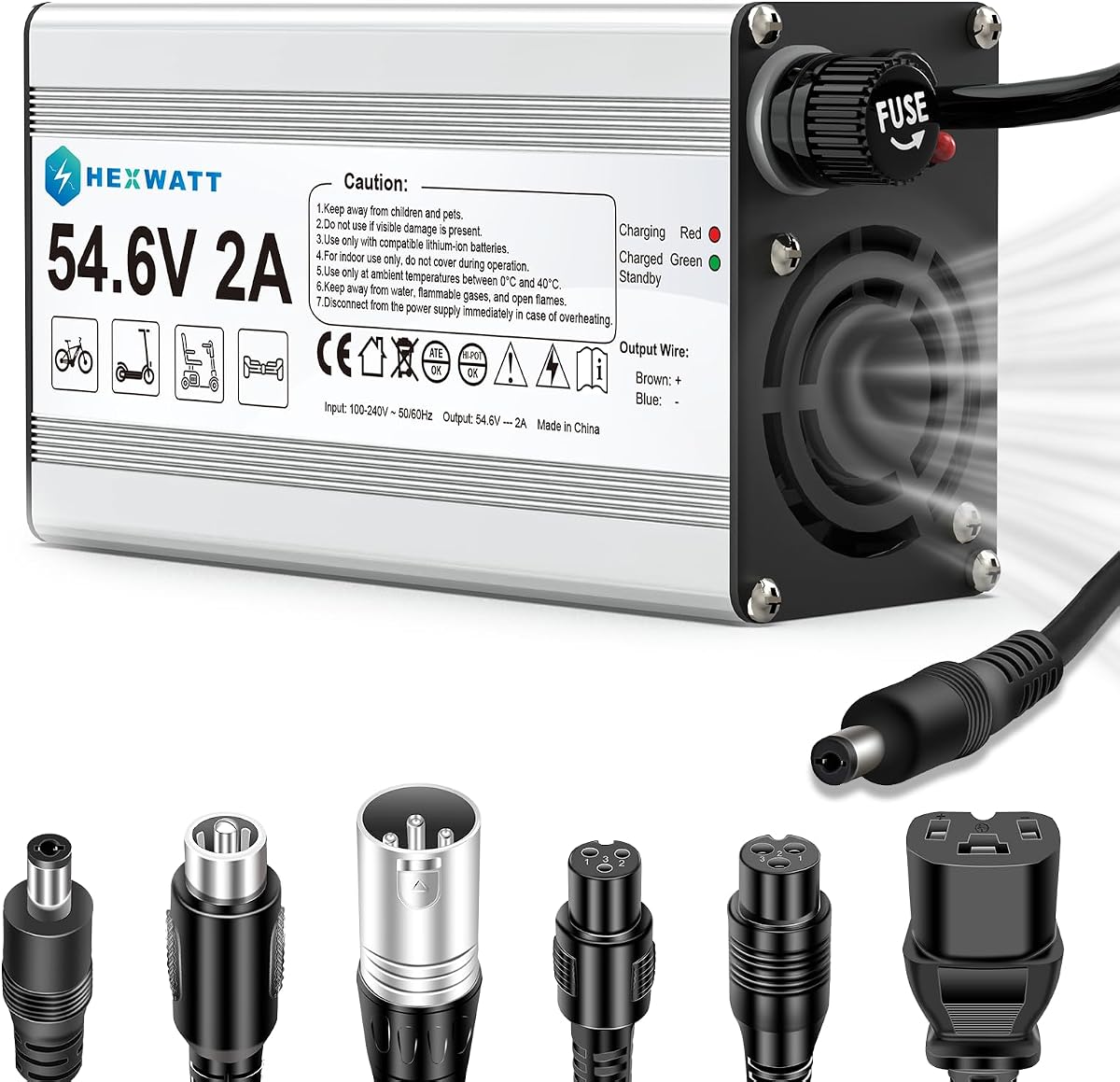
This UL-listed replacement charger combines a 54.6V 2A output with five interchangeable adapter plugs, giving it broader practical value than a single-tip model. It is intended for 48V lithium-ion e-bike and scooter batteries and specifically calls out compatibility considerations for Rad Power Bikes, Velotric, Heybike, Juiced, and Ecotric products. Its 4.3 rating places it well among the highly rated options in this guide.
We may earn a commission when you buy through this link, at no additional cost to you.
The five-adapter format is the central selling point because charging ports vary considerably across e-bikes and scooters even when their battery voltage is identical. The charger also includes protection against overcharging, short circuits, over-voltage, and over-current. A color-coded LED provides useful feedback: solid red indicates charging, while solid green indicates that the battery is fully charged and ready for use.
Its limitations are straightforward. The product is designed specifically for 48V lithium batteries, so it is not a universal answer for 36V, 42V, higher-voltage, or lead-acid packs. The listed brand compatibility does not eliminate the need to inspect the actual charging port, and a matching-looking connector can still differ in polarity or pin arrangement. Buyers should compare the original charger's output label before ordering.
This is a sensible general-purpose replacement for someone with a 48V lithium e-bike or scooter who wants several likely connector options without moving to a larger multi-tip kit. The combination of UL listing, 2A output, clear status indication, and five adapters makes it a balanced choice for daily use. It is especially attractive when the original charger has been lost or damaged and the battery itself is in good condition.
Five included adapters make it easier to support more than one 48V rideable without carrying separate charger tips. The stated brand focus is useful for shortlisting, but visual port matching and an original-output check remain the safest way to confirm fit.
The red and green LED states remove ambiguity during long charging sessions. Red communicates active charging, while green signals a completed charge, helping users avoid unnecessary unplugging or leaving a connected charger unattended unnecessarily.
We may earn a commission when you buy through this link, at no additional cost to you.
This UL-certified 54.6V 2A charger is designed for the large 48V lithium e-bike category and carries a 4.2 rating. It specifically names Lectric XP 2.0 and 3.0, Ecotric City and Beach, and Evercross H5 and H7 models, giving buyers several recognizable points of reference when beginning a compatibility check.
We may earn a commission when you buy through this link, at no additional cost to you.
Five universal connector options are supplied, described as a DC barrel configuration, a 12mm aviation plug, and a cannon-style connector. The 100-240V, 50/60Hz input supports use across regions, while the CC-CV operating mode is intended to manage the charge more consistently than a simple constant-voltage approach. Protection covers over-voltage, over-current, short circuit, excessive temperature, reverse connection, and fuse-related concerns.
The charger automatically stops when the battery reaches full charge, which is one of its most useful features for routine overnight charging. Nevertheless, compatibility remains model-specific. A connector shape alone is not enough to establish suitability; voltage, chemistry, polarity, and connector pinout must also agree. The product is expressly unsuitable for lead-acid batteries and should not be selected for 36V systems.
For a rider who owns one of the named 48V brands and has lost the original charger, this is a practical choice with solid protective features and several tip options. It is less compelling when a buyer needs exceptionally broad model coverage, but for common Lectric, Ecotric, and Evercross setups, it offers a clear balance of compatibility, safety, and convenience.
The listing identifies the certified model as JY-546200, providing a more useful reference than an unqualified claim that a charger is safe. Buyers can also look for the UL certification mark on the physical unit when it arrives.
Reverse-connection, over-temperature, short-circuit, over-voltage, and over-current protection make the charger suitable for regular charging cycles when operated with a compatible battery. These safeguards do not remove the need to verify electrical compatibility before connecting it.
We may earn a commission when you buy through this link, at no additional cost to you.
This 48V charger delivers 54.6V at 2A and comes with five connector configurations, giving it a useful balance of output and adaptability. Its 4.2 rating reflects a generally positive reception, and the stated applications include e-bikes, electric bicycles, One Wheel devices, and Rad Power Bike products. The charger operates from a 100-240V input at 50/60Hz.
We may earn a commission when you buy through this link, at no additional cost to you.
The connector selection includes a 5.5×2.5mm one-prong DC plug, an 8mm three-prong mini connector, a 12mm three-prong connector, an 8mm RCA connector, and a three-pin male XLR connector. That variety is helpful for owners comparing ports across several brands, although it should not be mistaken for guaranteed support for every 48V product. Buyers still need to match the port, polarity, and battery requirements.
Status feedback is straightforward: the indicator remains red during charging and turns green when the battery is full. The charger also uses CC-CV control and includes short-circuit, overload, over-current, and over-voltage protection. A noteworthy restriction is that it is only for lithium battery packs and must not be used with lead-acid systems.
This option fits riders who want a fast 2A charger and several likely port formats without moving to a seven-tip bundle. It is a particularly practical replacement when the original charger has failed but the battery label confirms a 48V lithium configuration. The broad connector selection and straightforward status lights make it easy to organize, provided the buyer performs the required compatibility check first.
DC barrel, mini three-prong, aviation-style three-prong, RCA, and XLR formats cover several common charging arrangements. The assortment is most useful for owners of multiple 48V devices or those familiar with their own model's connector.
A red-to-green status change gives users an immediate visual indication of the charging cycle. Once the light turns green, the battery has reached the charger's full-charge state and can be disconnected according to the manufacturer's instructions.
We may earn a commission when you buy through this link, at no additional cost to you.
The EVAPLUS 54.6V Safe Charger is a focused replacement for 48V lithium batteries, combining a 4.4 rating with UL certification. It is intended for e-bikes, scooters, and other devices using compatible 48V packs, while its 100-240V AC input makes it suitable for a wide range of locations. Unlike the larger multi-adapter selections, it keeps the design centered on barrel-style charging ports.
We may earn a commission when you buy through this link, at no additional cost to you.
Compatibility is listed for DC 5.5mm x 2.5mm or 2.1mm connectors, with an explicit reminder to verify the port size before buying. The charger includes over-voltage, over-current, and short-circuit protection, along with automatic shutoff at full charge. Red and green LEDs provide immediate status monitoring, and the product information states that most 48V 13S lithium batteries can charge in about four to six hours.
The main trade-off is connector breadth. Riders whose charging socket matches the supplied barrel options can appreciate the compact and straightforward package, but those who need several specialized three-prong, RCA, or XLR tips may need to look elsewhere. The connector's apparent fit should also be checked alongside polarity rather than judged by diameter alone.
This is the best budget-oriented choice in the guide for a straightforward 48V lithium e-bike or scooter with a common barrel connector. It combines certification, useful fault protection, automatic shutoff, international input support, and clear status lights without adding unnecessary complexity. Confirm the battery label and charging socket first, and it offers a focused alternative to more heavily bundled universal chargers.
Instead of carrying a large collection of specialized tips, this charger concentrates on the widely used 5.5mm barrel format. That makes it a sensible option when compatibility has already been confirmed and the rider prefers a straightforward replacement.
The 100-240V input allows the same unit to be used in many countries, subject to the availability of a suitable local plug and the user's normal travel safety practices. It is particularly convenient for riders who take a bike or scooter abroad.
We may earn a commission when you buy through this link, at no additional cost to you.
This EVAPLUS charger fills an important gap in a list dominated by 48V models: it is designed specifically for 36V lithium batteries and provides a 42V 2A output. It holds a 4.2 rating and carries SGS safety certification, along with protection from short circuits, over-current, over-voltage, and polarity errors. It is a strong candidate for a compatible 36V electric scooter rather than a typical 48V e-bike.
We may earn a commission when you buy through this link, at no additional cost to you.
Three connector types are included: a 0.31-inch one-prong plug, a 0.31-inch mini three-prong connector, and a 5.5mm x 2.5/2.1mm DC female connector. The listing specifically cites compatibility with Razor Pocket Mod and Sports Mod models and many other 36V scooters using those formats. Its 2A output is claimed to charge a typical 36V battery in approximately four to six hours.
Compatibility boundaries are unusually clear. The charger is not suitable for the Hover-1 Ranger, Jetson models using a three-pin XLR connection, 24V batteries, or lead-acid packs. It also measures only 5.03 by 2.16 by 1.57 inches, making it easy to carry in a backpack or scooter compartment. A one-year replacement warranty adds reassurance for routine home use.
Choose this model if the original battery is labeled 36V lithium and its port matches one of the included connectors. It is a specialized but well-rounded replacement with certification, compact size, three plug options, and a stated warranty. Buyers should not stretch its suitability to other voltages or incompatible proprietary ports simply because the charger is marketed as universal.
A 42V charger is not a lower-powered version of a 48V charger; it is designed around a different battery pack. This option prevents buyers from making the serious mistake of using a 54.6V charger on a 36V lithium battery.
Its compact listed dimensions make it easier to carry than a full-size e-bike charger. Riders can keep it in a compartment or backpack, provided the battery and charger are stored and transported according to the battery manufacturer's guidance.
We may earn a commission when you buy through this link, at no additional cost to you.
The QKIIP 54.6V 2A Charger is the premium connector-heavy selection in this guide, pairing a 4.4 rating with seven interchangeable plug tips. It is intended exclusively for 48V 13S lithium-ion packs and provides a 54.6V 2A output. The included tips cover 5.5×2.1mm and 5.5×2.5mm barrel plugs, a 12mm three-prong connector, a 9mm mini three-prong, an 8mm RCA, a three-pin XLR, and a universal three-prong option.
We may earn a commission when you buy through this link, at no additional cost to you.
Compatibility information is unusually thorough, naming Lectric, Ecotric, Rad Power, Aventon, Ancheer, Jetson Haze, Evercross, Jasion, Velotric, Ninebot, and other brands or models. The charger includes over-voltage, overload, over-current, over-temperature, and short-circuit protection, along with a fire-resistant housing. Its three-stage CC/CV process is designed to regulate charging and support battery health.
The trade-off is that a seven-tip kit can be more elaborate than a simple two- or three-connector charger. It remains restricted to 48V 13S lithium batteries and is expressly unsuitable for 36V, 42V, 24V, 52V, and lead-acid systems. The green light can indicate a full charge, disconnection, or no active charging, so it should not be read in isolation without considering the charger's connection state.
This is the best premium choice for a rider who wants one replacement charger to cover many common 48V brands. The product also gives buyers three useful pre-order checks: confirm that the battery says 48V lithium, verify that the original charger outputs 54.6V, and compare the port with the included tips. For owners of several e-bikes or an uncertain connector, that clarity and coverage justify the more extensive package.
The seven supplied connectors span the formats most likely to appear across 48V e-bikes and scooters. That breadth is valuable for households with multiple brands or for replacing a charger whose original model is no longer readily identifiable.
The seller provides a simple three-part compatibility process and offers to review a rider's model. Buyers should still independently confirm voltage, chemistry, and port characteristics, but the guidance helps narrow the decision before ordering.
We may earn a commission when you buy through this link, at no additional cost to you.
This SGS-certified charger provides a 54.6V 2A output for 48V 13S lithium e-bike and scooter batteries. It carries a 3.9 rating, lower than the other 48V choices here, but it includes a substantial safety and connector package. The product information states that units pass UL testing and undergo aging tests before shipment.
We may earn a commission when you buy through this link, at no additional cost to you.
Seven plug configurations are provided, including 5.5×2.1mm and 5.5×2.5mm barrel connectors, 9mm and 12mm three-prong formats, 8mm RCA, three-pin XLR, and a universal IEC plug. The charger also has over-voltage, over-current, short-circuit, and temperature protection, plus a V-0-rated flame-retardant enclosure. Red and green LEDs indicate charging and completion.
The lower rating is the main reason to consider this model more carefully. It remains a credible technical package, but buyer feedback is less favorable overall than that of the leading products in the comparison. It is also strictly limited to 48V 13S lithium battery packs and cannot be used with 24V, 25V, 29.4V, 36V, 42V, or lead-acid batteries.
For someone with a matching 48V 13S system who values a seven-tip selection, enclosure materials, aging tests, and a broad set of protections, this charger remains relevant. However, it is not the strongest choice for a buyer who places the greatest weight on customer feedback. Confirming the connector and battery specification is essential, and reading current user feedback can provide additional context before purchase.
The stated V-0 flame-retardant enclosure and pre-shipment aging tests distinguish this model from chargers that mention only basic electrical protections. These design features support confidence in repeated use, provided the charger is operated according to its instructions.
The extensive plug selection does not make the charger appropriate for every battery. The 48V 13S lithium restriction is firm, and buyers should disregard the word universal when it appears in a product title without confirming the detailed specifications.
We may earn a commission when you buy through this link, at no additional cost to you.
This UL-listed 54.6V 2A charger is tailored to 48V electric-bike batteries and holds a 4.4 rating. The listed information says it supports lithium battery capacities from 7.8Ah through 20Ah and explicitly excludes scooters, hoverboards, electric motorcycles, lead-acid packs, LiFePO4 chemistry, and batteries outside 48V.
We may earn a commission when you buy through this link, at no additional cost to you.
Its standout feature is silent operation. Rather than using a cooling fan, the charger relies on smart temperature control, which the product information says lowers peak temperature by 30% compared with a standard 54.6V 1.5A charger. It also claims a 30% charging-time improvement over that 1.5A reference and a threefold charger lifespan, though actual results depend on the battery and conditions.
Three connector forms are included: a 5.5×2.5/2.1mm DC plug, a 12mm three-prong plug, and an 18mm XLR plug. The compatibility list covers numerous brands and models, including Ancheer, Jasion, Funhang, TST, Lectric, Rad Power, Heybike, Himiway, ESKUTE, Qlife, and Aipas. A velvet storage bag is also included, making the charger easier to keep together with its cable and tips.
This is an attractive pick for an e-bike owner who prefers quiet charging and values a branded, organized package. The LED sequence distinguishes wall connection, active charging, and full charge, while automatic shutdown or trickle charging provides an additional layer of battery care. Because the model list is long and specific, buyers should verify their exact battery, connector, and model rather than relying on brand-level compatibility alone.
The absence of a cooling fan can make an indoor nighttime charge less noticeable. Temperature regulation is instead handled electronically, making this model appealing to riders who charge in apartments, offices, or shared spaces.
The included storage bag helps keep cables and interchangeable connectors together, while the long list of supported models provides a useful starting point for compatibility research. Exact port and battery checks remain necessary because names and model years can involve different charging arrangements.
We may earn a commission when you buy through this link, at no additional cost to you.
This 54.6V 2A charger is the strongest overall pick in the guide, combining the highest listed rating, 4.6, with extensive connector coverage and detailed compatibility information. It is designed for 48V 13S lithium-ion NMC battery packs and supplies a regulated 54.6V output at 2A. Seven interchangeable connectors allow it to cover a particularly broad mix of e-bikes and scooters.
We may earn a commission when you buy through this link, at no additional cost to you.
Its compatibility list includes many Lectric XP variants, Rad Power RadRover, RadCity, RadRunner, RadWagon, RadExpand, RadMini, and other models, plus Ride1Up, GOTRAX, Himiway, Heybike, SONDORS, ECOTRIC, and Aventon products. The 48V scooter section names GOTRAX, Hiboy, Apollo, EVERCROSS, Fluid, Kaabo, VMAX, Kukirin, VSETT, and EMOVE models. This breadth makes it a compelling one-charger solution for households with more than one compatible rideable.
Safety is a major strength. The charger was tested by a CNAS ISO/IEC 17025-accredited laboratory against CSA C22.2 No. 62368-1 and UL 62368-1 standards. It uses an aluminum housing, a quiet cooling fan, replaceable fuse, PWM control, and intelligent CPU management, while providing over-voltage, over-current, overheating, and short-circuit protection. It automatically shuts off after charging, with red indicating active charging and green indicating a full or disconnected state.
There is one critical limitation: it is only for 48V 13S lithium-ion or NMC batteries requiring 54.6V charging. It is not compatible with LiFePO4, lead-acid, 52V, 60V, or 72V packs. Buyers should also confirm connector size, polarity, and pinout because fit can vary by model year. Subject to those checks, its rating, construction, testing, and exceptional model coverage make it the most complete replacement in this roundup.
The extensive list of named models goes well beyond a generic claim of universal fit. It is particularly useful for owners of recognizable e-bike and scooter brands, although exact model years and charging-port versions should still be checked before purchase.
Testing against recognized UL and CSA standards gives the safety claim more substance than a generic reference to built-in protection. Multiple electrical safeguards, regulated output, a replaceable fuse, and automatic shutoff make it a well-rounded choice for regular charging.
We may earn a commission when you buy through this link, at no additional cost to you.
This six-plug charger is designed as a replacement for 48V lithium devices, providing a 54.6V 2A output from a 100-240V AC input. It has a 3.8 rating, the lowest in this comparison, but its construction and international input range still make it relevant for commuters, travelers, and owners of several compatible rideables. SGS certification is among its stated safety credentials.
We may earn a commission when you buy through this link, at no additional cost to you.
Six interchangeable connectors are supplied, and the product information names GOTRAX, Hiboy, Jetson, Segway, Ninebot, and Razor scooters among the potential applications. The aluminum alloy housing is designed to dissipate heat, while over-voltage, over-current, short-circuit, and over-temperature protection address common charging faults. The listed housing also emphasizes scratch resistance and corrosion resistance.
A smart trickle mode is used after the battery reaches full charge, supporting the product's goal of protecting battery cells and extending cycle life. The claims that this unit meets or exceeds OEM standards and works as a direct plug-and-play replacement should be treated as product claims, not as a guarantee of compatibility with every model. Actual port shape, polarity, chemistry, and voltage still have to match.
For a buyer who wants a portable, globally usable 48V charger with several connector choices, this model covers the essential features. Its lower rating is a reason to review recent customer feedback carefully, especially if a specific brand or model is central to the purchase. It is best considered a practical multi-device option for confirmed-compatible 48V lithium systems rather than a guaranteed fit for every named brand.
Six interchangeable tips can reduce the inconvenience of keeping separate chargers for different 48V devices. The benefit is greatest for riders who already know which connectors their bikes and scooters use.
Automatically moving to trickle mode after a full charge is intended to reduce unnecessary charging time on a connected battery. Correct battery pairing remains essential because trickle behavior cannot make an otherwise incompatible charger safe.
We may earn a commission when you buy through this link, at no additional cost to you.
A replacement charger should be selected by electrical compatibility first, connector fit second, and convenience third. The battery label, original charger specification, charging port, and battery chemistry are more important than a broad universal compatibility claim.
Start by reading the label on the battery or locating the voltage and chemistry information in the bike or scooter manual. Most replacements in this guide are 54.6V chargers intended for nominal 48V lithium-ion packs, while the EVAPLUS 42V model serves 36V lithium batteries. A nominal voltage label is not the same as the charger's required output voltage: a 48V 13S lithium battery typically requires a 54.6V charging profile. The charger must match both the battery's cell configuration and its chemistry, including whether the pack is lithium-ion, NMC, lead-acid, or LiFePO4.
In short: match the battery chemistry and required charge voltage exactly, and never assume that a physical connector match means the charger is electrically compatible.
The connector must physically fit and also have the correct center pin or pin arrangement. Common options in this category include 5.5×2.1mm and 5.5×2.5mm barrel plugs, 12mm aviation-style three-prong plugs, 9mm mini three-prong connectors, 8mm RCA plugs, three-pin XLR connectors, and other proprietary forms. Some of the larger kits include seven interchangeable tips, but even a physically similar tip can differ in polarity. Compare the replacement port with the original charger connector, consult the product images, and check the bike manufacturer's documentation before ordering.
In short: check diameter, shape, center-pin position, and pin configuration rather than relying on connector appearance alone.
Most 48V options in this guide use a 2A output, while the EVAPLUS 42V charger for 36V systems also provides 2A. Current affects how quickly a compatible battery can be replenished, but faster is not automatically better. The battery's original charger rating, cell configuration, capacity, temperature, and charging-management requirements all matter. Some listings state four-to-six-hour charging times for typical batteries, while others compare 2A output with a standard 1.5A unit. These are useful references, but actual charging time varies with battery capacity and condition.
In short: 2A is a common practical rating here, but follow the battery manufacturer's guidance rather than choosing solely for the fastest stated output.
Look for relevant certification, such as UL, UL listing, SGS certification, or testing against UL and CSA standards, rather than relying only on a generic safety claim. Electrical protections should include over-voltage, over-current, short-circuit protection, and temperature management. Reverse-polarity detection, a fuse, automatic shutoff, and a constant-current/constant-voltage charge profile add further safeguards. Certification applies to a particular product or model, so checking the listed identifier and physical certification markings can help verify that the correct unit has been supplied.
In short: prioritize recognized certification, multi-fault protection, and automatic full-charge control over vague statements about being safe or fast.
A clear LED system makes routine charging easier. A red light usually indicates active charging, while green commonly signals completion, disconnection, or a standby state. Products that explicitly describe automatic shutoff or trickle behavior offer a clearer account of what happens after the pack reaches full charge. The indicators should supplement, not replace, the battery manufacturer's instructions. If a light remains red unexpectedly, or if green appears while charging is not behaving normally, charging should stop and the charger, battery, and connection should be inspected.
In short: choose simple red-and-green status feedback, and verify whether green means fully charged, disconnected, or both.
A replacement charger may live beside a bike, in a garage, under a desk, or in a travel bag. The EVAPLUS 36V model is especially compact, while the Hyleton option includes a storage bag. Models with several interchangeable tips can be more organized when a pouch is included, because loose connectors are easy to lose. A charger with a 100-240V input offers useful geographic flexibility, but travelers should still use an appropriate plug and follow local electrical guidance. Portability should be balanced with heat ventilation, cable length, and the need to keep the charger dry.
In short: consider where the charger will live, whether its tips stay organized, and whether 100-240V input would simplify international use.
Named compatibility can make the search much faster, particularly for recognizable models such as Lectric XP, Rad Power, Ecotric, Aventon, and Ninebot products. It should nevertheless be treated as a starting point. A brand may use different battery voltages or charging ports across model years, and manufacturer naming can change. Cross-reference the listed model with the battery label, original charger output, connector type, and polarity. For a less familiar model, the seller may be able to review a photograph of the original charger label or identify the bike from its model name.
In short: use named models to narrow the field, then verify voltage, chemistry, port, and polarity for the exact battery.
Ratings provide useful context but do not replace technical verification. The products here range from 3.8 to 4.6, and a lower-rated charger may still be appropriate for a battery and port it supports very well. Review recent customer feedback for recurring complaints about connector fit, heat, noise, or charging behavior. Also consider warranty terms and whether the seller offers compatibility assistance. The EVAPLUS 36V model includes a one-year replacement warranty, while the 48V Seven-Connector Charger offers a replaceable fuse, both of which can add confidence in the replacement category.
In short: use ratings and recent feedback as context, compare recurring issues, and favor sellers that provide clear support or a meaningful warranty.
Before the first charge, confirm the battery chemistry, nominal voltage, required charge voltage, and connector configuration against the charger's specification. Compare the replacement with the original charger's output label, inspect the charging socket, and verify the connector's physical fit and polarity. If any information conflicts, stop and consult the bike or battery manufacturer. Do not use a 54.6V charger on a 36V, 42V, LiFePO4, lead-acid, or other incompatible battery, even if the connector appears to fit.
Connect the charger to the battery before plugging it into the wall, unless the product instructions state a different sequence. Place the charger on a stable, dry, hard surface where air can circulate and where it cannot be stepped on, crushed, or exposed to rain. Do not cover the charger with clothing, bedding, bags, or other materials. Use the correct wall outlet and avoid visibly damaged cables, wet connectors, extension arrangements that are not rated for the load, and signs of excessive heat.
Watch the status lights and follow the battery manufacturer's charging guidance. Red generally means charging, while green commonly means fully charged or disconnected, although the exact meaning varies by model. Unplug the charger promptly when charging is complete, and disconnect it before inspecting the battery or changing connectors. Keep the charger dry, store its tips together, and avoid repeated sharp bends or crushing at the plug. If the charger becomes unusually hot, smells burnt, shows damaged insulation, stops charging normally, or causes a connector to deform, disconnect it and do not use it again until it has been professionally assessed.
A 54.6V charger is commonly appropriate for a nominal 48V 13S lithium-ion battery because 54.6V is the full-charge voltage used for that cell configuration. It must not be used with 36V, 42V, LiFePO4, lead-acid, or other battery chemistries unless their manufacturer explicitly specifies that output. Always check the battery label and original charger before connecting a replacement.
A 42V charger is designed for a nominal 36V lithium battery, while a 54.6V charger is designed for a nominal 48V 13S lithium battery. They are not interchangeable because using the higher voltage charger on a 36V pack can cause serious damage. Identify the pack's voltage and chemistry before choosing a replacement.
Compare the socket on the bike with the original charger plug, or check the manufacturer's manual and product images for the charging-port specification. Look closely at barrel diameter, center-pin size, and the number and arrangement of pins. If the original charger is missing, ask a seller that offers compatibility assistance and provide the bike model or clear photographs of the port and battery label.
A multi-connector charger can be convenient, but the included plug does not guarantee compatibility. The battery voltage, chemistry, connector dimensions, polarity, and pinout must all match. Universal or interchangeable is best understood as referring to connector variety, not permission to connect the charger to every e-bike or scooter.
A 2A charger can charge a compatible battery faster than a 1.5A unit, and many of the products here use 2A. The battery manufacturer may specify a maximum current or particular charge profile, so follow that guidance when available. Actual charging time also depends on battery capacity, condition, temperature, and the charger's charging controls.
Different e-bike and scooter brands use several common port formats even when their batteries share the same nominal voltage. A charger with multiple tips lets one unit replace chargers for several compatible rideables. Buyers should keep unused tips organized and confirm the correct tip and polarity before every connection.
Charging indoors is common, but the charger needs ventilation and should sit on a stable, nonflammable surface. Do not cover it with blankets, clothing, or bags, and keep it away from children, pets, moisture, and combustible materials. Follow the battery manufacturer's instructions and unplug the charger when the charge is complete.
First confirm that the charger and battery voltage, chemistry, connector, and polarity are correct, then check whether the status light changes when the charger is connected. Inspect the outlet, cable, plug, and battery socket for visible damage or contamination. If the battery has been unused for a long period, consult its manufacturer, and if problems continue, have the charger and battery evaluated by a qualified technician.
The 54.6V 2A Charger with Seven Connectors is the strongest overall choice because it combines the guide's highest rating with extensive named-model coverage, laboratory testing, and a broad connector kit. The EVAPLUS 54.6V Safe Charger is the budget pick for a common 48V battery with a barrel-style port, while the QKIIP 54.6V 2A Charger stands out as the premium option for buyers who value seven tips and especially clear pre-order guidance.
Prioritize electrical compatibility over convenience features. Confirm the battery chemistry and voltage, read the original charger's output label, and verify the connector size, polarity, and pin arrangement. Once those essentials match, safety protections, certification, charge indicators, portability, and included accessories can help distinguish the most suitable model for your particular bike or scooter.
Ratings, product details, availability, and prices can change, so review the current listing and recent customer feedback before ordering. Comparing the current charger label with the replacement specifications is the most important final step. A technically compatible charger that matches your battery is a far more useful purchase than a heavily bundled model that cannot safely connect to it.