
GE 5,000 BTU Window AC
3.9Editor score
Low 440W power draw
Cools up to 150 square feet
Two quiet cooling modes
Mechanical temperature controls
Our expert guide compares the best low wattage air conditioner options for small rooms, camping, bedrooms, apartments, and larger indoor spaces in 2026.
A low wattage air conditioner can provide targeted relief without the power demands associated with cooling an entire home. The most useful units balance cooling capacity, room coverage, noise levels, drainage needs, and electrical requirements, whether the intended location is a bedroom, tent, RV, office, or apartment.
We compared all ten products using the specifications and feature information supplied for this guide. The list includes compact compressor models, portable room units, window air conditioners, smart systems, dual-hose designs, and camping-oriented equipment, with particular attention to power draw, BTU capacity, operating modes, and installation requirements.
Each review explains the most relevant strengths, limitations, and ideal use case so readers can distinguish between genuinely low-power choices and higher-capacity units that simply include energy-saving features. Product availability, ratings, and promotions can change, so confirm the latest specifications and current cost directly on the linked listing before purchasing.
3.9Editor score

4.4Editor score
The table below compares cooling capacity, electrical draw, room coverage, and primary installation type across ten low wattage air conditioner options, helping narrow the field before reading the detailed reviews.


The Mini Portable Air Conditioner is the clearest match for the core idea behind a low wattage air conditioner because its compressor operates at only 280W. Unlike many evaporative coolers, it uses a real 2,700 BTU compressor to remove heat from a confined area. The supplied information states that it can cool spaces up to 108 square feet within an operating range of 60°F to 90°F, making it more appropriate for a small bedroom, dorm, RV, tent, office cubicle, or personal resting area than for a typical living room.
We may earn a commission when you buy through this link, at no additional cost to you.
Its strongest features are efficiency, portability, and flexibility. The unit can operate from 110V or 220V power sources, which is useful for campers and off-grid users with compatible generators or power stations. It also includes cooling, dehumidification, and fan modes, a 45dB sleep setting, a remote control, and a programmable timer lasting as long as 12 hours. The exhaust hose and installation hardware support straightforward setup without permanently modifying a window or wall.
The main limitation is scale. A 2,700 BTU compressor cannot be expected to cool a spacious bedroom or an open-plan living area, and the stated 108-square-foot limit reinforces the need to use it in a tightly enclosed location. A rating is not available in the supplied product data, so buyers should not treat the listing as having an established customer-review score. Its list of features is compelling, but real-world performance will depend heavily on ventilation, ambient temperature, and correct hose installation.
This is our top overall recommendation for readers who prioritize the lowest stated power draw and need true compressor cooling in a small space. It is particularly attractive for travel-oriented users because the unit is lightweight, requires no permanent installation, and supports both common power configurations. For a studio, bedroom, or campsite, it offers the most focused balance of cooling capability, electrical efficiency, and portable design among the products reviewed.
The 280W compressor rating separates this model from many portable evaporative coolers. It is designed to cool a genuinely small enclosed room rather than merely circulate air across a wet surface, although users should still expect the strongest performance when doors and windows are properly managed.
Compatibility with 110V and 220V sources, an included exhaust hose, and a compact grab-and-go form make the unit practical for RV travel, tailgating, road trips, and temporary cooling away from conventional window air conditioning.
We may earn a commission when you buy through this link, at no additional cost to you.
The Garvee 3-in-1 Portable Air Conditioner brings substantial room-cooling capacity to the comparison, with a listed 14,000 BTU and a 9,300 BTU SACC rating. The supplied description says it is intended for rooms as large as 750 square feet, including bedrooms, apartments, and home offices. It has a 4.0 rating in the provided data, placing it among the more established options in this list despite its relatively high cooling capacity.
We may earn a commission when you buy through this link, at no additional cost to you.
Convenience is a major strength. A clear LED panel, programmable 24-hour timer, sleep mode, remote control, rolling casters, and ergonomic side handles make the appliance easier to operate and move. The included window kit supports a no-drill setup for common double-hung and sliding windows, which is useful for renters. Cooling, fan, and dehumidification functions broaden its usefulness beyond the hottest periods of summer.
This is not the most literal low-wattage selection because no specific operating wattage is provided. A 14,000 BTU unit will generally require more electrical power than the 280W, 400W, and 440W products in this guide. The SACC figure is lower than the headline rating, so buyers should evaluate the more conservative capacity number and consider operating it with the thermostat and sleep settings rather than assuming the highest advertised output is continuously required.
Garvee is best for readers whose priority is cooling a relatively large room from one portable appliance. It may not be the first choice for a power station, small RV, or highly energy-conscious user, but it offers a practical alternative when room size matters more than minimum power draw. Its moveable design, no-drill kit, and three-in-one functionality make it especially suitable for temporary and rental-friendly setups.
With coverage stated at up to 750 square feet, this unit addresses a gap left by compact models. The 9,300 BTU SACC rating gives buyers a more practical way to compare the product with other portable systems and against the size of the intended room.
The included installation kit and adjustable exhaust hose allow cooling without permanent modification in many common window types. A 24-hour timer, sleep mode, remote, wheels, and side handles also reduce the friction associated with moving and operating a larger portable unit.
We may earn a commission when you buy through this link, at no additional cost to you.
The SereneLife SLPAC805W combines an 8,000 BTU compressor with Wi-Fi support, a 300-square-foot recommended room size, and integrated dehumidification. It has the highest numerical rating in the supplied data at 5.0, although that figure should be understood in the context of the available listing information rather than a claim made here about personally testing the appliance.
We may earn a commission when you buy through this link, at no additional cost to you.
The unit operates in cooling, dehumidifier, and fan modes, and the supplied information says the dehumidifying function can remove up to 1.1 liters of moisture per hour. That makes it appealing for humid rooms where simply lowering the temperature is not enough. A remote control, LED display, push-button panel, easy-roll wheels, and a complete window mount kit make it approachable, while the Wi-Fi feature adds a convenient way to manage settings remotely.
Its cooling-mode rated power is 1,150W, considerably higher than the 280W and 400W models highlighted in this guide. The fan mode is listed at 120W, showing that power use varies considerably by function. This distinction matters for off-grid users: the lower fan-only figure should not be mistaken for the electricity required by the compressor. Buyers with limited power capacity should prioritize the cooling figure when evaluating the complete setup.
SereneLife is a strong choice for a bedroom, home office, or apartment zone where balanced features matter more than minimum wattage. It is not the strongest pick for a tent, compact RV, or remote campsite, but the five-star listed rating, capable dehumidification, flexible controls, and moderate room coverage make it a versatile option for everyday indoor use.
The stated ability to pull up to 1.1 liters of moisture per hour distinguishes this model from basic fan-and-cool portable units. That capability is especially useful in humid environments where the independent dehumidifier mode can provide targeted moisture removal.
Wi-Fi support, a remote control, and an easy-to-read LED panel provide several ways to operate the appliance. The 120W fan mode also lets users maintain airflow at substantially less power than the 1,150W cooling mode.
We may earn a commission when you buy through this link, at no additional cost to you.
The GE 5,000 BTU Window Air Conditioner combines a modest 440W power draw with the familiar form and installation style of a traditional window unit. It is designed for rooms up to 150 square feet, including bedrooms, dorm rooms, home offices, workshops, and studio apartments. The supplied product data lists a 3.9 rating, and the unit's no-frills mechanical interface may appeal to buyers who value simplicity over connected features.
We may earn a commission when you buy through this link, at no additional cost to you.
Its dimensions of 16.4 inches wide by 13.4 inches deep and 12.6 inches high help it fit tighter spaces. Mechanical dials provide temperature and fan-speed control across ten temperature settings, while two cooling modes and two fan speeds allow users to balance cooling speed against noise. Low mode is listed at 52 dBA, which is useful for nighttime use, and auto restart helps preserve settings after a power interruption.
The trade-off is that this is a window appliance, so it needs a compatible double-hung opening between 27.125 and 36 inches wide with at least 13.375 inches of vertical clearance. The included EZ Mount kit and foam insulation simplify installation, but renters and apartment residents should confirm window compatibility and building policies before buying. Its 5,000 BTU capacity is more than the smallest portable models, but its coverage remains firmly within the small-room category.
GE is a practical budget recommendation for someone who wants modest, efficient cooling without the expense and setup complexity of a larger portable system. It offers relatively quiet low-mode operation, a washable filter, and no routine manual drainage under normal conditions. It is best for a single compact room where a dedicated window is available, rather than for cooling several spaces or operating from a power station.
The mechanical dials avoid the learning curve and potential connectivity problems associated with app-based systems. Ten temperature settings, two fan speeds, and two cooling modes provide enough control for a straightforward bedroom or office installation.
A 440W draw and coverage of up to 150 square feet place the unit in a useful middle ground. The narrow chassis and included insulation kit help it fit eligible double-hung windows without requiring permanent drilling.
We may earn a commission when you buy through this link, at no additional cost to you.
The Portable Tent Air Conditioner is designed specifically for enclosed small spaces such as tents, RVs, vans, trucks, bedrooms, and garages. It combines a 5,200 BTU compressor with a listed 400W operating power and a recommended area of 130 square feet. The supplied rating is 4.4, placing it among the better-reviewed products in the guide.
We may earn a commission when you buy through this link, at no additional cost to you.
Its dual-loop water-cooling system is intended to improve condenser heat dissipation, with the product information claiming airflow that is 3.6°F colder than standard air conditioners. The unit offers cooling, dry, sleep, and fan modes, a 24-hour timer, and a 45dB sleep setting. A 75-degree vertical swing and external duct mode are designed to distribute cooled air more evenly and reduce internal negative pressure.
The listing says the unit can operate without manual drainage when relative humidity remains below 70%. It is also compatible with 110V AC, suitable power stations of 1,500W or more, and EV V2L connections, although the necessary adapters are sold separately. This is an important distinction for campers: possessing an otherwise capable power station does not guarantee that every cable or adapter is included.
This is the strongest dedicated camping option in the comparison because it combines genuine compressor cooling with a low 400W draw, a carry handle, and a body that can reportedly operate from its storage bag. It is well suited to a tent or vehicle cabin where space is tight and humidity is moderate. Buyers operating it in a very humid environment should verify drainage arrangements in advance, especially for long, unattended periods.
The 400W operating draw is manageable for many RV electrical systems and compatible power stations. Compatibility with EV V2L and 110V AC broadens the potential use cases, although required adapters remain a separate purchase.
The compact 12.8-by-10.6-by-22.8-inch body, integrated carry handle, four operating modes, and sleep-level noise target make the unit particularly relevant to campers. External ducting and a wide vertical swing help compensate for the constrained airflow often found in tents.
We may earn a commission when you buy through this link, at no additional cost to you.
The DREO Portable Air Conditioner 318S combines 8,000 BTU ASHRAE capacity, a 5,000 BTU SACC rating, and smart-home controls in a standing design intended for bedrooms and other indoor rooms. It has a 4.2 rating in the supplied information. Airflow is listed as reaching as far as 14 feet, while the temperature can be adjusted from 61°F to 86°F.
We may earn a commission when you buy through this link, at no additional cost to you.
Cool, fan, and dry modes give the appliance more than one way to manage comfort. The integrated app can display temperature and humidity, while voice support works with Siri, Amazon Alexa, and Google Home. A remote control is also listed. Users can customize settings and a sleep curve, and the unit's self-evaporating system is designed to eliminate routine drainage in spaces below 90% humidity. A drain hose is included for more humid conditions.
This model is not as explicitly low-wattage as the 280W and 400W products in the guide, and no exact power draw is supplied. Its energy behavior may be managed through the smart controls, but a buyer seeking a known maximum draw should not infer one from the BTU or SACC figures. The 45dB operating level makes it a reasonable candidate for a bedside position, while the upright form avoids some of the bulk associated with large portable units.
DREO 318S is best for a bedroom occupant who values automatic control, voice integration, and flexible sleep settings more than absolute minimum wattage. It is also a good choice for humid homes because the drainage-free design is effective below the stated 90% humidity threshold. Buyers should use the included hose when conditions exceed that range and confirm that the unit's outlet can be positioned without obstructing airflow.
A dedicated sleep curve can be configured through the DREO app, while remote and voice commands provide alternatives for changing settings. The listed 45dB level supports use in a bedroom, where fan and compressor noise can otherwise disrupt sleep.
The patented self-evaporating system is designed to manage excess water without manual draining below 90% humidity. An included hose provides a more controlled solution for environments where the automatic capacity is insufficient.
We may earn a commission when you buy through this link, at no additional cost to you.
The DREO 515S raises the smart portable category to 12,000 BTU ASHRAE capacity, equivalent to an 8,000 BTU SACC rating in the supplied title. It is intended for bedrooms and larger indoor spaces, with airflow listed as reaching 16 feet. The product has a 4.1 rating, placing it slightly below the 318S in the supplied data while offering more cooling capacity and a wider stated airflow reach.
We may earn a commission when you buy through this link, at no additional cost to you.
Like the smaller DREO model, it provides cooling, fan, and dehumidification modes, app-based monitoring, voice control through Siri, Amazon Alexa, and Google Home, and remote operation. Users can monitor temperature and humidity and configure a personalized sleep curve. The self-evaporating drainage-free system is designed for spaces under 90% humidity, with an included drain hose available for higher-humidity conditions.
No exact operating wattage is provided, so this should not be treated as one of the most power-conscious selections by default. Its larger compressor may consume more electricity than the compact 280W and 400W models, although an exact comparison is not possible without a stated draw. Its vertical standing design and 45dB operating level are intended to preserve useful capacity while keeping noise relatively restrained.
The 515S is a good match for a larger bedroom, apartment room, or office where smart automation and stronger cooling are priorities. It also suits users who want a single appliance to handle cooling, air circulation, and dehumidification. Those needing a tent unit, window-only form, or explicitly low electrical draw will find more specialized options elsewhere in this guide.
The increase from 14 feet of airflow on the 318S to 16 feet on the 515S gives the larger model an advantage in wider rooms. Its 8,000 BTU SACC figure also makes it better suited to spaces that need more than spot cooling.
Temperature and humidity monitoring, customizable sleep curves, and voice-platform compatibility make the 515S convenient for unattended or hands-free operation. Remote and physical controls provide alternatives when the app is not immediately accessible.
We may earn a commission when you buy through this link, at no additional cost to you.
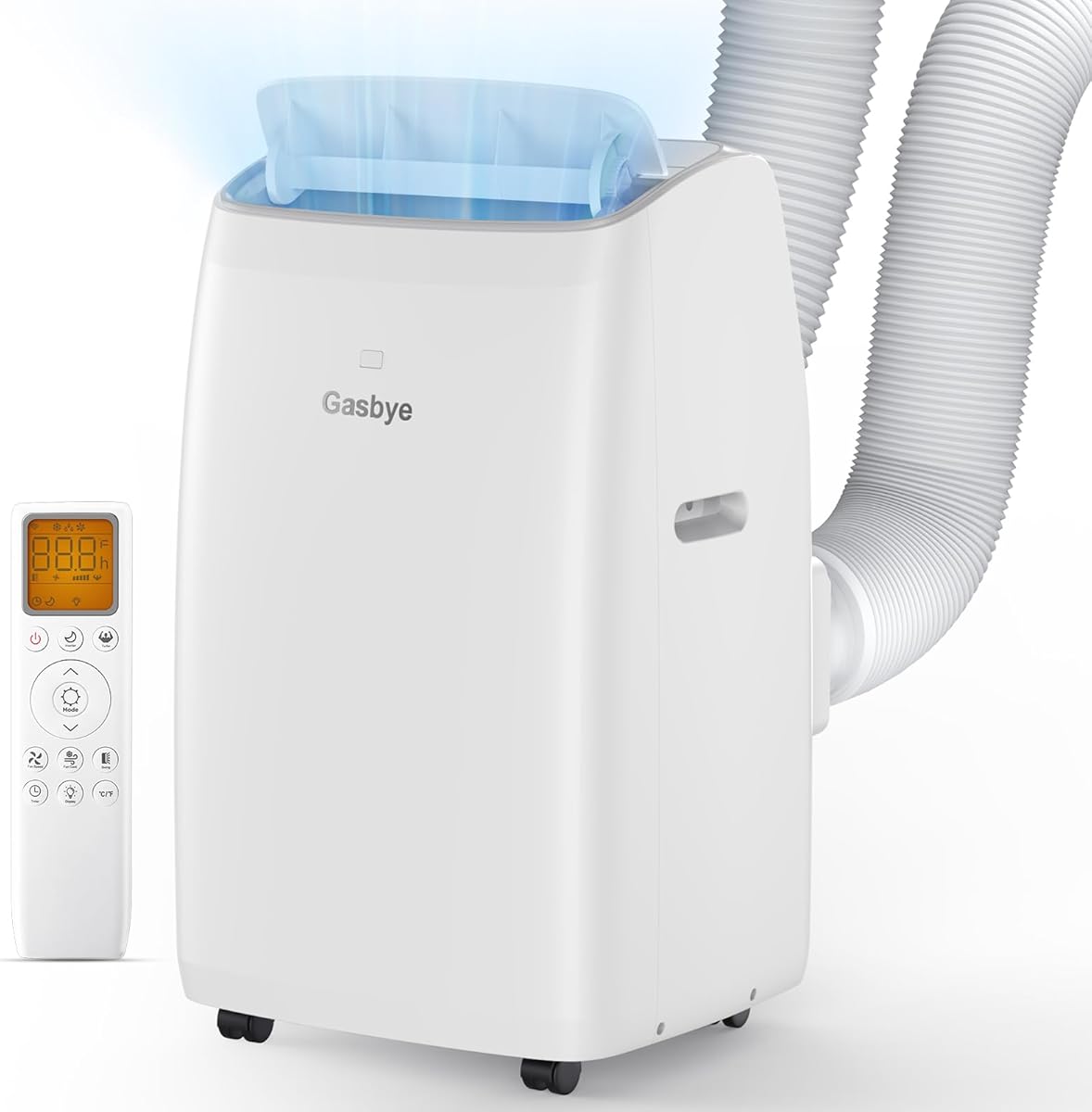
The Gasbye Dual Hose Portable Air Conditioner is the most advanced premium entry in the guide, combining a full DC inverter compressor with a 13.6 CEER efficiency rating. Its title lists 14,000 BTU ASHRAE capacity, while the supplied details identify 10,500 BTU SACC and room coverage up to 500 square feet. It carries a 4.4 rating, and the inverter system distinguishes it from fixed-speed portable units.
We may earn a commission when you buy through this link, at no additional cost to you.
The most important energy feature is variable compressor output. Turbo mode can use approximately 800 to 1,300W for rapid cooling, while inverter mode can reduce consumption to around 500 to 800W when less cooling is required. The product information notes that a fixed-speed unit mainly reduces power by changing fan speed, whereas this system adjusts the compressor itself. A backlit remote and display-off function improve nighttime usability.
The dual-hose arrangement is intended to reduce negative pressure and hot-air influx, supporting more stable room-temperature control from 61°F to 90°F. Both hoses are listed as 5.9 inches in diameter and 59 inches long, and the unit measures 15.5 inches deep by 17.7 inches wide by 29.3 inches high. That height is substantial, so buyers should measure furniture, window placement, and available floor space before ordering.
Gasbye is the premium choice for a buyer willing to invest in a full-size, efficiency-focused portable system. It suits larger bedrooms, living rooms, and offices where balanced pressure, flexible output, and strong capacity matter. Its 500-to-800W lower-power mode is still substantially more demanding than the smallest camping units, but the inverter approach offers finer control than a conventional on-or-off compressor.
The full DC inverter compressor changes output rather than merely cycling a fixed-speed compressor on and off. This allows the unit to use roughly 500 to 800W in inverter mode when the room is closer to the selected temperature.
Separate intake and exhaust hoses are designed to reduce negative pressure and unwanted hot-air influx. The result is more stable room control, although both long hoses and adequate window access must be planned before installation.
We may earn a commission when you buy through this link, at no additional cost to you.
The Gasbye 12,000 BTU Dual-Hose Portable Air Conditioner has the highest numerical customer rating in the supplied data at 4.7. It combines a 12,000 BTU SACC capacity, an 8,300 BTU ASHRAE rating, and coverage of up to 450 square feet. The supplied description positions it for living rooms, bedrooms, apartments, and offices where a portable unit must cover a meaningful living area.
We may earn a commission when you buy through this link, at no additional cost to you.
Its dual-hose design is intended to maintain balanced indoor pressure while reducing the hot-air influx associated with some single-hose portable units. The listed temperature range is 64°F to 90°F. Cooling, fan, and dehumidification modes provide year-round flexibility, while the 45dB operating level makes the product suitable for conversation, television, or bedtime use.
Nighttime convenience comes from a backlit remote and a display-off function that turns off the top panel lights. Mobility is handled with 360-degree smooth-rolling casters and ergonomic handles. The unit measures 14.4 inches deep, 13.1 inches wide, and 27.4 inches high, making it narrower than the premium 14,000 BTU Gasbye model but still much larger than a compact personal AC.
Gasbye is a strong choice for buyers who prefer dual-hose operation and want a full-featured portable unit without moving to the larger premium inverter model. Its listed rating, 450-square-foot coverage, and relatively quiet operation make it particularly appealing for larger rooms. Exact wattage is not given, so those focused strictly on the lowest possible electrical demand should choose one of the explicitly documented low-watt models.
The 4.7 numerical rating is the strongest supplied rating among these ten products. While the listing does not replace hands-on evaluation, it provides a useful signal when comparing customer feedback alongside capacity and feature sets.
A narrow 13.1-inch body, 360-degree casters, and ergonomic handles make the unit easier to reposition than many full-size portable ACs. Backlit remote and display-off features preserve convenience and quiet visual operation at night.
We may earn a commission when you buy through this link, at no additional cost to you.
The Midea 8,000 BTU Smart Inverter Window Air Conditioner is the only product in this guide that explicitly combines cooling with a heat-pump function. It is rated to cool rooms up to 350 square feet and has a 4.1 numerical rating in the supplied information. For a bedroom or apartment where a window unit is practical, its multi-season capability offers broader year-round utility.
We may earn a commission when you buy through this link, at no additional cost to you.
Five modes—Heat, Auto, Cool, Dry, and Fan—are supported by three speed settings, a 24-hour timer, an energy-saving ECO setting, vertical swing, and an LED display. The heat-pump function operates only when the outdoor temperature is above 41°F, so it should be treated as supplemental rather than primary cold-weather heating. Wi-Fi support allows operation through a SmartHome app or compatible voice assistants, in addition to the remote and panel.
Energy Star certification and variable-speed inverter technology distinguish the unit from fixed-speed window models. The product information claims up to 35% energy savings compared with the Energy Conservation Standard, though actual savings depend on usage, climate, and settings. The appliance operates as quietly as 45 dBA, and a front-accessible washable filter makes routine maintenance convenient.
Midea is an excellent fit for someone who wants a single window unit for summer cooling, dehumidification, fan use, and mild-weather supplemental heat. Installation is limited to double-hung windows with openings from 24 to 38.5 inches wide and sufficient vertical clearance for the 19.41-by-22.17-by-13.9-inch chassis. Confirm those dimensions and the building's window rules before ordering.
The integrated heat-pump mode extends usefulness into cooler weather, provided outdoor temperatures remain above 41°F. It complements rather than replaces a dedicated heating system during genuinely cold conditions.
Variable-speed inverter operation, Energy Star certification, and an ECO setting help manage energy use. App, voice, remote, and panel controls make the unit adaptable to different routines and preferences.
We may earn a commission when you buy through this link, at no additional cost to you.
Choosing the right low wattage air conditioner requires balancing electrical demand against cooling capacity, room size, portability, drainage, controls, and installation constraints rather than looking at wattage alone.
BTU describes the cooling capacity of a unit, but the most useful figure is the one matched to the room's size, insulation, sunlight exposure, heat-producing electronics, and expected occupancy. The 2,700 BTU model is intended for areas up to 108 square feet, the 5,000 BTU GE unit handles up to 150 square feet, and the 5,200 BTU camping model lists 130 square feet. Larger portable options extend to 300, 450, or 750 square feet, depending on the model and rating system. SACC is generally more conservative than an ASHRAE figure and can make products easier to compare fairly.
Choose capacity that matches the space without expecting a tiny unit to cool an open room. Undersized equipment may run continuously without reaching the thermostat setting, while excessive capacity can cycle on and off inefficiently. Measure the usable floor area and account for doors, windows, and direct sun before deciding.
The most explicitly low-power choices in this guide are the 280W mini portable AC, the 400W tent unit, and the 440W GE window model. The premium Gasbye inverter offers a lower range of approximately 500 to 800W when reduced output is sufficient, while turbo operation can reach 1,300W. Other products do not provide an exact wattage in the supplied information. Consider both the compressor draw and the power source's continuous output, surge capability, outlet type, and circuit limits.
Do not use fan-mode wattage as a substitute for cooling-mode requirements. The SereneLife, for example, uses 1,150W in cooling mode but only 120W in fan mode. Match the appliance to the intended power station or RV electrical system and avoid using extension arrangements that reduce safe operation.
Portable air conditioners expel heated air and bring in replacement air. A single-hose design uses one large hose and can slightly depressurize the room, while a dual-hose design separates intake and exhaust airflow. Gasbye emphasizes its dual-hose system as a way to reduce negative pressure and hot-air influx. Dual-hose units can improve temperature consistency, but they require two connections and more window space, so the added installation logistics should be considered.
For a tightly controlled bedroom or office where stable temperatures matter, dual-hose operation can be advantageous. For occasional use, easier window compatibility, or a temporary setup, a simpler portable arrangement may be more practical. Always follow the included installation instructions and avoid improvised hoses that increase airflow resistance.
The amount of moisture in the air affects both comfort and the need for drainage. The SereneLife lists up to 1.1 liters of moisture removal per hour, making dehumidification one of its strongest features. The DREO 318S and 515S use self-evaporating systems designed to avoid routine drainage below 90% humidity, while the camping unit is listed as drain-free below 70%. The Gasbye products may also require manual drainage when very high humidity and an unsealed room exceed the automatic system's capacity.
Choose an automatic arrangement for typical indoor use, but keep a plan for high-humidity conditions. A drain hose, elevated outlet, or other controlled drainage method can prevent water from collecting near the unit. In extremely humid locations, a dedicated dehumidifier may complement rather than replace the air conditioner's cooling function.
Air conditioner noise includes compressor sound, fan movement, and airflow, and the perceived level depends on placement as well as the published specification. The 280W mini unit, 400W camping unit, DREO models, Gasbye models, and Midea window unit list low operating levels of 40 to 45 dB in their most favorable modes. These figures are most useful when comparing similarly situated units, and compressor sound can still be noticeable in a very quiet bedroom.
Prioritize sleep mode, automatic fan control, and a display-off option if the appliance will run overnight. Place the unit on a stable surface with airflow unobstructed, keep the exhaust hose as short and straight as practical, and avoid placing it directly beside a pillow or a wall that can amplify vibration.
Window units generally provide the simplest permanent installation but require a compatible opening. Portable models can move between rooms, yet they need an exhaust hose and access to a window or similar opening. The 280W unit emphasizes tool-free setup and compatibility with power sources, while the camping model includes a carry handle and can operate from its storage bag. Larger portable systems add wheels and handles but require more floor space and longer hoses.
Measure the window, sill, outlet, and intended unit position before buying. Check whether double-hung or sliding windows are supported, whether brackets are included, and whether a landlord or building manager imposes restrictions. For camping and RV use, verify the power source, adapter, and hose route before leaving for a remote location.
Manual dials remain dependable and easy to understand, while remotes, apps, and voice controls can make automation more convenient. The GE unit uses mechanical temperature and fan dials, the Garvee and SereneLife include remotes, the DREO models support apps and major voice platforms, and the Midea window unit offers app, voice, remote, and panel control. Three-in-one cooling, fan, and dehumidification modes are common, with the camping product adding a dedicated sleep mode.
Choose the control style that matches the household. Smart features are useful for sleep schedules and remote monitoring, but they add setup requirements and may depend on account setup or network access. Mechanical controls remain a practical choice for a guest room, rental, or workshop where uncomplicated operation is the priority.
Before operating the unit, read the included instructions, confirm window and electrical compatibility, and install the exhaust system exactly as directed. Portable models should be placed on a level, stable surface with intake and outlet openings unobstructed. For window units, verify that the chassis is securely supported, the sash does not press against the housing, and the installation kit seals gaps without blocking the required clearance.
Set an appropriate temperature and operating mode, then allow the room to stabilize. Closing doors and nearby curtains can improve consistency, while using external sunshades and reducing internal heat sources makes the compressor work less often. Avoid frequently opening exterior doors or windows because incoming warm air can negate the benefit of the cooling and increase moisture in the room.
Clean the washable filter regularly and keep vents unobstructed. Empty any drainage receptacle before it becomes full, and use the included hose or a higher drainage outlet when automatic evaporation cannot keep up. Store portable units upright after draining, clean the filters, coil the hose without sharp bends, and avoid leaving the appliance in damp or dusty storage conditions.
The Mini Portable AC has the lowest stated operating draw at 280W. The 400W camping model and 440W GE window unit are the next most explicitly efficient choices. Remember that fan-only operation and full compressor cooling can consume very different amounts of power, so compare the mode and conditions that match your intended use.
It depends on the bedroom's size and insulation. The 2,700 BTU mini unit is intended for spaces up to 108 square feet, while the 5,000 BTU GE model covers up to 150 square feet. Larger portable models can address bedrooms up to 300, 450, or 750 square feet, depending on the model and its stated capacity.
The GE 5,000 BTU window unit is rated for areas up to 150 square feet. A small bedroom, office, dorm, workshop, or studio may therefore be suitable if the room is reasonably insulated and not heavily exposed to direct sunlight. A larger room may leave the compressor running too often to maintain a comfortable temperature.
They can be, provided the tent or vehicle cabin is small enough and the power source matches the unit. The 280W and 400W models are the most relevant choices in this guide, and both support camping-oriented use. Verify the adapter, power-station capacity, window or duct arrangement, and ventilation before relying on either unit away from mains power.
Many use a self-evaporating system that reuses condensation to help cool the condenser, but the automatic process has humidity limits. The DREO models are listed as drainage-free below 90% humidity, while the camping unit is drain-free below 70%. In very humid or poorly sealed rooms, a drain hose or manual drainage may still be necessary.
Dual-hose units are designed to maintain more balanced room pressure and reduce the hot-air influx associated with many single-hose models. That can improve temperature consistency, but the appliance needs two hose connections and more space. Installation quality, window design, and maintenance also influence performance in either arrangement.
BTU is a measure of cooling capacity, while SACC provides a more conservative rating for room air conditioners. Products can therefore advertise one headline BTU figure while listing a lower SACC figure. Comparing the more conservative number across similar products gives a better indication of real room-cooling capacity.
It depends on the model, mode, fan setting, and how hard the compressor must work. The explicitly documented products in this guide range from 280W to 1,150W in relevant operating modes, while the premium inverter Gasbye lists 500 to 800W in inverter mode and up to 1,300W in turbo. Check the compressor draw before connecting to a power station or limited circuit.
The Mini Portable AC 2700 BTU is the strongest overall match for genuine low-power compressor cooling, with a 280W draw, three operating modes, sleep-friendly noise control, and support for 110V and 220V sources. The GE 5,000 BTU window model is a practical budget alternative for a small room, while the Gasbye 14,000 BTU inverter represents the premium approach to variable efficiency and balanced dual-hose cooling.
Prioritize the lowest draw only when power availability is genuinely restrictive. For normal bedrooms and offices, room size, capacity, drainage, noise, and installation can matter more than a small difference in wattage. Camping users should examine compressor capacity, adapter compatibility, and humidity, while apartment dwellers should confirm window dimensions and whether a portable hose system is more practical than a permanent window unit.
Ratings, features, and promotions can change after this November 2026 guide was prepared. Review the latest product listing, electrical specifications, installation requirements, and current cost before ordering, and compare the product's measured coverage and modes against the size and conditions of the room where it will be used.