
UGREEN 2K@30Hz 1080P 60FPS Video Capture Card
4.5Editor score
4K30 input capability
2K30 and 1080p60 output
USB-A and USB-C ports
This Low Latency Capture Card guide compares 10 leading options for resolution, passthrough, audio, compatibility, and streaming performance.
A low latency capture card converts an HDMI source into a signal your computer can record or broadcast, making it essential for game streams, live demonstrations, cameras, and online teaching. The best model balances quick response with dependable video, clear audio, broad device support, and a connection method that fits your setup.
We compared ten capture cards using their stated specifications and intended use cases, including capture resolution, frame rate, passthrough behavior, VRR and HDR support, audio features, operating-system compatibility, and connection options. The list covers compact USB devices, portable cards, an internal PCIe model, and higher-end options for demanding consoles.
Each review explains where a product stands out, where compromises may appear, and which creators are most likely to benefit. Specifications can differ by source device, operating system, capture format, and software, so verify your exact requirements before purchasing. Prices and availability change, but the feature-level guidance in this guide remains practical.
4.5Editor score
4.5Editor score

4.8Editor score
This side-by-side comparison highlights each card's resolution, passthrough, connection method, and strongest documented use case, helping you identify the right balance for gaming, broadcasting, teaching, and portable production.





The Rybozen HDMI capture card offers a broad mix of useful features for creators who want a straightforward path from an HDMI source to a streaming computer. Its 4.3 rating reflects a generally capable budget-oriented option, particularly notable for true plug-and-play behavior, USB 3.0 transfer, HDMI loop-out, and commentary support.
We may earn a commission when you buy through this link, at no additional cost to you.
Capture quality reaches 1080p, while the HDMI input can accept 4K30, 1080p120, and 1080p144 signals. The device identifies itself as a webcam, automatically detects input, and supports OBS and other common capture tools. Its loop-out lets a console or camera remain visible on a local display while the computer receives the capture feed.
The main limitation is that this is not a high-frame-rate 4K capture solution. Output reaches only 2K30, and its stated low-latency advantage is most useful for ordinary 1080p workflows. Audio capture is optional, while commentary relies on a 3.5mm TRS headset connection rather than a broader range of professional audio interfaces.
Choose this card if you need affordable HDMI capture for console play, cameras, teaching, or general streaming and can work at 1080p. It is a sensible starting point for beginners and a flexible secondary device for creators who already understand their capture software.
Because the card requires no external power or additional driver, setup is largely a matter of connecting HDMI, USB, and the computer. The dedicated 3.5mm TRS microphone input adds a useful commentary option for game streams and live demonstrations.
HDMI loop-out allows the source to remain connected to a nearby display while the capture card sends video to the computer. This is particularly handy for console gaming, where a second display often provides a more private viewing experience.
We may earn a commission when you buy through this link, at no additional cost to you.
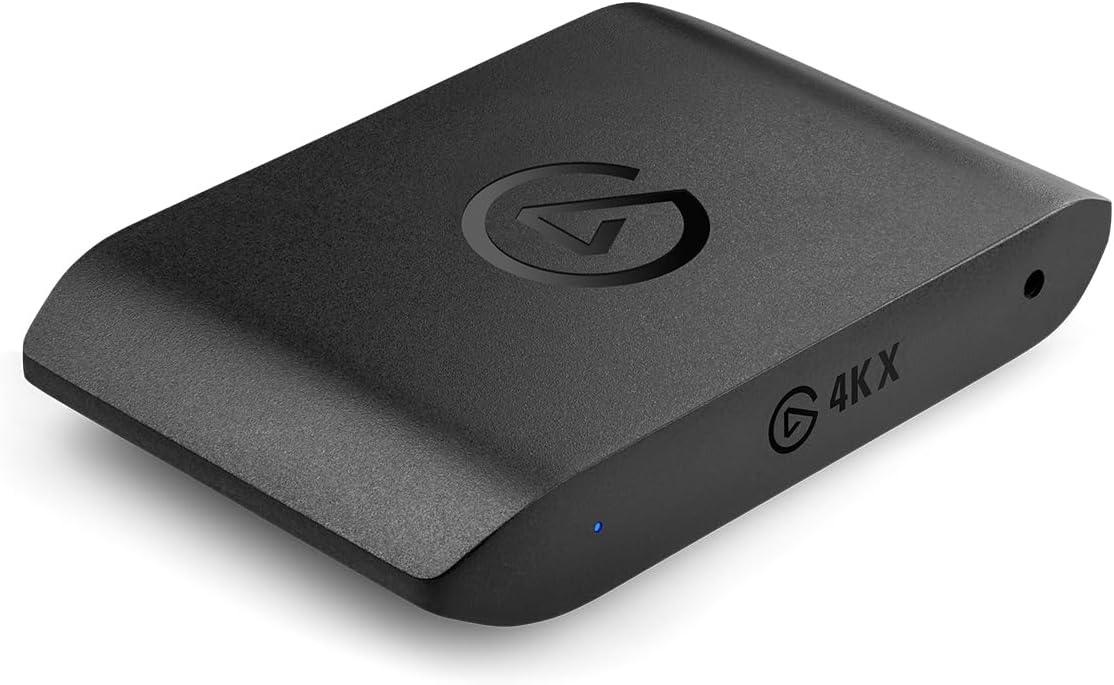
The Elgato 4K X combines high-frame-rate capture, modern HDMI connectivity, and explicitly low-latency operation, making it the most complete general-purpose option in this guide. Its 4.5 rating is supported by an ambitious specification set aimed at console creators, competitive streamers, and users producing demanding 4K video.
We may earn a commission when you buy through this link, at no additional cost to you.
The card can capture at 4K144, while HDMI 2.1 passthrough can handle up to 240fps at 1080p. VRR passthrough is included for smooth variable-refresh-rate gaming, and USB 3.2 Gen 2 supplies the bandwidth intended to keep capture responsive. Compatibility extends to OBS, Streamlabs, Twitch Studio, Restream, Zoom, Teams, and major streaming platforms.
This is still an external capture card, so installation requires a free USB port and appropriate computer bandwidth. The headline resolutions also depend on the source, display, software, and encoding settings. Creators working only in 1080p60 may not use its high-end capabilities, making the feature set more than their workflow requires.
Choose the 4K X when responsive gameplay, modern console support, and high-frame-rate capture matter. It is our top overall recommendation for creators seeking a balance of flexibility, passthrough features, and strong performance without moving to an internal installation.
HDMI 2.1 passthrough supports signals as high as 1080p240, while 4K144 capture gives fast-moving content more temporal detail. These capabilities suit modern consoles and demanding PC configurations when the entire signal chain supports them.
Variable Refresh Rate passthrough helps maintain smooth visuals on a compatible display. It also reduces the temptation to sacrifice local display quality merely to make the stream feed available.
We may earn a commission when you buy through this link, at no additional cost to you.
The Elgato 4K Pro is a specialized internal capture card built for creators with a desktop workstation and a strong need for modern display passthrough. Its 4.5 rating reflects a capable combination of 4K60 capture, 8K60 passthrough, HDMI 2.1, and ultra-low-latency operation.
We may earn a commission when you buy through this link, at no additional cost to you.
Rather than relying on an external USB enclosure, the card installs directly into a compatible PCIe slot. The computer then handles the capture internally, making it well suited to a permanent streaming station. HDMI 2.1 supports passthrough up to 1080p240, and VRR passthrough helps maintain smooth gameplay.
The obvious trade-off is installation complexity and platform limitation. It is not a travel-friendly option and cannot be moved easily between systems. A compatible motherboard, case, operating system, and PCIe slot are prerequisites, so buyers should confirm fit before considering the product.
Choose the 4K Pro for a dedicated gaming or production PC where clean internal integration, high-end passthrough, and 4K60 capture justify a fixed installation. It is less appropriate for laptops, temporary events, or creators who need a simple plug-and-play device.
Installing the capture function inside the PC can suit a studio or dedicated broadcast system. It avoids relying on a general-purpose external USB connection for every recording session and keeps the capture card integrated with the machine.
The headline 8K60 passthrough is primarily about maintaining a high-quality local image on a capable display. Capture output remains up to 4K60, which is still ample for many high-quality streams and recordings.
We may earn a commission when you buy through this link, at no additional cost to you.
The UGREEN capture card combines a 4.5 rating with a practical feature set at a modest tier, making it an attractive budget choice. It supports 4K30 input, 2K30 output, and backward-compatible 1080p60, while offering both USB-A and USB-C connections for flexible setup.
We may earn a commission when you buy through this link, at no additional cost to you.
USB 3.0 is used for a stated 5 Gbps transfer rate, supporting low-delay capture for consoles, cameras, and mobile sources. The driver-free design works with Windows, macOS, Linux, phones, and tablets, including iPadOS 17 or later. OBS, XSplit, PotPlayer, and QuickTime are among the listed applications.
Its limits are clear. It does not provide 4K60 output, and protected console content may not appear unless HDCP is disabled. The one-way HDMI-to-USB signal path also means it is a capture device rather than a general-purpose converter or direct display adapter.
Choose the UGREEN when low latency, flexible USB connectivity, and dependable 1080p60 or 2K30 capture matter more than premium passthrough. It is well suited to learning OBS, sharing a console, teaching, or creating a mobile-friendly capture station.
Having both USB-A and USB-C interfaces makes the card useful with older desktops as well as modern laptops and tablets. USB 2.0 is supported, although USB 3.0 is preferable for bandwidth-intensive resolutions.
The aluminum alloy casing helps dissipate heat and shields the internal electronics from electromagnetic interference. Its built-in cable uses tinned copper conductors to support stable signal transmission.
We may earn a commission when you buy through this link, at no additional cost to you.
This compact USB 3.0 capture card is aimed at creators who need portable 1080p60 recording without a complicated installation. Its 4.4 rating and broad source compatibility make it a practical option for gaming, podcasts, events, and temporary production setups.
We may earn a commission when you buy through this link, at no additional cost to you.
The card accepts a 4K HDMI input and captures 1080p60, which provides ample output for mainstream live streaming and video recording. It works without drivers or external power and is listed as compatible with OBS Studio, Streamlabs, and XSplit. Nintendo Switch, PS5, Xbox Series X, DSLR cameras, and PCs are among the stated source options.
Compared with more specialized cards, the specifications provide fewer details about high-refresh-rate passthrough, HDR, VRR, and advanced audio. The product description promises seamless passthrough, but it does not define the maximum refresh rates as clearly as the premium alternatives in this guide.
Choose it for mobile streaming, travel, classroom demonstrations, or a secondary capture station where 1080p60 and quick setup are the priorities. Buyers seeking advanced 4K60 passthrough or detailed high-frame-rate support should consider a more specialized model.
The lightweight enclosure and driver-free operation make the card convenient to carry between locations. It can be deployed quickly for an event, LAN gathering, classroom, or temporary live production.
Recording at 1080p60 is a widely compatible target for streaming and online video. It also avoids many of the bandwidth and processor demands associated with capturing 4K at high frame rates.
We may earn a commission when you buy through this link, at no additional cost to you.
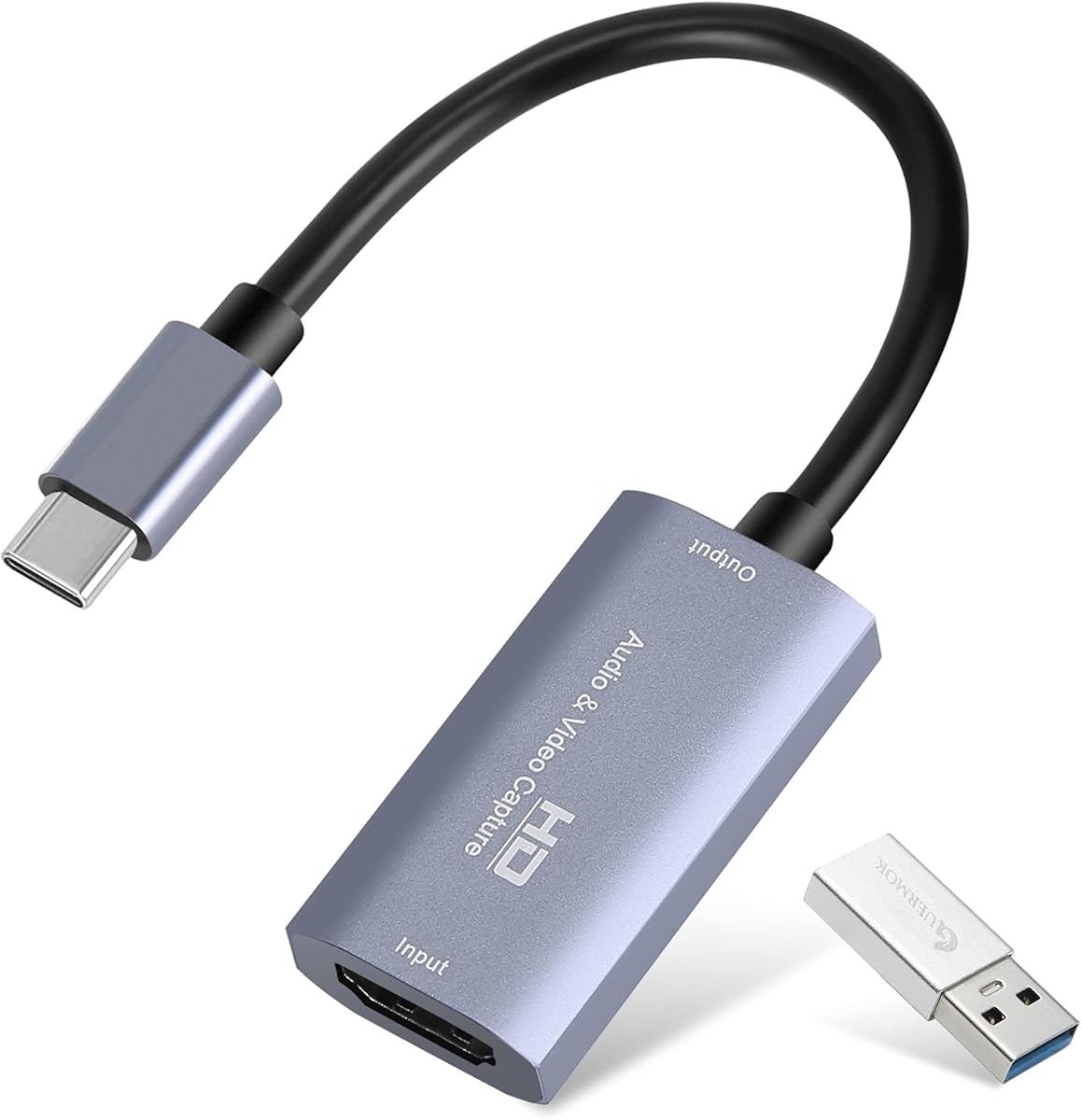
The Guermok capture card delivers a useful mix of 1080p60 capture, 2K30 output, and broad compatibility in a small package. Its 4.4 rating makes it a credible value option for creators who need USB-C access and frequently work across different computers or source devices.
We may earn a commission when you buy through this link, at no additional cost to you.
The included USB 3.0-to-USB-C adapter expands compatibility with modern laptops and tablets, while the aluminum body helps manage heat. The card supports Windows, macOS, Linux, and Android, and is listed for use with OBS Studio, Zoom, VLC, PotPlayer, Twitch, YouTube, and Facebook.
It requires capture software and introduces millisecond-level delay through video decoding, which is normal for this category. The included adapter presents a potential bandwidth concern: if the device appears as USB 2.0, the card may need to be flipped and reconnected or paired with a different connection. It supports one-way HDMI-to-USB-C transfer only.
Choose this model for portable 1080p60 capture, teaching, presentations, console sharing, and live meetings. It is particularly useful when a computer lacks USB-A, although creators should keep the connection-speed caveat in mind and use USB 3.0 whenever possible.
The bundled adapter makes the card accessible to modern USB-C computers without requiring a separate purchase. It remains important to confirm that the host recognizes the connection at USB 3.0 rather than USB 2.0.
Compatibility with major operating systems and capture applications reduces setup friction. Supported sources include consoles, Switch-family devices, cameras, webcams, set-top boxes, and conventional video equipment.
We may earn a commission when you buy through this link, at no additional cost to you.
The AVerMedia Live Gamer Ultra S is a feature-rich capture card for console and PC creators who care about display features as much as recording. Its 4.2 rating is somewhat lower than several competitors, but the combination of 4K60 HDR passthrough, VRR, RGB24, ultrawide support, and 5.1 audio makes it distinctive.
We may earn a commission when you buy through this link, at no additional cost to you.
The card can play at up to 4K60, 1440p144, or 1080p240 with HDR and VRR passthrough on supported displays. Streaming Center can record VRR at up to 1440p60 or 1080p240, while 3440×1440 and 2560×1080 inputs address 21:9 gaming. Windows users can capture 5.1-channel audio.
Compatibility is broad, covering current consoles, Switch 2, PCs, macOS 13 or later, and iPadOS 17 or later. However, some advanced recording features depend on the included software and appropriate host configuration. The stated capabilities should not be interpreted as automatic support for every resolution and operating system.
Choose the Live Gamer Ultra S when multichannel sound, ultrawide input, high refresh rates, and polished console passthrough are priorities. It is especially relevant to creators who want a full-featured capture environment rather than a minimal 1080p device.
HDR, VRR, and high-refresh passthrough let a modern console maintain its intended display experience. The card is designed for creators whose source hardware can take advantage of those features.
Support for 5.1-channel audio and 21:9 input resolutions reflects attention to real gaming and media workflows. These capabilities are valuable when the goal is a polished feed rather than a basic camera image.
We may earn a commission when you buy through this link, at no additional cost to you.
The acer USB 3.0 capture card combines a strong 4.5 rating with practical features for game commentary, teaching, and general streaming. It provides 4K HDMI input, 1080p60 output, YUY2 video, loop-out, and a direct 3.5mm microphone input in a small package.
We may earn a commission when you buy through this link, at no additional cost to you.
YUY2 is presented as a format that delivers richer color than MJPEG, which can be useful when image quality matters. The microphone input simplifies voice capture without requiring a separate adapter, while low-latency technology is designed to keep commentary synchronized with the picture.
The device requires no extra drivers or external power, making it suitable for mobile and emergency use. Its output ceiling is 1080p60, and the supplied information gives less detail about advanced high-refresh passthrough, HDR, and multichannel audio than some premium models. Wide compatibility does not guarantee identical behavior on every operating system.
Choose the acer card if direct commentary, loop-out, and a conventional 1080p60 workflow are your main needs. It is a strong compact option for creators moving between gaming, classroom, and on-the-go streaming locations.
The built-in 3.5mm microphone connection is especially useful for game streamers who want commentary without routing every voice source through a separate mixer. Compatible headsets and microphones can connect directly to the card.
Loop-out preserves a local HDMI display connection while the computer captures the source. Combined with the compact body and driver-free operation, this makes the card convenient for changing production locations.
We may earn a commission when you buy through this link, at no additional cost to you.
The ezcap386 is the highest-rated product in this guide at 4.8, and its specifications justify that strong result for creators seeking a capable premium capture solution. It supports 4K60 recording and passthrough, 1440p144 capture, 1080p240 capture, HDR, and VRR.
We may earn a commission when you buy through this link, at no additional cost to you.
Its one-way HDMI-to-USB workflow is designed around modern game consoles, including PS5, Xbox, and Switch. A high-speed USB-C 3.0 connection supports stable transmission, and built-in ezcap Link software provides a dedicated configuration environment alongside compatibility with OBS and Streamlabs.
Exceptional resolution and refresh-rate combinations still depend on the source, display, computer, and encoding workflow. Windows 10 or 11 and macOS 11 or 12 are listed as supported platforms. As with any high-bandwidth card, the host system should be able to process the selected capture format without dropping frames.
Choose the ezcap386 when high-frame-rate 4K capture, modern display features, and dedicated software matter. It is particularly appealing to console streamers and recording creators who want a complete package without assembling a multi-device capture chain.
Capturing at 4K60 creates an unusually capable baseline for high-quality output, while loop-out lets a compatible display retain the console experience. Faster modes provide additional flexibility for motion-heavy recordings.
The included ezcap Link software provides a focused route for configuring the card and preparing a streaming workflow. Familiar platforms such as OBS and Streamlabs remain available for creators who already have a preferred setup.
We may earn a commission when you buy through this link, at no additional cost to you.
The Elgato Game Capture Neo is built around portability, making it an interesting choice for console owners who want a compact card for travel, events, or a secondary streaming setup. Its smartphone-sized enclosure and straightforward console, display, and computer connections reduce the physical footprint of a capture station.
We may earn a commission when you buy through this link, at no additional cost to you.
The card provides 4K60 HDR passthrough, allowing a compatible display to retain the source's high-resolution output, while capture itself operates at 1080p60. PlayStation, Xbox, Switch, and other compatible consoles are supported, and the stated setup can connect to either a computer or iPad.
Its compactness comes with a clear limitation: 1080p60 is the maximum stated capture resolution. It does not match the 4K recording or very high frame-rate capture capabilities of the premium alternatives. The product data also provides no customer rating, so there is no rating value to use as a quality signal.
Choose the Game Capture Neo for portable 1080p60 console capture where small size and simple setup matter most. It is less suitable for creators whose priority is 4K recording, high-refresh capture, or advanced passthrough specifications.
The small enclosure makes the card easier to carry than a full-size capture device. It can serve as a traveling companion for a console streamer or a convenient second setup at another display.
Keeping the local display at 4K60 HDR while recording at 1080p60 balances modern console presentation with broadly compatible capture output. It is a sensible strategy for creators who prioritize a strong viewing experience and accessible stream quality.
We may earn a commission when you buy through this link, at no additional cost to you.
Choosing a capture card starts with the source, output resolution, software, and physical connection you need. A card that looks powerful on paper will perform best when every part of the signal chain supports the same resolution, refresh rate, color feature, and audio format.
Resolution determines how detailed the recorded file will be, while frame rate affects motion smoothness. A 1080p60 card is suitable for many mainstream streams and recordings, but creators capturing fast games, sports, or high-end console footage may prefer 4K60 or a high-refresh mode. Input resolution and capture output are separate: a card can accept 4K30 while delivering only 2K30 or 1080p60.
Choose the lowest target that still meets your quality needs, then confirm the host computer, software, and source can sustain it. High capture rates also increase bandwidth, processing load, and storage requirements.
Passthrough sends the source image to a local display while the capture card also feeds the computer. For consoles, this preserves the familiar gaming display experience and can be essential for private gameplay, high refresh rates, HDR, or VRR. Check whether passthrough and capture support the same modes, because the lower of those limits can determine what you actually use.
Prioritize a modern HDMI implementation if your console or PC supports it. Also verify the display, cables, adapter, and software all recognize the desired HDR, VRR, and high-refresh format.
External USB capture cards are portable and easy to move between computers, making them suitable for most creators. USB 3.0 or better provides the bandwidth needed for common high-resolution workflows, but the computer must expose a compatible port. Internal PCIe cards offer a fixed, direct-to-system installation and suit dedicated production workstations, although they require compatible hardware and physical installation.
Choose USB for flexibility and PCIe for a permanent desktop station. Avoid relying on an unverified adapter when high bandwidth or a stable connection is important.
A capture device can support excellent hardware while behaving differently across operating systems. Confirm compatibility with your exact Windows, macOS, Linux, or iPadOS version, and check whether the device includes its own utility or relies entirely on software such as OBS or Streamlabs. The listed applications may support different resolutions, audio formats, and passthrough options.
Read the requirements for your preferred capture application before buying. If a dedicated utility is included, account for its setup process and determine whether it must remain open during recording.
Good picture quality is only half of a live production. Some cards capture audio directly from the HDMI source, while others add a 3.5mm microphone input for commentary. Dedicated tools such as Streaming Center can provide deeper control over multichannel audio, but they may also require additional setup.
Decide whether console audio, presenter commentary, or both are priorities. Check the supported channel count, sample options, and whether a separate mixer is needed for a professional audio workflow.
HDR and VRR can improve the local display experience on supported consoles and PCs. Video format also matters: the acer card explicitly uses YUY2, while other devices may offer MJPEG or other options suited to different workflows. Capture format can influence image quality, bandwidth, and processing requirements.
Match the card to your display and source rather than treating these features as universal. If your production software does not support a particular color or refresh mode, the feature may remain unavailable even when the hardware is capable.
Compact cards are easier to carry to events, classrooms, and LAN gatherings. Some include USB-C adapters, while others rely on USB-A for broader desktop compatibility. Aluminum housings can improve heat dissipation, and a durable built-in cable reduces the need to carry extra accessories.
Choose a portable model if your setup changes frequently. For a permanent studio, prioritize sustained performance, connector arrangement, and software support over physical size.
Console capture may be affected by HDCP, which protects copyrighted content. Several products explicitly work with PlayStation, Xbox, and Switch systems when HDCP is disabled, but restrictions can vary by console mode and application. Cameras, set-top boxes, and computers may have entirely different content rules.
Check your intended sources and avoid assuming every console screen can be captured. Keep protected material off the capture feed unless the source explicitly permits it.
Begin by identifying the direction of the signal. For a typical external card, connect the source to HDMI input, connect the capture card to the computer by USB, and connect the source directly to the local display or monitor through HDMI loop-out. If protected content is involved, disable HDCP on the source only when permitted by its settings and terms.
Install the capture application and select the card as the video source. Choose a supported resolution and format rather than forcing a mode the hardware or host cannot sustain. Test audio separately, confirm frame rate, and monitor preview delay before beginning a long recording or live broadcast. Software such as OBS, Streamlabs, XSplit, QuickTime, PotPlayer, or a manufacturer utility may be appropriate depending on the platform and card.
Keep the device connected to a reliable USB 3.0 or newer port, avoid sharp bends in built-in cables, and provide ventilation around the enclosure. For recurring production, label cables and save separate software profiles for console, camera, and teaching workflows. Clean the exterior with a dry, soft cloth, and do not open the enclosure while it is powered or connected.
No. A low-latency card reduces the delay between the source and the captured feed, but the total delay also includes the source, HDMI processing, USB transfer, capture format, software preview, encoding, and internet delivery. Local passthrough can make direct gameplay feel immediate even while the streamed version has a small delay. The stated latency figures are also more meaningful when the entire system is configured consistently.
For many creators, yes. It produces a sharp, familiar image at a frame rate suitable for most live content, and it places less demand on the host computer and upload connection than 4K capture. Competitive games, cinematic production, and high-refresh console footage may benefit from 4K60 or a high-frame-rate mode. Choose the resolution that your source, computer, software, bandwidth, and storage can handle consistently.
HDMI input describes the signal the card can accept, while capture output describes what the computer receives and records. A card may accept 4K30 but capture only 1080p60, or accept high-refresh 4K while producing a lower-resolution stream. Always check both figures and ensure the source and software support the selected output format.
They are valuable if your console, PC, display, and software support them. HDR preserves a wider range of brightness and color, while VRR adjusts the display refresh timing to match the game's frame output. For basic 1080p recording, they may be optional. For modern high-end gaming and local viewing, they can materially improve the experience.
Generally, protected console content cannot be captured normally while HDCP is active. Several listed cards explicitly support PlayStation, Xbox, and Switch systems when HDCP is turned off, but the procedure and applicable console modes can differ. Only disable protection for content you are permitted to capture, and expect games, streaming services, and disc playback to behave differently.
Choose an external card for portability, easier setup, and the ability to move between laptops and desktops. An internal PCIe card is better for a dedicated desktop production system where direct integration and a permanent installation make sense. Before selecting PCIe, confirm case clearance, slot availability, operating system support, and the capture resolution your processor can handle.
The host port, cable, or adapter may not provide full USB 3.0 bandwidth. Some USB-C adapters can also be wired or negotiated for lower-speed operation. Try a direct connection to a known USB 3.0 port, test another certified cable or adapter, and confirm the device manager or capture application reports the expected speed. Higher capture resolutions may not remain stable until the link is corrected.
Start with a card and source combination that explicitly supports low-latency operation. Use a direct USB 3.0 or newer connection, avoid unnecessary adapters, and use a capture format that your computer can handle. In streaming software, remove unnecessary filters, preview delays, and redundant processing while retaining the settings needed for stable recording. Local loop-out is often preferable for the person playing.
The Elgato 4K X is the strongest all-around recommendation for creators who want modern HDMI 2.1, high-frame-rate capture, VRR passthrough, and broad application support. The UGREEN card stands out as a budget-friendly option with flexible USB-A and USB-C connections, while the ezcap386 is the premium pick for 4K60 capture, high-refresh modes, HDR, and VRR.
Prioritize the features your source actually needs. A portable 1080p60 card may be ideal for travel or teaching, while a modern console setup may justify 4K capture, HDR, and VRR. Internal installation, multichannel audio, ultrawide support, commentary inputs, and dedicated software can be more important than a headline resolution for some creators.
Before purchasing, confirm the output resolution and frame rate, supported source devices, host operating system, preferred application, connection requirements, and HDCP behavior. Current prices, deals, and availability can change, so compare the complete feature set and verify the latest product details before making a final decision.