
Newentor Weather Station
4.3Editor score
Large color LCD display
Up to three remote sensors
Atomic clock with dual alarms
Personalized weather forecasts
Continuous or battery operation
Our Large Screen Weather Station guide compares 10 models for display size, sensors, forecasts, wireless range, smart features, and ease of use at home today.
A large screen weather station makes complex environmental data easier to read at a glance. The most useful models combine temperature, humidity, barometric pressure, forecasts, and clock features with an easy-to-see color display, while advanced systems add wind, rainfall, smart-home integration, and remote monitoring.
We compared all ten products by display quality, sensor coverage, forecast capabilities, wireless range, alert options, power requirements, installation demands, and suitability for home or backyard use. The guide covers everything from simple temperature stations to professional smart stations, so readers can choose a model without paying for capabilities they will never use.
Each pick highlights a distinct reason to consider it, from a large LCD and useful alerts to comprehensive outdoor sensing and app-based automation. Marketplace pricing can change, so compare the current listing, included components, and technical specifications before making a final purchase.
4.3Editor score

4.4Editor score

4.2Editor score
The comparison below shows how each large screen weather station balances display visibility, environmental sensors, forecasting, connectivity, and installation requirements.


The Newentor Weather Station combines a large color LCD with an unusually broad collection of household features. It displays indoor and outdoor temperature and humidity, daily high and low records, customizable alerts, time and date, an alarm with snooze, a forecast, moon phase, and barometric pressure. Its 4.3 rating reflects a balanced package for readers who want more than a basic digital thermometer.
We may earn a commission when you buy through this link, at no additional cost to you.
Its strongest advantage is the three-channel design. The console can support up to three remote sensors, although the package includes one, making it possible to monitor additional rooms or outdoor locations later. The forecasting system calculates conditions for the next 12 to 24 hours, while a calibration period of seven to ten days is intended to improve local predictions. A continuous backlight is available when connected to the included wall adapter.
Battery operation provides flexibility, but the display behaves differently in that mode. When running on batteries, which are not included, it enters an energy-saving mode and illuminates for approximately 15 seconds before dimming. That limitation is reasonable for a bedroom or secondary room, though a plugged-in location is preferable for the full always-on display experience.
This is the strongest value-oriented choice for someone who wants a large display, multiple sensor locations, forecasts, and clock functions without moving into a full smart-weather platform. It is less appropriate for someone seeking wind, rainfall, UV, or app-based remote access. Even so, the generous feature set and clear screen make it an easy recommendation for everyday home monitoring.
The display brings the most relevant household readings into a single view. Temperature, humidity, pressure, forecast, records, and clock information can be checked without opening an app or navigating a complicated menu.
Three-channel support makes the console adaptable beyond a single indoor-outdoor pairing. Additional compatible sensors can extend monitoring to more spaces, provided the transmission distance and placement suit the property.
We may earn a commission when you buy through this link, at no additional cost to you.
The AcuRite Iris is an excellent general-purpose weather station because it balances a readable display, detailed condition tracking, and uncomplicated setup. Its 4.4 rating and broad collection of over 55 data points make it a strong all-around recommendation for households that want meaningful backyard data without a complex installation.
We may earn a commission when you buy through this link, at no additional cost to you.
The large color LCD shows current indoor and outdoor temperature and humidity along with wind speed and direction, barometric pressure, and rainfall. It also provides heat index, dew point, feels-like temperature, pressure trends, and historical information. The adjustable dimmer is especially useful in a bedroom or living room because it allows the display to remain visible without being unnecessarily bright.
Setup is refreshingly direct. After installing the batteries, the outdoor sensor can be attached to a pole or post using the included bracket. The station combines elevation data with pressure information to create a personalized 12-hour forecast based on current conditions. The current time, date, and weather information remain visible together, which gives the product a practical clock-console function as well.
The Iris is not the right choice for every buyer. It does not list app-based remote monitoring, voice-assistant control, or broad smart-home compatibility, and accurate wind and rain readings depend on careful outdoor placement. Even with those limitations, it offers one of the most balanced combinations of data, presentation, and ease of use in this category.
More than 55 data points make the Iris more informative than a basic indoor-outdoor thermometer. Heat index, dew point, feels-like readings, pressure trends, and historical records help users interpret conditions rather than merely observe a number.
A large color screen, adjustable dimmer, and integrated clock make the console suitable for high-traffic living areas and bedside use. Multiple measurements can be viewed without repeatedly checking a phone.
We may earn a commission when you buy through this link, at no additional cost to you.
The La Crosse Technology C85845-INT specializes in understandable, customizable environmental information. It has a 4.4 rating and a large display designed to show indoor and outdoor temperature, humidity, dew point, heat index, forecast icons, trend arrows, and comfort-level color bars. That combination makes it particularly useful for people who want actionable warnings rather than raw readings alone.
We may earn a commission when you buy through this link, at no additional cost to you.
Both temperature and humidity alerts can be configured for indoor and outdoor conditions. A 10 to 99 percent relative humidity range is represented through colorful comfort bars, helping users quickly identify dry, comfortable, or humid conditions. The console also tracks high and low temperature and humidity records, automatically resetting them each day. Dynamic forecast icons and trend arrows provide a visual summary of changing conditions.
The clock is a polished component rather than an afterthought. It uses atomic self-setting time, supports 12- and 24-hour formats, offers a Crescendo alarm with 10-minute snooze, includes a complete calendar date, and can automatically adjust for daylight saving time. Seven time zone options add flexibility. The backlight is continuously illuminated when connected to the included 5V power cord and can be adjusted.
The main compromises are calibration and backup power. Forecast icons and trend arrows need seven to ten days for barometric calibration, and optional battery backup requires three AA batteries that are not supplied. For users who value personalized alerts and clear comfort indicators, these are minor trade-offs compared with the station's broad feature set.
Separate high and low settings for temperature and humidity make it possible to define useful thresholds for the home, garden, or a room occupied by a sensitive person.
The station needs several days of barometric data before its icons are fully calibrated. Keeping the console powered and its pressure readings stable during that period produces the best basis for its personalized forecast.
We may earn a commission when you buy through this link, at no additional cost to you.
The Ambient Weather WS-5000 is a smart weather station built around a full-color TFT display and an all-in-one ultrasonic sensor array. Its 4.1 rating reflects a capable system aimed at users who want rapid updates, remote access, and automation rather than only a household clock and thermometer.
We may earn a commission when you buy through this link, at no additional cost to you.
The package includes the ultrasonic sensor array, rain cup, an indoor-outdoor thermo-hygrometer-barometer, and the TFT console. Because the array uses ultrasonic sensing rather than moving components, it avoids the mechanical wear associated with some traditional wind sensors. Conditions update every five seconds, which can make short-lived changes in wind, temperature, and rainfall easier to observe.
Smart-home capability is a defining feature. Alerts can be configured, data can be accessed remotely, and conditions can be used to automate the home through services such as IFTTT, Google Home, and Alexa. Enhanced Wi-Fi can also transmit readings to the Ambient Weather Network. Users can customize dashboard tiles and share hyperlocal conditions through that platform.
This is a more involved system, and its benefits depend on a reliable Wi-Fi connection and a sensible location for the sensor array. A premium smart setup is not necessary for someone who only wants indoor and outdoor temperature, but for weather enthusiasts and home-automation users, the WS-5000 offers a strong combination of speed, connectivity, and maintenance-conscious construction.
Five-second updates can make the station useful for responsive automations and detailed observation. Changes in wind, pressure, humidity, or other conditions reach the connected ecosystem quickly.
The ultrasonic array has no moving parts, reducing exposure to wear in exposed outdoor locations. Setup remains fast, but the sensor still needs a clear, representative mounting area.
We may earn a commission when you buy through this link, at no additional cost to you.
The Ambient Weather WS-2000 combines a TFT color display with a capable all-in-one outdoor sensor array. It has a 4.4 rating and gives users wind speed and direction, temperature, humidity, rainfall, ultraviolet index, and solar radiation in one coordinated system.
We may earn a commission when you buy through this link, at no additional cost to you.
The integrated array is a practical choice for users who do not want to assemble several separate instruments. Measurements support both imperial and metric units, and calibration is available when local conditions require adjustment. A color display keeps the readings visually organized, while the included 5V console adapter means the indoor unit can remain continuously powered.
Enhanced Wi-Fi connectivity allows the station to transmit data to the Ambient Weather Network, a personal weather station community. This opens a path toward remote viewing and sharing hyperlocal observations. The outdoor sensor array requires three AAA batteries, which are not included, and should be mounted where it can collect representative data without obstruction.
Compared with the WS-5000, this model is a more conventional connected station and does not list ultrasonic sensing. It does, however, cover the essential advanced weather categories at a 4.4 rating. It is well suited to homeowners who want wind, rain, UV, and solar radiation plus a large display without a complex smart-home setup.
Bundling wind, rainfall, UV, and solar radiation into one sensor simplifies outdoor installation. Users get a broader environmental picture without maintaining a collection of disconnected instruments.
The console supports imperial and metric measurements, with calibration available for fine-tuning readings. That makes the display adaptable to different measurement preferences and local conditions.
We may earn a commission when you buy through this link, at no additional cost to you.
The La Crosse Advanced Station focuses on the features many homes need most: a clear color forecast, wireless indoor and outdoor conditions, alerts, and an accurate clock. Its 4.4 rating and full-color LCD make it a dependable option for a kitchen, office, bedroom, or living room.
We may earn a commission when you buy through this link, at no additional cost to you.
The included weather-resistant outdoor sensor transmits readings up to 330 feet when there are no obstructions. It sends indoor and outdoor temperature in Fahrenheit or Celsius, relative humidity, and minimum and maximum records to the console. Customizable alerts allow users to decide when a temperature or humidity threshold deserves attention. Dynamic forecast icons and tendency indicators communicate expected changes at a glance.
Timekeeping is handled by an atomic self-setting clock and calendar with automatic daylight saving adjustment. Users can select 12- or 24-hour formatting, while a 10-minute snooze adds convenience to the alarm. The backlight has high, low, and off settings. When the station runs on battery power alone, the backlight illuminates temporarily on demand to conserve energy.
A 5V power adapter enables the full continuous display, while optional backup operation requires three AAA alkaline batteries that are not included. The lack of listed app connectivity means it is better suited to local viewing than remote monitoring. For a traditional, attractive indoor console that provides dependable forecasts and environmental alerts, it remains a strong choice.
Dynamic color icons and tendency indicators translate changing barometric conditions into a format that can be understood quickly. This makes the station convenient for everyday awareness without constant menu navigation.
Continuous operation is possible with the power adapter, while battery mode retains core features with a temporary backlight. Users can therefore choose brighter always-on access or a more energy-conscious setup.
We may earn a commission when you buy through this link, at no additional cost to you.
The Tempest Weather Station is the most complete premium system in this guide, combining broad environmental sensing, fast wireless updates, app support, and smart-home automation. Its 4.2 rating reflects a sophisticated product for users who want detailed backyard conditions and remote control.
We may earn a commission when you buy through this link, at no additional cost to you.
A single outdoor device measures temperature, humidity, barometric pressure, wind speed and direction, dew point, solar radiation, ultraviolet index, lightning strikes, rainfall, and additional conditions. The solar-powered sensor transmits wirelessly up to more than 1,000 feet and sends real-time updates every three seconds. Its lack of moving parts supports long-term reliability and near-zero maintenance.
The system is designed for integration rather than isolated display use. It works with Amazon Alexa, Rachio, IFTTT, and popular smart-home platforms, allowing real-time backyard data to inform lighting, thermostat, and irrigation decisions. The app and wireless connection make the station especially useful for users who want information while away from home or want conditions to trigger automated routines.
Unlike the simpler console-based picks, Tempest requires an app-oriented workflow and a more considered outdoor setup. It is also a broader system than a user may need for basic household monitoring. Even so, for someone seeking a premium, low-maintenance hyperlocal station with extensive sensors and automation, it offers one of the most compelling feature sets available.
Three-second updates reveal short-term variations that slower stations may miss. The breadth of measurements also supports better understanding of heat, storms, sunlight, wind, and rain around the property.
Compatibility with Alexa, Rachio, and IFTTT allows users to connect backyard conditions to practical actions. Irrigation, lighting, and thermostat routines can respond to changing weather rather than relying only on a scheduled program.
We may earn a commission when you buy through this link, at no additional cost to you.
The S84107 Forecast Station blends an attractive color display with detailed barometric information. It carries a 4.4 rating and is especially appealing to users who like visual forecasts, seasonal presentation, and a clear record of pressure changes.
We may earn a commission when you buy through this link, at no additional cost to you.
Its dynamic color forecast and tendency indicator provide an immediate impression of expected conditions. The seasonal foliage background changes every three months, keeping the display visually fresh over time. More importantly for weather watchers, the console includes a 24-hour barometric pressure graph, allowing users to examine recent trends rather than seeing only the current pressure value.
Indoor and outdoor temperature can be shown in Fahrenheit or Celsius, and relative humidity is included with minimum and maximum records. Customizable alerts make it possible to receive attention when conditions cross selected thresholds. The combination of forecast, trends, records, and alerts provides a useful set of information without requiring a phone.
The specified indoor temperature range is 32 to 99 degrees Fahrenheit, or 0 to 37 degrees Celsius, which is narrower than many competing systems. Users should also consult the included manual for setup and troubleshooting. Despite that limitation, the S84107 is a well-balanced choice for home weather awareness with particularly strong visual design and pressure history.
The 24-hour pressure graph gives context to changing readings and complements the forecast tendency indicator. It is useful for users who want to understand how conditions have been developing.
The seasonal foliage background changes every three months. This subtle visual update helps the console feel less static without interfering with the underlying weather information.
We may earn a commission when you buy through this link, at no additional cost to you.
The La Crosse V42-PRO-INT bridges a local large-display station and a remotely monitored smart system. Its 4.2 rating reflects a capable mix of vibrant forecasts, app-based access, wind and rain gauges, and a broad range of environmental data.
We may earn a commission when you buy through this link, at no additional cost to you.
The console offers six display views when used as a standalone station, with extended options when connected to Wi-Fi. It can display the current forecast, the next seven days, and hourly data for the upcoming 12 hours. Enhanced backgrounds and additional information, including ultraviolet index, sunrise and sunset, thunderstorms, and air quality, are part of the connected experience. Seasonal foliage scenes also appear as part of the visual design.
Wind information includes current and top speed, direction, and a compass rose. Rainfall is represented through a graph and historical records, while temperature, humidity, comfort information, and timestamped high and low records round out the local display. The La Crosse View mobile app adds customizable alerts and notifications for remote monitoring of backyard conditions.
Installation is more involved than with a single outdoor probe. The system includes a temperature and humidity sensor, a wind and rain sensor, a 5V adapter, and a CR2032 backup battery, but several AA batteries are not included. The outdoor temperature range is exceptionally broad, extending from minus 40 to 140 degrees Fahrenheit, with transmission up to 400 feet. Users who want both a local display and remote intelligence will find this combination especially useful.
Six standalone views keep the console useful without a network connection, while Wi-Fi expands the forecast and environmental options. This makes the station adaptable to temporary outages and different household routines.
Current and top wind speeds, compass direction, rainfall graphs, and historical records help users understand recent conditions. A dedicated wind and rain sensor captures the measurements away from the indoor console.
We may earn a commission when you buy through this link, at no additional cost to you.
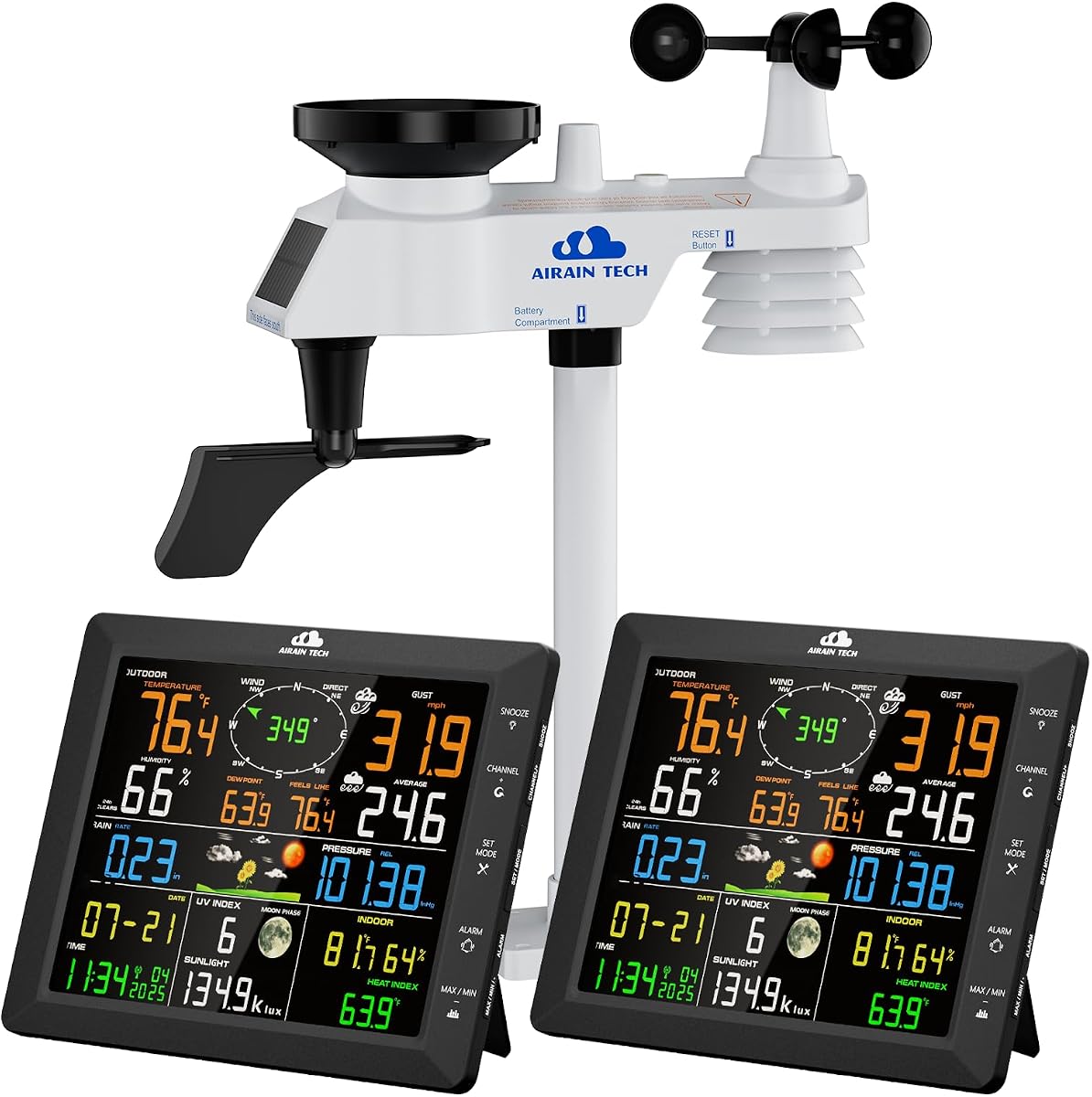
The Dual Display Weather Station stands out for its unusually large 8.5-inch color LCD and the inclusion of two display units. With a 4.4 rating, it gives users the same central information in two locations, making it particularly useful for a home office and kitchen, bedroom and living room, or any pair of frequently visited spaces.
We may earn a commission when you buy through this link, at no additional cost to you.
The screen combines wind speed and direction, future weather trends, indoor and outdoor temperature and humidity, and barometric pressure changes. Adjustable brightness helps accommodate different rooms and times of day. The included atomic clock adds familiar clock functionality, while moon phase, ultraviolet index, wind chill, and dew point broaden the environmental information beyond basic comfort readings.
The outdoor package includes a professional-style rain gauge, anemometer, and temperature and humidity sensors. The specified temperature range extends from minus 40 to 140 degrees Fahrenheit, with stated accuracy of plus or minus 2 degrees Fahrenheit or 1 degree Celsius. Humidity ranges from 10 to 99 percent with stated accuracy of plus or minus 5 percent. The outdoor unit transmits up to 328 feet, or 100 meters, under the stated unobstructed conditions.
Installation is designed to be approachable. The outdoor sensor includes an adjustable-angle bracket, mounting pole, backplate, screws, and nuts, while the display units automatically pair after power-up. There is no Wi-Fi, app, or listed smart-home integration, so the system is best for local viewing. Its two large screens and broad outdoor sensor suite nevertheless make it a distinctive choice for readers who prioritize visibility and multi-room access.
Two included displays remove the need to choose which room receives the console. Both units show the connected sensor data, improving convenience in multi-level or frequently used living spaces.
The outdoor unit combines rainfall, wind, temperature, and humidity hardware. Its mounting accessories and automatic pairing process reduce the setup effort, though transmission can be affected by obstructions.
We may earn a commission when you buy through this link, at no additional cost to you.
The most suitable large screen weather station depends on the readings you need, where the console will live, and how much outdoor hardware you are willing to install. Consider display readability, sensor coverage, connectivity, and power before choosing.
A large screen is valuable when a station serves as a shared household display rather than a device checked only on a phone. The Newentor, AcuRite Iris, La Crosse models, Ambient Weather consoles, and S84107 all use color or full-color displays, while the Dual Display model goes as large as 8.5 inches. Beyond diagonal size, consider dimming controls, adjustable backlight levels, contrast, and whether important data can be understood without opening menus. A display that is large but difficult to dim may be uncomfortable in a bedroom, whereas one with a temporary battery backlight can remain unobtrusive while preserving quick visibility.
The included outdoor probe determines the depth of environmental monitoring. Newentor and AcuRite offer simple temperature and humidity sensors, while the Ambient Weather, Tempest, and La Crosse professional systems add wind, rain, UV, solar radiation, or lightning measurements. More sensors create a fuller picture but require additional mounting, power, and maintenance. Think about which information changes decisions around the home. A homeowner concerned about condensation may need humidity and dew point, while a gardener may prioritize rainfall, wind, UV, and soil-level conditions.
Forecast icons are most useful after the station has collected enough local pressure data. The Newentor description identifies a seven-to-ten-day calibration period, and the La Crosse C85845-INT likewise notes that barometric calibration takes seven to ten days. During this learning period, the display should remain powered and its pressure readings should not be disrupted. The AcuRite Iris combines elevation and barometric data for a personalized 12-hour forecast, while the La Crosse V42-PRO-INT adds longer connected forecast views when connected to Wi-Fi.
Advertised range is most reliable when there are no obstructions between the console and outdoor sensor. Stated figures range from 328 feet for the Dual Display model to more than 1,000 feet for Tempest. La Crosse's professional system reaches up to 400 feet, while the included sensor for the Advanced Station operates within 330 feet. A longer theoretical range does not guarantee a strong signal through multiple walls or floors. Consider the actual layout, the mounting point, and the possibility of running the cable or power supply before deciding that maximum range is essential.
Wi-Fi, app, and voice-assistant support can turn a weather station into an automation tool. The Ambient Weather WS-5000 supports IFTTT, Google Home, and Alexa, the WS-2000 can connect to the Ambient Weather Network, and Tempest integrates with Alexa, Rachio, IFTTT, and other smart-home platforms. The La Crosse V42-PRO-INT provides remote monitoring through the La Crosse View mobile app. These features are valuable for irrigation, lighting, and thermostat routines, but they also create a greater dependence on network stability and compatible services.
Alerts are most useful when they are specific enough to prompt action. Several models support high and low temperature thresholds, humidity alerts, min and max records, and daily resets. The La Crosse C85845-INT stands out for customizable indoor and outdoor thresholds and comfort charts, while the AcuRite Iris provides the deepest library of historical and calculated data. Atomic clocks, dual alarms, snooze functions, moon phase, and calendar displays are valuable for a bedroom or living room console but should not replace the environmental features you need.
Power configuration affects display behavior and reliability. The Newentor offers a continuous backlight with its wall adapter and a dimmed energy-saving mode on battery power. The La Crosse C85845-INT uses a 5V cord for constant illumination and can use three AA batteries for backup. The Ambient Weather WS-2000 includes a console adapter but needs three AAA batteries in its outdoor array. Tempest uses a solar-powered outdoor sensor, while the Dual Display package includes a power adapter. Check which batteries and adapters are included so the station can operate as intended immediately after setup.
Simple temperature probes can usually be mounted in minutes, while all-in-one arrays require a secure outdoor position and careful clearance. The AcuRite Iris includes a mounting bracket, the Dual Display model includes a pole and mounting hardware, and the Ambient Weather and Tempest systems use integrated arrays designed for fast setup. Ultrasonic and other no-moving-parts designs can reduce ongoing maintenance. In every case, compare the instructions with the intended location and verify that cables, adapters, and battery compartments are accessible after installation.
Begin by unpacking the components, installing the specified batteries, and identifying the console, remote sensors, mounting hardware, and power adapter. Place the console in a stable, dry location where its display is easy to see and where an outlet or backup power source is accessible. Keep it away from direct sunlight, heating vents, exterior doors, and kitchen appliances, since those can distort temperature readings and pressure trends.
Mount each outdoor sensor according to the manual. A temperature and humidity probe should be positioned in shaded, ventilated air while remaining protected from direct rain when possible. Wind sensors need unobstructed exposure, and rain gauges should be level and away from trees, roofs, sprinklers, and roof runoff. Allow the included bracket, pole, screws, or adjustable-angle hardware to establish a firm installation without obstructing the sensing area.
Power on the console and confirm that the sensor channels pair and transmit current readings. Let the station remain stable for the full barometric calibration period, and do not repeatedly moving the console or changing its altitude setting during that time. Check forecasts, alerts, high and low records, and clock settings after pairing. For connected models, complete the app registration, Wi-Fi setup, location configuration, notification preferences, and any smart-home service linking. Periodically clean exposed sensor openings, remove debris from the rain gauge, and inspect mounts for loosening or weather damage.
A large screen makes frequently checked data easier to see from across a room or at a glance near a doorway. It is especially useful when the station combines temperature, humidity, pressure, forecasts, records, and a clock. The best size depends on where the display sits, since a bright oversized screen may be less comfortable in a bedroom than in a kitchen or living area.
Only if wind, rainfall, UV, or detailed outdoor conditions matter to your activities. A temperature and humidity probe is sufficient for many indoor comfort checks. Gardeners, weather enthusiasts, and users automating irrigation are more likely to benefit from an all-in-one array that measures rain, wind, and additional environmental variables.
Several models require approximately seven to ten days of barometric data for reliable forecast icons and tendencies. Keep the console powered in the same location throughout that period. A stable indoor environment and consistent sensor connection help the station establish a useful local pressure baseline.
No. Range is only one part of signal quality, and walls, floors, metal objects, and placement can reduce reliability. Choose a model whose stated range comfortably covers the intended outdoor location, then position the console and sensor to minimize obstructions where possible.
Wi-Fi is unnecessary if you mainly want readings and forecasts on the console. It becomes valuable when you want remote access, longer forecast views, historical tracking, notifications, weather-network sharing, or automation for irrigation, lighting, and thermostats. App-based models also require reliable network availability for some connected features.
They can display indoor conditions, but most models are designed to pair with an outdoor sensor for a complete forecast and outdoor reading. Leaving the remote sensor indoors reduces the usefulness of barometric forecasts and outdoor-specific measurements. If indoor-only monitoring is the sole goal, a basic indoor thermo-hygrometer may be more direct.
Inspection and occasional cleaning are important, especially for rain gauges, wind sensors, and exposed temperature probes. Remove leaves, debris, insects, and mineral buildup when present, and verify that brackets remain secure. Stations with no moving parts generally require less mechanical maintenance, but they still benefit from regular visual checks.
An atomic clock is convenient when accurate time and automatic synchronization matter. It is particularly useful in a bedroom, kitchen, or office where the weather station also serves as the primary clock. If precise time is not important, a standard clock display may provide the same environmental functions at a lower level of complexity.
The Newentor Weather Station offers the most approachable combination of a large color screen, multiple sensor channels, forecasts, alerts, and atomic time. The AcuRite Iris is the strongest all-around choice because it combines more than 55 data points, a dimmable display, a complete outdoor sensor, and personalized forecasting. For advanced users, the Ambient Weather WS-5000 and Tempest Weather Station provide smart connectivity, faster updates, and broader outdoor measurement capabilities.
Prioritize the conditions that influence your routines, the placement available for outdoor hardware, and the amount of setup you are prepared to maintain. A local console is often enough for temperature, humidity, alerts, and clock functions. Choose a smart or professional system when remote monitoring, wind, rainfall, UV, lightning, or automation justify the additional hardware and setup.
Before purchasing, review the current product listing, package contents, power requirements, and transmission specifications. Marketplace pricing and availability can change, and accessories or package configurations may vary. Comparing the latest listing with the priorities in this guide will help you choose a large screen weather station that remains useful in the intended location.