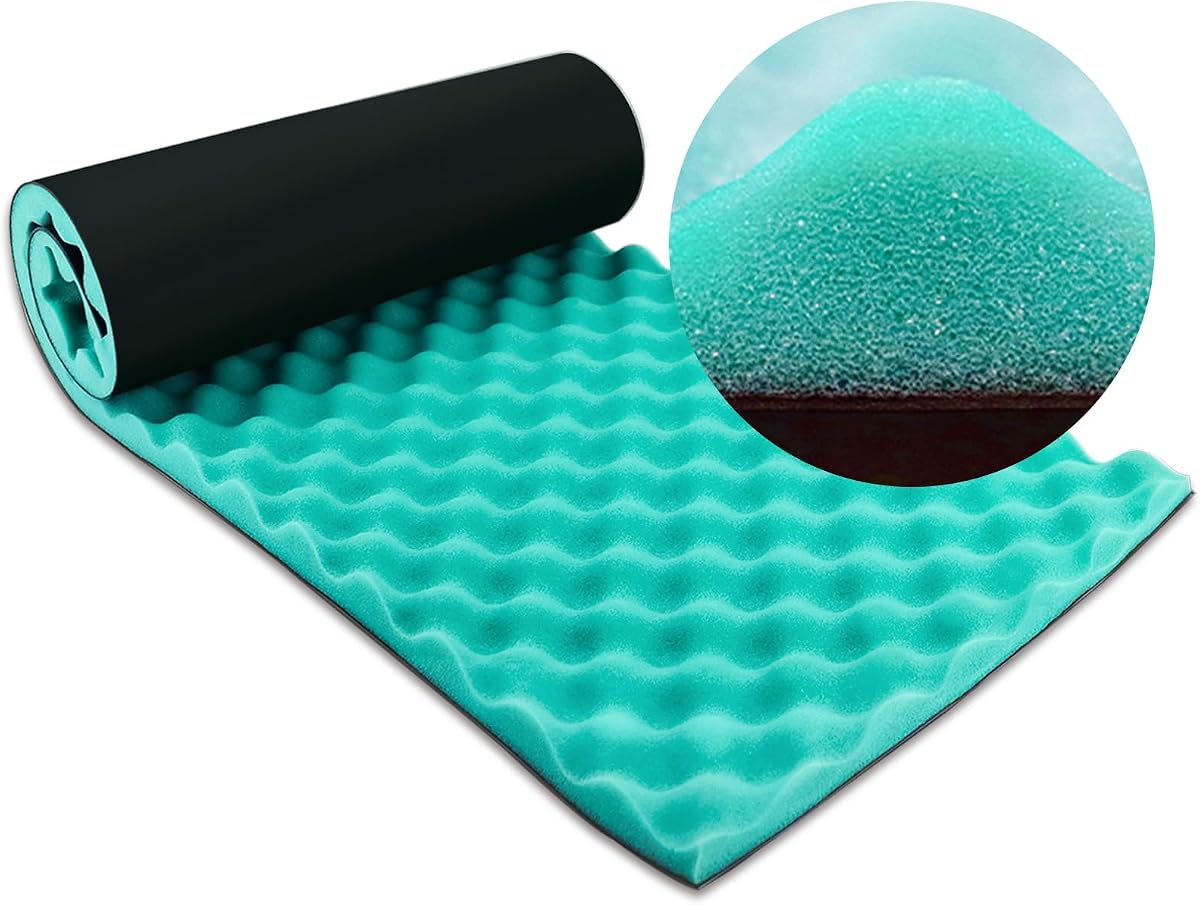
BXI Dual-Layer Noise Reduction Foam
3.7Editor score
Combined absorption and barrier layers
Cuttable rubber-backed construction
Rated for indoor and outdoor use
Foam for noise reduction comes in many forms, from porous acoustic wedges designed to soften reflections to dense closed-cell sheets that block vibration and heat. The right choice depends on whether you need to control echoes inside a room, reduce structural vibration, or add some barrier performance in a vehicle.
We compared all ten products by examining their stated construction, dimensions, density, installation method, intended applications, safety features, and customer ratings. The list covers studio panels, wall treatments, vehicle insulation, and multipurpose rolls so readers can compare solutions for both rooms and vehicles.
Each review explains what distinguishes the product, where it performs best, and where its design creates trade-offs. Ratings reflect the supplied customer feedback, while availability, installation requirements, and prices can change, so verify current product details before purchasing.
3.7Editor score

4.2Editor score
4.4Editor score
As an Amazon Associate we earn from qualifying purchases.
The comparison below highlights the most important differences among the ten options, including foam type, coverage, installation method, and the environments each product is designed to address.


The Focusound Acoustic Foam Panels set includes 52 triangular-groove panels measuring 12 by 12 inches and one inch thick. With a 3.7 customer rating, it is best viewed as a convenient, high-quantity treatment option rather than a complete soundproofing system. Its wedge surfaces are designed to absorb echoes, waves, reverberation, and flutter echoes within a treated space.
We may earn a commission when you buy through this link, at no additional cost to you.
One of the most useful features is the included supply of 300 pieces of double-sided adhesive tape. That allows a homeowner or creator to arrange panels across walls and other suitable surfaces without separately purchasing mounting tape. The foam is described as high-density, air-permeable, non-toxic, and fire resistant, with a shape-recovery method involving soaking compressed foam and allowing it to dry.
The primary trade-off is its one-inch depth. Compared with the two-inch and one-and-a-half-inch options elsewhere in this guide, these panels offer less material for absorbing low-frequency reflections and may require broader coverage to achieve a meaningful acoustic change. The product is intended for sound absorption and room refinement, not for preventing noise from traveling entirely through walls.
This is a sensible pick for a home office, recording corner, vocal booth, or control room where many small panels can be distributed around the listening position. Choose it when convenient placement, abundant quantity, and included mounting hardware matter more than maximum depth from each panel.
With 52 separate panels, the set can cover a broad surface area or be concentrated behind a desk, microphone, monitor, or gaming setup. The included adhesive also makes it easier to experiment with positioning before committing to a permanent installation.
The triangular grooves increase surface area and help soften reflections inside the room. They do not replace mass-loaded barriers, resilient channels, or a complete room-in-room build when the objective is to stop sound from entering or leaving a space.
We may earn a commission when you buy through this link, at no additional cost to you.
This 24-pack pyramid foam set uses a two-inch profile to increase the surface area presented to incoming sound waves. Its 4.0 rating reflects generally favorable customer feedback, and the stated NRC positioning makes it a practical choice for reducing echo and reverberation in studios, offices, theaters, podcast rooms, and gaming spaces.
We may earn a commission when you buy through this link, at no additional cost to you.
The panels are made from flame-retardant foam and are described as durable, lightweight, and easy to install on walls or ceilings. Their pyramid geometry can serve a dual role as acoustic treatment and decorative wall treatment. Compared with flat foam, the pronounced profile may occupy more depth but can make a practical acoustic layout easier to visualize.
Mounting adhesive is not included, so buyers need to supply construction adhesive or suitable double-sided tape. That makes the set less convenient for a quick installation but also allows the installer to select a bonding method appropriate to the wall and desired permanence. The product is explicitly designed for sound absorption rather than complete soundproofing.
Choose this set when a relatively deep, recognizable wedge profile and a generous 24-panel count are priorities. It is especially suited to musicians, podcasters, and home-office users who understand that treatment must be positioned carefully to address reflections rather than simply installed in one large cluster.
The two-inch profile provides more acoustic depth than one-inch panels and can help reduce persistent reflections around a listening area. Placement opposite speakers and at reflective wall junctions often makes better use of the material than covering only one wall.
Because adhesive is not included, installers can choose removable tape or more permanent construction adhesive. Check the surface, test a small area, and avoid creating visible gaps between adjoining wedges that could undermine the visual finish.
We may earn a commission when you buy through this link, at no additional cost to you.
The WVOVW Egg Crate Acoustic Foam set includes six 12-by-12-inch panels with a 1.5-inch depth. Its 4.2 rating is among the strongest in this guide, and its three-dimensional egg-crate surface is designed to increase the area over which sound interacts with the foam. The result is a compact option for reducing reflections and improving a small room's acoustic balance.
We may earn a commission when you buy through this link, at no additional cost to you.
The panels are made from polyurethane and are described as fire resistant, non-toxic, and compliant with California Technical Bulletin 117-2013. A useful middle ground is claimed between thinner one-inch foam and deeper two-inch designs: enough depth for meaningful treatment without the bulkier profile or stronger wall pull associated with the thickest options.
Shipping compression is a notable consideration. The foam arrives vacuum-sealed and may need to be separated and left in a ventilated area before regaining its intended shape. Its high resilience also allows secondary uses such as packaging fill, gift protection, and pet care, although those functions should not interfere with acoustic placement.
This is our top general-purpose pick for readers who want a manageable number of substantial panels without an enormous installation. It is well suited to a home studio, podcast corner, office, or vocal booth, particularly when the priority is treating nearby reflections and improving clarity within the room.
The egg-crate profile creates numerous ridges and recesses that increase the exposed surface. Positioning the six panels at first-reflection points or behind a listening setup can make their relatively compact footprint more effective than treating only one distant wall.
Vacuum compression helps reduce shipping volume but can temporarily alter the panel shape. Separate the interlocking pieces, allow airflow around them, and wait for the foam to regain its profile before installing it for the best fit.
We may earn a commission when you buy through this link, at no additional cost to you.
Siless Liner 157 is a 36-square-foot roll of four-millimeter closed-cell polyethylene foam with a waterproof adhesive layer. Its 4.5 rating is the highest among the ten products. Rather than serving as decorative room absorption, it is built for car sound deadening, heat insulation, and vibration control across broad vehicle surfaces.
We may earn a commission when you buy through this link, at no additional cost to you.
The material is described as lightweight, flexible, compressible, odor-free, and resistant to moisture. It is also credited with blocking up to 98 percent of radiant heat transfer, making it useful for engine, exhaust, and summer heat control. Its stated operating range extends to 215 degrees Fahrenheit, and the adhesive-backed format supports installation with or without a roller.
Because this is a thin closed-cell sheet rather than a deeply profiled acoustic wedge, its main value is damping vibration and adding a lightweight barrier. It will not provide the same midrange absorption as open-cell wall panels, and it is not intended to create a studio treatment by itself. Large-area coverage nevertheless makes it appealing for multi-panel automotive projects.
Choose the Siless Liner when reducing road noise, engine vibration, and heat transfer across a door, floor, hood, or other vehicle region is the goal. It is also a sensible option for broader insulation work where waterproof, flexible material and substantial roll coverage are more important than acoustic appearance.
The single 36-square-foot roll can cover several sections without the need to join multiple smaller sheets. That is particularly useful for floors, doors, and trunks where uniform material coverage helps create a more consistent dampening layer.
The waterproof closed-cell construction offers an advantage in humid conditions and around heat-producing vehicle components. It can serve as a thermal barrier while also helping reduce the transfer of structure-borne vibration through panels.
We may earn a commission when you buy through this link, at no additional cost to you.
The Geynnple Soundproof Wall Panel is a single 48-by-24-inch foam panel with a two-inch depth. It has a 4.1 customer rating and is intended for home studios, offices, podcasting spaces, and other rooms where acoustic enhancement or noise control is needed. Its large face provides a simple way to cover a meaningful section of wall.
We may earn a commission when you buy through this link, at no additional cost to you.
The foam is described as high density and quick recovery, meaning compressed areas should return toward their original form. That resilience makes the panel practical for storage and repeated handling. Adhesive is not included, but the product can be fitted with the buyer's preferred double-sided tape or construction adhesive.
One panel does not create a comprehensive acoustic system, and buyers may need several units to establish a useful treatment pattern. The listing also clarifies that split or two-part imagery illustrates the shape rather than indicating two separate panels in the package. Its black finish is unobtrusive in a studio environment.
This is a good option for someone who prefers large, visually simple panels and already has a mounting method or expects to purchase several. It is best used for reflections and damping within a room rather than as a sole solution for isolating sound from neighboring spaces.
A 48-by-24-inch face can cover a substantial wall zone with fewer seams than small square tiles. That makes the format convenient for placing behind monitors, above a desk, or at a major reflection point.
The benefit of separate adhesive is flexibility, but the bond must match both the panel and the surface. Use a product recommended for acoustic foam, test in a hidden area, and press firmly along the contact points for a secure mount.
We may earn a commission when you buy through this link, at no additional cost to you.
The Kaqiluo Closed Cell Acoustic Foam is a self-adhesive 12-by-71-inch sheet that covers 5.8 square feet and measures approximately ten millimeters thick. Its 4.1 rating reflects solid customer feedback, while the high-density, rubber-plastic foam construction positions it as a barrier and damping material rather than a deeply profiled absorber.
We may earn a commission when you buy through this link, at no additional cost to you.
The product is described as B1 flame-retardant, waterproof, and moisture proof. Its self-adhesive back allows one-person installation without separately applying tape, and the sheet can be cut into different shapes. Intended uses include rooms, automobiles, apartments, studios, classrooms, and factories, giving it broad versatility.
Closed-cell material does not provide the same porous absorption as egg-crate or pyramid foam. It is better at limiting transmission, dissipating some vibration, and adding insulation than at removing strong midrange reflections. The listed 50-plus-kilogram-per-cubic-meter density and enhanced hardness suggest a durable, resilient layer.
Choose Kaqiluo when a thin, waterproof, self-adhesive barrier or vibration pad is needed. It can complement dedicated acoustic foam in a studio, but it should not be treated as the only solution in a room dominated by echo.
The stiff closed-cell formulation is suited to reducing structure-borne vibration on panels, doors, appliances, and vehicle surfaces. Adding it to a broader absorption strategy can make the room treatment more comprehensive.
The pressure-sensitive backing simplifies mounting, while the continuous sheet can be trimmed for irregular shapes. Cut with a suitable tool and clean the surface before contact to help the adhesive establish a strong, even bond.
We may earn a commission when you buy through this link, at no additional cost to you.
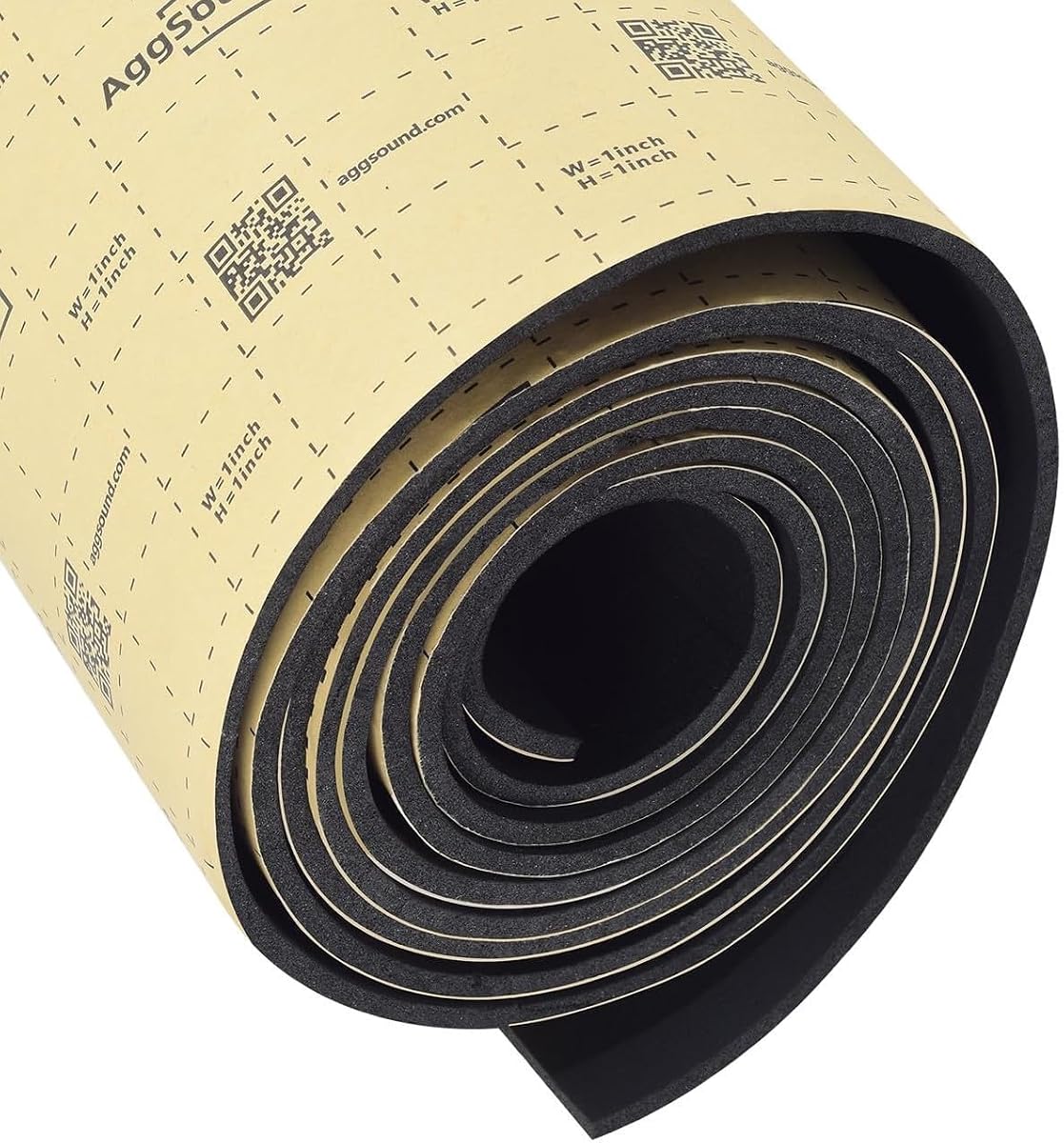
The AggSound Car Sound Deadening Mat covers six square feet and uses a three-layer, four-millimeter closed-cell construction. Its 4.4 rating makes it one of the strongest-rated options in the guide. It targets road noise, engine vibration, heat transfer, and shock absorption in cars, trucks, and recreational vehicles.
We may earn a commission when you buy through this link, at no additional cost to you.
The high-density material is described as resistant to collapse and compression, with heat-resistant adhesive intended to remain stable in warm conditions. A smooth backing peels away for installation, and the flexible sheet can be cut and trimmed around door cavities, hoods, trunks, and firewalls without interfering with panel closure.
Six square feet is enough for a focused installation but may require several pieces for comprehensive vehicle coverage. Like other thin deadening mats, it is best used to damp vibration rather than replace dedicated porous acoustic treatment in a recording room. Its value lies in doing several jobs at once.
This is our best budget pick for drivers who want to improve one focused section of a vehicle rather than outfit an entire cabin immediately. Start with a door or floor section where vibration is noticeable, and inspect the fit before removing trim or permanently closing panels.
The three-layer format adds more structure than a basic single-sheet mat. This can help dissipate vibration while also serving as a heat shield in locations exposed to engine bay or road heat.
The modest coverage area makes it practical to target the most problematic panel without committing to a much larger installation. Its flexibility also helps it conform to recesses that a rigid sheet could bridge or wrinkle.
We may earn a commission when you buy through this link, at no additional cost to you.
The BXI Dual-Layer Noise Reduction Foam combines an egg-crate absorption layer with a sturdy rubber soundproofing layer. Its 3.7 rating is lower than several alternatives, but the dual-material construction gives it a clear technical distinction. The roll measures 39.4 by 13.4 inches and one inch thick, covering 3.66 square feet.
We may earn a commission when you buy through this link, at no additional cost to you.
The stated performance figures include an average transmission loss of 24 decibels, an absorption coefficient of 0.74, and an NRC of 0.75. The foam side is intended to absorb sound, while the rubber layer dissipates vibrational energy. This combination allows the product to address both airborne reflections and mechanical vibration in a single material.
Installation requires care because the preferred orientation changes by application. The foam side should face pipes when wrapping them, while the rubber side should contact flat surfaces such as doors and windows. The material is waterproof, heat resistant, non-toxic, tear resistant, and suitable for both indoor and outdoor projects.
Choose BXI for mechanical equipment, HVAC components, pipes, windows, or multipurpose noise-control work where both absorption and damping matter. Its specialized dual-layer design justifies premium consideration, but the limited roll coverage and lower rating make it less convenient than higher-rated options for broad wall coverage.
The egg-crate surface softens sound while the rubber backing reduces vibration through adjoining surfaces. That combination is valuable where a room has both reflective noise and a persistent mechanical hum from equipment or ductwork.
Install the foam face toward the incoming sound or the pipe surface, and use the rubber face against rigid panels. Cutting the flexible roll to size makes it possible to fit irregular equipment and frames without leaving large gaps.
We may earn a commission when you buy through this link, at no additional cost to you.
This 48-by-24-inch egg-crate wall panel combines a two-inch depth with high-density polyurethane construction. Its 4.4 customer rating places it among the most favorably reviewed products here. The three-dimensional profile increases the contact area between sound and foam, helping reduce transmission and soften reflections within a room.
We may earn a commission when you buy through this link, at no additional cost to you.
The material is described as non-toxic, tasteless, flame retardant, and capable of helping prevent fire spread. It is also easy to clean and maintain, which matters in studios, offices, home theaters, and podcast environments. The black finish gives the panel a professional, low-visibility appearance.
As with other single-panel products, its acoustic effect depends on quantity and placement. One panel can address a specific reflection, but a room with strong echo generally needs several strategically positioned panels rather than one concentrated patch. The product description also emphasizes installation according to the included instructions.
Choose this panel for a large studio wall, office, theater, or podcast room when two-inch depth and a professional appearance are priorities. Its combination of a strong rating, high-density construction, and simple maintenance makes it a particularly confident choice for interior acoustic treatment.
The combination of a wide face and deep profile offers substantial treatment in fewer pieces. It can cover a major reflection zone more efficiently than a grid of small tiles while maintaining the familiar egg-crate acoustic geometry.
A dark surface suits professional studios and media rooms where visual distraction should be minimized. Routine care should focus on removing dust without saturating the foam or using harsh chemicals that could damage the material.
We may earn a commission when you buy through this link, at no additional cost to you.
The TroyStudio Sound Proof XPE Foam Roll is a self-adhesive, ten-millimeter closed-cell sheet measuring 13 by 78 inches and covering 7.04 square feet. Its 4.2 rating and emphasis on tear resistance make it a durable option for noise reduction, heat shielding, and vibration isolation across residential, automotive, and mechanical applications.
We may earn a commission when you buy through this link, at no additional cost to you.
The product is credited with reducing noise by up to 23.5 decibels in tested conditions, although real performance depends on installation and the structure being treated. Its tightly sealed cellular structure creates a durable barrier, while the compressed pockets also dissipate impact energy. The stated operating range is from 14 to 212 degrees Fahrenheit.
The material is waterproof, odor-free, heat resistant, scratch resistant, and described as suitable for indoor or outdoor use. The self-adhesive backing simplifies installation, and the sheet can be cut for doors, vehicle interiors, appliances, HVAC units, pipes, floating floors, vents, and generator enclosures.
Choose TroyStudio when durability, thermal performance, and vibration control are more important than sculpted acoustic appearance. It is a strong complement to porous studio foam, but because it is a thin closed-cell sheet, it should not be expected to perform like a deep egg-crate absorber by itself.
Cross-linked polyethylene is designed to withstand handling, tearing, moisture, and temperature changes better than many soft open-cell products. That durability makes the roll suitable for mechanical enclosures and exposed installation areas where a fragile panel could be damaged.
The same material can line vehicle doors, surround appliances, or fit around HVAC and pipework. When used for thermal insulation, orient the adhesive side toward the clean, rigid mounting surface and press along the full contact area.
We may earn a commission when you buy through this link, at no additional cost to you.
Choosing effective foam requires matching the material's acoustic mechanism, physical dimensions, and installation method to the specific noise problem and environment. The most important distinction is between absorption, barrier control, and vibration damping.
Choose absorption for a bright, echo-prone studio or office; choose barrier or damping materials for vibration traveling through a panel.
Use profiled foam for room reflections and dense sheets for vibration, heat, or barrier control.
Balance panel depth against room size and use coverage strategically at reflection points.
Favor resilient foam that holds its profile, and let compressed panels recover before mounting.
Verify fire-performance claims and local requirements before installing foam in occupied rooms.
Select an adhesive that suits the surface, and confirm the foam's orientation before mounting.
Use waterproof closed-cell foam in damp or hot environments, but verify temperature limits.
Select for the room, equipment, and noise path rather than choosing only by thickness.
Begin by identifying the dominant problem. Stand or sit in the room and listen for harsh reflections, long reverberation, background hum, structural vibration, or heat transfer. Map obvious reflective surfaces such as bare walls, ceilings, glass, and desktops, then position treatment where it can interrupt the path of the unwanted sound rather than simply adding product in an unused corner.
Prepare the surface and material before mounting. Clean and dry the wall, allow vacuum-compressed foam to recover, and check the installation orientation for dual-layer products. Apply the specified amount of adhesive, press each section evenly, and leave adequate curing time before attaching equipment or reinstalling removable trim. For vehicle deadening, work in manageable sections so panels can be inspected before closure.
Maintain foam by keeping it away from standing moisture, direct high heat, and harsh cleaning chemicals. Remove dust with a soft brush or suitable low-suction vacuum attachment, and address accidental tears early to prevent the material from fraying. If foam becomes compressed, reshape it gently and allow it to recover; for closed-cell sheets, inspect adhesive edges periodically and replace sections that have loosened.
No. Acoustic foam is primarily designed to absorb reflections and reduce echo within a room. Soundproofing describes controlling sound transmission through walls, doors, windows, floors, and ceilings. Foam can improve a room's internal acoustics, but complete isolation usually requires dense barriers, decoupling, sealing, and careful structural treatment in addition to absorption.
One-and-a-half-inch or two-inch panels generally offer more depth for absorption than one-inch products, particularly in rooms where stronger low-frequency reflections are a problem. The best result also depends on panel quantity and placement. A smaller set of substantial panels at first-reflection points can outperform a large quantity of thin panels installed in one location.
Standard porous foam has limited ability to block direct sound transmission. It softens echoes that reach it from inside the room and may add a small amount of loss at certain frequencies. If outside noise is the primary concern, focus on doors, windows, wall gaps, and other weak points in addition to adding internal absorption.
Closed-cell PE or XPE is generally more practical for vehicle deadening because it resists moisture, remains flexible, and can damp vibration through panels. Egg-crate foam is primarily an indoor acoustic treatment material. A vehicle project may use closed-cell material on doors and floors while separately adding porous panels in the cabin if interior echo is also a concern.
There is no single number because room dimensions, surfaces, furnishings, and the noise problem all matter. A practical approach is to identify the first reflection points and the most distracting sound sources, then cover enough surface area to make those areas noticeably better. Starting with several strategically placed panels allows you to evaluate the effect before purchasing a larger quantity.
Usually, yes, when the adhesive is appropriate for the surface. Painted drywall can be dusty or slightly textured, so clean it first and test a small hidden area. Use removable double-sided tape for temporary treatment and a suitable construction adhesive for a more permanent mount. Avoid applying heavy foam to wallpaper or weak surfaces without checking their adhesion.
NRC stands for Noise Reduction Coefficient and summarizes how much sound a material absorbs across a set of midrange frequencies under standardized testing conditions. A higher NRC generally indicates greater absorption. Actual performance in a room depends on thickness, placement, mounting, and the room's reflections, so NRC should be considered alongside those practical factors.
Separate any interlocking panels and leave them in a ventilated area until they return to their intended shape. Do not force a compressed panel onto a wall, because uneven pressure can make the bond unreliable. The Focusound and WVOVW products specifically mention water soaking or air recovery methods, so follow the instructions for the particular product being purchased.
The WVOVW Egg Crate Acoustic Foam stands out as the strongest general-purpose choice, balancing a 4.2 rating with a useful 1.5-inch depth. BXI earns the premium recommendation for buyers who need combined absorption and vibration damping, while the AggSound mat is a cost-conscious option for focused vehicle upgrades. These picks address different needs rather than representing one universal foam format.
Prioritize the type of noise before the appearance or number of panels. Use porous wedges or egg-crate foam to reduce internal reflections, closed-cell sheets to damp vibration and heat, and dual-layer products when both mechanisms are necessary. Then match thickness, coverage, safety information, and mounting method to the room or vehicle and install the material at reflective or vibrating surfaces for the greatest practical benefit.
Finally, check current prices, availability, dimensions, and installation instructions before ordering, because listings and costs can change. Customer ratings also reflect experiences that may differ from your room's construction and noise profile. A careful match among the material, the problem, and the installation location remains the most dependable path to a worthwhile result.