
Sonos Beam Gen 2
4.4Editor score
Dolby Atmos processing
Clear dialogue emphasis
Compact room-friendly design
Extensible Sonos platform
Discover the best Soundbar for Clear Speech options, comparing dialogue modes, channel design, connectivity, room features, and overall clarity.
A soundbar for clear speech should make dialogue easy to hear without forcing you to turn the television up until action scenes become overwhelming. The most useful models combine focused voice processing, balanced volume, and enough channel separation to keep conversations distinct from music and effects. Features such as dialogue modes, dedicated center channels, and adaptive sound can make a substantial difference in busy rooms.
This guide compares ten soundbars built for listeners who regularly struggle with muted voices, fast conversations, or dialogue buried beneath music and action. We evaluated the supplied specifications, focusing on speech enhancement, channel configuration, bass management, connectivity, room adaptation, and control options. The list includes compact all-in-one models, systems with wireless speakers, and advanced surround-oriented designs.
Each review explains where a particular soundbar fits best and where compromises remain. Some products prioritize a small footprint, while others provide more processing, stronger spatial audio, or dedicated vocal reinforcement. Ratings reflect the supplied customer feedback rather than personal testing, and availability, features, and prices can change, so readers should confirm current details before purchasing.
4.4Editor score

4.5Editor score

4.1Editor score
The comparison below highlights dialogue-focused processing, channel design, connectivity, and major listening features. It shows how the ten options differ in complexity, physical design, and the degree of control offered for separating speech from other audio.


The Bose TV Speaker is a compact, straightforward option created around one especially relevant goal: making television dialogue easier to understand. It carries a 4.3 customer rating and distinguishes itself with two angled full-range drivers designed to produce a wider, more natural presentation than a typical television speaker. The result is especially relevant to viewers who understand the words but struggle to hear them clearly.
We may earn a commission when you buy through this link, at no additional cost to you.
Speech clarity is the central selling point. The soundbar is designed to focus on vocals and pronunciation, while the included remote adds a dedicated dialogue mode for further vocal emphasis. A separate bass-boost option gives listeners a way to add low-frequency weight without relying on a full surround system. The angled drivers also help the sound extend beyond the narrow limits of the television cabinet.
Its limitations are straightforward. This is a 2.0-style compact unit rather than a multi-speaker surround system, so it does not offer the same directional overhead effects as models with up-firing drivers. The optical cable is included, but an HDMI cable must be purchased separately. Bass expansion also requires a compatible Bose Bass Module and a connection cable, none of which is included.
This is a strong recommendation for older adults, viewers with reduced hearing, couples who argue over the television volume, and anyone wanting a small, uncomplicated upgrade. The Bose TV Speaker may not be the first choice for cinematic enthusiasts seeking a large soundstage, but its dedicated speech controls and compact construction make it particularly effective for the core task of understanding television dialogue.
The remote-controlled dialogue mode provides a direct way to bring forward speech when a movie becomes busy or a news broadcast is recorded quietly. Because this adjustment is available from the included remote, listeners do not need to navigate a complicated application before enjoying improved vocal clarity.
At just over two inches tall, the speaker can sit in front of a television or be wall-mounted with separately sold brackets. HDMI-ARC, optical, AUX, and Bluetooth connections also make it useful beyond a single television setup.
We may earn a commission when you buy through this link, at no additional cost to you.
The Samsung HW B400F combines a 2.0-channel soundbar with an integrated woofer, offering a more full-bodied presentation than a basic television speaker. Its 4.0 rating reflects generally positive customer feedback, while the Voice Enhance mode targets the exact issue of quiet or masked dialogue. It is a practical option for apartments, bedrooms, and living rooms where a separate subwoofer would be inconvenient.
We may earn a commission when you buy through this link, at no additional cost to you.
A major advantage is the built-in subwoofer, which delivers bass without adding another large box to the room. The soundbar can therefore produce fuller effects for films and music while retaining a relatively straightforward setup. Its surround expansion projects audio across the room, while automatic dialogue amplification makes voices easier to pick up during speech-heavy content.
The night-listening feature is another thoughtful detail. It lowers the overall volume and minimizes bass, allowing viewers to watch without disturbing others who may be sleeping. That makes the B400F more versatile than a soundbar designed solely for maximum impact. Control through the Samsung television remote for power, volume, and sound effects further reduces the number of remotes required.
The main compromise is its lack of a dedicated center channel and more advanced room analysis. It cannot reproduce the same overhead or rear spatial presentation as the Samsung HW-S60D, Bose Smart Atmos Soundbar, or Sonos Beam Gen 2. Even so, for users who prioritize understandable speech, useful bass, and uncomplicated operation, the B400F is a persuasive all-in-one choice.
The soundbar automatically amplifies dialogue so viewers are less likely to miss words during quiet or action-heavy scenes. This is a convenient alternative to manually changing equalizer settings each time a program changes.
The integrated woofer adds low-end depth while preserving a simpler installation. For smaller rooms, that balance can be more practical than managing a soundbar and a separate bass module.
We may earn a commission when you buy through this link, at no additional cost to you.
This detachable 80W soundbar is the most value-oriented option in the guide, with a 4.1 rating and a useful collection of speech-oriented tools. Its automatic volume boost is designed to elevate faint sounds, while three equalizer modes for movies, music, and news let listeners tailor the presentation to different content. The news mode is the most relevant choice for podcasts, talk shows, and conventional broadcasts.
We may earn a commission when you buy through this link, at no additional cost to you.
Four high-performance drivers provide the stated 80W output, and the two-in-one design can be separated or placed horizontally and vertically. The listed positioning options extend beyond ordinary tabletop use: vertical placement can fill a room, while wall mounting is presented as a way to create a more enveloping presentation. The product also supports Bluetooth 5.0, ARC, optical, and AUX connections.
The main concern is limited information about long-term platform support and the absence of a specified surround-channel configuration. It should not be confused with a 5.1 or Dolby Atmos system, and its 80W figure should not be interpreted like a standardized home-theater power rating. It also offers a less polished smart-platform experience than established ecosystem products.
Despite those caveats, the soundbar makes a strong case for value-conscious buyers who need speech reinforcement more than elaborate cinema effects. The automatic boost, news preset, broad input support, and flexible placement make it especially useful for TVs, computers, projectors, and gaming displays. It is the budget recommendation for listeners who want clearer words without a complex installation.
The automatic loudness feature targets audio that may be too faint to follow comfortably. It can be particularly helpful with older recordings, low-volume broadcasts, or source material mixed with sparse dynamics.
The dedicated news equalizer mode prioritizes clarity for speech-oriented programming. It is a simple but useful shortcut for viewers who watch more talk shows, news, and documentaries than action films.
We may earn a commission when you buy through this link, at no additional cost to you.
The Sonos Beam Gen 2 is a premium compact soundbar that combines vivid bass, clear dialogue, and a panoramic soundstage. Its 4.4 rating reflects strong customer feedback, and the product appeals to buyers who want a television upgrade that can also function as a full music and podcast system. Dolby Atmos support gives movies a more dimensional presentation without requiring a large array of visible speakers.
We may earn a commission when you buy through this link, at no additional cost to you.
The speech benefit comes from the overall tonal balance and ability to present voices cleanly within a wider soundstage. Rather than merely boosting every vocal frequency, the Beam aims to preserve dialogue detail while giving music and effects room to breathe. TruePlay tuning adjusts the presentation to the room, which can also improve consistency across seating positions.
Sonos provides a mature selection of controls and streaming options. The soundbar can be managed through the Sonos application, a television remote, Apple AirPlay 2, and voice commands. It can stream music, radio, podcasts, and audiobooks when the television is off, and it can later be expanded with additional Sonos speakers for multiroom listening and true surround sound.
The trade-off is cost, particularly for listeners whose only goal is louder speech. The Beam does not include rear speakers, and its premium position brings fewer dedicated speech shortcuts than some competing models. It also lacks a separate center channel in the conventional multichannel sense. Despite this, it is the best premium option here for buyers who want clear dialogue, elegant design, strong streaming support, and future expansion in one capable enclosure.
The Beam places speech inside a broad, dimensional presentation rather than isolating it in a narrow central channel. This makes dialogue easier to follow while preserving the atmosphere of films and the scale of music.
Wi-Fi streaming, AirPlay 2, voice control, and compatibility with additional Sonos products make this more than a temporary television speaker. The platform is especially attractive for households considering multiroom audio or later surround expansion.
We may earn a commission when you buy through this link, at no additional cost to you.
The Bose Smart Dolby Atmos Soundbar is designed for listeners who want a small system capable of immersive sound and especially explicit voice control. Its 4.1 rating reflects positive customer feedback, while the A.I. Dialogue Mode is the feature most directly tied to the goal of clear speech. It balances voices against the surrounding mix to keep dialogue crisp during busy scenes.
We may earn a commission when you buy through this link, at no additional cost to you.
The acoustic design is unusually ambitious for a compact enclosure. Five transducers fit into the frame, including two upward-firing drivers that help create a spacious presentation. Bose TrueSpace can also analyze non-Dolby-Atmos signals such as stereo and 5.1 audio, then upmix them into a more immersive multichannel result.
The streaming and control options are extensive. Bluetooth, Apple AirPlay 2, Spotify Connect, and built-in Chromecast cover several common listening methods. Built-in Amazon Alexa, Bose Voice4Video, the included remote, and app control provide additional ways to manage the system and even operate compatible television or cable boxes.
The compromises concern both setup and expansion. Some voice functions require compatible services and configuration, while Bose Ultra Open Earbuds used as personal surround speakers are sold separately. The soundbar may also be more complex than a viewer needs for basic television speech. Even so, its dedicated A.I. dialogue processing and compact five-driver architecture make it a compelling option for those who want both clarity and cinematic scale.
A.I. Dialogue Mode is specifically designed to keep character voices intelligible as surround effects and music move around them. This makes it a useful first control to try when television dialogue is difficult to parse.
Upward-firing transducers and TrueSpace upmixing create a more spacious presentation than the enclosure might suggest. The result is useful for viewers who want cinematic scale without a large visible speaker system.
We may earn a commission when you buy through this link, at no additional cost to you.
The Sonos Ray focuses on a smaller footprint and a polished listening experience. It has a 4.2 rating and is positioned as a compact soundbar for television and music. Its main attraction is the ability to produce clearer, more powerful sound with a surprisingly wide soundstage, all from a relatively modest standalone unit.
We may earn a commission when you buy through this link, at no additional cost to you.
The Ray does not list a dedicated speech-enhancement mode, so its dialogue performance comes from general sound quality rather than an explicit vocal-processing control. That is still meaningful for many households: a more accurate and powerful presentation can make muted voices audible without aggressive processing. Its dynamic sound also adds drama without requiring the complexity of a full surround package.
Setup is handled through only two cables and guidance from the Sonos application. Once connected, the unit supports streaming through the Sonos app, Apple AirPlay 2, Spotify Connect, and other familiar services. This makes it practical for users who want one speaker to handle both television dialogue and everyday music.
The limitation is its position within the lineup. Dolby Atmos is not stated, and there is no clearly advertised dialogue preset or dedicated center channel. Buyers focused strictly on vocal enhancement may find a more explicitly speech-oriented model more appropriate. Still, the Ray is a compelling compact choice for apartments, secondary televisions, and listeners who value simplicity, design, and Sonos integration over elaborate surround effects.
Without a dedicated dialogue switch, the Ray relies on its balanced, dynamic presentation to make voices more present and powerful. This natural approach can work well for mixed content rather than only speech-heavy broadcasts.
The compact enclosure is easy to position near a television and visually less intrusive than a full home-theater system. It also provides a clear upgrade over the limited speakers found in many televisions.
We may earn a commission when you buy through this link, at no additional cost to you.
The Samsung HW-S60D is an unusually complete all-in-one soundbar, offering 5.0-channel output, wireless Dolby Atmos, built-in subwoofers, and automatic room optimization. Its 4.4 rating reflects strong customer feedback. For clear speech, the combination of Adaptive Sound and the Active Voice Analyzer is especially noteworthy because it is designed to identify important voices and separate them from room noise.
We may earn a commission when you buy through this link, at no additional cost to you.
Adaptive Sound analyzes scenes in real time and adjusts the output according to the type of content. Active Voice Analyzer breaks down room noise and optimizes onscreen speech, while SpaceFit Sound Pro examines the surrounding environment and calibrates the soundbar for that specific space. These features go beyond a simple dialogue button by responding to both content and room conditions.
The five-channel all-in-one architecture creates a wide soundstage and delivers bass without requiring a separate subwoofer. Wireless Dolby Atmos adds overhead effects while reducing cable clutter. Q-Symphony can coordinate the soundbar with a compatible Samsung television, and Game Mode Pro automatically activates when appropriate. Alexa, Chromecast, and AirPlay 2 broaden the smart-feature set.
The soundbar's feature density can feel like a disadvantage to newcomers. Some processing and platform functions require compatible televisions, services, or careful setup. Q-Symphony is specifically tied to Samsung products, and the full value of the system is best appreciated by users who want adaptive sound and gaming features. Even so, the speech-focused tools are among the most advanced in this guide, making the S60D a strong recommendation for a modern smart-television setup.
Adaptive Sound examines scenes in real time and adjusts the audio to prioritize important information. This can make dialogue easier to understand without requiring the listener to change modes for every program.
SpaceFit Sound Pro analyzes the environment and optimizes the output accordingly. That calibration is particularly useful for rooms with unusual furniture, reflective surfaces, or speakers positioned away from the ideal listening area.
We may earn a commission when you buy through this link, at no additional cost to you.
The TCL S65K S Series is a complete 5.1-channel home-theater system rather than a single compact bar. Its 4.4 rating reflects strong customer feedback, and the dedicated center channel gives it a clear advantage for speech reproduction. Voices are assigned to a purpose-built speaker, helping them remain consistent while action sounds move around the room.
We may earn a commission when you buy through this link, at no additional cost to you.
The center speaker includes a tweeter designed to reproduce precise high-frequency detail. That focus is relevant for dialogue because consonants, pitch changes, and subtle vocal nuances often become easier to distinguish when they are not competing with the left and right music channels. The package also includes wireless surround speakers and a wireless subwoofer with a 6.5-inch driver and Bass Boost.
Surround formats add further immersion. Dolby Atmos and DTS:X are supported, while Ray Danz technology is designed to create an expansive soundstage. AI Sonic Auto Room Calibration adjusts the system to the room, and the built-in center channel works with the television speakers to create a wider presentation. Bluetooth allows convenient music streaming from phones and tablets.
The important trade-off is complexity. A soundbar, subwoofer, and two surround speakers require more placement and setup than an all-in-one model. Cables and wireless interference may also require attention even though the surround speakers and subwoofer are wireless. Buyers with a larger room and a willingness to arrange the system will receive the most balanced result. For speech specifically, the dedicated center channel makes this one of the strongest traditional surround choices.
The dedicated center speaker anchors dialogue in a consistent location, reducing the need to raise the volume when characters begin speaking. Its tweeter adds high-frequency detail that can improve intelligibility during fast conversations.
Wireless rear speakers and a substantial subwoofer create a genuine surround presentation. The result is particularly effective when the system has enough open space and correctly positioned components.
We may earn a commission when you buy through this link, at no additional cost to you.
The Samsung HW-B630F is the strongest all-around recommendation for clear speech because it combines a dedicated center channel, a Voice Enhance mode, and Adaptive Sound processing. It has the highest supplied customer rating in the group at 4.5. The 3.1-channel arrangement gives dialogue a defined home within the mix, while the included wireless subwoofer handles low-frequency impact without crowding the main enclosure.
We may earn a commission when you buy through this link, at no additional cost to you.
The dedicated center speaker is the most important feature. It enhances voices so words remain more noticeable during busy scenes, and users can additionally select Voice Enhance when a program needs extra help. Adaptive Sound recognizes the type of content and automatically adjusts settings to favor clear voices and detailed effects, reducing the need to manage several controls manually.
DTS Virtual:X expands the presentation with multidirectional audio intended to move around the viewer. The soundbar can also switch between two Bluetooth devices, such as a smartphone and computer, while cross-talk noise cancellation is designed to improve gaming communication. A single Samsung television remote can handle key functions, reducing clutter when the television and soundbar are used together.
Virtual surround effects should not be confused with dedicated rear speakers, so buyers seeking sound physically coming from behind should choose a multi-component system. Samsung remote compatibility can also depend on the television model. Even with those qualifications, the combination of a true center channel, automatic content analysis, and the highest rating makes the HW-B630F the editor's choice for viewers who want clear words without abandoning cinematic scale.
The center channel is designed to keep speech prominent as other sounds move across the wider presentation. Voice Enhance adds a further manual option for especially quiet or difficult content.
Adaptive Sound identifies the type of program and changes settings to emphasize voices and relevant detail. This hands-off approach is useful for households that do not want to adjust sound modes while switching between news, sports, and movies.
We may earn a commission when you buy through this link, at no additional cost to you.
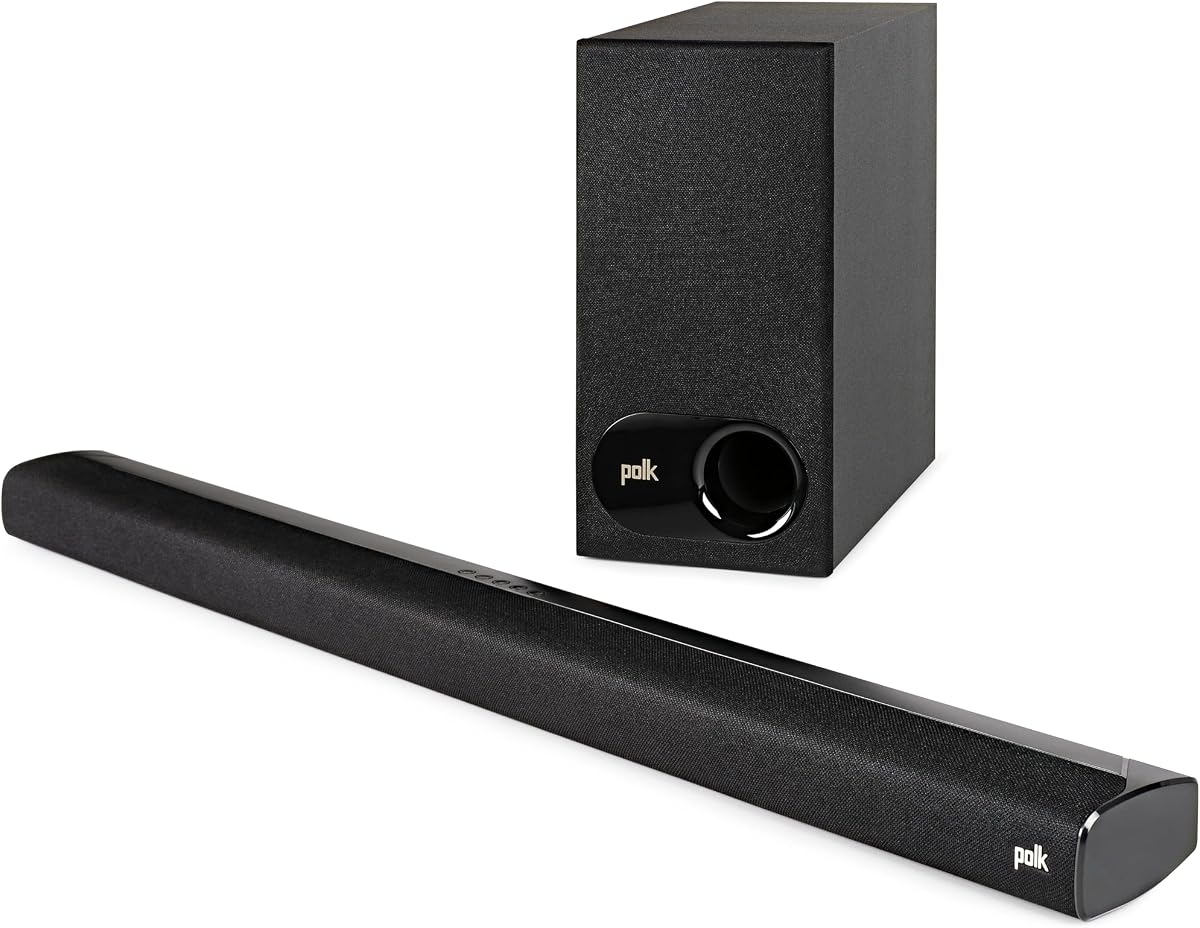
The Polk Audio Signa S2 combines a slim soundbar with an included wireless subwoofer and a speech-focused feature called VoiceAdjust. Its 4.4 rating makes it one of the stronger customer-rated products in the guide. Five full-range drivers provide the main audio, while Dolby Digital Decoding and VoiceAdjust are intended to improve clarity and reduce vocal delay.
We may earn a commission when you buy through this link, at no additional cost to you.
VoiceAdjust is the feature to consider first when speech is the priority. It is designed to maximize audio clarity and improve the timing and delivery of voices, making it useful for dialogue-heavy films, news, and reality programming. The included subwoofer supplies deep bass without requiring a separate purchase, and the soundbar can be wall-mounted or positioned in front of a television.
Its ultra-slim enclosure is only just over two inches tall. That low profile reduces the chance of blocking the bottom edge of a television or its infrared remote sensor. HDMI, optical, and auxiliary inputs provide broad source compatibility, while Bluetooth allows music to be streamed from compatible phones and tablets. The supplied HDMI and optical cables make the initial connection relatively direct.
The trade-offs are the absence of a sophisticated surround-speaker arrangement and a smaller smart-feature set. Dolby Digital decoding is useful, but there is no stated multi-speaker spatial configuration comparable to the HW-S60D or TCL S65K. Nevertheless, for listeners who value a slim physical design, an included subwoofer, and dedicated voice enhancement, the Signa S2 remains a practical and well-rounded choice.
VoiceAdjust is designed to make speech clearer and reduce perceived vocal delay. It offers a direct way to improve the presentation of dialogue without requiring complex equalizer changes.
The low-profile enclosure can fit beneath a television or be mounted on a wall, making it suitable for rooms where a large soundbar would be intrusive. The separate wireless subwoofer adds bass without changing the bar's slim shape.
We may earn a commission when you buy through this link, at no additional cost to you.
The best soundbar for clear speech is not necessarily the model with the most speakers or loudest output. Focus first on vocal reproduction, then consider room size, bass management, connection options, and the controls that make speech easier to hear during everyday viewing.
Look for a clearly labeled dialogue mode, voice enhancement feature, or adaptive system that prioritizes speech. The Samsung HW-B630F combines a dedicated center channel with Voice Enhance and Adaptive Sound, while the Bose Smart Atmos Soundbar uses A.I. Dialogue Mode to balance voices against the surrounding mix. These tools can be more helpful than simply increasing overall volume because they focus attention on the information viewers need to understand.
A dedicated center channel is also worth prioritizing. Center speakers anchor voices in one location, which helps maintain consistent intelligibility when music and effects spread across the left and right channels. The Samsung HW-B630F and TCL S65K provide this type of physical channel design, while several compact models achieve comparable emphasis through processing.
Decide whether you want one compact unit or a complete system. All-in-one soundbars are easier to install and generally better suited to apartments and smaller rooms. Multi-speaker systems can place voices in a center channel and surround effects behind the viewer, but they require more floor or shelf space and more careful placement.
Look for a 3.1 or 5.1 configuration when physical separation is important. A 3.1 layout adds a center channel to left and right speakers, while 5.1 adds surround channels. Virtual surround is less spatially authentic, though it may be sufficient for speech-focused listening in a compact room.
Automatic room calibration can correct for furniture, walls, reflections, and speaker placement. The Samsung HW-S60D uses SpaceFit Sound Pro to analyze its environment, while the TCL S65K provides AI Sonic Auto Room Calibration. These systems are particularly helpful when a soundbar cannot be placed in an acoustically ideal position.
Adaptive content analysis is another useful feature. It can detect whether a program is a movie, news broadcast, or sports event and adjust the emphasis accordingly. The HW-B630F and HW-S60D both offer this type of scene-aware optimization, reducing the need to switch modes manually.
Strong bass can make action scenes exciting, but excessive low-frequency output can make dialogue harder to distinguish and disturb people nearby. Look for a separate nighttime mode, bass reduction, or a way to control the subwoofer independently. The Samsung HW B400F can lower volume and minimize bass for quieter hours.
Integrated and wireless subwoofers are both valid approaches. The B400F, Signa S2, and HW-B630F include or pair with a subwoofer, while the Bose TV Speaker can expand with compatible Bose bass modules. Choose based on space and convenience rather than bass quantity alone.
A soundbar should connect easily to the television while leaving room for other sources. HDMI-ARC is convenient because it can carry sound and allow television-remote control, while optical input offers broad compatibility with older televisions. AUX is useful for computers and projectors, and Bluetooth permits convenient music streaming.
Consider the complete control ecosystem. Samsung models can work with Samsung television remotes, Sonos products offer app, voice, AirPlay 2, and streaming integration, and the Bose Smart Atmos Soundbar includes Alexa and several wireless streaming options. Simpler systems may be easier for less technical users, while smart models offer greater flexibility.
Check the soundbar's height, depth, and weight before ordering, and compare those dimensions with the television stand or wall space. The Bose TV Speaker is just over two inches tall, and the Polk Audio Signa S2 uses a similarly slim design. Both can work beneath a television without blocking its lower edge or remote sensor.
Also consider the subwoofer and rear speakers. A system with a separate bass speaker may need a nearby outlet and suitable placement away from walls or corners. A compact all-in-one model reduces visual clutter, makes wall mounting easier, and is usually more portable between rooms.
Wi-Fi streaming, Bluetooth, AirPlay 2, Spotify Connect, Chromecast, and voice assistants can turn a soundbar into a general-audio system. These features are valuable if the television is off or if the household wants to listen to music, podcasts, radio, or audiobooks through the same speaker.
Extra features are not automatically better for speech. A model with a well-tuned center channel and straightforward dialogue controls may serve the main purpose more effectively than a feature-heavy unit that requires extensive setup. Favor the functions you will use and make sure they operate with your existing television, streaming subscriptions, phone, and voice ecosystem.
The best system is one you can configure correctly and keep using. Products such as the Sonos Ray and Beam Gen 2 emphasize a two-cable setup and application guidance, while conventional HDMI and optical connections are quick for most households. The Samsung B400F, HW-B630F, and Bose TV Speaker can also be controlled through familiar television remotes.
Read the compatibility notes for any remote, wireless, or surround features. A soundbar may support the main functions perfectly while requiring additional equipment for its most advanced modes. Confirm television model, input availability, app requirements, and included cables before making a final decision.
Begin by choosing the correct television audio output and disabling the television's own speakers if the soundbar will control volume. For HDMI-ARC, connect the soundbar to the compatible television input, select that input, and use the television remote for basic power and volume commands. Optical and AUX installations are also straightforward, although the remote and equalizer settings may need to be adjusted directly on the soundbar.
For speech, start with moderate volume and enable the dedicated dialogue, voice, or news setting. Use the center channel and adaptive mode when available, but avoid extreme bass or treble boosts that can make voices sound harsh. Allow any automatic calibration to complete, and then test several program types, including quiet dialogue, fast conversation, music, and action-heavy scenes.
Keep the soundbar and subwoofer unobstructed, clean them with a dry or lightly damp soft cloth, and avoid pushing controls or connectors. Wireless speakers need a clear path and compatible power connections, while wired equipment should have slack in the cables to prevent strain. Check manufacturer instructions before updating apps, changing room settings, or adding compatible surround components.
A soundbar with a dedicated center channel, a voice-enhancement mode, and adaptive scene processing is generally the most dependable choice. The center channel gives voices a consistent position, while processing can raise dialogue when it is quiet or masked by effects. Samsung HW-B630F, Samsung HW-S60D, and TCL S65K are strong examples with different levels of complexity.
It often does. Raising television volume increases every sound, including music, explosions, and background noise, and may still leave some voices difficult to distinguish. A soundbar can rebalance the mix, isolate a central channel, and apply a dialogue preset so speech becomes clearer without requiring the same overall volume.
No. Speech clarity depends more on vocal balance, channel placement, room acoustics, and the selected sound mode than on bass quantity. Some compact models, including the Bose TV Speaker and Sonos Ray, can improve dialogue without a subwoofer. A subwoofer may improve the overall experience, but it does not automatically improve voice intelligibility.
A compact model can be better when its sound is properly balanced and its dialogue controls are easy to use. Larger systems provide more output and physical surround separation, but extra volume does not guarantee clear speech. The best choice depends on room size, speaker placement, and the quality of the center channel and voice processing.
HDMI-ARC is generally the most convenient because it can carry digital sound and allow the television remote to control the soundbar. Optical audio is also dependable and widely compatible, although some control functions may differ. Use whichever connection your television and soundbar support best, and consult the included instructions for the correct input setting.
Yes. Start by lowering distracting television effects if your equipment allows it, keep the soundbar at a moderate level, and reduce bass if voices are being masked. Placement also matters: keeping the main unit in front of the television and keeping the room relatively uncluttered can improve perceived clarity before any setting changes.
They are most useful for news, talk shows, podcasts, quiet dramas, and action films with compressed dialogue. Some listeners may find dialogue mode overly forward on music or animation, where natural balance is preferable. Trying a few modes with familiar content is the best way to determine which processing sounds accurate.
Prioritize a dedicated dialogue feature, a center channel, clear remote controls, and the ability to lower bass independently. Also confirm room size, connection compatibility, subwoofer requirements, and whether television-remote control is supported. A higher rating can indicate general satisfaction, but the specified speech features are more directly relevant to this particular need.
The Samsung HW-B630F is the strongest general recommendation because its dedicated center speaker, Voice Enhance mode, and Adaptive Sound processing directly address the core challenge of understanding dialogue. The Sonos Beam Gen 2 is the best premium choice for buyers who also value refined design, streaming, and future Sonos expansion, while the detachable 80W soundbar offers the strongest budget-oriented package with automatic boost and a news mode.
Prioritize vocal handling before maximum output. A center channel, dedicated voice controls, adaptive scene analysis, and adjustable bass can matter more than additional surround effects. Match the system's physical size to the room, confirm that the television remote and required cables will work, and remember that a separate subwoofer is useful for cinematic impact but not mandatory for intelligible speech.
Customer ratings, promotional terms, software behavior, connectivity options, and prices can change over time, so verify the current product page and manufacturer documentation before ordering. Once you choose a model, place it correctly, begin with moderate volume, and test the available dialogue settings with several kinds of television content to find the most natural and understandable result.