
VTech Play Smart Preschool Laptop
4.6Editor score
Thirty leveled learning activities
English and Spanish content
Personalized child profile
Laptop for 3 Year Old buying guide comparing 10 educational toy laptops for learning, creativity, bilingual skills, music, computer basics, and play.
A laptop designed for a 3-year-old should feel playful rather than demanding, with age-appropriate activities, simple controls, and enough variety to hold a child's attention. The strongest options combine letters, numbers, music, stories, pretend play, and basic computer skills in a sturdy, child-friendly format.
We compared all 10 featured laptops by age guidance, educational breadth, modes of interaction, included activities, portability, and the skills children can practice. The list covers basic learning computers, bilingual models, character-based games, 2-in-1 designs, and more advanced options for children ready to explore.
Each review explains what the product does best, who it suits, and where it falls short for a particular child. Ratings reflect the supplied customer feedback, while practical recommendations consider the child's age, interests, and developmental stage. Prices and availability can change, so compare the current listing before purchasing.
4.6Editor score

4.7Editor score

4.8Editor score
The comparison below highlights the educational range, age guidance, core interaction styles, and distinctive features of all 10 laptops, making it easier to find a model that matches a 3-year-old's interests and abilities.


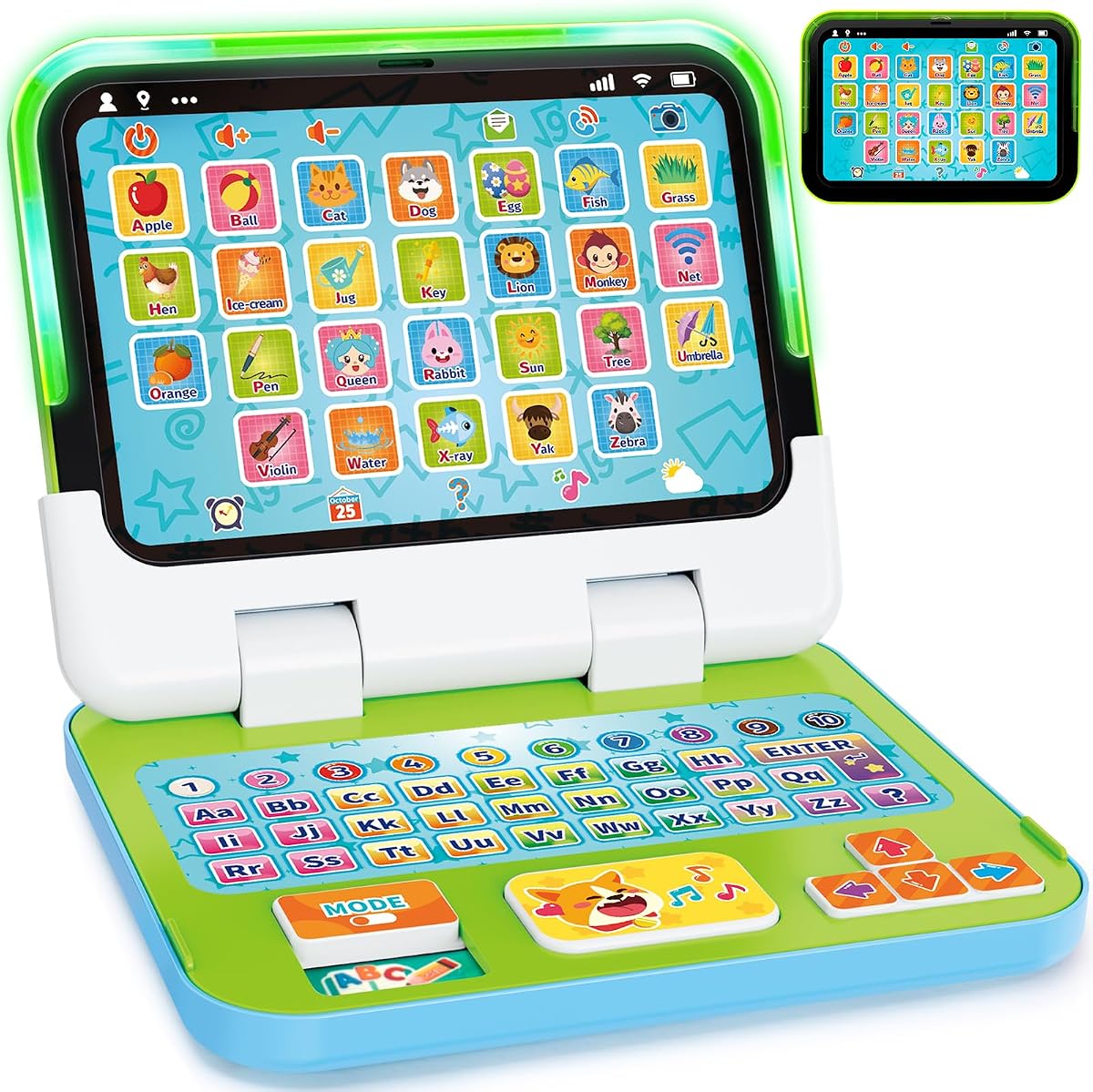


The LeapFrog 2-in-1 LeapTop Touch is a well-rounded choice for a 3-year-old because it combines a traditional keyboard toy with a touch-oriented tablet mode. Its customer rating of 4.7 reflects strong reception, while the age guidance of 2-5 places it squarely within the preschool stage. It offers enough variety to remain engaging without expecting a child to read complex instructions.
We may earn a commission when you buy through this link, at no additional cost to you.
The screen flips to convert between laptop and tablet configurations, giving the child two distinct ways to interact with the same device. Keyboard mode includes the alphabet and numbers 1-10, while touch mode makes tapping and swiping part of the experience. Five modes cover ABCs, numbers, games, music, and messages. Parents can customize activities so a child can practice spelling their own name, adding a personal element to the learning content.
Role-play is another strength. Children can imitate familiar adult computer tasks, including emailing Scout, which supports imaginative play while reinforcing early communication concepts. The main limitation is that the toy requires three AA batteries, and the batteries included are intended only for demonstration. Families should plan to use fresh batteries for regular sessions, and some buyers may also feel the curriculum is more explicitly preschool-focused than a general-purpose computer.
This is a strong overall recommendation for a 3-year-old because it balances letters, numbers, games, music, messages, and touch interaction in one compact product. It works particularly well for a child who enjoys switching between device styles or wants a laptop that can become a tablet. For parents seeking age-appropriate computer basics, personalization, and varied content in a single preschool toy, it offers a balanced package.
The flip-screen design lets children explore the same educational material as a keyboard activity or a tablet experience. That flexibility is useful for short sessions because different children may naturally prefer tapping, pressing keys, or combining both methods.
Name customization helps turn a general alphabet lesson into a more meaningful activity. It also allows parents to connect the toy to recognizable words, making independent play easier for a newly developing reader.
We may earn a commission when you buy through this link, at no additional cost to you.
The VTech Play Smart Preschool Laptop is an especially useful choice for a 3-year-old because its intended age range begins at three and extends through kindergarten. It carries a 4.6 customer rating and packs 30 activities into a conventional laptop format. The result is broad educational coverage in a product that looks like a small adult computer.
We may earn a commission when you buy through this link, at no additional cost to you.
Its lessons extend beyond basic letters and numbers. Children can identify letters, explore letter sounds, recognize shapes, practice numbers, and sort foods into fruits and vegetables. Logic games, animal sounds, footprints, and a music game add variety across subjects. Spanish words are also introduced, giving families a useful way to begin bilingual learning without requiring an internet connection.
Personalization is a major strength. A child's name, age, avatar, and other details can be entered, which can make activities feel more relevant and encourage repeated use. The main drawback is that the laptop has a fixed form rather than a convertible screen, so it may not appeal as strongly to a child who wants both a keyboard and a tablet. It also needs two AA batteries, with fresh batteries recommended for regular play.
For families seeking a straightforward preschool laptop with many activities and a clear progression, this model is difficult to overlook. It suits children beginning letter recognition and number practice while still providing enough depth for a longer learning journey through age six. It is our budget pick because it delivers a particularly complete set of age-appropriate subjects in a familiar, approachable design.
The activity mix includes alphabet recognition, sounds, numbers, shapes, food categories, logic, animals, instruments, and introductory Spanish. This variety makes the laptop useful for both structured learning and spontaneous play.
Adding a child's name, age, and avatar makes the device feel less generic. Personalized content can also improve engagement when an adult invites the child to find letters, identify items, or complete a simple game together.
We may earn a commission when you buy through this link, at no additional cost to you.
LeapFrog My Own Leaptop is built around a simple idea that resonates with many young children: pretend to be a grown-up using a computer. With a 4.7 rating and an age range of 2-4, it is especially relevant to children who are just beginning to explore symbolic play. Its pink finish and take-along handle give it the appearance and portability of a personal computer.
We may earn a commission when you buy through this link, at no additional cost to you.
The toy supports four learning modes covering ABCs, messages, games, and music. Children can learn the alphabet, spell their name, identify animal names, and explore pretend emails with Scout or Violet. Sixteen songs and melodies add a strong musical component, while the role-play format allows adults to introduce the idea of sending and receiving messages in a safe, child-friendly setting.
This imaginative framing is the model's defining strength, but it also limits the experience for some children. Unlike a convertible model, it remains a dedicated laptop toy without a touch-tablet mode. The included demonstration batteries are not intended for long-term regular use, and the device requires three AA batteries. Parents who want extensive subject coverage may find that the four modes are less varied than those offered by larger activity libraries.
The best reason to choose this laptop is its combination of early learning and pretend adult behavior. It is particularly suitable for a 3-year-old who likes stories, songs, characters, and acting out familiar routines. The handle also makes it convenient for supervised travel or play away from a table. For families prioritizing imaginative play, early alphabet skills, and music in one portable toy, it is a compelling choice.
The email and messaging themes let children act out familiar adult activities without entering or receiving real information. This can support vocabulary, communication, and social learning while keeping the experience entirely controlled.
Sixteen songs and melodies give the child a rhythmic change of pace from letter activities. Music can also make the device easier to introduce to a child who is not yet ready to sit through a sustained lesson.
We may earn a commission when you buy through this link, at no additional cost to you.
The VTech Bluey Game Time Laptop is the strongest choice in this guide for a child who responds enthusiastically to familiar characters. Its 4.8 rating is the highest among the listed products, and the age guidance of three and up is a direct match for a 3-year-old. Instead of presenting a broad preschool curriculum, it concentrates on entertainment-inspired learning through the Bluey series.
We may earn a commission when you buy through this link, at no additional cost to you.
A character selector lets the child choose Bluey, Bingo, Mum, Dad, Muffin, Chloe, or Honey before entering a game. Ten games are included, with recognizable activities such as Grannies, Fancy Restaurant, Musical Statues, and Spy Game. The dedicated Bluey button provides spoken phrases and character audio, adding an immediate element of recognition that can make the toy easier to use independently.
Its primary limitation is thematic rather than functional: this is not a broad early-learning computer. The listed activities focus on games inspired by the show, so parents looking for alphabet lessons, number practice, or a wide academic curriculum may need to provide that alongside it. The device also requires two AA batteries, and new batteries are recommended for regular use.
For a household where Bluey is a favorite, this laptop can be an ideal first computer toy. Familiar characters create an inviting entry point, while the range of games offers enough variety for repeated play. It is our premium pick because the polished character experience and strong customer rating make it especially appealing. For other children, however, a broader educational activity set may be a wiser choice.
Selecting a favorite character gives the child a sense of control before play begins. For a 3-year-old, that simple act of choosing can make the laptop feel more like a familiar toy and less like a lesson.
The ten games cover different concepts, including pretend restaurant play, movement through musical statues, observation, and spy-style challenges. This gives the character theme more depth than a single repeating activity.
We may earn a commission when you buy through this link, at no additional cost to you.
The VTech Genio Bilingual JuniorBook is a feature-rich learning laptop, but its age guidance of five and up makes it better suited as an early-years choice for a 3-year-old than as a primary purchase. A 3-year-old could explore it with adult support, especially alongside an older sibling or parent, but the interface and amount of content are designed for children beyond the immediate preschool stage.
We may earn a commission when you buy through this link, at no additional cost to you.
Its major distinction is the fully bilingual design. Every activity can be played in English or Spanish, while the content library includes more than 80 activities. Subjects span math, science, language arts, music, and Spanish. A full-size QWERTY keyboard and cursor controller make the device feel authentic, and apps such as a weekly calendar, notebook, and music player teach familiar computer routines.
All content is preloaded and works without an internet connection, which is convenient for travel and eliminates the need for an online account. The trade-off is that four AA batteries are needed, with demonstration batteries included and fresh batteries recommended for regular use. Families shopping strictly for a newly three-year-old should also consider whether the advanced layout may feel less immediately inviting.
This laptop is a strong long-term educational tool for a bilingual child and an excellent option when a product must work offline. It is less suitable as the first independent toy for a 3-year-old due to its age rating, but a short, supervised introduction can reveal whether the child is ready for the full-size controls. For families seeking future-facing bilingual content, it offers exceptional breadth.
Rather than isolating Spanish into a small section, the product lets the child choose the language for each activity. This creates more consistent bilingual exposure and makes language practice feel integrated into play.
Preloaded activities mean the laptop can be used without connectivity, a major convenience for travel, waiting rooms, or homes with limited internet service. The broad app selection also encourages different kinds of computer play.
We may earn a commission when you buy through this link, at no additional cost to you.
This Toy Laptop Tablet for Ages 1-3 is designed for the youngest end of the preschool range, making it a relevant choice for a 3-year-old who prefers tactile, sensory play. Its 4.4 rating is slightly lower than several other selections, but the feature list is extensive. The central design advantage is a detachable base that lets the child alternate between keyboard and tablet configurations.
We may earn a commission when you buy through this link, at no additional cost to you.
Four modes organize the content. Learning Mode covers numbers, letters, and colors; Spelling Mode provides word practice and feedback; Quiz Mode presents more than 70 questions; and Music Mode introduces melodies. The product also claims more than 120 learning themes, adding lights and sounds to the experience. Pretend calls and emails provide another layer of role-play for children who are beginning to understand everyday computer tasks.
The construction details are particularly relevant for this age group. The product is described as made with strong ABS plastic and chew-resistant material, with rounded edges, an anti-drop and anti-scratch design, and a secured battery compartment that requires a screwdriver. However, the supplied information does not state the exact battery type or quantity, so parents should check the listing before use.
For a 3-year-old who is still developing fine-motor control, the detachable tablet may be easier to hold than a full-size computer. The quantity of themes and modes also provides more variety than a single-purpose toy. The trade-off is that its generic naming provides less visible detail about its learning structure, and the supplied rating is modest. Even so, it is a well-rounded early-learning option with a particularly flexible two-form design.
The screen and base detach to create a tablet-style setup, while the attached configuration provides a familiar keyboard experience. This makes the product adaptable to a child's changing attention and motor control.
Lights, sounds, music, colors, spelling, and quizzes work together to make the learning content more engaging. The range supports children who learn best through repetition, sound, and active exploration.
We may earn a commission when you buy through this link, at no additional cost to you.
The VTech Tote and Go Laptop is designed around progressive learning, a useful feature for a child who is ready for more than basic tapping and repetition. Its 4.5 rating reflects a balanced experience, while the age range of 3-6 is especially relevant. The orange design, attached mouse, and full set of 20 activities create a traditional educational-computer experience.
We may earn a commission when you buy through this link, at no additional cost to you.
The curriculum covers more than 60 words, spelling, shapes, logic, and animals. Progressive levels gradually increase difficulty, allowing the same broad activity set to accommodate a growing child. Music adds 30 melodies in rock, country, and jazz styles, and the attached mouse introduces basic pointing skills. Parents can also add a child's name, age, favorite food, avatar, and other details to personalize the experience.
One practical limitation is that the screen is not backlit. Its contrast can be adjusted manually according to surrounding light, which helps in different settings but may still make some environments less comfortable. The device uses two AA batteries, with batteries included for demonstration and new batteries recommended for regular use. It is also a stationary laptop rather than a portable or convertible model.
This is a compelling choice for a 3-year-old who benefits from organized progression and wants to practice mouse skills alongside early literacy and logic. It offers more structured variety than many simplified learning toys, while remaining within the preschool age band. For families who will use it in a well-lit room and value curriculum progression, the Tote and Go Laptop is a dependable all-around option.
Progressive levels can prevent a child from becoming bored with content that is too easy. They also make it easier for an adult to keep a three-year-old challenged without skipping directly into material designed for older children.
The attached mouse teaches the basic movements associated with a computer mouse. For a preschooler, this is a useful bridge between a conventional toy and a later full-size computer.
We may earn a commission when you buy through this link, at no additional cost to you.
The Lexibook Unicorn Educational Laptop offers one of the broadest academic ranges in this collection, with a 4.3 customer rating. Activities cover English and Spanish, mathematics, typing, general knowledge, logic, music, and clock reading. This subject mix makes it a compelling choice for a 3-year-old who wants a computer that feels like a miniature adult workstation.
We may earn a commission when you buy through this link, at no additional cost to you.
Its learning structure moves from acquiring information to applying it. Children can work through different difficulty levels, test their knowledge, and then reinforce concepts through games based on logic, memory, and speed. The realistic mouse and keyboard offer useful computer familiarity, while the slim design and manageable size are intended to fit comfortably in small hands.
Music activities add a creative dimension, covering note recognition, composition, and playing melodies rather than simply providing background music. The main drawback is that the supplied data does not provide a specific age range, so parents must judge suitability from the activity set and the child's readiness. Its 4.3 rating is also the lowest among the ten products listed, which may warrant a closer look at recent customer feedback.
For families seeking a visually distinctive laptop with many subjects, the Unicorn design is appealing. It offers more visible academic breadth than a character-driven game toy, while its bilingual content and realistic controls make it educational in a practical sense. A 3-year-old will probably benefit most from adult-guided play, using the device gradually as attention span, language, and mouse control develop.
The product is not limited to passive content. Children can first explore a subject, test what they remember, and then revisit the material through games that emphasize logic, memory, and speed.
The keyboard and mouse mimic familiar adult equipment, helping a young child practice the visual and motor patterns associated with everyday computer use. Its slim body also keeps it more manageable than a full-sized laptop.
We may earn a commission when you buy through this link, at no additional cost to you.
The LeapFrog ABC and 123 Laptop combines foundational letter and number practice with an animated character named Pixel. Its 4.7 rating places it among the strongest products in the guide, and the stated age range of 3-7 makes it an excellent fit for a 3-year-old while offering continued value as the child develops.
We may earn a commission when you buy through this link, at no additional cost to you.
Eleven activities cover letters, counting, and basic computer skills. Pressing a letter or number key triggers the name of that item along with an animation. Pixel's face animates, his hands move, and his antenna lights up as he talks, tells jokes, sings, and dances. These reactions create a more personable learning experience than a static screen and can make repetition more appealing.
Simple programming adds a valuable early STEM element. Children can create code sequences to clean or cuddle Pixel and then exchange messages with Pixel's friend Chip. These activities use cause-and-effect logic without requiring advanced computer knowledge. The limitation is that the product requires four AA batteries, and its academic emphasis is more concentrated on letters, numbers, and introductory computer skills than on a large general curriculum.
This laptop is a strong recommendation for a child who enjoys animated companions and responds well to audio-visual feedback. It provides a meaningful transition from tapping alphabet keys to creating simple instructions for a character. For a 3-year-old, the most enjoyable approach may be a blend of independent exploration and adult-guided activities. The wide age range makes it a good choice for families seeking more than a one-year novelty.
Pixel's expressions, movements, voice, songs, and jokes reward each interaction. For a young child, that immediate feedback can sustain attention and make repeated letter or number practice feel more like play.
The code activities let children arrange actions so Pixel completes a task. The concept is simple enough for preschool play while introducing the idea that a sequence of instructions can produce a result.
We may earn a commission when you buy through this link, at no additional cost to you.
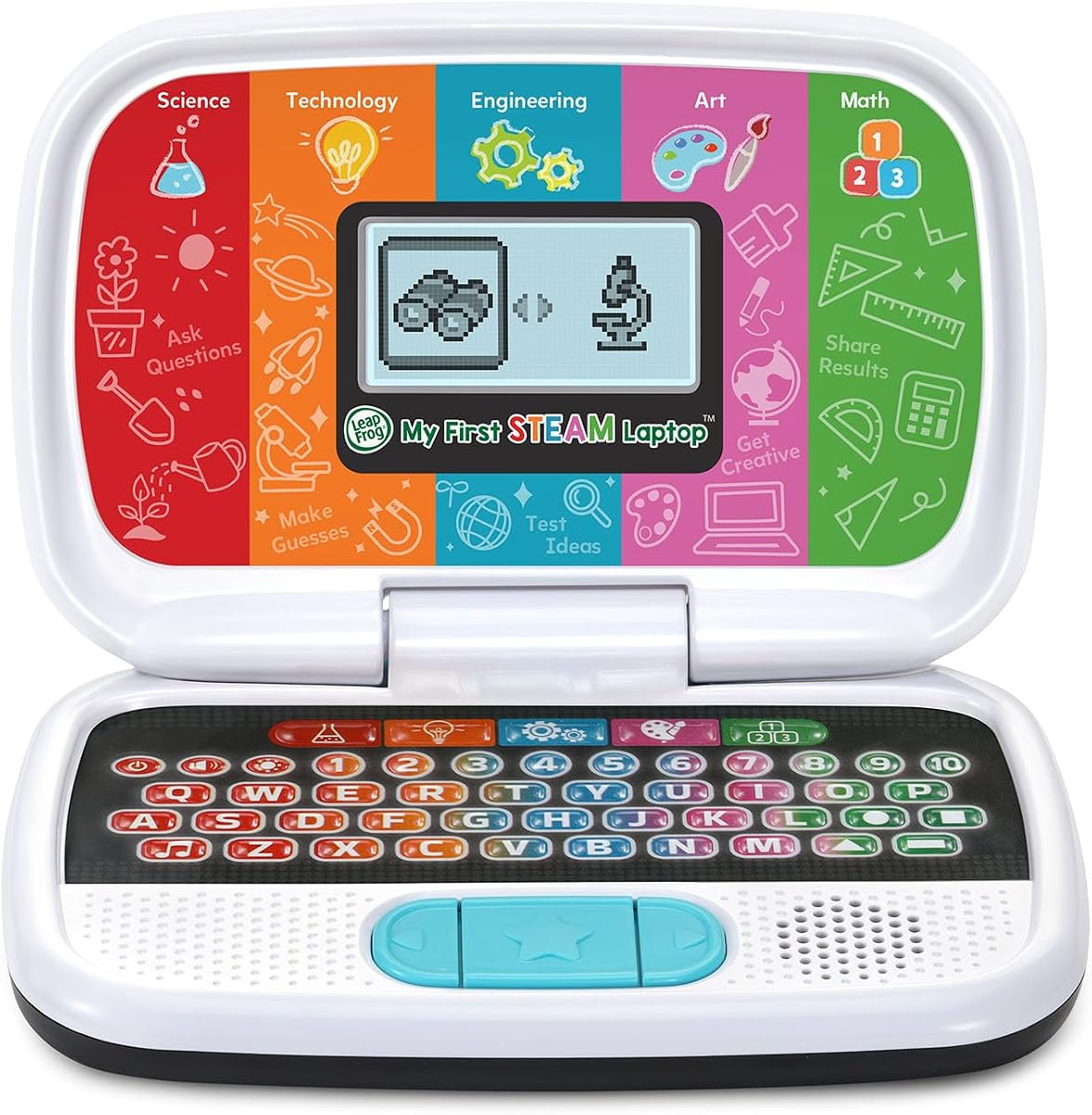
LeapFrog My First STEAM Laptop is designed to introduce science, technology, engineering, art, and mathematics through guided activities featuring Dr. Frankensteam and STEAM-Bot. It has a 4.5 rating and an age range beginning at three, making it a natural fit for a child with an interest in discovery rather than traditional typing practice.
We may earn a commission when you buy through this link, at no additional cost to you.
The activities cover a wide STEM range. Children can grow plants, investigate fossils, and learn why sunlight matters, then move into building robots and machines, matching shapes to parts, and creating imaginative animal designs. They can also explore inventions and their uses, count with dinosaur bones and test tubes, and combine art with early engineering themes.
This subject matter makes the laptop a strong choice for a curious three-year-old, but it is less focused on keyboard literacy than models centered on letters and typing. The screen-based construction of robots and machines is not a physical building set, so parents should not expect hands-on construction beyond the toy itself. The device also requires two AA batteries, and new batteries are recommended for regular use.
The recommendation is strongest for families who want to introduce STEM vocabulary and problem-solving through a child-friendly format. It can spark conversations about plants, fossils, sunlight, inventions, and machines, allowing an adult to extend each activity with simple questions or real-world observations. For a 3-year-old who is fascinated by how things work, it offers a more focused and distinctive alternative to a general preschool laptop.
Growing plants, examining fossils, and exploring sunlight give a child concrete ideas to discuss. The themes are accessible while still introducing vocabulary associated with living systems, natural history, and scientific observation.
Robot and machine challenges encourage children to imagine parts, combinations, and solutions. Matching shapes to parts also supports early visual reasoning and connects creative play with basic engineering concepts.
We may earn a commission when you buy through this link, at no additional cost to you.
The right preschool laptop should match the child's developmental stage, interests, attention span, and home learning goals. Age guidance, activity complexity, portability, language options, and practical features are more useful than the number of activities alone.
Begin with the stated age range rather than assuming that every learning laptop is appropriate for a three-year-old. The LeapFrog 2-in-1 LeapTop Touch, My Own Leaptop, and Toy Laptop Tablet are designed for younger children, while the Tote and Go Laptop and Play Smart Preschool Laptop explicitly begin at age three. The ABC and 123 Laptop, Bluey Game Time Laptop, and My First STEAM Laptop also start at three. The Genio Bilingual JuniorBook is intended for ages five and up, so a three-year-old would need substantial adult support and may not receive the intended experience.
Choose a model whose stated age range matches the child without making the activities too advanced. Age labels are also a guide to control complexity, reading demands, attention span, and the kind of interaction the manufacturer expects.
A three-year-old is more likely to engage with a laptop that reflects familiar interests. The Bluey Game Time Laptop favors character-based games, the My First STEAM Laptop emphasizes science and construction, and the Lexibook model offers broad academic practice. The Play Smart Preschool Laptop balances letters, numbers, shapes, logic, animals, music, and introductory Spanish. Consider whether the child gravitates toward stories and characters, music, construction, or structured school-like subjects.
Interest matching is not about limiting learning; it is about making the entry point inviting. A child who initially chooses a favorite activity can gradually discover letters, numbers, or logic within that setting, especially when an adult introduces the broader purpose of play.
A useful activity count is only a starting point. Look for variety across literacy, mathematics, language, logic, music, and pretend play. The Play Smart Preschool Laptop has 30 activities, the Genio has more than 80, and the Toy Laptop Tablet advertises more than 120 learning themes plus 70-plus quiz questions. Other models provide fewer but more focused modes, such as four modes in the LeapTop Touch and five in the Bluey laptop.
Evaluate whether the child can use the content in more than one way and whether difficulty can grow. Progressive levels, leveled knowledge tests, and a wide age range are useful indicators that the product can remain relevant beyond the first few weeks of play.
Some children benefit from a traditional keyboard, while others naturally explore a touchscreen. The LeapFrog 2-in-1 LeapTop Touch flips between keyboard and tablet modes, and the Toy Laptop Tablet for Ages 1-3 uses a detachable base for the same purpose. The My Own Leaptop, Tote and Go, Play Smart, Bluey, and Lexibook models remain in a more conventional laptop format.
Also consider motor skills. A child who has not mastered a pointer may benefit from large, obvious keys and simple interactions. A mouse can introduce useful pointing skills, while a tablet can make tapping more accessible. The best choice is the format the child can operate with minimal frustration.
Bilingual support may be a deciding factor for multilingual families. The Play Smart Preschool Laptop includes beginning Spanish words, the Genio makes every activity available in English or Spanish, and the Lexibook offers English and Spanish activities. Other models focus more heavily on letters, numbers, games, music, or STEM. If language learning is the goal, confirm that the product provides a meaningful selection of activities rather than only a few translated words.
For a child who is still learning in English, listen to the narration and examine the available vocabulary. Age-appropriate content should encourage speaking, listening, recognition, and repetition rather than requiring independent reading of complex instructions.
Music activities can make learning feel less academic while supporting listening and rhythmic engagement. The My Own Leaptop includes 16 songs and melodies, the Tote and Go Laptop plays 30 melodies in several styles, and the Lexibook includes note learning, composition, and melody playing. The Toy Laptop Tablet for Ages 1-3 also includes a dedicated Music Mode.
Creative content may be especially useful for children with short attention spans because it provides an alternative way to engage with the device. Look for a balance: a child should have opportunities to explore rhythm and sound without losing access to letters, numbers, logic, or other developmental content.
Consider where the laptop will be used. A portable model with a handle, such as the My Own Leaptop, can move easily between rooms or accompany supervised travel. The Bluey Game Time Laptop is also described as portable. Larger or fixed designs may be better suited to a table, while compact models with rounded edges may be easier for small hands.
For younger children, inspect the stated materials, edge design, and battery-compartment security. The Toy Laptop Tablet for Ages 1-3 specifically mentions chew-resistant material, rounded edges, anti-drop and anti-scratch construction, and a screwdriver-secured power compartment. Physical design should complement the child's age and environment.
Most models in this guide require AA batteries, and batteries included for demonstration should not be assumed to provide normal long-term use. Check the required battery count, keep a fresh set ready, and replace demonstration batteries before extended use. The Genio JuniorBook, for example, uses four AA batteries, while several other models use two or three.
Offline capability is another practical consideration. The Genio states that all activities are preloaded and require no internet connection. For families who value portability, predictable use, and screen-based learning without online setup, offline operation can be a significant advantage.
Introduce the laptop gradually rather than presenting every feature at once. Choose one activity connected to something the child already enjoys, such as animal sounds, a favorite character, counting objects, or music. Demonstrate one key press, allow the child to repeat it, and then let the child lead the next interaction. Short, responsive sessions are generally more useful than trying to complete every lesson in one sitting.
Use the personalization and level controls thoughtfully. Adding a child's name or age can make spelling, vocabulary, and profile activities more meaningful. If a model has progressive levels, remain with the easier stage until the child demonstrates consistent understanding, then offer the next level. Adult participation can turn the toy into a conversation starter without taking over control from the child.
For care, follow the battery instructions and use fresh batteries for regular play. Remove batteries when the toy will not be used for an extended period, especially if the battery compartment is accessible. Wipe the exterior with a lightly damp cloth, avoid pushing liquid into openings, and keep food and drinks away from the keyboard and screen. Supervise younger children, inspect the toy for damage, and stop use if cables, keys, the screen, or the battery cover become loose or compromised.
The LeapFrog 2-in-1 LeapTop Touch is the strongest overall option because it suits ages 2-5 and combines keyboard and touch interaction with letters, numbers, games, music, and messages. The VTech Play Smart Preschool Laptop is also excellent for a three-year-old who wants more structured activities, while the Bluey Game Time Laptop is ideal when a familiar character is the main source of motivation. The best choice ultimately depends on the child's interests and how independently they like to play.
Yes, but look for products that provide spoken instructions, visual cues, music, and activities requiring little written direction. Most preschool models in this guide are designed to support children who are still developing early literacy. A three-year-old may need help navigating at first, so a familiar adult should demonstrate each function and explain the goal of the activity.
A laptop-style toy is useful for learning the visual conventions of a computer, including a keyboard, screen, mouse, and familiar icons. A tablet-style device is often easier for small hands because tapping is direct and the screen may be easier to hold. The LeapFrog 2-in-1 LeapTop Touch and Toy Laptop Tablet for Ages 1-3 both offer laptop and tablet configurations, making them flexible options when the answer is not obvious.
They can be useful when families want regular exposure to a second language in an interactive format. The Genio JuniorBook is particularly extensive because every activity can be played in English or Spanish. The Play Smart Preschool Laptop and Lexibook also include bilingual content. For best results, use the language activities regularly and keep sessions short rather than forcing intensive study.
A preschool laptop is best treated as an interactive learning toy rather than passive entertainment or a substitute for hands-on play. Let the child's attention guide the session, and pause when interest fades. Adults can turn each activity into a conversation, point to objects in the room, sing the music, or let the child act out the pretend scenario afterward.
The Genio Bilingual JuniorBook is explicitly described as fully preloaded and ready to play offline. The supplied information does not provide the same offline confirmation for every product, so parents should check the current listing for connection requirements, account setup, and included content before purchasing. Batteries are still required for all products whose specifications call for them.
The most useful features are age-appropriate activities, clear spoken guidance, simple controls, and variety across literacy, numbers, logic, music, and pretend play. Personalization can add engagement, while progressive levels can extend the useful range. Physical durability, rounded controls, a secure battery compartment, and portability are also important for a child who is three years old.
The product information states that included batteries are for demonstration purposes and recommends new batteries for regular use. This applies to the LeapFrog, VTech, and related models that mention demonstration batteries. Check the required battery count on the listing, use the correct type, and replace batteries according to the manufacturer's guidance.
The LeapFrog 2-in-1 LeapTop Touch is the best overall choice for most three-year-olds because it combines a touch tablet with a keyboard, offers five learning modes, and supports personalized name practice. The VTech Play Smart Preschool Laptop is an excellent budget-oriented alternative with 30 leveled activities, bilingual content, and personalization. The VTech Bluey Game Time Laptop is the most engaging choice for a child who is a committed Bluey fan.
Prioritize age guidance, developmental fit, and the child's interests before focusing on the total activity count. A broad curriculum will not help if the interface is too advanced, while a favorite character can make a narrower toy more engaging. Consider keyboard versus touchscreen design, portability, battery requirements, and whether multilingual content or early STEM activities align with your goals.
Finally, check the current product listing before buying, especially for age guidance, included components, connection requirements, and battery details. Customer ratings and feature sets can change over time, and current pricing and availability vary. A laptop for 3 year old works best as a short, interactive addition to reading, talking, music, physical play, and plenty of hands-on exploration.