
Gossen Luna Pro SBC
3.7Editor score
Incident and reflected modes
Digital EV exposure display
Setting-ring compatibility
Clock and timer functions
Analog Light Meter guide comparing analog and digital exposure meters, features, accuracy, accessories, and ideal uses for photographers and filmmakers.
An analog light meter provides a tactile, dependable way to measure exposure without navigating menus, charging a battery, or waiting for an electronic display. The best models combine calibrated incident or reflected-light sensing with clear aperture and shutter-speed scales, helping photographers and cinematographers make faster decisions on location.
This guide compares ten meters selected for useful differences in metering method, measurement range, display type, environmental functions, portability, and included accessories. It covers traditional battery-free analog instruments alongside digital illuminance meters and compact exposure meters that may be especially practical for set checks, plant monitoring, or general lighting work.
Each pick highlights the capabilities that distinguish it within the group, from the straightforward Sekonic dial to advanced digital tools with temperature readings, peak capture, and backlit screens. Product ratings and availability can change, and prices fluctuate, so check the current listing before making a final purchase decision.
3.7Editor score

4.6Editor score

4.4Editor score
The table below compares all ten selections by metering approach, measurement range, display, portability, and most important feature, making it easier to distinguish a traditional exposure meter from a general-purpose digital illuminance instrument.
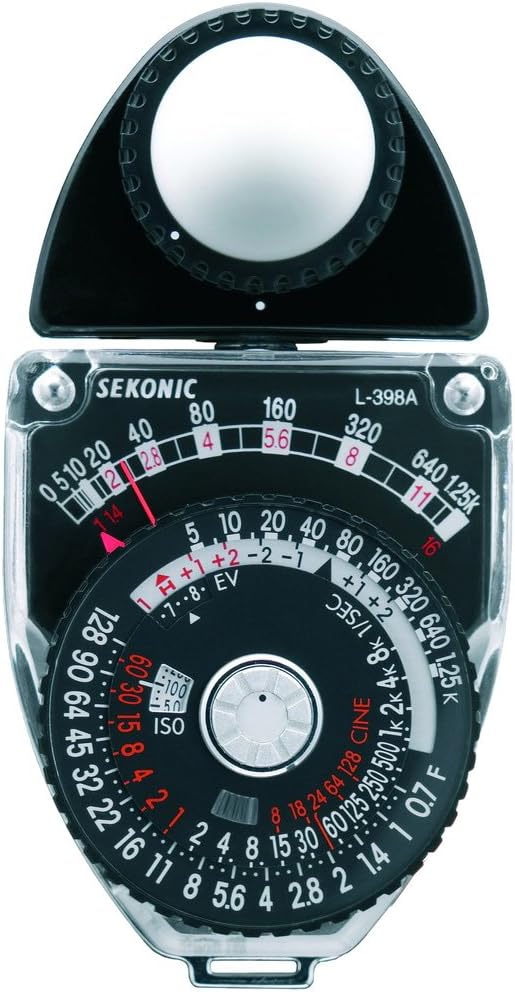


The Sekonic L-398A Studio Deluxe III earns the Editor's Choice position because it combines dependable battery-free operation with a conventional exposure dial that gives photographers and cinematographers the information they need without a menu. Its 4.6 rating also reflects a strong level of customer satisfaction. The full-dial presentation shows aperture and shutter-speed combinations at a glance, which remains a genuine advantage when exposure decisions must be made quickly.
We may earn a commission when you buy through this link, at no additional cost to you.
Its amorphous photocell draws power from ambient light, so the meter can be ready for a location assignment without a spare-battery check. The swivel head allows the sensor to be positioned while the display remains visible, making it practical for subjects, tables, and large lighting setups. Interchangeable accessories extend the basic instrument into incident and reflected-light configurations, with a lumisphere, lumidisc, lumigrid, and high slide included.
The main limitation is that this is an analog ambient meter rather than a flash meter. It also does not provide the exact numerical lux display, temperature readings, or electronic data logging found in digital models. Those omissions matter for facility inspections and some technical workflows, but they do not undermine the meter's purpose: translating light into practical camera settings with minimal delay.
This is the most complete choice for photographers who value a traditional analog meter, especially those moving between still photography and cinematography. Its battery-free sensor, broad accessory set, and immediate dial make it more versatile than a simple pocket meter. For users who want a fast visual exposure reference without dependence on batteries or complex electronics, the L-398A is the most balanced recommendation in this guide.
The integrated amorphous photosensor eliminates battery anxiety, which is valuable during remote assignments, location shoots, and fast-paced set work. The meter powers itself from available light, simplifying the pre-shoot checklist and avoiding the sudden loss of a measurement tool when batteries are forgotten.
The supplied lumisphere, lumidisc, lumigrid, and high slide cover common metering needs. Photographers can measure general subject illumination, selective areas, directional light, and high-reflectance surfaces without investing in a separate collection of adapters.
We may earn a commission when you buy through this link, at no additional cost to you.
This digital illuminance meter is the Best Budget selection for readers who need a straightforward way to measure light levels across homes, offices, factories, and sets. Its 4.4 rating indicates a well-received balance of useful features, and the 200,000-lux ceiling covers a wide range of indoor and outdoor conditions. The color LCD makes the result immediately legible rather than requiring interpretation of a needle.
We may earn a commission when you buy through this link, at no additional cost to you.
Beyond lux measurement, the device includes ambient temperature sensing, which broadens its usefulness for HVAC checks, indoor environment assessments, and set temperature monitoring. Minimum and maximum readings help users identify stable conditions, while data hold keeps a selected value visible. Its stated accuracy varies by range, and the 0-to-10,000-lux specification is identified as ±3 percent reading plus eight digits, with a different tolerance above that point.
This product does not function like a dedicated photographic exposure meter. It lacks a photographic EV display, aperture and shutter-speed scales, incident-light diffuser, and flash-measurement mode. That makes it less convenient for establishing camera settings directly, but it remains a capable instrument for checking whether a room, work surface, plant-growing area, or fixture meets a desired light level.
Choose this meter when affordability, compactness, and broad measurement utility matter more than dedicated photography features. It is particularly suitable for facility work, set-design checks, and general light inspections. Users creating a camera-ready exposure workflow should instead favor a photographic meter with EV, ISO, shutter-speed, and aperture information.
Ambient temperature measurement adds a second useful data point in a single handheld device. That makes the meter appropriate for environmental surveys, indoor inspections, and set-design work where a lux value can be considered alongside room conditions.
The four-digit color LCD, minimum and maximum modes, and data hold function make temporary measurements easier to record. These conveniences are particularly useful when checking multiple fixtures, monitoring whether light remains stable, or comparing different areas of a workspace.
We may earn a commission when you buy through this link, at no additional cost to you.
This Sekonic L-398A Studio Deluxe III listing offers the core qualities that make the model popular with cinematographers: analog exposure measurement, incident and reflected-light support, and no battery requirement. Its 4.4 rating reflects a solid reception, while the included case and strap reinforce its portability. It provides a practical middle ground between a full photography kit and a bare meter.
We may earn a commission when you buy through this link, at no additional cost to you.
The 180-degree lumisphere supports general readings from three-dimensional subjects, while the included lumidisc allows selective area measurements. The swivel head is particularly valuable when walking a set because the user can keep the metering button depressed while repositioning the sensor and checking different parts of the scene. The lumigrid and high slide expand the range of available measurements further.
As with other analog meters, the information is presented through scales rather than exact digital values. There is no temperature reading, maximum-value capture, or direct conversion into modern video frame-rate and shutter-angle references. The meter also does not measure electronic flash, so it is better suited to ambient-light work and conventional scene exposure checks.
This listing is a strong choice for a photographer or cinematographer who wants the established Sekonic L-398A format in a compact package with carrying accessories. It may appeal especially to users who already understand analog scales and value dependable operation over modern data displays. Buyers seeking only the fastest or simplest tool should compare the full feature bundle before deciding.
The swivel head supports a practical workflow in which the meter remains stable while the user moves through a location or checks several lighting positions. Its size and included strap make it easy to carry without turning the meter into another piece of bulky equipment.
The lumisphere, lumidisc, lumigrid, and high slide support general subject readings, selective measurements, directional conditions, and bright or reflective targets. This kit provides flexibility without requiring separate accessory purchases for common scenarios.
We may earn a commission when you buy through this link, at no additional cost to you.
The MT-92H stands out with a split-sensor design, rapid 0.5-second refresh rate, broad 200,000-lux range, and switchable backlight. Its 4.6 rating places it among the strongest-rated products in the group. The instrument is aimed at users who need fast, visible illuminance readings rather than a traditional analog exposure scale.
We may earn a commission when you buy through this link, at no additional cost to you.
The split sensor separates the measuring probe from the main body, which supports flexible positioning when the display needs to remain visible. Resolution down to 0.1 lux and a stated ±3 percent accuracy make the readings useful for nuanced comparisons. Lux and foot-candle modes serve different international and industry conventions, while temperature can be shown in Celsius or Fahrenheit across the listed 14℉-140℉ range.
A glare-resistant, ultra-bright backlight improves visibility in dark conditions and direct sunlight. The body weighs 188 grams and measures 125 by 56 by 30 millimeters, balancing portability with a substantial display. Unlike the analog selections, though, it depends on three AAA batteries and does not translate the measurement directly into ISO, aperture, shutter speed, or video frame-rate settings.
The MT-92H is ideal for lighting inspections, rapidly changing illumination, environmental readings, and anyone who values a large, highly visible display. It is less appropriate as the primary meter for a still photographer or cinematographer who wants direct exposure guidance. Its strongest case is professional environmental and set monitoring rather than camera calibration.
The 0.5-second refresh rate makes the MT-92H useful when light changes quickly, such as during fixture adjustments, moving clouds, or rapidly tested setups. It reduces the wait for a stable result and allows users to observe variations as they occur.
The switchable backlight is useful in dim locations, while the glare-resistant screen is designed to remain legible in direct sunlight. Combining those features makes the instrument easier to read across studios, exterior sets, workshops, and industrial environments.
We may earn a commission when you buy through this link, at no additional cost to you.
The Dr.meter Digital Illuminance Light Meter offers a 4.5 rating and a useful combination of broad range, fast response, and peak recording. Its 0-to-200,000-lux range accommodates bright daylight as well as many indoor environments, while the two-readings-per-second response provides more immediate feedback than a slower display.
We may earn a commission when you buy through this link, at no additional cost to you.
Its standout function is peak data recording. A dedicated control can lock and display the highest light pulse, making the meter suitable for brief events, intense fixtures, lightning, and laser-related measurement tasks. Users can switch between lux and foot-candle units without confusion, and a low-battery indicator provides a clear warning before readings become unreliable.
The product is designed more as an illuminance meter than a photographic exposure instrument. It does not provide incident or reflected metering accessories, an EV scale, ISO selection, or camera-ready aperture and shutter-speed recommendations. Its single 9V battery is also less convenient to share across a crew than a more widely available cell format.
This meter is a good fit for home, office, factory, gardening, and general outdoor light checks, particularly when a momentary peak matters. Photographers can use it to evaluate illumination but will need to translate the lux value or pair it with a dedicated exposure meter. Its fast refresh and peak capture set it apart from basic digital lux readers.
Peak mode preserves the highest detected value, which is valuable when a source flashes briefly or a measurement changes faster than a person can visually note. It is especially relevant for technical checks involving lightning, lasers, or sudden high-intensity illumination.
Lux and foot-candle conversion makes the same meter useful to users working with SI measurement or North American lighting conventions. The one-button approach keeps the tool approachable for occasional as well as regular users.
We may earn a commission when you buy through this link, at no additional cost to you.
The Extech LT300 is built around a remote sensor, a feature that makes it more versatile than many handheld illuminance meters. Its 4.3 rating reflects a dependable utility-focused design. The sensor can be positioned where a measurement is needed while the main display remains in the operator's hand, an advantage in tight spaces and under large fixtures.
We may earn a commission when you buy through this link, at no additional cost to you.
It records lux and foot-candle readings up to 40,000 lux through a cosine- and color-corrected sensor. Peak mode, relative mode, minimum and maximum functions, data hold, and zero adjustment provide the tools needed to log, compare, and establish a baseline. A large backlit LCD supports one-handed operation, and the supplied protective sensor cover helps during transport.
The 40,000-lux ceiling is lower than the 200,000-lux range offered by several digital competitors. While that is sufficient for many interiors and ordinary exterior conditions, it may be restrictive under intense direct sun or specialized high-output lighting. The device also remains an illuminance meter, not a full photographic exposure tool with scene-referred camera settings.
Choose the LT300 for facility inspections, industrial work, laboratory checks, and photography set measurements where remote positioning is valuable. Users who need a wider range or an incident diffuser may prefer another model, but those who regularly work around obstructions will appreciate the separate sensor and straightforward handheld display.
The remote sensor allows the probe to reach shaded, recessed, or otherwise awkward locations while the display stays visible. This is especially helpful below fixtures, inside cabinets, behind equipment, or beneath large studio modifiers.
Relative mode, zero adjustment, peak capture, data hold, and minimum and maximum readings support more than a single instantaneous value. Together, they help users establish a reference level and compare fixtures, surfaces, or changing lighting conditions.
We may earn a commission when you buy through this link, at no additional cost to you.
The Gossen Luna Pro SBC is the Best Premium choice for photographers who want an exposure meter to handle both ambient and flash readings while retaining a setting-ring workflow. Its 3.7 rating is the lowest in the group, so buyers should weigh the richer feature set against less uniformly positive customer feedback. The digital EV display remains paired with a traditional mechanical exposure reference.
We may earn a commission when you buy through this link, at no additional cost to you.
Incident and reflected-light modes provide flexibility in how the scene is evaluated. The EV value can be transferred to a setting ring where shutter-speed and f-stop combinations are visible at a glance, preserving a quick visual decision process without abandoning the digital calculation stage. The product also includes a clock with alarm, a timer, and a temperature readout.
Compared with a basic analog meter, the Luna Pro SBC offers more measurement functions but also introduces more controls and a denser system of scales. Its lower customer rating may reflect fit-and-finish, learning curve, or accessory considerations that are not fully described in the supplied listing. Buyers should confirm the complete bundle and compatibility before ordering.
This is a compelling match for established photographers who need flash as well as ambient capability and prefer a physical setting ring. It is less suitable for a first-time buyer who wants a simple, modern screen, or for a cinematographer who primarily needs video-specific frame rates and shutter angles. Its feature breadth justifies serious consideration among premium users.
Handling both incident and reflected measurements expands the meter's usefulness across portraiture, interiors, events, and controlled flash work. The ambient and flash capabilities also make it more adaptable to changing production requirements than an ambient-only analog model.
The setting ring translates the digital EV result into familiar shutter-speed and f-stop combinations. This bridges modern calculation and familiar analog decision-making, allowing the operator to see several possible exposure combinations without leaving the meter.
We may earn a commission when you buy through this link, at no additional cost to you.
The Fluke 941 Light Meter has the highest customer rating in this selection at 4.8, giving it strong appeal for users who trust a well-known professional instrumentation brand. It is positioned as a digital illuminance meter and testing instrument rather than a traditional analog exposure dial, making it relevant to photographers, facility teams, and technical lighting users.
We may earn a commission when you buy through this link, at no additional cost to you.
The supplied product information is intentionally limited, identifying the brand as Fluke and describing the 941 as a light meter, illuminance meter, and tester. That concise positioning is appropriate for a recognizable professional model, but it also means the listing does not provide detailed specifications such as measurement range, sensor construction, or specific modes. Those details should be confirmed on the current product page.
Unlike the Sekonic analog models, the Fluke 941 does not provide a mechanical aperture and shutter-speed dial. It is also not explicitly described as a flash meter or as having incident and reflected accessories. Its appeal therefore rests more on the Fluke name, dedicated meter format, and 4.8 rating than on a feature list that can be evaluated in detail here.
This is a strong candidate for buyers who prioritize brand reputation and a high customer rating, particularly within professional inspection and lighting workflows. Verify the included diffuser, measurement range, and application requirements before buying. For a dedicated analog camera meter, one of the Sekonic L-398A options offers a more clearly documented photography feature set.
Fluke is widely associated with electrical and diagnostic instrumentation, and the 941's 4.8 rating gives users additional confidence in the listing. Brand familiarity can be valuable when a meter will support recurring facility checks, production work, or other tasks requiring consistent results.
The provided listing identifies the product and brand but does not enumerate its range or operating modes. Prospective buyers should check the current listing for those details, along with diffuser options and the intended photography applications, to ensure the meter fits their workflow.
We may earn a commission when you buy through this link, at no additional cost to you.
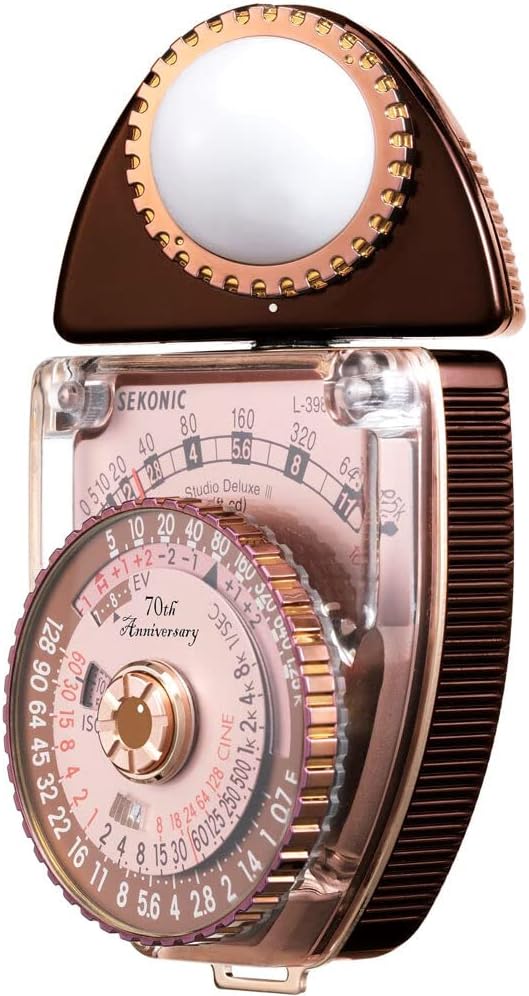
The Sekonic Studio Deluxe III 70th Anniversary Analog Light Meter holds a perfect 5.0 customer rating, making it the most favorably reviewed selection in the guide. Its central strength is the immediate display of full aperture and shutter-speed combinations. For photographers who enjoy analog instruments, the model combines practical exposure guidance with the distinction of an anniversary edition.
We may earn a commission when you buy through this link, at no additional cost to you.
The dial-based format is inherently efficient once the user understands its scales. Rather than stepping through settings, the photographer sees possible exposure combinations directly and can select the one that matches the creative intent and available light. This directness is valuable when working quickly, particularly with film, fixed-lens cameras, or systems where the photographer prefers a traditional meter.
The supplied information is limited to the analog exposure function, so the listing does not explicitly confirm the same accessory package as the standard Studio Deluxe III. Buyers should verify included diffusers, cases, straps, and sensor details on the current page. It should also not be assumed to include flash-metering capability because the available description identifies it as an analog light meter without specifying flash support.
This anniversary model is ideal for collectors, analog-photography enthusiasts, and users who value a traditional, visually rich instrument. Its perfect rating and distinctive edition status add appeal beyond basic utility. For routine production use where a complete standard accessory bundle is important, the regular Studio Deluxe III listings may offer clearer documentation.
A mechanical dial creates a direct relationship between measured light and chosen camera settings. For users who prefer the feel and visual character of traditional photographic tools, that experience can be as valuable as a compact digital display.
The 70th Anniversary designation makes this a distinctive version of the Studio Deluxe III. It is well suited to collectors and enthusiasts who want a functioning exposure instrument with a special-edition identity rather than an anonymous utility meter.
We may earn a commission when you buy through this link, at no additional cost to you.
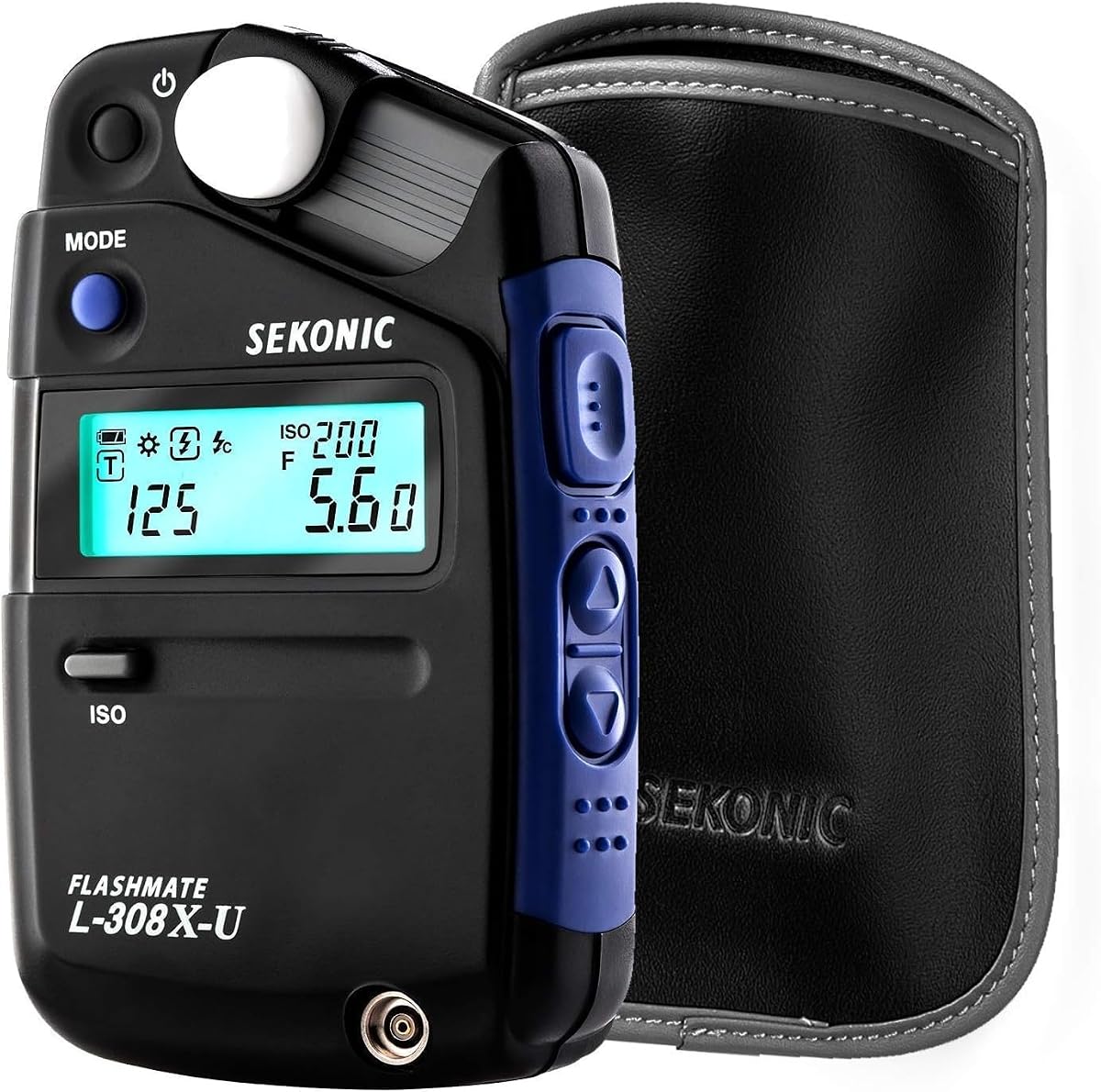
The Sekonic L-308X-U Flashmate is a compact digital exposure meter with a 4.7 rating, making it one of the strongest all-around choices for modern creators. Unlike a general lux meter, it converts illumination into exposure information for both photography and video. Photo, Cine, and HD Cine modes allow the same compact device to serve different production workflows.
We may earn a commission when you buy through this link, at no additional cost to you.
Its ambient EV range at ISO 100 extends from 0 to 19.9, while the flash range supports f/1.0 to f/90.9 and shutter speeds from 60 seconds to 1/8000 of a second. For flash, the listed range runs from 1 second to 1/500 of a second. Photo Mode includes shutter- and aperture-priority displays along with ambient and flash functions, including cord and cordless flash measurement.
The trade-off is that a compact digital body requires batteries and some familiarity with its controls, unlike a battery-free analog model. It also occupies less space than a full-size professional meter, so photographers working with large cinema rigs may prefer a dedicated production instrument. Nevertheless, the auto-backlit LCD and pocket-sized format support mobile use well.
Choose the L-308X-U for a photographer moving into video, a mirrorless creator who wants one meter across still and motion formats, or anyone who values compactness with precise exposure guidance. It is particularly useful for establishing consistent readings across a shoot without carrying separate tools for photography, flash, and basic illuminance work.
Photo Mode presents familiar aperture and shutter-priority information, while Cine and HD Cine modes align exposure decisions with useful frame rates and shutter angles. This makes the L-308X-U a practical bridge for creators who alternate between still photography and motion work.
The listed tenth-of-a-stop precision and broad exposure ranges provide detailed guidance despite the compact body. Its pocket-sized format makes it easy to carry as a backup or primary meter without occupying much space in a camera bag.
We may earn a commission when you buy through this link, at no additional cost to you.
The right light meter depends on whether you need camera-ready exposure information, general illuminance readings, flash capability, or a battery-free analog workflow. Consider the intended environment, lighting conditions, and level of interpretation you are comfortable making before choosing.
An analog meter presents aperture and shutter-speed combinations on a physical scale, which can make camera adjustments immediate and intuitive. A digital display provides numerical readings, clearer low-light visibility, and often more environmental or recording functions. Traditional analog models also tend to be operationally simple, although a model such as the L-308X-U demonstrates that a compact digital meter can still be highly portable and purpose-built for photographic exposure.
Incident metering evaluates light reaching the subject, while reflected metering evaluates light returning from a surface. A meter that supports both methods is more adaptable across portraits, product photography, interiors, landscapes, and high-contrast sets. Look for a hemisphere or diffuser for general incident readings and selective attachments for controlled or specialist measurements.
An ambient-only meter can be excellent for available light but may not handle electronic flash or strobes. A flash-capable model adds a sensor mode and exposure calibration for those sources. The Gossen Luna Pro SBC and Sekonic L-308X-U are the clearest choices in this group for users who expect to meter flash as well as ambient light.
A wide range helps in both dim studios and bright exterior locations, but range alone does not guarantee useful performance. Check the stated tolerance at the light level you expect to encounter. The listed digital meters reach 200,000 lux, while the Extech LT300 reaches 40,000 lux with a remote sensor; the actual reading may also be influenced by the diffuser and placement.
A still-photography meter may list shutter speeds and apertures without helping a videographer select practical frame rates or shutter angles. A video-capable meter should provide dedicated modes or controls for those decisions. The L-308X-U covers Photo, Cine, and HD Cine modes, while the L-398A remains a more traditional ambient exposure tool.
Battery-free operation is a major convenience for analog models because it removes one item from the pre-shoot checklist. Digital meters trade that simplicity for backlit displays, data recording, and temperature functions, so include batteries in the gear plan. Also consider size, hand comfort, sensor reach, and whether a lanyard or protective cover is included.
Features such as temperature measurement, min and max values, data hold, peak capture, and relative readings can make a general illuminance meter substantially more useful. The MT-92H combines a split sensor with temperature and backlighting, while the Dr.meter focuses on fast response and peak recording. These extras matter most for facility checks, rapid changes, and technical lighting work.
Some meters are complete kits with diffusers, discs, grids, slides, straps, and cases, while others are standalone instruments. Match the bundle to your subjects and locations rather than buying by headline range alone. For general photography, a complete analog kit may be ideal; for HVAC, plant care, or facility work, the essential priorities are numerical range, backlighting, data hold, and temperature.
Begin by identifying the light you need to measure and choosing the correct attachment. For general incident readings, use the appropriate hemisphere over the sensor; for selective or reflected readings, use the disc, grid, or other supplied accessory. Hold the meter at the subject's position when measuring incident light, or aim it at the relevant surface when taking a reflected reading.
Take several readings from different positions and angles, especially when a scene combines windows, practical lamps, modifiers, or reflective surfaces. Compare the resulting aperture and shutter-speed combinations with your camera's available settings, then make deliberate adjustments for exposure intent. Digital users should stabilize the meter long enough to obtain a stable reading and use hold, min, max, or peak modes only when they suit the task.
Keep the sensor clean and avoid touching sensitive surfaces unnecessarily. Store analog meters in their case with accessories organized, and prevent moisture, sand, and direct heat from reaching the body. Digital models should be stored with their batteries managed according to the manufacturer's instructions, especially if they will remain unused for long periods. Recheck the meter's response and calibration if readings appear inconsistent.
Neither format is universally better. An analog meter can provide faster aperture and shutter-speed comparisons, a tactile workflow, and battery-free operation, while a digital meter offers exact readings, backlighting, video modes, and additional environmental functions. The best choice depends on whether immediate visual exposure guidance or numerical data is more important to your workflow.
Only if the specific model includes flash-metering capability. The Sekonic L-398A models and the anniversary edition described here are ambient-light instruments, while the Gossen Luna Pro SBC and Sekonic L-308X-U include flash-related functions. Confirm the model description before using a meter with electronic strobes or speed lights.
Incident metering measures illumination arriving at a subject, generally with a dome or diffuser placed at the subject's position. Reflected metering measures light bouncing from a surface toward the meter. Incident readings often suit portrait and product lighting, while reflected readings are useful when matching the appearance of a specific surface or checking illumination across a set.
A camera's metering system can provide a convenient initial exposure, but a separate meter helps when lighting is unusually complex, rapidly changing, or inconsistent across a scene. It is also useful for placing lights, comparing fixtures, establishing consistent set values, and monitoring a location. Photographers working with fixed exposure workflows may find a dedicated meter especially valuable.
A higher maximum range is useful under direct sunlight and with powerful sources, but it does not replace accuracy, correct sensor placement, or the right measurement method. Choose a range that comfortably covers the intended environment and pay attention to the stated tolerance at that level. Remote positioning, backlighting, and recording features may matter more than maximum range in daily use.
A general lux meter can help assess brightness, but it may not provide ISO, EV, aperture, shutter-speed, flash, or video frame-rate guidance. Photographers can use its reading as a reference or convert it using familiar formulas, though a dedicated exposure meter is usually faster and less error-prone. Digital lux meters are especially useful for facility, plant, and set-design checks.
The smallest and lightest models are generally the most convenient for a mobile bag, while analog Sekonic options benefit from being battery-free. The L-308X-U emphasizes a pocket-sized body, and the compact L-398A listing includes a strap and case. Actual comfort depends on the user's hand size, gloves, and whether accessories need to remain accessible during a measurement.
Verify that the display or dial responds, inspect the sensor and diffuser, and compare a test reading with a trusted meter or a familiar reference setup. Test at more than one location and confirm that the selected accessory matches the intended measurement. For digital models, check the battery warning and make sure the screen is readable under the expected conditions.
The Sekonic L-398A Studio Deluxe III is the most complete traditional choice in the guide, combining a battery-free sensor, incident and reflected metering, a swivel head, and a generous accessory set. The Gossen Luna Pro SBC stands out for photographers who want ambient and flash measurement, a digital EV readout, and a physical setting ring, while the compact digital illuminance meter offers the most approachable general-purpose budget option.
Prioritize the measurement method before any secondary feature. Photographers should consider incident versus reflected capability, flash support, and video modes; technical users should look for range, accuracy, remote sensing, peak capture, and backlighting. Battery-free operation is especially attractive for field photographers, while digital functionality is preferable when exact values and recorded comparisons are essential.
Ratings, bundle contents, and prices can change, and several listings provide different levels of product detail. Check the current Amazon listing to confirm the complete package, dimensions, operating requirements, and intended application before purchasing. That final check will help ensure the selected analog or digital light meter matches your specific photography, filmmaking, or lighting-inspection workflow.