
Supco MFD10 Digital Capacitor Tester
4.7Editor score
0.01–9,999 μF range
Continuity fault detection
Bright LED display
Soft carry case
Digital Capacitor Tester guide comparing 10 models for range, accuracy, HVAC use, portability, displays, accessories, and diagnostic features.
A digital capacitor tester helps technicians and experienced DIY users measure capacitance, identify faulty components, and verify start or run capacitors without relying on visual inspection alone. The best model balances range, accuracy, readability, safe operation, and practical accessories for the kind of work you actually perform.
We compared ten digital capacitor testers using the supplied specifications, customer ratings, measurement ranges, display designs, power requirements, and intended applications. The list covers dedicated HVAC instruments, general-purpose capacitance meters, a versatile multimeter, and an LCR tweezer for work with small surface-mounted parts.
Each review explains the product's strongest qualities, practical limitations, and best-fit user. Ratings and specifications reflect the available product information, while prices and availability can change, so readers should verify current listings and compare the included accessories before purchasing.
4.7Editor score
4.9Editor score

3.9Editor score
The comparison below places all ten instruments by measurement range, accuracy, power source, display, portability, and diagnostic purpose, helping distinguish dedicated HVAC tools from broader meters and bench-oriented devices.




This MFD10 is built primarily around the work performed by HVAC technicians, appliance repairers, and experienced users who need a straightforward way to test start and run capacitors. Its 4.2 rating reflects a generally positive reception, while the combination of a 0.001 to 9,999 microfarad range, stated ±5% accuracy, and bright red display makes it a practical dedicated instrument.
We may earn a commission when you buy through this link, at no additional cost to you.
The field-ready feature set is particularly appealing. Alligator clip leads support direct connection to capacitor terminals, two-button operation should reduce the learning curve, and the included battery means the tester can be put into service without an immediate extra purchase. The supplied manual and discharge guidance also help users follow a more deliberate process when working around charged components.
Its main trade-off is that ±5% accuracy is adequate for many HVAC diagnostic tasks but not the most technically demanding option in this list. The dedicated design also means it does not replace a full multimeter for voltage, resistance, and current measurements. Compared with tighter-accuracy meters, this instrument prioritizes range, durability, display visibility, and a complete kit.
This is a strong choice for technicians who primarily diagnose motors, compressors, household appliances, and HVAC start or run capacitors. It is particularly attractive for anyone who values a ready-to-use package and a highly visible LED display over bench-level accuracy or a broad collection of electrical measurement functions.
The broad microfarad range covers capacitors encountered in common HVAC and appliance systems. High-visibility red digits and simple controls help reduce setup time when working in dim mechanical rooms or bright outdoor service environments.
The tester, test leads, 9V battery, and manual are listed as included. That package is convenient for new technicians or users who want a portable instrument ready for a service call without assembling separate accessories.
We may earn a commission when you buy through this link, at no additional cost to you.
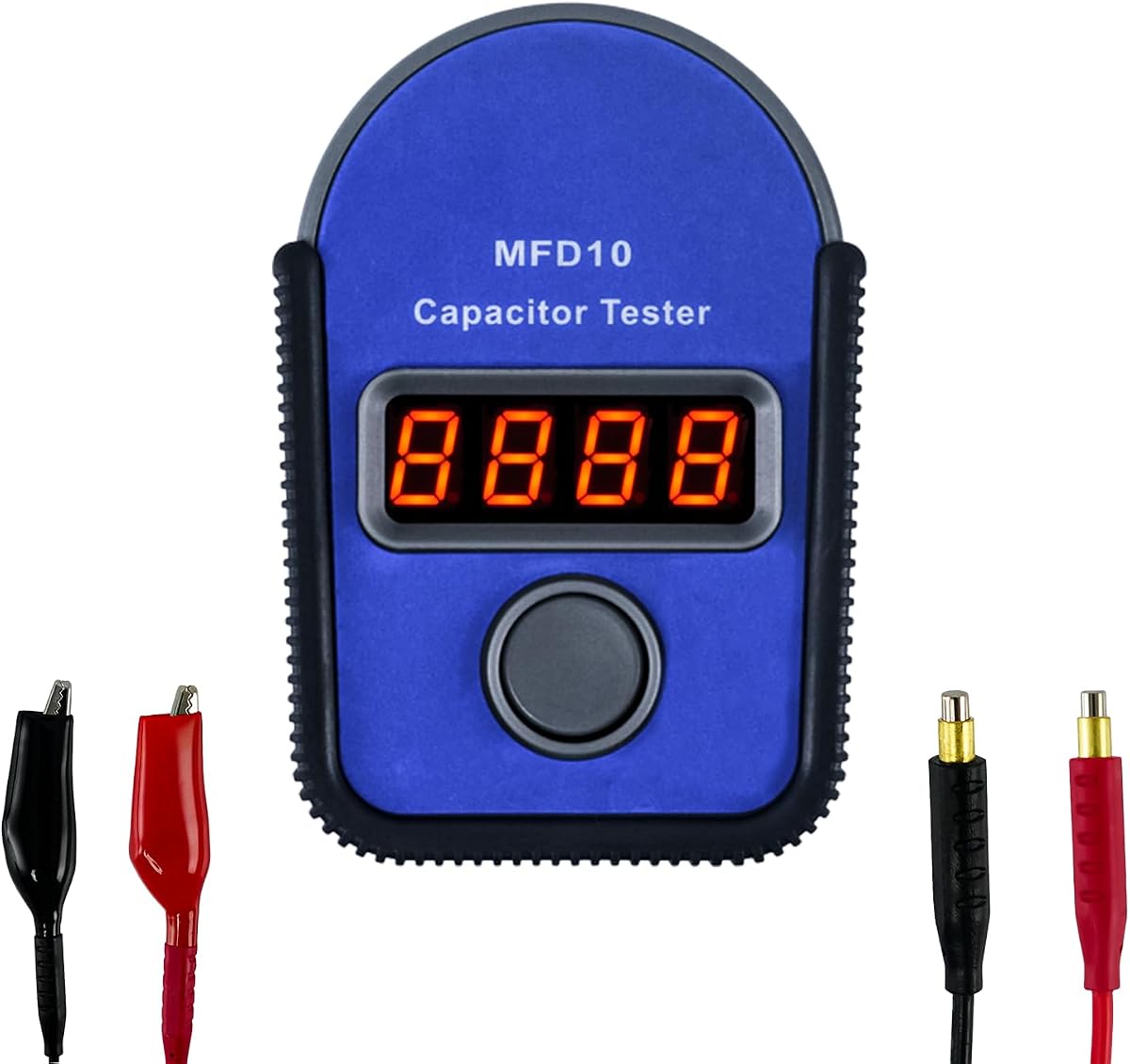
The Supco MFD10 combines a 4.7 customer rating with a clear focus on HVAC capacitor diagnostics. It measures from 0.01 to 9,999 microfarads, offers a bright LED display, and provides a simple connect-and-measure workflow intended to make troubleshooting faster in the field or workshop.
We may earn a commission when you buy through this link, at no additional cost to you.
Its distinguishing extra function is continuity testing for open and short circuits. That capability helps users investigate suspect components rather than relying only on a capacitance value. The unit's compact enclosure and included soft carry case also suit technicians who move regularly between appliances, air-conditioning equipment, and refrigeration systems.
The stated accuracy is 5 percent, which fits the product's practical HVAC orientation. It operates on three AAA batteries that are not included, so new owners should account for that small additional requirement. Like most dedicated capacitor meters in the roundup, it does not provide the broad voltage, current, and resistance suite found in a full digital multimeter.
Choose the Supco MFD10 when HVAC work is central, continuity checks add useful context, and a protected portable package matters. It is a confident selection for service professionals who want more diagnostic functionality than a simple capacitance reading without moving to a general-purpose multimeter.
Continuity testing for open and short circuits adds an important layer of diagnosis. Technicians can use it to investigate whether a suspect capacitor also shows an obvious wiring or component fault.
The compact body, bright LED display, and soft case support repeated mobile use. Its dedicated HVAC design keeps the controls and measurement focus straightforward for common start and run capacitor work.
We may earn a commission when you buy through this link, at no additional cost to you.
This MFD10 version stands out for its unusually generous accessory package and flexible connection options. The 4.4 rating, 0.001 to 9,999 microfarad range, and 5% stated accuracy make it suitable for HVAC service, appliance maintenance, and general capacitor troubleshooting.
We may earn a commission when you buy through this link, at no additional cost to you.
A large, high-brightness LED display is designed to remain readable in dim or bright conditions. Magnetic wires and vise clips offer alternatives when alligator leads are awkward, and the sliding door helps keep cables organized. The package also includes a soft tool kit and user manual, creating a more complete setup than many basic meters.
The instrument is powered by three AAA batteries, which are not included. Its readings may take up to approximately ten seconds to stabilize, which is important when comparing the meter with instruments that settle more quickly. The fault-checking functions for open circuits and short circuits add useful diagnostic context.
This model makes the most sense for buyers who value included connection accessories, organized storage, and broad HVAC applicability. It is a solid service tool for technicians and experienced DIY users, provided they are comfortable waiting for the displayed measurement to stabilize and can supply the specified batteries.
Magnetic wires and vise clips can be more useful than standard leads on cramped components or terminals with unusual shapes. These alternatives are particularly relevant to field repair work.
The sliding door stores test cables and clips in the tester itself, helping prevent tangled leads. A separate soft tool kit provides a more organized carrying setup.
We may earn a commission when you buy through this link, at no additional cost to you.
The MFD10 Digital Capacitor Tester with LED Display earns the highest customer rating in the group at 4.9. It offers a 0.001 to 9,999 microfarad range, ±5% accuracy, and a large display in a compact, rugged housing, making it an attractive all-around choice for routine capacitor diagnostics.
We may earn a commission when you buy through this link, at no additional cost to you.
Its broad range is suitable for testing many common start, run, and other capacitors without switching instruments. Advanced circuitry is stated to produce stable results with minimal error, while the large screen reduces the chance of misreading a displayed value. The compact, lightweight construction also makes it convenient to carry in a technician's tool bag.
The product information is comparatively concise, so buyers should not assume functions beyond the specified capacitance measurement, display, and housing. The ±5% specification is practical but not as tight as the CapMaster's claimed ±1%. It is therefore better viewed as a focused, highly rated service tool than a laboratory-grade reference instrument.
For users who prioritize rating, straightforward operation, portability, and a proven customer response, this model is a particularly persuasive choice. It suits HVAC and appliance diagnostics where a dedicated capacitance meter is more convenient than carrying a full multifunction meter.
A 4.9 rating is the strongest listed result among these ten products. While customer ratings do not guarantee perfect performance, they provide a useful signal when combined with clear range and accuracy specifications.
The described rugged housing and lightweight body balance portability with a more robust feel. That makes the tester suitable for regular transport between homes, workshops, and service locations.
We may earn a commission when you buy through this link, at no additional cost to you.
CapMaster 470F is the most technically expansive instrument in this roundup, measuring from 0.01 picofarad to 470 farad. Its 3.9 rating is the lowest listed, but the specification sheet reveals useful features for electronics work, including automatic and manual ranging and claimed accuracy of up to ±1%.
We may earn a commission when you buy through this link, at no additional cost to you.
The range can handle ceramic, electrolytic, motor-run, HVAC, and large-capacity capacitors. Automatic mode selects the appropriate range quickly, while manual selection gives users more control. A 128×64 LCD presents values clearly, and the ability to run from two AA batteries or 5V Micro USB adds flexible power options for bench or mobile use.
Its most significant caveat is the 3.9 customer rating, the lowest among the selected products. The stated “up to ±1%” figure may also vary by range and test condition, so buyers needing traceable precision should consult the manual. Batteries are not included, although USB power can reduce that dependency in a fixed workspace.
This is the best budget pick for a technician or advanced hobbyist who wants exceptional range and flexibility in a single capacitance meter. It is less obviously suited to buyers who prioritize a dedicated HVAC workflow or a large body of favorable customer feedback, but its measurement coverage is unmatched in the group.
The 0.01 pF to 470 F span reaches far beyond typical microfarad-focused HVAC meters. That makes the CapMaster useful for small ceramic parts as well as large motor-run and energy-storage capacitors.
Two-AA battery operation supports mobile work, while 5V Micro USB power is convenient for a bench. Zeroing and automatic shutoff functions add everyday convenience, although batteries are not supplied.
We may earn a commission when you buy through this link, at no additional cost to you.
The AstroAI Digital Multimeter is the most versatile option in the list for general electrical troubleshooting. Its 4.6 rating and 6000-count, auto-ranging design add strong everyday appeal, while capacitance is one of many available measurements alongside AC and DC voltage, current, resistance, frequency, duty cycle, diode, continuity, and temperature.
We may earn a commission when you buy through this link, at no additional cost to you.
True RMS measurement makes it more relevant to modern AC testing than a basic average-responding meter. A large backlit screen, data hold, auto shutoff, and kickstand improve visibility and hands-on operation. The protective fuse arrangement is designed to reduce damage from overloads and provide a safer general-purpose instrument.
Unlike the dedicated capacitor meters, however, the supplied specifications do not state a dedicated capacitance measurement range. That omission matters for buyers whose main objective is testing a very small or unusually large capacitor. The manual should also be consulted, and the product information specifically advises removing the battery cover before using the leads and following the usage guidance.
Choose this multimeter when one instrument must cover capacitors alongside voltage, current, resistance, and other electrical checks. It is the better all-purpose solution for automotive or household troubleshooting, while a dedicated meter may be easier to use repeatedly for nothing but capacitor diagnostics.
Capacitance sits within a much larger set of electrical functions. This makes the meter more useful when a repair visit may involve voltage, current, resistance, temperature, diodes, or continuity rather than a simple failed capacitor.
Data hold keeps a value visible while probes are repositioned, and the kickstand supports a hands-free bench setup. The backlit display and automatic shutoff further improve practical daily use.
We may earn a commission when you buy through this link, at no additional cost to you.
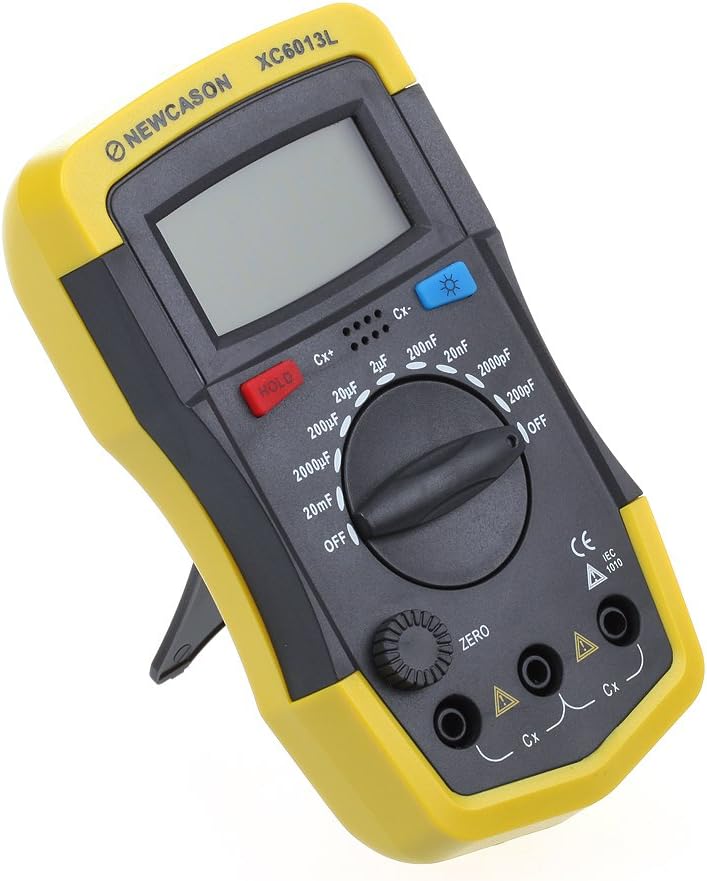
The New Capacitor Meter XC6013L is a compact, lightweight option with a 4.4 rating and a broad stated measurement range of 0.1 picofarad to 20,000 microfarads. It is designed for digital analysis, identifying unknown capacitance, matching capacitors, and measuring cable capacitance.
We may earn a commission when you buy through this link, at no additional cost to you.
Its large LCD screen makes values easy to inspect, while the small housing and low power consumption suit mobile or space-conscious work. The 20,000-microfarad upper limit also covers a substantial range of run and start capacitors, and the picofarad floor makes it more versatile than units that begin at several hundred picofarads.
The supplied information does not quote a numerical accuracy figure, and no continuity or short-circuit function is explicitly listed. Those omissions make it harder to compare with testers offering ±1% or ±5% claims. It also appears focused on capacitance tasks rather than a complete electrical troubleshooting package.
This meter is best for users who need a portable, straightforward instrument for unknown capacitors, component matching, and cable-capacitance work. Buyers focused on HVAC service may prefer a dedicated start/run tester, while electronics hobbyists may appreciate the unusually broad picofarad-to-microfarad coverage.
The range supports unknown-capacitor identification, matching, and cable-capacitance measurement. Those applications make it useful for hobby electronics as well as general component assessment.
Its compact, lightweight body reduces bulk in a tool kit or on a workbench. Low power consumption also supports the stated goal of convenient, extended use.
We may earn a commission when you buy through this link, at no additional cost to you.
The Watris Veiyi Digital Capacitance Meter provides a 1999-count LCD, data retention, and a backlight within a compact safety jacket. Its 4.0 rating places it near the lower end of the group, but the instrument provides a broad 0.1 picofarad to 20,000 microfarad range across nine levels.
We may earn a commission when you buy through this link, at no additional cost to you.
The backlit display helps in dim workspaces, while data retention allows a reading to remain visible. An integrated bracket lets the meter stand stably during longer bench tasks, and the protective jacket supports safer handling. Its stated sampling rate of two to three readings per second offers responsive feedback during routine measurements.
Power comes from a 6F22 9V laminated battery, which is not included. The listed dimensions are 5.59 by 2.91 by 1.38 inches, making it portable without becoming difficult to view. Like several inexpensive meters in this list, it focuses on capacitance rather than a broad set of electrical diagnostics.
This is a sensible choice for electronics learners, hobbyists, and technicians who want a self-contained capacitance meter with a readable display and stand. A dedicated HVAC model is more focused for motor capacitors, while buyers needing verified accuracy specifications may prefer one of the meters with a stated percentage.
The 1999-count backlit display improves readability, and data retention preserves a result while the user moves the probes or writes down information. Both features are useful in dim repair environments.
The built-in bracket creates a stable viewing angle without requiring a separate holder. It is a practical touch for repeated measurements or comparisons involving multiple capacitors.
We may earn a commission when you buy through this link, at no additional cost to you.
The Digital Capacitance Meter combines a 4.6 rating with a 0.1 picofarad to 20,000 microfarad range. Its 1999-count LCD includes a backlight, while the safety jacket gives the instrument a more protected feel and helps define its practical role as a dedicated, portable capacitance tester.
We may earn a commission when you buy through this link, at no additional cost to you.
The broad range is suitable for identifying capacitors across a wide mix of small and large values. A backlight is valuable in closets, equipment cabinets, and other locations where ambient light is poor. The protective jacket may also make the meter easier to grip during repetitive testing.
The available product information is sparse, and it does not provide a numerical accuracy rating, sampling speed, power requirements, or detailed accessory list. As a result, it is difficult to compare its precision with the CapMaster, MFD10 models, and FNIRSI. Prospective buyers should consult the current listing and manual for those operational details.
This meter is a compelling choice for users attracted by its 4.6 rating, broad range, and illuminated display without needing a multifunction meter. It may serve hobbyists and repairers particularly well, provided they can confirm power and accuracy requirements from the available documentation.
The LCD backlight makes readings easier to see inside appliances, control cabinets, or other poorly illuminated work areas. This is especially helpful when both hands are occupied with probes.
A 0.1 pF to 20,000 μF range provides considerable flexibility while keeping the tool focused on one job. It is a practical middle ground between specialized HVAC instruments and advanced LCR equipment.
We may earn a commission when you buy through this link, at no additional cost to you.
The FNIRSI LCR-ST1 takes a different approach by combining capacitance, resistance, inductance, and diode measurement in a pair of smart tweezers. Its 4.3 rating and 1.14-inch HD color display make it especially relevant to PCB repair, where traditional probe tips can be clumsy on tiny surface-mounted components.
We may earn a commission when you buy through this link, at no additional cost to you.
Three test frequencies—100 Hz, 1 kHz, and 10 kHz—provide flexibility for different component values. The capacitance range is 1 pF to 22 mF, while resistance, inductance, and diode functions broaden its usefulness. Automatic component recognition, primary and secondary parameter displays, ESR readings, and stored test records add substantial capability for electronics work.
Pointed and hook heads accommodate different component shapes, and the included storage bag helps protect the instrument. Records can be transferred to a computer via Excel, which is useful for documenting board-level diagnostics. The fixed screen does not flip or rotate, so users will need to work around its viewing angle.
This is not the most natural choice for testing a large HVAC run capacitor, but it is the strongest pick here for SMD repair and board-level troubleshooting. Buy it when precision access to tiny components and multi-parameter analysis matter more than a large motor-capacitor workflow.
Tweezer probes make contact directly with compact SMD components without the need to hold two separate probes. The pointed and hook heads provide options for tiny resistors, capacitors, and diodes.
Resistance, inductance, diode, ESR, D, Z, and Q readings turn the device into a compact board-analysis tool. Multiple frequencies allow users to examine component behavior rather than relying on a single reading.
We may earn a commission when you buy through this link, at no additional cost to you.
The right digital capacitor tester depends on the components you need to test, the accuracy you require, and whether you also need continuity, resistance, or broader electrical diagnostics.
Start with the capacitance values found in the equipment you service. HVAC motor and run capacitors commonly call for a microfarad-scale range, while electronics work may include picofarad ceramic capacitors or farad-scale units. The CapMaster 470F offers the broadest stated range, spanning 0.01 pF to 470 F, while several MFD10 models and dedicated meters focus on approximately 0.001 to 20,000 microfarads.
Choose a range that comfortably covers the expected values, including some headroom for tolerance and replacement parts. A meter whose maximum is too low will be unsuitable, while an unnecessarily wide range can make small values harder to resolve if accuracy is limited.
Accuracy determines how closely a displayed value should be expected to match the actual capacitance. The CapMaster claims up to ±1% accuracy, the MFD10 models state approximately ±5%, and some listings do not provide a numerical accuracy figure. A tighter specification can be valuable for selecting a matching capacitor, but range, stability, and test technique also affect real-world usefulness.
For routine HVAC fault diagnosis, a stated ±5% specification is generally practical when the reading is significantly different from the expected value. For precision matching or electronics design work, verify the accuracy specification and conditions in the product manual before relying on small differences.
A dedicated capacitor meter concentrates on capacitance, while some models also test continuity, open circuits, or short circuits. The Supco MFD10 adds continuity fault detection, and the AstroAI combines capacitance with voltage, current, resistance, temperature, and other functions. The FNIRSI adds resistance, inductance, diode, ESR, and frequency measurements for board-level work.
Match the instrument to the job rather than choosing only by the longest feature list. A technician diagnosing a compressor may need more range and clear results, while a board repairer may value automatic component recognition and data export.
A large display reduces mistakes when reading values in dim mechanical rooms, under appliances, or on a crowded workbench. LED and LCD technologies both appear in the list, and several products add a backlight. The MFD10 with the red LED display is designed for visibility in varying light, while the CapMaster uses a 128×64 LCD and the FNIRSI uses a 1.14-inch color screen.
Look beyond screen size and consider whether the digits are distinct, whether data hold is available, and whether the display suits your work environment. A backlight is particularly valuable when a stable overhead light is not available.
Power requirements affect field readiness and long-term ownership. Some MFD10 products use a 9V battery or three AAA batteries, and batteries may not be included. The CapMaster can use two AA batteries or 5V Micro USB power, while the FNIRSI is charged through a data cable. Confirm the required power source before ordering so you do not need to make an unplanned additional purchase.
For bench work, USB power can reduce battery changes. For service calls, a widely available battery format and a simple replacement process may be more valuable than a permanently connected power supply.
The right test leads can determine whether a meter is convenient on a particular component. The first MFD10 includes alligator clip leads, the third includes magnetic wires and vise clips, and the FNIRSI includes pointed and hook tweezer heads. Some meters also provide a soft case or integrated storage door.
Think about how you will actually connect to a capacitor. Clips are convenient for exposed terminals, magnetic wires may help in crowded assemblies, vise clips can provide a firm grip, and tweezers are valuable for small SMD parts. Included accessories should complement your normal connection method rather than merely adding clutter.
Field technicians need instruments that are easy to carry and capable of surviving repeated handling. Compact, lightweight construction appears across several products, and some housings are described as rugged, sturdy, or wear resistant. The AstroAI adds a kickstand for bench placement, while several dedicated meters include a soft case or a sliding storage compartment.
Balance size with durability and readability. A very small meter may be easy to carry but less comfortable to operate, while a larger instrument can still be practical if it has a protective housing and organized storage.
Extra features such as auto-ranging, manual ranging, zeroing, auto shutoff, data hold, data export, and automatic shutdown can simplify daily work, but they also matter only if you need them. For example, the CapMaster provides both automatic and manual ranges, the FNIRSI exports records to Excel, and the AstroAI supports data hold and a kickstand.
Also note limitations that affect daily operation. The FNIRSI has a fixed screen, some meters do not include batteries, and the third MFD10 may take approximately ten seconds for a reading to stabilize. These details often matter more than a secondary feature in a tool used under time pressure.
Begin by identifying the capacitor type, expected value, and the equipment's power state. Disconnect power and follow the service procedure for the appliance or circuit. A capacitor can retain a dangerous charge after it has been removed, so discharge it through an appropriate resistor before touching its terminals. Never short a large capacitor directly with a metal tool.
Remove the component when practical, or isolate it according to the equipment's service instructions. Connect the test leads to the correct capacitor terminals, select the appropriate range if the meter is manual, and take a reading. On models with auto-ranging, wait for the value to stabilize. The third MFD10 states that stabilization may take up to approximately ten seconds, so compare readings only after the display settles.
Compare the measured capacitance with the component's marked value and the service specification. Use continuity or fault checks where available, but remember that a capacitance value alone does not prove a capacitor is suitable for every circuit. Clean the meter, remove batteries during long storage, keep the contacts dry, and store loose leads in the supplied case or storage compartment.
A range extending to at least several thousand microfarads covers many common HVAC start and run capacitors, while a lower starting point adds flexibility. The MFD10 models reach 9,999 microfarads, and the CapMaster reaches 470 farad, which is an exceptionally broad upper limit. Always confirm the required value and tolerance for the specific equipment before testing.
Yes, if its measurement range covers the capacitor's marked value. Dedicated MFD10 and Supco models are explicitly intended for HVAC start and run capacitor testing. Disconnect and discharge the component safely, then compare the stabilized reading with the marked or service specification.
No, but ratings are useful when considered alongside specifications and intended use. The MFD10 with a 4.9 rating is dedicated to capacitance measurement, while the 3.9-rated CapMaster has a much broader range and tighter stated accuracy. The better choice depends on the components you test and the features you need.
A dedicated meter is usually simpler when capacitor testing is the main task because it focuses the controls and measurement range. A multimeter is more economical when you also need voltage, current, resistance, temperature, and other diagnostics. The AstroAI is the broadest general-purpose option in this list, while the FNIRSI is specialized for compact board components.
The printed tolerance, capacitor type, temperature, age, and measurement conditions can affect the result. A reading within the component's allowed tolerance is generally expected, while a large discrepancy may suggest deterioration or another fault. Use the service manual and the meter's guidance when interpreting borderline results.
First disconnect all power and verify that the circuit is de-energized. Use an appropriately rated discharge resistor and confirm that the capacitor is safe to handle before testing. Avoid directly shorting terminals with a screwdriver or other metal object, especially on large HVAC capacitors.
The FNIRSI LCR-ST1 is specifically designed for SMD work, with tweezer probes, a 1 pF to 22 mF capacitance range, and multiple test frequencies. The pointed and hook heads make it easier to contact tiny surface-mounted components than conventional full-size meter leads.
No. The first MFD10 includes a 9V battery, but the Supco MFD10, third MFD10, and CapMaster list batteries as not included. Check the product listing and packaging before use so the instrument is ready for its first measurement without an unexpected delay.
The MFD10 Digital Capacitor Tester with LED Display is the most compelling all-around dedicated pick because it combines a 4.9 rating, a broad 0.001 to 9,999 microfarad range, ±5% accuracy, and a compact rugged design. The Supco MFD10 is an excellent premium service option with continuity checks and a carry case, while the CapMaster 470F is the budget choice for exceptional range and up to ±1% stated accuracy.
Prioritize measurement coverage and accuracy for the capacitors you actually test, then add display visibility, accessories, and power convenience. HVAC professionals may favor a focused MFD10 or Supco instrument, electronics hobbyists may appreciate the CapMaster's range, and board repairers will find the FNIRSI tweezers unusually practical.
Ratings, product details, and availability can change, and current prices should be checked before buying. Review the latest listing and manual as well, particularly for the exact measurement range, accuracy conditions, included batteries, safe discharge procedures, and the accessories required for your preferred testing method.