
YCA1031 Photocell Sensor
4.6Editor score
Metal wall plate included
UL-listed 120V design
IP65 weather protection
A light sensor for outdoor lights gives lamp posts, porch fixtures, floods, and pathway lights the ability to switch on at dusk and off at dawn. The right photocell should match your fixture, electrical system, weather exposure, and mounting arrangement while avoiding false switching caused by headlights, lightning, or brief flashes.
This guide compares ten light sensors using the stated electrical ratings, compatibility, weather protection, mounting methods, delay features, and available customer ratings. It includes hard-wired sensors, twist-lock replacements, wall-plate options, swivel models, and multipacks for residential, commercial, and larger lighting projects.
Each review explains where that sensor is strongest and where its installation requirements may matter. The top three selections represent the overall, wall-plate-equipped, and multipack options, while the remaining entries provide useful alternatives. Product availability and pricing can change, so verify current listings before purchasing.
4.6Editor score

4.4Editor score

4.2Editor score
As an Amazon Associate we earn from qualifying purchases.
The table below highlights the major differences among all ten photocell sensors, including their electrical limits, mounting approach, weather resistance, and most relevant use cases.




The YCA1030 Dusk to Dawn Sensor is a broadly compatible hard-wired photocell for outdoor fixtures, earning a 4.4 customer rating. Its standout appeal is the combination of a standard through-hole design, a broad 120V–277V operating range, and compatibility with incandescent, fluorescent, LED, halogen, mercury vapor, high-pressure sodium, and CFL loads. That makes it a practical choice for lamp posts, wall packs, floodlights, and wall scones.
We may earn a commission when you buy through this link, at no additional cost to you.
The listed electrical rating is 600W tungsten, which is sufficient for many residential fixtures but requires attention when controlling large commercial arrays. Weather protection is a meaningful strength: the sensor has an IP65 rating, and its weather-resistant body is designed to handle rain and dust. The built-in time delay helps prevent a lamp from shutting off because of headlights, lightning, or a short-lived flash, making the unit better suited to real outdoor conditions than a bare minimum sensor.
The principal trade-off is installation complexity. This is not a plug-in replacement; it uses a through-hole mount with a locking nut and washer gasket, and the minimum opening is listed as 5/8 inch. It also does not provide the highest load rating among the products reviewed. Nevertheless, those constraints are predictable and may be preferable for someone replacing a wired fixture or installing a new post light with a conventional mounting opening.
This is the strongest general recommendation for homeowners and installers who want one sensor to cover several common fixture types without moving to a more specialized mounting system. Check the fixture's voltage and load, confirm that a 5/8-inch opening is available, and verify local electrical requirements. If those conditions align, the YCA1030 offers broad compatibility, dependable weather protection, and useful delay behavior in a familiar hard-wired format.
The unusually broad list of compatible loads is the model's defining practical advantage. It can serve residential or commercial post lights, wall packs, floods, and scones without requiring the installer to limit the installation to only one lamp category. Its 120V–277V range also offers more flexibility than a sensor limited strictly to 120V.
An IP65 rating and a moisture-oriented body make the sensor appropriate for exposed outdoor positions. The optional frosty cap is not needed for the stated protection level, so users can prioritize appearance while preserving the sensor's weather-resistant construction.
We may earn a commission when you buy through this link, at no additional cost to you.
The YCA1031 Photocell Sensor carries a 4.6 rating and stands out because its metal wall plate can serve as a ready-made mounting solution for exterior and porch installations. It can control floodlights, wall packs, or wall scones while remaining adaptable for lamp posts or fixture-mounted replacements. That combination of included hardware and placement flexibility makes it the most thoughtfully equipped wall-plate option in this guide.
We may earn a commission when you buy through this link, at no additional cost to you.
Electrical specifications cover 100V–277V AC at 50/60Hz, with a 600W tungsten rating and compatibility across incandescent, fluorescent, LED, halogen, mercury vapor, high-pressure sodium, and CFL lighting. Both the sensor and wall plate are rated IP65, and the plate includes a waterproof pad. A modern electronic trigger circuit is also included, giving the product a more refined construction than older photocells with exposed squiggly red wires.
Its limitations are similar to those of the first-ranked model: the 600W tungsten maximum is not intended for every heavy commercial circuit, and installation involves connecting the device rather than simply pushing it into a receptacle. The included wall plate reduces the need for separate mounting hardware, but users still need a suitable surface and must follow safe electrical procedures. Fixture placement and wire routing also need care to prevent the sensor from being shaded or illuminated by its own controlled light.
Choose the YCA1031 when a clean wall-mounted installation is the priority and you want the metal plate and weatherproof pad in one package. It is particularly attractive for a porch, garage-side floodlight, exterior sconce, or an existing wall-pack circuit. For lamp-post replacement, the same sensor can also be used without the wall plate, giving buyers more options than a product sold strictly as a wall accessory.
The included metal wall plate and waterproof pad reduce the number of separate parts needed for a traditional exterior installation. It is particularly useful where the sensor needs to sit away from a fixture opening, giving the installer a more deliberate location for sensing ambient light.
Because the plate can be removed, the photocell can be installed inside a fixture or used with a post light. This makes the product adaptable to multiple outdoor layouts rather than locking the buyer into one fixture style.
We may earn a commission when you buy through this link, at no additional cost to you.
This two-pack photocell sensor is rated 4.2 and provides a practical choice for buyers who need more than one outdoor light controlled automatically. Its two-unit format is useful for matching fixtures along a driveway, across a yard, around a parking area, or at opposite ends of a property. The stated 1800W/1100VA load support also makes it one of the higher-capacity options in the comparison.
We may earn a commission when you buy through this link, at no additional cost to you.
The sensor turns a compatible light on at dusk and off at dawn without a central controller or app. Its specified switching thresholds are 10–20 lumens for activation and 30–60 lumens for deactivation, giving the user a defined operating range. A built-in delay helps isolate the fixture from brief environmental light sources, while the rotating installation lets an installer orient the sensing area.
The pack is limited to 120V AC, so it is less flexible than several multi-voltage choices. Its IP54 protection handles rain, dust, and outdoor conditions, although IP65 models offer a higher ingress-protection designation. The load figures also should not be treated as permission to connect any fixture regardless of its own rating. Confirm the fixture type, voltage, and load before installation.
This multipack is best for someone upgrading several fixtures at once or maintaining a commercial-style property with multiple outdoor lights. It offers automatic operation, useful delay behavior, adjustable placement, and high stated capacity without requiring a separate controller. Choose it when 120V is the circuit voltage and both units will be used. If a single 120V fixture needs a higher ingress rating, one of the IP65 alternatives may be a better fit.
The two included sensors are suited to coordinated installations where consistent dusk-to-dawn behavior matters across a property. They can serve yards, sidewalks, parking areas, signage, and perimeter fixtures without separate purchases for each site.
Stated activation and deactivation levels give users a clearer expectation of when the sensor will respond. Combined with the delay function, these thresholds help create stable operation around roads, walkways, and areas exposed to passing headlights.
We may earn a commission when you buy through this link, at no additional cost to you.
The Outdoor Photoelectric Sensor earns a 4.5 rating and offers the most generous stated tungsten capacity in this group at 1800W. It also supports a 1100VA ballast rating, making it a relevant option for larger hard-wired outdoor fixtures. Its adjustable base and swivel design are especially useful when a fixture's knockout or conduit opening is not perfectly aligned with the desired sensing direction.
We may earn a commission when you buy through this link, at no additional cost to you.
The 120VAC, 50/60Hz sensor automatically controls compatible lights at dusk and dawn. It works with LED, CFL, fluorescent, incandescent, and other bulb types, while the stated uses include lamp posts, parking lots, streets, holiday and string lights, pathways, factories, and landscape illumination. The time-delay function is intended to prevent occasional light from causing an incorrect response.
The product is UL listed, and its polycarbonate casing is described as corrosion preventive and waterproof. The stated IP65 rating supports use in exposed locations. However, the 1800W tungsten and 1100VA ballast figures describe the sensor's limits rather than the capacity of every attached fixture. Electrical compatibility remains the installer's responsibility, and the unit requires a hard-wired setup.
This sensor is a strong candidate for contractors, property managers, or homeowners comfortable with fixture wiring who want a high load rating and adjustable orientation. It can be especially helpful where the photocell needs to be turned away from a nearby wall, roof edge, or other obstruction. Confirm that the circuit is 120V, respect both load limits, and ensure the swivel direction provides an unobstructed view of changing daylight.
The base can be adjusted through a maximum of 180 degrees, allowing the installer to direct the sensing lens toward open sky or a more representative part of the surroundings. This helps reduce shadows created by nearby structures.
The listed 1800W tungsten and 1100VA ballast ratings support use with more demanding fixtures than lower-capacity sensors. These limits should still be checked against the lamp and driver being controlled.
We may earn a commission when you buy through this link, at no additional cost to you.
The Multivoltage Swivel Photocell provides two sensors and a 4.5 customer rating. Its most useful feature is the broad electrical range, with the product information describing 120V–277V AC operation and compatibility with LED, CFL, fluorescent, incandescent, and other loads. That makes it suitable for a mixed property containing different outdoor circuits rather than a single standardized installation.
We may earn a commission when you buy through this link, at no additional cost to you.
The threaded swivel mount allows the sensor to be positioned at a precise point, while the stated IP65 water-resistant body and heavy-duty construction suit exterior use. The sensor includes surge protection, a 5–20-lux on level, a 20–60-lux off level, and a delay intended to prevent headlights or lightning from switching the load off unexpectedly. A three-year warranty is also offered.
The product information does not state a specific maximum wattage or ballast load, which makes comparison more difficult than with models that publish clear figures. Buyers should ask the seller for confirmation if their planned fixture approaches the limits of the system. The threaded body must also fit the available knockout, and the rubber gasket and lock nut need proper installation to maintain weather resistance.
Choose this product when you need two outdoor sensors and operate across more than one standard AC voltage. It is suited to exterior, street, passage, and doorway lighting where a swivel can improve the sensor's view. The delay, surge protection, and wide voltage range are its strongest arguments. Ensure the fixture's own operating specifications and local electrical requirements are met before purchase.
Supporting 120V–277V allows one product family to handle several common outdoor circuits. Buyers should still verify the exact voltage at each installation and should not assume that every fixture component shares the same rating.
Surge protection adds a layer of protection for the controlled lamp post, while the time-delay behavior helps the load remain on during brief environmental flashes. Neither feature changes the need for correct wiring or safe installation.
We may earn a commission when you buy through this link, at no additional cost to you.
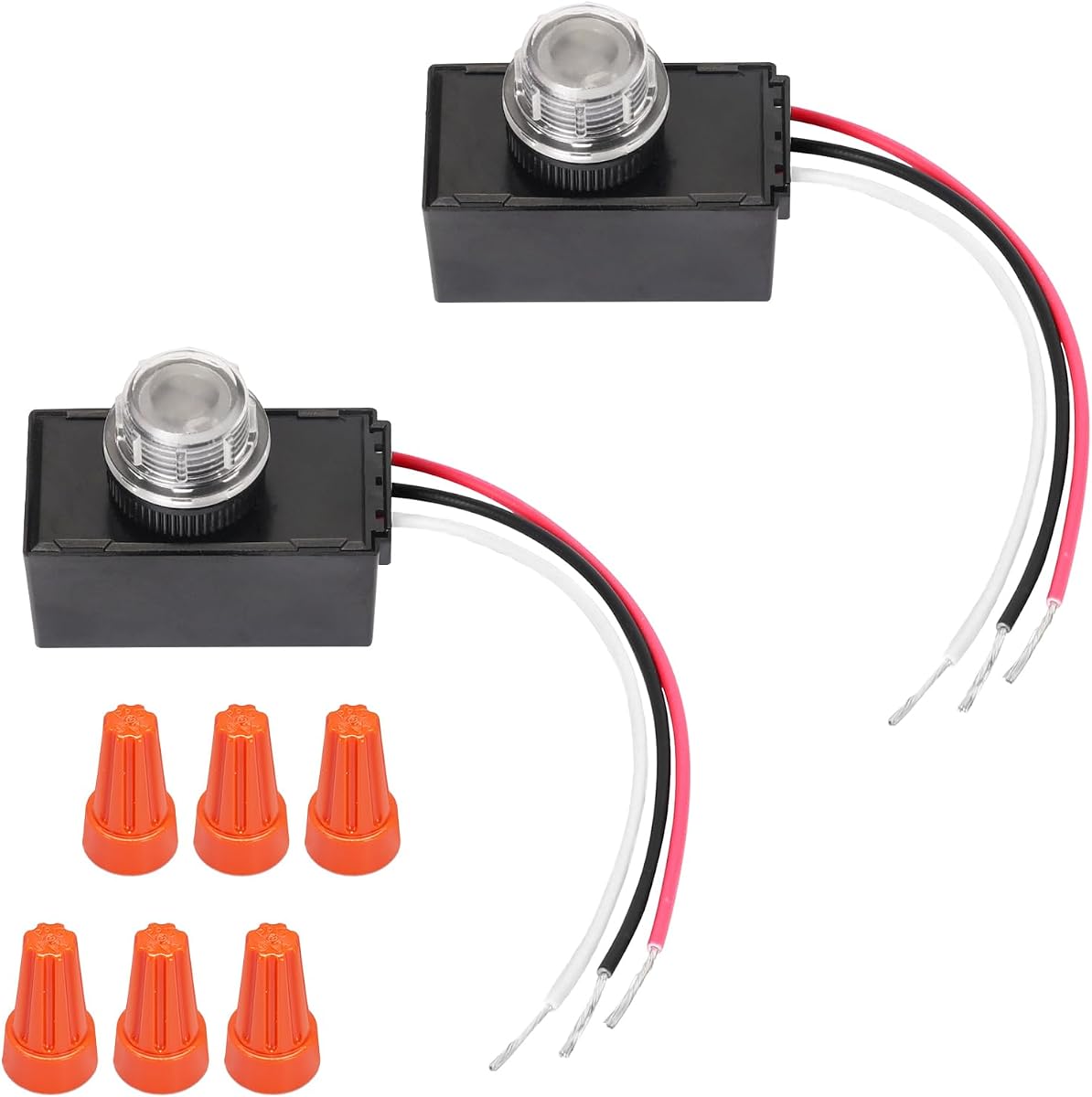
The 2-Pack Photoelectric Switch has a 4.5 rating and combines a compact body, a broad 120V–277V operating range, and the convenience of receiving two complete units. Its stated dimensions of approximately 2 by 1 by 2 inches are designed to fit residential outlet boxes and many standard outdoor fixtures, making it less cumbersome than a larger externally mounted assembly.
We may earn a commission when you buy through this link, at no additional cost to you.
An updated integrated circuit is used to trigger automatic operation according to ambient light. The heavy-duty plastic case and sealing design are rated IP65 and are intended to withstand rain, wind, and snow. The product is compatible with incandescent, CFL, LED, and halogen sources, covering the types most commonly found in post lamps, porch lights, and floodlights.
The package includes six wire caps, two gaskets, two lock nuts, and two lens covers. Those accessories support assembly, but they do not eliminate the need to match the sensor to the fixture opening and wiring system. The listing does not provide a clear maximum wattage, which is an important limitation for buyers with high-output lamps. The product is hard-wired, so it is less convenient than a plug-in photocell.
This two-pack is a good match for homeowners who want to add automatic control to two compact fixtures or want a spare for future replacement. Its advantages are simple packaging, a useful voltage range, and a form factor suited to residential boxes. Before installing, confirm that the fixture provides a suitable opening, verify the load with the seller if necessary, and position the lens where artificial light will not cause repeated switching.
The small housing is intended for outlet boxes and common outdoor fixtures where a larger wall enclosure may be inconvenient. Its size does not eliminate the importance of a secure, moisture-resistant connection.
Each sensor is supported by included wire caps, gaskets, lock nuts, and lens covers. That makes the package convenient for two installations and provides basic consumable components at the same time.
We may earn a commission when you buy through this link, at no additional cost to you.
The Solus Dusk-to-Dawn Sensor has a 4.6 rating and is designed around a specific replacement experience. Its Ezee Change Plug allows a worn sensor to be exchanged without rewiring after the initial installation, making it appealing for residential post lights where future maintenance may otherwise require opening the fixture and reconnecting wires.
We may earn a commission when you buy through this link, at no additional cost to you.
The unit is UL listed, operates at 120V, and is intended for lamp posts with a 3-inch body and a 1.375-inch-diameter mounting hole. The stated load support includes up to 300W incandescent, 60W LED, 39W fluorescent, and 100W HID. A built-in photocell provides automatic on-at-dusk and off-at-dawn operation, and the product is backed by a five-year warranty.
Its capacity is lower than that of several competing sensors, especially for incandescent and HID loads, so matching is essential. The specified 3-inch post and 1.375-inch mounting hole may not suit a different fixture or an existing standard wall-pack design. The plug-based replacement also presupposes that the original installation used a compatible arrangement; it does not make the sensor appropriate for every hard-wired application.
Choose the Solus model for a compatible 3-inch outdoor post light when future serviceability matters. The quick-change plug and long warranty make it particularly attractive for residential installations where convenience and dependable replacement access are priorities. Verify both the fixture dimensions and the lamp's electrical requirements before ordering. If the post does not match or the load exceeds the stated limits, select a broader hard-wired sensor instead.
The Ezee Change Plug separates ongoing sensor replacement from the original wiring task. Once installed correctly, a future unit can be exchanged more quickly, which is particularly helpful for hard-to-reach post lights.
The product lists separate wattage ceilings for incandescent, LED, fluorescent, and HID sources. Those explicit limits make it easier for buyers to identify a suitable lamp before beginning the installation.
We may earn a commission when you buy through this link, at no additional cost to you.
The Twist-Lock Photocell earns a 4.6 rating and offers one of the simplest installation paths in the guide. Instead of attaching wires inside a fixture, it twists into a standard receptacle designed for a photoelectric control. That arrangement can dramatically simplify replacement when an existing outdoor fixture already accepts this style of photocell.
We may earn a commission when you buy through this link, at no additional cost to you.
The sensor operates across 120V–277V AC and has listed ratings of 1000W tungsten and 1800VA ballast. It automatically turns a compatible light on at dusk and off at dawn, with surge protection and an IP65 weather-resistant housing. Its time delay is specified at three to 20 seconds, helping the controlled fixture remain on during a lightning flash or another temporary source of light.
The main constraint is obvious: the fixture must have a compatible twist-lock receptacle or base. A buyer cannot assume every outdoor light accepts this sensor without first identifying its socket. The product is also hard-wired at the base even though the final sensor-to-fixture connection uses a twist lock, so fixture wiring and electrical safety remain relevant during the initial setup.
This is a particularly good choice for streetlights, barn lights, parking-lot lamps, and other fixtures designed around a standard twist-lock photo control. It is best for users who prioritize fast replacement and broad voltage support over the flexibility of a through-hole mounting kit. Confirm the receptacle type, confirm that the fixture's lamp remains within the listed limits, and install the base with the required gasket and locking hardware.
The twist-lock connection reduces the physical work involved when replacing an existing compatible sensor. It is an efficient option for commercial fixtures designed for serviceable photocell controls.
A three-to-20-second delay gives the switch time to distinguish sustained darkness from short-lived illumination. This is useful near roads, driveways, and open areas where vehicles, lightning, or other brief sources may otherwise interrupt the circuit.
We may earn a commission when you buy through this link, at no additional cost to you.
The 120V Hard-Wired Photocell has a 4.5 rating and distinguishes itself through low power consumption and a clearly documented three-wire installation. It is intended to be mounted inside a weatherproof outdoor fixture, which makes it relevant for wall packs, driveway and walkway lights, post lamps, pole lanterns, and entryway porch lights.
We may earn a commission when you buy through this link, at no additional cost to you.
Its maximum loads are listed as 100W incandescent, 55W fluorescent, and 55W LED driver. The sensor itself consumes only 0.5W, and its rated service life is stated at up to 50,000 hours. It complies with the ETL lighting-control standard and FCC Part 15, Class B, while a five-year warranty adds support for buyers seeking long-term reliability.
The lower load limits are the main consideration, especially for modern LED fixtures with a driver rated above 55W. The sensor also requires a 3/8-inch hole with M9 by 1.0 pipe threads, so the fixture must accept that specific threaded pattern. It is designed for hard-wiring with black connected to line, white to neutral, and red to load, meaning it offers less convenience than a twist-lock model.
This sensor is best for a compatible 120V fixture with a relatively modest lamp load and a suitable threaded opening. Its low consumption and long stated service life make it attractive for frequently used residential or commercial outdoor lighting. Install it only within a weatherproof enclosure and verify the voltage, load, thread size, and wiring scheme before connecting it.
The 0.5W operating consumption is notably low for a continuously active control. The photocell uses very little power while comparing ambient light levels, and it switches the attached fixture without routine manual operation.
A documented line, neutral, and load arrangement reduces ambiguity once the fixture has been de-energized. The unit is intended for inside a weatherproof housing rather than for direct exposure in an open enclosure.
We may earn a commission when you buy through this link, at no additional cost to you.
The Greencycle Water-Resistant Photocell has a 4.7 customer rating, the highest rating among the ten products, and combines that reception with a stated 1800W maximum load. Its additional 9.2A current ceiling provides a second important limit to check before connecting a fixture or a group of fixtures to the sensor.
We may earn a commission when you buy through this link, at no additional cost to you.
The housing and waterproof seal are rated IP65 for outdoor durability, and the electronic trigger circuit is designed for operation in rain, snow, sun, humidity, and cold. A built-in delay of 20–30 seconds prevents the load from temporarily switching off because of passing headlights, lightning, or a light flash. The unit is UL listed and backed by a five-year service commitment.
Installation is hard-wired, with black connected to black, white to white, and red to the load. The product can be wired from the back or side, which gives some flexibility when working inside a fixture. The current restriction is especially important for multiple-lamp installations: wattage alone is not enough to confirm suitability because the combined draw must also remain below 9.2A.
This sensor is well suited to a larger outdoor fixture or a 120V circuit whose load remains within both stated limits. Its strong weather rating, long delay, and high customer rating make it a convincing all-around alternative for exposed or demanding installations. Confirm the circuit voltage, lamp load, current draw, and mounting location before purchase, and use a weatherproof enclosure wherever required.
The combination of a 1800W maximum and 9.2A maximum current supports larger fixtures while giving installers two separate checks. For multipoint circuits, calculate the current rather than merely adding bulb wattage.
A 20–30-second delay gives the sensor time to ignore brief illumination near roads and open properties. That delay can reduce unnecessary cycling caused by headlights, lightning, or transient light sources.
We may earn a commission when you buy through this link, at no additional cost to you.
Choosing a reliable outdoor photocell requires matching the control to the fixture, circuit, environment, and maintenance plan. The following factors help narrow the options before installation begins.
Begin by identifying the voltage at the fixture rather than assuming that every outdoor light uses the same supply. Several options in this guide operate from 120V to 277V AC, while others are restricted to 120V. A multivoltage sensor can be convenient on a mixed property, but the attached lamp, ballast, driver, and existing wiring must all be compatible. Mismatched equipment can prevent reliable operation or create an unsafe installation, so treat the voltage listed on the fixture and power supply as the controlling information.
Load ratings determine which lamps and fixtures a photocell can safely control. Tungsten, fluorescent, LED-driver, and ballast figures are not interchangeable, so read the rating that applies to your source. One option lists 1800W tungsten and 1100VA ballast, while another supports up to 300W incandescent, 60W LED, 39W fluorescent, and 100W HID. A separate model adds a 9.2A maximum current. If one sensor controls several lamps, evaluate both the combined wattage and current rather than checking each bulb in isolation.
Mounting style determines whether installation will be straightforward. A twist-lock sensor fits a standard photo-control receptacle and is usually the quickest replacement option. Through-hole models require a specified opening, gasket, and lock nut. The Solus model targets 3-inch lamp posts with a 1.375-inch mounting hole, while another sensor uses M9 threaded pipe and a 3/8-inch opening. The YCA1031 includes a metal wall plate for exterior mounting. Inspect the existing fixture before choosing, because a sensor cannot create a suitable opening or receptacle on its own.
Outdoor sensors need protection from rain, dust, snow, and sunlight. An IP65 rating appears on most of the products reviewed and indicates a higher level of ingress protection than the IP54 rating assigned to the two-pack 120V sensor. Weather ratings describe the sensor housing, not permission to expose any wiring or connection. Some products are intended to be installed inside a weatherproof fixture, while others are designed for a direct exterior position or an external wall plate. Follow the stated mounting conditions and use the specified gasket, pad, lens cover, and lock nut to preserve protection.
A photocell must receive a useful view of changing ambient light. Swivel bases and rotating installation options allow the sensor to face away from an obstruction or the light it controls. A wall plate can also help place the sensor where the fixture's own lamp will not create a false signal. The YCA1030 has a standard post-eye shape, while several alternatives advertise adjustable positioning. Before installation, consider nearby walls, eaves, trees, signs, and the direction of the controlled lamp so the sensor can distinguish dusk and dawn from temporary illumination.
A time-delay feature can prevent lights from switching off in response to headlights, lightning, or brief flashes. Published delays range from three to 20 seconds on the twist-lock model and 20–30 seconds on the Greencycle sensor, while other products describe the feature without one exact figure. Some models also publish ambient-light thresholds, such as activation at 10–20 lumens and deactivation at 30–60 lumens. These details help predict behavior around roads and driveways. Choose a delay and response range that suit the site rather than assuming every sensor will react at the same point.
The list of supported sources matters because some photocells specify tungsten and ballast limits while others explicitly cover LED, CFL, fluorescent, incandescent, halogen, mercury vapor, high-pressure sodium, and other loads. A fixture with an integrated LED driver may have its own surge, dimming, or switching requirements that are not addressed by the sensor listing. Use a photocell approved for the complete fixture, and avoid using a dimmer-specific arrangement unless both devices are designed to work together. The goal is automatic switching without reducing lamp compatibility or introducing erratic behavior.
A simple installation can make a major difference in future serviceability. Twist-lock sensors are convenient when the fixture already has a compatible base. The Solus Ezee Change Plug is designed for quick replacement in compatible 3-inch post lights, and the YCA1031 includes wall-mounting hardware. Other units are hard-wired through a threaded or through-hole mounting arrangement. Before buying, assess whether you can safely de-energize the circuit, reach the fixture, make the required connections, and seal the installation. Correct tools, a compatible opening, and sound weatherproofing matter more than minor differences in marketing language.
Start by switching off and properly de-energize the fixture's circuit before touching the sensor or wiring. Identify the fixture's voltage, load, and mounting method, then compare them with the photocell's specifications. Confirm that the existing opening, receptacle, or threaded mount is compatible. If replacing a sensor, note the original wire positions and follow the product's stated line, neutral, and load arrangement; never assume that color coding alone makes every installation safe.
Mount the sensor where it can perceive ambient light without being shaded by a roof, wall, or dense foliage. Keep the lens clean and make sure the controlled lamp does not shine directly back into it. For swivel or rotating models, orient the sensor toward open sky or the area whose light level best represents dusk and dawn. If using a wall plate, install the gasket and pad as specified, and route the wiring so it does not remain exposed beyond the approved enclosure.
Restore power and test the control in darkness. Cover the lens completely with an opaque material to simulate nighttime and confirm that the lamp turns on; remove the cover and allow the sensor to see ambient light again to confirm that it turns off appropriately. Do not perform the test with exposed energized wiring. During maintenance, wipe away dust, leaves, insects, and water deposits, check that seals remain seated, and inspect the connection for moisture or corrosion. Replace the sensor if operation becomes erratic or its housing is damaged.
A light sensor for outdoor lights is a photocell that measures ambient light and automatically controls a connected fixture. It typically turns the light on when dusk lowers the light level below its operating threshold and turns it off when dawn raises it above the threshold. Many models also include a delay so passing headlights or brief flashes do not cause unwanted switching.
Yes, but only when both the sensor and the LED fixture are rated for that use. Many products in this guide explicitly support LED loads, while others publish separate wattage ceilings for LED, incandescent, fluorescent, and ballast-operated fixtures. Check the lamp's own rating, the driver or ballast specifications, and the sensor's voltage before installing. An LED bulb connected to a fixture that is not compatible with automatic control may flicker or switch incorrectly.
A twist-lock sensor is usually easier when the fixture already has a compatible photo-control receptacle. It can be removed and replaced without reconnecting the individual wires. A hard-wired sensor still requires the appropriate base, wiring, opening, gasket, and locking hardware, and the initial connection must be completed carefully. The most convenient option is the one that matches the fixture rather than simply the one with the shortest description.
Many residential outdoor lights operate on 120V AC, but some products support a broader 120V–277V AC range. A sensor restricted to 120V is not interchangeable with a 240V fixture or circuit. Read the voltage label on the lamp, ballast, driver, or power supply and verify it against the sensor before installation. Multivoltage models offer flexibility but still require every connected component to be suitable.
A well-designed time-delay feature reduces the chance that headlights will switch the fixture off. The sensor evaluates the light over a short interval instead of reacting immediately to every isolated flash, so temporary illumination is less likely to interrupt the circuit. This does not guarantee perfect behavior at every location. Position the sensor away from roads and other strong light sources where possible, and follow the manufacturer's delay and sensing instructions.
Both are ingress-protection ratings, with IP65 indicating a higher level of protection than IP54. The first digit in each rating concerns solid-particle protection, while the second concerns water ingress. An IP65-rated sensor is generally the stronger choice for a directly exposed exterior location. The rating applies to the sensor as specified, and it does not make improperly exposed wiring or a non-weatherproof fixture enclosure safe.
The answer depends on the fixture, the electrical system, and the installer's qualifications. Every installation involves working around mains electricity, even when the connection seems simple. Some twist-lock replacements can be straightforward for an experienced homeowner, but new hard-wired sensors may require opening fixtures, identifying line and neutral conductors, and making code-compliant connections. Follow local requirements and use qualified electrical assistance when the circuit is uncertain or the work is beyond your experience.
Possible causes include a sensor shaded by an eave or wall, direct illumination from the controlled lamp, a lens covered by dirt, incorrect wiring, or a fixture that does not support the sensor. Confirm that the photocell is exposed to changing ambient light and that its mounting orientation is appropriate. If the sensor is in direct sunlight, shield it only in a manner consistent with its instructions. Also verify the voltage and wiring before replacing any component.
The YCA1030 Dusk to Dawn Sensor is the strongest overall option because it combines a broad voltage range, compatibility with numerous lamp types, IP65 protection, and a conventional through-hole installation. The YCA1031 is especially attractive when a metal wall plate and weatherproof pad are needed, while the two-pack photocell is the most useful choice for multiple 120V fixtures and offers substantial stated load capacity.
Before choosing, prioritize physical compatibility. Verify the voltage, lamp type, load, current, mounting opening, and fixture receptacle first. Then consider the environment, sensing direction, weather rating, and delay behavior. A sensor that suits the installation correctly is more valuable than one with a higher headline rating but an opening, load limit, or enclosure that does not match your outdoor lighting.
Product details and pricing can change, so confirm the current listing, specifications, warranty information, and included installation parts before purchasing. With those final checks in place, the right photocell can provide dependable automatic lighting while reducing the need to operate exterior fixtures manually.