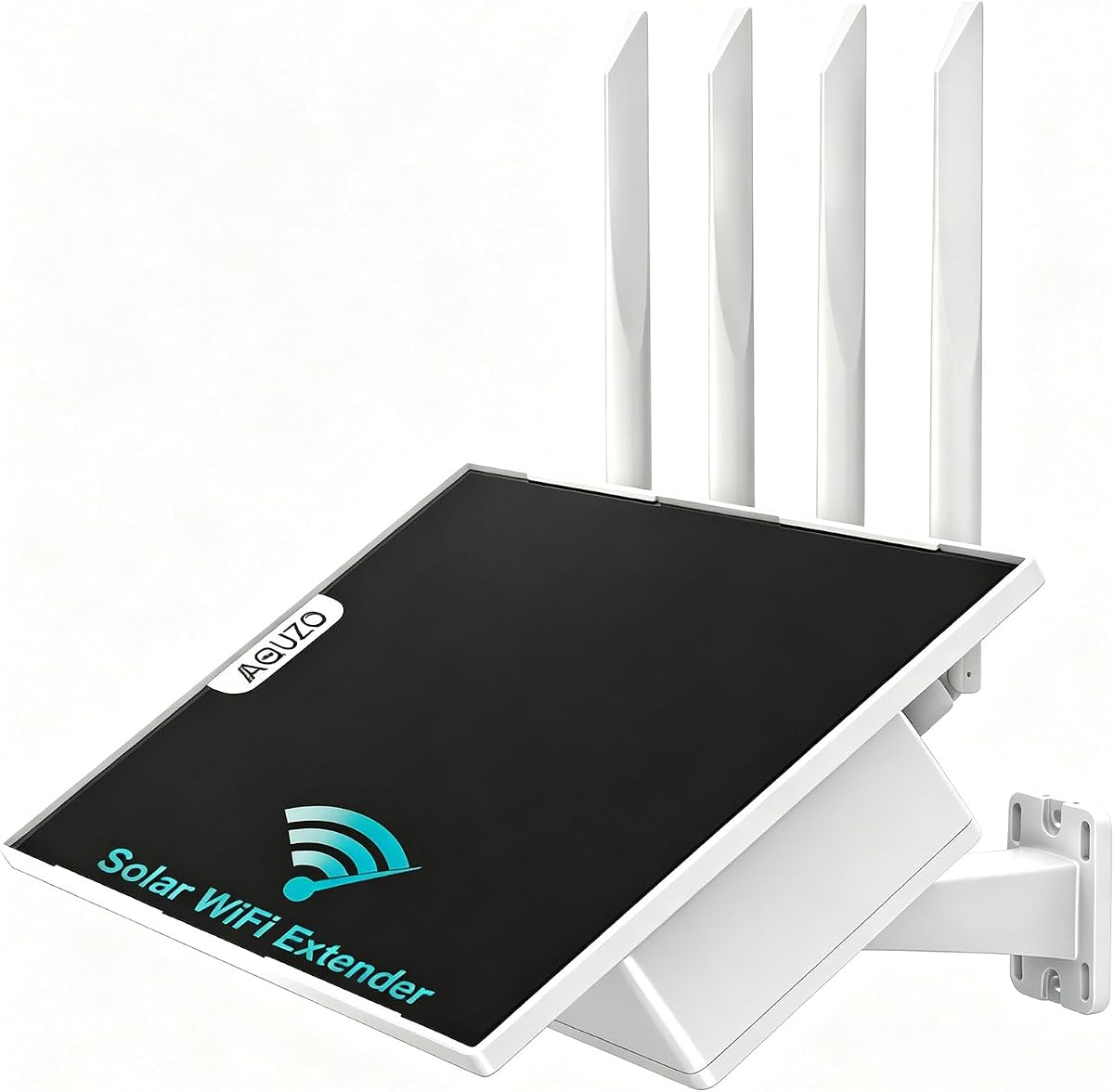
WiFi Extender Outdoor Solar Powered E8
4.5Editor score
Solar-powered 2.4GHz system
IP66 weather-resistant enclosure
Four 5dBi external antennas
Our outdoor WiFi range extender guide compares weatherproof models, wireless standards, PoE options, antenna design, coverage claims, and installation
Outdoor WiFi range extenders can transform weak or unavailable connections across yards, farms, garages, patios, parking areas, and other open-air spaces. The right model combines a suitable wireless standard, durable weather resistance, effective antennas, flexible power options, and enough flexibility for the layout of your property.
We compared ten outdoor-focused and outdoor-capable extenders using their published specifications, stated coverage, weather ratings, wireless standards, operating modes, supported device counts, and installation requirements. The list covers dual-band and single-band systems, wired and solar-powered options, and products designed for either simple coverage expansion or centrally managed networks.
Each pick highlights a different balance of features, revealing which model best fits a broad yard, a remote camera, a complex mesh setup, or a budget-conscious installation. Product configurations and availability can change, and prices vary over time, so verify the current listing and technical details before purchasing.
4.5Editor score
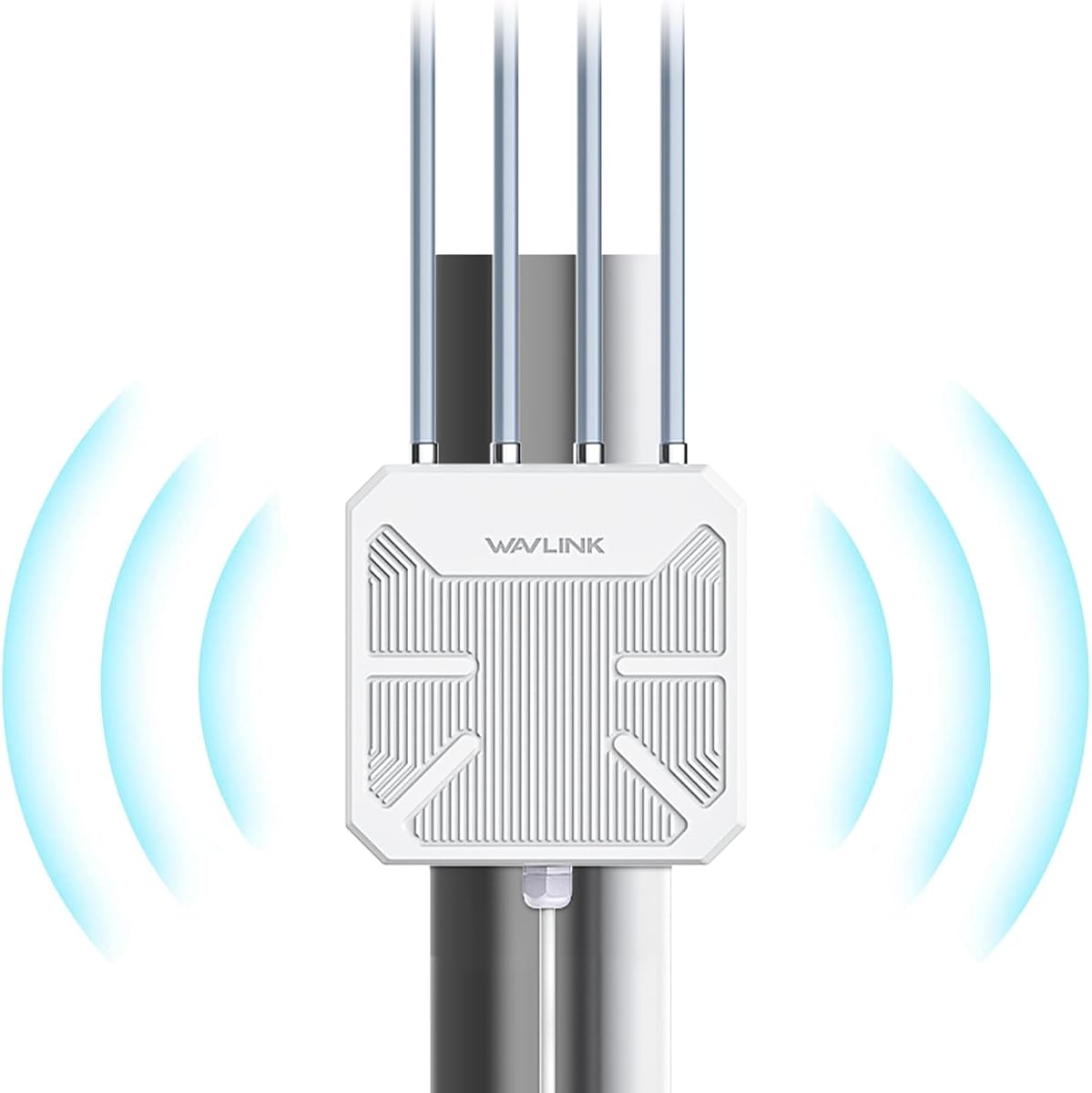
4.3Editor score

4.2Editor score
The comparison below highlights the major differences in wireless generation, radio configuration, weather protection, power delivery, coverage claims, and management features across all ten products.


The 2026 WAVLINK AX1800 Outdoor WiFi 6 Extender Long Range, IP67 Weatherproof is the strongest all-around choice in this guide because it combines modern WiFi 6 hardware, a genuinely outdoor-oriented enclosure, four external antennas, and flexible wired power. Its listed 4.3 rating reflects a favorable buyer response, while the specification sheet targets properties where an indoor router signal simply cannot reach.
We may earn a commission when you buy through this link, at no additional cost to you.
The unit offers dual-band AX1800 performance, with the supplied information listing 1201 Mbps on 5GHz and 574 Mbps on 2.4GHz. Four detachable 8dBi omni-directional fiberglass antennas are intended to project coverage across open areas, while the product listing claims a line-of-sight radius of approximately 200 to 300 meters and support for as many as 256 devices. Those figures describe the manufacturer's stated potential rather than guaranteed real-world results, and walls, vegetation, terrain, and interference can materially change performance.
Outdoor durability is another major strength. The IP67 housing is described as sealed, heat resistant, and capable of operating from -20°C to 50°C. The specification details also list resistance to moisture, dust, 6KV lightning, and 15KV static discharge. Installation is flexible because the extender supports 802.3af/at active PoE and passive PoE, allowing data and power to travel over one Ethernet cable. However, the included adapter is not waterproof and must be kept in a protected location.
This is a strong recommendation for owners of large yards, farms, estates, garages, RV areas, and other open environments. It is especially attractive when a user wants dual-band WiFi 6, wired deployment, and support for cameras or other connected devices without relying on a nearby power outlet. Buyers who only need a basic indoor extension may find a simpler device more appropriate, but for a comprehensive outdoor installation, this model offers the most balanced feature set.
The four 8dBi antennas are intended to distribute signal in multiple directions, making the unit well suited to broad yards, driveways, agricultural areas, and RV parking spaces. Coverage is most likely to perform well with an unobstructed line of sight between the extender and connected clients.
Active or passive PoE simplifies installations where conventional power is inconvenient. Mesh, AP, Router, Repeater, and AP-plus-Repeater modes also allow the device to fill different roles, although unified mesh operation is limited to compatible WAVLINK products.
We may earn a commission when you buy through this link, at no additional cost to you.
The TP-Link AC1200 WiFi Extender Dual Band 5GHz/2.4GHz (RE315) is a practical choice for extending a network into a garage, basement, patio area near the house, or another lightly exposed location. It carries a 4.2 rating and uses familiar dual-band AC1200 technology, with listed maximum bandwidth of 867 Mbps on 5GHz and 300 Mbps on 2.4GHz.
We may earn a commission when you buy through this link, at no additional cost to you.
The RE315 emphasizes convenient placement and management. Adaptive Path Selection, One-Touch Connection, and the TP-Link Tether app help users locate a suitable position, while an intelligent signal indicator makes it easier to judge connection strength. Two adjustable external antennas support coverage across areas of up to 1,500 square feet, and the device can support up to 32 connected clients. A Gigabit Ethernet port also provides a wired option for a compatible desktop, game console, or other networked device.
Network integration is another benefit. The listing says the RE315 can form a whole-home mesh connection with an EasyMesh-compatible router, using Adaptive Path Selection to move clients toward stronger signals. It is not compatible with Deco mesh systems. As with any extender, the device improves coverage and signal reliability rather than directly increasing the speed delivered by the main router, and throughput can be reduced when the client is far from the main access point.
This model makes the most sense for indoor or protected-area extension where ease of setup matters more than weatherproof construction. Buyers needing a true outdoor enclosure should look farther down the list. Even so, the RE315 is a sensible general-purpose extender for extending a home network without installing a new cable run, particularly when the target area remains sheltered.
The Tether app and illuminated signal indicator reduce guesswork during installation. One-touch connection also offers a quick path for users who want to extend coverage without building an extensive configuration process.
The Gigabit Ethernet port can provide a more consistent connection for a nearby device than WiFi. This is particularly useful in a home office or entertainment area where a wired network path is convenient.
We may earn a commission when you buy through this link, at no additional cost to you.
The Omada AC1200 Outdoor Wireless Access Point, w/PoE Injector(EAP225-Outdoor) stands out for administrators who need centralized control rather than a simple one-device range extension. Its 4.2 rating, dual-band AC1200 specification, and IP65 enclosure make it a credible outdoor option, particularly for estates, hospitality properties, campuses, or business sites with more than one access point.
We may earn a commission when you buy through this link, at no additional cost to you.
The access point supports 802.11ac Wave 2 MU-MIMO and is listed for dual-band speeds up to 1200 Mbps. It can provide multiple SSIDs, including up to 16 across both bands, while features such as Mesh WiFi, Seamless Roaming, Band Steering, Airtime Fairness, and Beamforming help organize client traffic. The stated outdoor reach extends beyond 200 meters on 2.4GHz and beyond 300 meters on 5GHz under suitable conditions.
Management is the distinguishing feature. The EAP225-Outdoor can operate in Omada SDN through a hardware controller, software controller, or cloud-based controller, as well as in standalone mode. Remote cloud access and the Omada app allow centralized management of devices across sites. This makes the product better suited to a growing network than an isolated one, although using SDN features requires compatible Omada controllers, access points, switches, and gateways.
Installation benefits from support for both 802.3af/at active PoE and passive PoE. The included PoE injector helps simplify the initial deployment, while its IP65 enclosure is designed for rain, dust, and temperature variation. The trade-off is the older WiFi 5 platform, but for organizations that already use Omada or want structured SSIDs and remote administration, this is a more professional fit than a basic repeater.
Omada SDN gives administrators one interface for access points, switches, gateways, and remote locations. This is valuable when coverage must be maintained across a property without visiting each installation location.
Support for multiple SSIDs allows different network names or access policies for distinct groups. Band Steering, Airtime Fairness, and seamless roaming can also improve behavior in a densely managed wireless environment.
We may earn a commission when you buy through this link, at no additional cost to you.
The WiFi Extender Outdoor Solar Powered, WiFi Signal Booster E8 is the easiest recommendation for a remote outdoor location without a nearby electrical outlet. It has a 4.5 rating and differentiates itself with a 15W solar panel, a built-in 27,000mAh battery, and an IP66 enclosure intended for farms, barns, campsites, rooftops, and remote work areas.
We may earn a commission when you buy through this link, at no additional cost to you.
Its wireless configuration is intentionally focused on reach rather than peak throughput. The 2.4GHz radio is listed at up to 300 Mbps and works with four high-gain 5dBi antennas. The manufacturer claims coverage across a radius of up to 120 meters, a useful target for outdoor cameras, garden equipment, or a workstation positioned beyond the main router's range. The enclosure also provides heat and UV resistance in addition to water and dust protection.
The solar-and-battery design eliminates the need to run power cable across a yard, field, or remote structure. The listing states that the battery can maintain operation through cloudy or rainy stretches, although actual uptime depends on sunlight, placement, orientation, temperature, and usage. Because the panel must receive direct sun, the mounting position is as important as the antenna position.
Setup is described as a quick web-based process after connecting a phone or computer to the extender, and the product is said to work with most mainstream routers, including Starlink. The main compromises are the lack of a 5GHz band and the relatively modest maximum throughput. It is best for straightforward long-range connectivity on the 2.4GHz band rather than high-bandwidth applications or modern WiFi 6 clients.
Solar charging and battery storage make the E8 a practical choice for isolated access points. Positioning the panel where it receives strong, unobstructed sunlight helps it maintain a dependable energy reserve.
The single-band 300 Mbps design is well matched to cameras, smart garden devices, basic browsing, and audio streaming where dependable 2.4GHz range is more valuable than the throughput available on a dual-band model.
We may earn a commission when you buy through this link, at no additional cost to you.
The 2026 WiFi Extender Signal Booster for Home,18888 Sq.ft WiFi Range Repeater receives a 4.9 rating and offers one of the broadest feature sets in this guide. It is designed to serve large homes and properties with four high-gain antennas, a stated coverage area of up to 18,888 square feet, support for more than 88 devices, and two Gigabit Ethernet ports.
We may earn a commission when you buy through this link, at no additional cost to you.
This is a general-purpose extender rather than a sealed outdoor access point. The listing describes use in garages, basements, attics, balconies, and other areas where walls and floors weaken the signal. Its five operating modes—Repeater, AP, Router, Bridge, and Client—give it more flexibility than many basic models, while WPS one-touch setup reduces configuration friction for compatible routers.
The smart IC chip is presented as a way to distribute signals efficiently and reduce congestion, and WPA and WPA2 encryption are included for network security. The product is also described as suitable for indoor or outdoor use, but the listing does not provide a formal IP weather-resistance rating. That distinction matters: it should not be treated as a weatherproof unit merely because it may function in a sheltered porch or under an eave.
The dual-side ventilation design is another useful detail for an always-on extender. It is intended to dissipate heat and reduce the likelihood of thermal shutdown, which can be valuable in enclosed rooms. Buyers should still allow airflow around the enclosure and protect it from direct rain. This is a strong choice for flexible home networking, especially when two wired ports and multiple operating modes are important, but exposed outdoor installations are better served by a model with an IP rating.
Repeater, AP, Router, Bridge, and Client modes let the same unit serve a home office, extension point, or secondary network role. This flexibility can reduce the need to buy separate devices for slightly different tasks.
Two Gigabit Ethernet ports allow nearby devices to receive a wired connection while the extender also serves wireless clients. The result is useful in home offices, media areas, and game rooms where a stable Ethernet path is available.
We may earn a commission when you buy through this link, at no additional cost to you.
The 2026 WiFi Extender Signal Booster for Home, 15000sq.ft Wireless Internet Repeater, Long Range WiFi Booster and Signal Amplifier w/Ethernet Port, WiFi Router Extender Support 99% Devices, 1-Tap Setup is a simple and popular option for extending a home network into dead zones. Its 4.8 rating indicates strong buyer satisfaction, and the product combines a stated 15,000-square-foot target with a one-tap WPS setup.
We may earn a commission when you buy through this link, at no additional cost to you.
Four adjustable external antennas are designed to spread the signal through interior spaces and around obstructions. The device supports up to 70-plus clients, making it relevant to homes with many phones, tablets, speakers, cameras, streaming boxes, and other connected products. Its listed 300 Mbps performance is based on a 2.4GHz processor, so it should be viewed as a coverage-oriented model rather than a high-throughput dual-band system.
Repeater, Bridge, Access Point, and Router modes allow the extender to fulfill several roles, and the Ethernet port gives nearby wired devices another connection option. Setup can be completed by pressing the WPS button on the router and the extender. Compatibility is stated for standard routers, gateways, and access points, while WEP, WPA, and WPA2 are supported for wireless security.
This product is well suited to a large residence, detached garage, garden office, or sheltered exterior area. However, like the 18,888-square-foot model, it has no stated IP rating and therefore should not be assumed to tolerate direct rain, snow, dust, or prolonged sun exposure. It wins on ease of use and flexible modes, while a sealed outdoor model remains the safer choice for exposed installations.
WPS pairing provides a short setup path for users who want coverage extended without detailed manual configuration. Ethernet and placement guidance can then be used to optimize the final connection.
Support for more than 70 devices suits households with numerous phones, tablets, cameras, speakers, and streaming equipment. Actual performance still depends on the internet connection, radio conditions, and client capabilities.
We may earn a commission when you buy through this link, at no additional cost to you.
The WAVLINK WiFi 7 BE5100 Outdoor WiFi Extender is the premium selection for users who want a current wireless standard and a specification level suited to demanding outdoor networks. It holds a 4.2 rating and uses dual-band 802.11be WiFi 7 with four streams, pairing 4,323 Mbps on 5GHz with 688 Mbps on 2.4GHz for a stated combined maximum of 5,011 Mbps.
We may earn a commission when you buy through this link, at no additional cost to you.
The hardware is designed for long reach. Four upgraded 8dBi omni-directional detachable fiberglass antennas, two high-power amplifiers, and a claimed radius of up to 300 meters support large properties and open areas. The product also lists support for as many as 256 connected terminals. Like the other outdoor systems, these figures depend on line of sight, distance, interference, and the capabilities of connected devices.
The IP67 enclosure includes 15KV ESD protection and 6KV lightning protection, while the fiberglass antennas are described as resistant to wind and corrosion. Installation options include 802.3af/at active PoE and passive PoE, with one Ethernet cable carrying data and power. The PoE converter is not waterproof, and the recommended cable is CAT5E or better with a maximum run of 100 meters.
Mesh, AP, Router, Repeater, and AP-plus-Repeater modes support different network structures, although mesh mode works only with WAVLINK series products. This is an excellent choice for owners of newer WiFi 7 devices who need broad outdoor capacity, or for installers building a high-speed property network. Those with older equipment can still connect, but they will not benefit from the full capabilities of the newer standard.
The four-stream 5GHz radio and high combined bandwidth target demanding networks with several active clients. Newer compatible devices can take advantage of the full standard, while older WiFi 5 and WiFi 6 clients benefit from the coverage but not the newest radio features.
Detachable fiberglass antennas, two amplifiers, IP67 construction, and surge-related protections create a package designed for extended outdoor deployment. Careful placement and protected PoE conversion remain essential for long-term reliability.
We may earn a commission when you buy through this link, at no additional cost to you.
The WAVLINK AX1800 Outdoor WiFi Extender, Long-Range, IP67 Weatherproof is a strong alternative for remote homes and rural properties where satellite internet is part of the setup. Its 4.2 rating reflects a well-regarded product, and the supplied information explicitly identifies compatibility with Starlink systems.
We may earn a commission when you buy through this link, at no additional cost to you.
The device uses dual-band WiFi 6 AX1800 with MU-MIMO and beamforming. Four custom-engineered 8dBi fiberglass antennas are intended to distribute a stable signal over a large outdoor area, while the IP67 enclosure protects against rain, snow, dust, wind, ultraviolet exposure, and temperature extremes. Its broad environmental design makes it a natural fit for farms, estates, RV parking areas, and large yards.
A single Ethernet cable can deliver data and power when the extender is connected through 802.3af/at active PoE or an appropriate passive PoE arrangement. Access Point, Router, Repeater, and WISP modes allow the hardware to match different network roles, and WAVLINK ecosystem mesh support is available for compatible products.
This model is a particularly strong fit for users extending Starlink or another fixed wireless connection into outdoor areas. It overlaps substantially with the higher-ranked WAVLINK AX1800, so the deciding factors may be current availability, antenna configuration, or the exact modes required. As with all outdoor equipment, the power-conversion hardware should be protected from direct weather, and expected range should be evaluated against trees, walls, terrain, and other obstructions.
Starlink compatibility makes this extender relevant to rural and off-grid properties where an indoor WiFi system may not reach a workshop, yard, or parking area. Ethernet placement gives the device a dependable backhaul path.
MU-MIMO and beamforming can improve efficiency in a busy environment with multiple clients. Combined with four external antennas, these features make the system more adaptable than a basic single-purpose repeater.
We may earn a commission when you buy through this link, at no additional cost to you.
The 2026 WAVLINK AX3000 Outdoor WiFi 6 Extender, Outdoor WiFi Repeater is a high-speed option for outdoor properties that need more throughput than a basic AC1200 or 300 Mbps system. Its 4.2 rating is supported by a specification list centered on 2,402 Mbps on 5GHz and 573 Mbps on 2.4GHz, with a Gigabit Ethernet port for wired clients.
We may earn a commission when you buy through this link, at no additional cost to you.
Four detachable 8dBi omni-directional fiberglass antennas and two built-in amplifiers are intended to provide a claimed line-of-sight radius of 200 to 300 meters. The system can handle up to 256 connections according to the listing, making it relevant to properties with numerous cameras, phones, work devices, and smart-home products. MU-MIMO, beamforming, band steering, and seamless roaming add tools for managing a broader wireless environment.
The IP67 enclosure is paired with 15KV ESD and 6KV lightning protection. Specified operating conditions range from -20°C to 50°C, with non-condensing humidity support from 10% to 90%. Active 802.3af/at PoE and passive PoE allow a one-cable installation, although the converter itself must be shielded from the elements.
Mesh, AP, Router, Repeater, and AP-plus-Repeater modes provide deployment flexibility, while unified mesh remains restricted to compatible WAVLINK products. This is a particularly attractive choice for users with high-bandwidth outdoor cameras, remote work stations, or several active clients. Its main drawback is complexity relative to a basic plug-and-play repeater, and clients must support the appropriate standards to enjoy the full benefit.
The AX3000 speed class offers more headroom for outdoor cameras, large transfers, and active work areas than a 300 Mbps single-band extender. It remains important to distinguish theoretical radio capability from internet throughput provided by the upstream service.
The Gigabit Ethernet port can serve as a high-speed wired connection for one nearby device or provide a reliable network path to the extender. PoE reduces the number of cables needed at a location without nearby power.
We may earn a commission when you buy through this link, at no additional cost to you.
The Outdoor WiFi Extender,Dual Band,IP65 Waterproof,300ft Range,30 Devices is a compact dual-band option with the highest listed customer rating in the group. Its 5.0 rating, IP65 housing, and AC1200 configuration make it appealing for a smaller outdoor area where a weather-resistant unit is needed without an oversized installation.
We may earn a commission when you buy through this link, at no additional cost to you.
The device uses the IEEE 802.11ac Wave 2 protocol and provides listed maximum speeds of 867 Mbps on 5GHz and 300 Mbps on 2.4GHz. Its directional transmission is intended to produce broad coverage and strong penetration, with the product listing stating a range of up to 300 feet. This is a more modest coverage target than the large-radius systems in the guide, but it may suit patios, rear gardens, workshops, and other medium-sized spaces.
The IP65 housing is described as waterproof, dustproof, frostproof, heat resistant, and corrosion resistant. It can support up to 30 connected devices, including laptops, phones, speakers, tablets, network cameras, and other internet-connected products. WPA-PSK, WPA2-PSK, WPA, and WPA2 protocols are supported to protect the network from unauthorized access.
This extender is best for users who need a straightforward dual-band outdoor bridge and have relatively few connected clients. Its lower device ceiling makes it less suitable for a busy property, while the shorter claimed range makes it a poor match for very large farms or estates. Within that scope, however, the combination of weather protection, dual-band operation, and a strong customer rating is compelling.
The 5GHz band is suited to faster nearby traffic, while 2.4GHz provides more useful reach through mild obstacles. This balance makes the extender practical for mixed client types across a medium-sized outdoor area.
The IP65 enclosure addresses rain, dust, frost, temperature variation, and corrosion. It still requires correct mounting and secure cable connections, and the manufacturer's guidance should be followed during installation.
We may earn a commission when you buy through this link, at no additional cost to you.
The best outdoor extender depends on where it will be mounted, how it will receive power, which devices need access, and how much management you want. Review weather ratings, radio standards, antenna design, backhaul options, and installation requirements before choosing.
An outdoor extender should have a clearly stated ingress-protection rating rather than merely a claim that it is weather resistant. IP65 and IP67 are the two ratings represented in this guide. An IP65 enclosure is designed to resist dust and water exposure, while an IP67 enclosure adds protection against temporary immersion. Both are more appropriate for exposed installations than an indoor extender with no formal rating, but neither rating eliminates the need to mount the unit correctly, seal cable entries, and avoid blocking ventilation.
Check the listed operating temperature as well. Some outdoor systems specify a broad range suitable for seasonal conditions, while others list less detail. Pay particular attention to units with solar panels, batteries, or external power converters because those components may have different environmental limits from the main access point.
Wireless generation determines the features available to compatible clients and helps distinguish newer models from established dual-band systems. WiFi 6 products offer features such as MU-MIMO, OFDMA-related efficiency, and beamforming, while the premium WAVLINK model uses WiFi 7 with higher multi-stream capability. AC1200 systems remain useful for coverage, but their 867 Mbps and 300 GHz-band figures describe link capability rather than guaranteed application speed.
Choose a standard your clients can use. A WiFi 7 extender offers limited benefit if the main router and connected devices are older. A 2.4GHz-only system may be adequate for cameras and basic connectivity, while a dual-band unit is preferable when nearby users need faster throughput on 5GHz.
Outdoor coverage depends heavily on antenna characteristics and placement. The featured WAVLINK models use four detachable 8dBi omni-directional fiberglass antennas, while the solar E8 uses four 5dBi antennas and the TP-Link RE315 uses two adjustable antennas. Omni-directional designs distribute coverage in multiple directions, making them appropriate for broad yards or properties. Directional designs can concentrate energy toward a specific target but require more careful aiming.
Antenna quantity alone does not guarantee performance. Obstacles, interference, cable quality, mounting height, and the position of the upstream router all influence the result. Favor models with adjustable or detachable antennas when alignment or flexible placement matters.
Power over Ethernet is especially useful for outdoor access points because it combines network data and electricity in one cable. Models supporting 802.3af/at active PoE can often work with suitable switches or injectors, while passive PoE requires a compatible power solution. The E8 avoids cabling through solar charging and a built-in battery, making it attractive where running power would be inconvenient.
Read the installation notes carefully. Several products explicitly state that the PoE converter is not waterproof, so it must be installed in a dry, protected location. Also verify that the Ethernet cable is rated appropriately and that passive and active PoE methods are not confused.
A good extender is not simply a stronger radio; it must connect to the existing network in a way that preserves performance. Repeater mode receives a wireless signal and retransmits it, while AP mode creates WiFi from a wired connection. Router, bridge, WISP, client, and combined modes offer additional options for particular network plans. Mesh mode can provide a unified network name and easier roaming, but compatibility is often limited to products from the same ecosystem.
For a large property, Ethernet backhaul is generally the most flexible foundation because each outdoor access point can be positioned according to coverage needs. Repeater mode can be faster to deploy but inherits the radio limitations of the wireless link back to the main router.
Single-device extenders are straightforward, while managed access points become valuable when several locations must be configured and maintained. The Omada EAP225-Outdoor supports centralized SDN, remote cloud access, multiple SSIDs, and coordinated site management. WAVLINK models offer several operating modes, including mesh within their own ecosystem, but they are not positioned as equivalent to a complete multi-site controller.
If you operate a business, property, or complex home network, centralized visibility and configuration can be worth more than a larger nominal square-footage claim. If the goal is a single remote camera or patio connection, a simpler device with fewer controls may be easier to maintain.
Advertised client counts offer a rough guide to capacity, but the radio band, upstream connection, interference, and client activity affect real-world performance. The featured products range from support for 30 devices to claims of as many as 256 connections. Larger numbers are useful for properties with several cameras, phones, work devices, and smart-home equipment. Smaller systems are adequate when only a few devices need outdoor connectivity.
Consider throughput per client rather than just the total. A 300 Mbps single-band system may become congested if numerous high-use clients connect simultaneously. A faster dual-band or AX-class system offers more headroom for streaming, large file transfers, and active remote work.
Look for current WPA2 or WPA3-related support, secure password configuration, and avoidance of unnecessary legacy modes. The products in this guide variously support WPA, WPA2, WPA-PSK, WPA2-PSK, or a mixed WPA2/WPA3 configuration. These controls help keep outdoor networks from being easy targets for unauthorized access.
Setup methods range from phone apps and WPS buttons to browser-based configuration and professional controller software. WPS is convenient, while app-assisted or centrally managed setup offers clearer placement guidance. Choose the method that matches your comfort level and the size of the network.
Start by mapping the target area, identifying the closest usable Ethernet connection, and choosing a mounting point that provides a clear path to the devices that need service. The extender should be installed high enough to avoid vegetation and obstructions, but it must remain accessible for maintenance. If the upstream router is far away, first improve that connection or use Ethernet backhaul rather than expecting a repeater to overcome a weak signal.
Configure the unit in the mode that matches the intended role. Use AP mode when a wired internet connection is available, Repeater mode when extending over WiFi, and a router mode only when the extender is expected to manage a separate network. Follow the manufacturer's pairing or app instructions, set a strong wireless password, and position the antennas based on the direction of the clients rather than simply toward the house.
For outdoor care, inspect seals, cable connections, and mounting hardware periodically, especially after severe weather. Keep non-weatherproof power converters and connectors in protected locations. Solar systems need an unobstructed view of the sky, while battery-powered units should be checked for charging performance. Updating the network configuration and testing signal strength at the intended outdoor locations will help reveal placement problems before they become persistent.
Most of the listed products are designed to work with common WiFi routers, access points, and gateways, but compatibility is more nuanced for specialized functions. WPS pairing, EasyMesh, and unified mesh can require particular router capabilities or matching products from the same ecosystem. Check the listing for supported standards and modes before installing a device with specialized management features.
A model with an IP65 or IP67 enclosure is better suited to exposed outdoor placement than an indoor extender. The enclosure should still be installed according to the manufacturer's instructions, and any non-weatherproof PoE converter, connector, or power supply must remain in a protected location. Regular inspection helps identify damaged seals and loose connections.
An extender primarily improves the reach and reliability of an existing connection; it does not inherently increase the speed supplied by the internet service. Because wireless data may pass through the extender twice, throughput can be lower in Repeater mode. Wired backhaul, a stronger upstream signal, and placement near the main router can produce better results.
The answer depends on camera count, required bandwidth, distance, and whether the cameras support Ethernet. The solar E8 is suited to remote 2.4GHz camera placements, while faster dual-band and AX-class systems offer more headroom for multiple high-resolution feeds. PoE models are especially attractive when the cameras can receive both data and power over Ethernet.
Published range figures represent ideal or stated conditions, not guaranteed results. Line of sight, antenna orientation, walls, trees, terrain, radio interference, and client capabilities all affect real coverage. Products in this guide claim different radii or distances, but comparing them requires using the same conditions and testing in the intended installation area.
Not always. Active or passive PoE can carry power and data together over one Ethernet cable, while the solar E8 uses an integrated panel and battery. If a device relies on a conventional adapter, plan for a nearby outlet or protected enclosure. Never assume a weatherproof extender body makes its power adapter weatherproof as well.
A 2.4GHz system can be effective for basic browsing, cameras, smart devices, and other coverage-oriented uses because the band can provide useful reach. Dual-band or WiFi 6 systems are generally preferable when nearby clients need higher throughput, lower congestion, or access to the 5GHz band.
Several access points can be deployed when the network plan accounts for overlap, backhaul, channel selection, and roaming behavior. Matching products and compatible mesh or centralized management systems make coordination easier. Independent repeaters placed poorly can create interference or inconsistent client movement, so plan the network before adding multiple units.
The WAVLINK AX1800 Outdoor WiFi 6 Extender Long Range is the most balanced overall recommendation because it combines dual-band WiFi 6, four 8dBi antennas, IP67 protection, flexible PoE, and several operating modes. The solar-powered E8 is the leading budget and remote-installation option, while the WAVLINK WiFi 7 BE5100 is the premium choice for owners with compatible modern clients and high-capacity outdoor needs.
Prioritize the installation environment over headline coverage numbers. Choose a formally weather-resistant model for exposed locations, a solar system when wiring power is impractical, Ethernet backhaul for the most stable network path, and centralized management when coordinating several access points. The TP-Link RE315 and two large-home extenders are useful for indoor or sheltered coverage rather than direct weather exposure.
Before buying, verify the current product listing, supported router functions, PoE requirements, mounting accessories, and technical specifications. Availability and prices can change, and installation conditions can alter performance substantially. Comparing the current configuration with the size of the area, number of clients, and available wiring will lead to the most dependable long-term result.