
Interstate Marine RV Group 31 AGM
4.1Editor score
Dual-purpose starting support
High 925 CCA rating
Deep-cycle plate construction
This guide compares the best battery for trolling motor options, including lithium, AGM, dual-purpose batteries, and marine power centers.
A trolling motor battery must deliver dependable starting power, sustain a long runtime, tolerate repeated discharge cycles, and fit safely aboard a fishing boat. Capacity, lithium or AGM chemistry, cold-weather protection, charging needs, and marine-rated construction all influence which battery works best for a particular setup.
This guide compares ten products that represent different approaches to powering trolling motors and onboard electronics. It covers compact Group 24 and Group 31 options, high-capacity 12V lithium systems, dual-purpose AGM batteries, and battery boxes that add protected power distribution without including a battery.
Each review explains the product's strongest benefits, practical limitations, and ideal boating use. Ratings are reproduced from the supplied product information, while specifications and features come directly from the manufacturer descriptions. Availability and current market conditions can change, so buyers should verify fit and specifications before purchasing.
4.1Editor score

4.4Editor score

4.2Editor score
This side-by-side comparison distinguishes actual batteries from battery boxes and power centers, allowing boaters to compare chemistry, capacity, monitoring features, physical format, and marine compatibility.




The 12V 320Ah LiFePO4 Lithium Battery Smart APP for Trolling Motor is an unusually substantial option for anglers who want extended runtime and detailed status information. It carries a 4.4 rating, and its defining characteristic is the combination of high 12V capacity with Bluetooth monitoring, a reinforced outdoor casing, and a smart battery management system.
We may earn a commission when you buy through this link, at no additional cost to you.
Its built-in app lets users check voltage, capacity, temperature, and cycle information from a phone. That visibility helps anglers identify abnormal conditions rather than relying entirely on a basic voltage estimate. The battery is also described as suitable for most 30–55 lb trolling motors, with stable output intended for continuous use. Its integrated BMS guards against overcharge, over-discharge, overheating, and short circuits.
Capacity is the main tradeoff. A 320Ah battery stores far more energy than a typical Group 24 or Group 31 unit, but it will also be heavier and more demanding to transport and secure. Buyers should measure their available compartment and confirm that the charger is compatible with 12V LiFePO4 chemistry. The 4P4S expansion support is useful for larger systems but requires careful matching, wiring, and voltage planning.
This is an appealing choice for multi-day anglers, larger boats, or anyone running a trolling motor alongside demanding electronics. It is particularly attractive for people who value remote monitoring and future expansion. For smaller boats where weight and space are decisive, a 100Ah lithium or AGM alternative may be more practical.
Phone-based access to voltage, temperature, capacity, and cycle information gives users a clearer view of battery condition. It is especially useful on long fishing days when the motor, fish finder, and livewell all draw power at once.
The 320Ah rating provides a large energy reserve for high-consumption setups. That headroom can reduce the need for close recharge planning, although the physical weight of the battery should be included in any loading decision.
We may earn a commission when you buy through this link, at no additional cost to you.
This 12V 100Ah marine battery combines a relatively compact lithium format with 1280Wh of energy, making it a versatile option for trolling motors and other onboard electronics. Its 4.2 rating reflects a balanced package of Bluetooth 5.0 monitoring, a 100A battery management system, and stated cycle life exceeding 4,000 deep cycles.
We may earn a commission when you buy through this link, at no additional cost to you.
The app displays battery level, voltage, current, and temperature, allowing the user to monitor conditions from the boat rather than opening the compartment repeatedly. Its 12.8V 100Ah design is listed for trolling motors, fish finders, livewells, and other marine electronics. The manufacturer also notes 4P4S expansion to larger 48V-class arrangements for ambitious off-grid or solar systems.
Compared with AGM, LiFePO4 offers a major weight and usable-capacity advantage for equivalent nominal capacity. The listed weight is about one-third that of a same-capacity 12V 100Ah AGM battery, while the enclosure takes up 15% less space. The tradeoffs include the need for a compatible charger, careful terminal handling, and awareness that low-temperature charging protection may limit operation in severe cold.
This battery is well suited to anglers who want meaningful monitoring without moving into an exceptionally large system. It also works for an RV or solar-storage role when one durable 12V unit is needed. Verify compartment dimensions, cable clearance, charger compatibility, and the app's regional availability before finalizing the installation.
Bluetooth 5.0 monitoring provides information on charge level, voltage, current, and temperature. For anglers running several electronics, this makes it easier to notice changing electrical conditions and manage loads responsibly.
The 12.8V 100Ah design combines high energy density with a capacity that many anglers can physically manage. Expansion is available, but a single-battery installation remains a practical starting point for typical electronics-heavy boats.
We may earn a commission when you buy through this link, at no additional cost to you.
The Interstate Marine/RV Group 31 AGM combines high cranking power with deep-cycle capability, making it a familiar all-in-one option for a trolling motor and boat electronics. It has a 4.1 rating and is explicitly designed to support the boat motor, trolling motor, appliances, audio, depth finders, fish locators, and windlass.
We may earn a commission when you buy through this link, at no additional cost to you.
Its 925 CCA figure is useful for engines that need a robust starting source, while thick plates support repeated, sustained discharge. The product is described as a pure lead AGM battery intended for marine deep-cycle applications rather than replacement of an automotive or mobility-device battery. Its expected service life is stated as three times that of conventional flooded batteries and twice that of an alloyed lead AGM battery.
The main disadvantage is weight. AGM remains less energy-dense than LiFePO4, so a high-capacity installation can become cumbersome. A single dual-purpose unit also means starting loads and accessory loads draw from the same pack, potentially leaving less reserve for the trolling motor. That makes careful sizing especially important for boats with substantial electronics.
This is a sensible choice for a boater who values conventional charging compatibility, robust cranking support, and a single battery that handles both engine starting and trolling motor demand. It may be less attractive for those seeking maximum runtime per pound or phone-based battery monitoring. Confirm physical fit and starting requirements before choosing it.
Dual-purpose construction simplifies installations that need both engine-starting current and sustained accessory power. Thick-plate design is intended to withstand repeated discharge and recharge cycles without the same performance loss associated with thinner conventional plates.
The battery is specifically positioned for marine and RV use, including trolling motors, electronics, audio systems, and windlasses. That focus makes it more relevant to boat owners than a generic automotive battery with similar dimensions.
We may earn a commission when you buy through this link, at no additional cost to you.
The 12V 100Ah Group24 LiFePO4 Lithium Battery with Smart APP is a flexible option for boaters who want lithium performance in a widely recognized Group 24 format. It carries a 4.1 rating and combines Bluetooth 5.0 monitoring with a robust protection system and configuration flexibility.
We may earn a commission when you buy through this link, at no additional cost to you.
The companion app displays state of charge, voltage, and temperature while also providing remote charge and discharge controls and fault alerts. More than twenty BMS safeguards are listed, including charging protection below 0°F and discharge protection below -4°F. The durable ABS casing is described as resistant to splashes, dust, and corrosion, which are useful qualities in a wet marine environment.
The battery supports 4S4P configurations, allowing up to sixteen units in a combined arrangement. That scalability can support 24V, 48V, or larger systems when wiring and charging are properly engineered. As supplied, the package includes one battery and two M8 terminal bolts, so buyers needing a matched pair must account for that separately.
This is a strong fit for an angler replacing a lead-acid battery while keeping a Group 24 footprint. It also suits RV and off-grid users who want app-based control. Confirm that the compartment offers sufficient ventilation and secure restraint, and use a charging device designed for LiFePO4 batteries.
State of charge, voltage, and temperature readings can be checked from the app, while remote controls add convenience for managed charging. Fault alerts provide another layer of awareness when the battery is not directly under observation.
The Group 24 format can simplify replacement planning for owners familiar with that battery class. It combines lithium's weight advantages with enough capacity for a trolling motor and multiple onboard electronics.
We may earn a commission when you buy through this link, at no additional cost to you.
The 12V 320AH LiFePO4 Lithium Battery with Bluetooth App for RV is a high-capacity energy bank intended for serious electrical demands. Its 4.1 rating accompanies a stated capacity of 4096Wh, more than 8,000 deep cycles, a ten-year lifespan, and a 200A battery management system.
We may earn a commission when you buy through this link, at no additional cost to you.
Bluetooth connectivity provides voltage, current, capacity, temperature, and cycle-count information through an app. The battery is positioned for RV appliances, trolling motors, solar storage, and backup power. Its product information explicitly discusses compatibility with a 3000W inverter, while 4P4S expansion allows a much larger 48V and 1280Ah configuration for advanced users.
Charging examples include a 12V 20A LiFePO4 charger, a 600W solar panel, and a 20A DC generator. These references help illustrate different ways to replenish the battery, but actual charging time depends on temperature, wiring, equipment efficiency, and the operating state of the battery. Low-temperature protection and integrated fault safeguards remain important features in cold environments.
This battery makes the most sense for RV owners or serious off-grid anglers who need substantial capacity in one unit. It may be excessive for a modest boat with a small trolling motor. Because weight affects vessel performance and handling, buyers should calculate the load rather than selecting solely on capacity.
The 4096Wh capacity provides considerable room for refrigerators, electronics, inverters, and trolling motors. It is particularly useful for boats and RVs that cannot recharge frequently or must operate through extended periods away from shore power.
Multiple charging methods and 4P4S scaling make this a versatile platform. Larger configurations require compatible chargers, correctly sized cables, matched settings, and a plan for safely managing the increased electrical load.
We may earn a commission when you buy through this link, at no additional cost to you.
The 12V100Ah LiFePO4 Lithium Battery for Trolling Motor two-pack is aimed at buyers who want a matched pair rather than assembling individual Group 24 batteries. It has a 3.0 rating, the lowest among the products reviewed, so its attractive bundle concept should be weighed against the limited visible customer feedback reflected in that score.
We may earn a commission when you buy through this link, at no additional cost to you.
Each battery provides Bluetooth 5.0 connectivity for state-of-charge, voltage, and temperature monitoring, along with remote charge and discharge control and instant fault alerts. The stated protections include more than twenty BMS safeguards, a charging cut-off below 0°F, and a discharge cut-off below -4°F. Each unit is described as a 100Ah Group 24 lithium battery.
The package contains two batteries and four M8 terminal bolts. Two 100Ah batteries can be used as separate banks or combined in a larger system, subject to correct wiring and compatible charging equipment. Buyers must also ensure that the boat's compartment can safely hold and restrain both units. A paired installation may need more secure anchoring than a single battery.
This package can be convenient for an angler who wants backup capacity or plans a future expansion. The lower rating means extra attention to recent customer feedback, warranty terms, and manufacturer support is wise. It is less compelling for a minimal setup where one battery is sufficient.
The two-pack format reduces the need to source separate units at different times. It can suit boats with dual-battery space, anglers who want a redundant reserve, or systems being prepared for later expansion.
Bluetooth monitoring and remote controls simplify routine battery checks, while low-temperature cut-offs help guard against unsafe charging or discharge conditions. Cold-weather anglers should still verify the stated thresholds against local conditions.
We may earn a commission when you buy through this link, at no additional cost to you.
The SUNAPEX Trolling Motor Smart Battery Box PRO is not a battery but a marine power center designed to house one. It carries a strong 4.6 rating and is especially relevant to boaters who want a tidy, protected way to distribute power to a trolling motor, electronics, and portable accessories.
We may earn a commission when you buy through this link, at no additional cost to you.
Its connection options include two 30A Anderson plugs, high-current terminals, a 12V cigarette-lighter socket, a QC3.0 port, and a PD Type-C port. Each Anderson plug has its own 30A fuse, while the listed combined maximum is 50A. A 16A overload switch protects the lower-current ports when loads exceed their limit, and a digital voltmeter displays battery status.
Because this is a battery box, buyers must source a compatible Group 24, 27, or 31 AGM or lithium battery separately. Its external dimensions are 14 by 12.6 by 8.5 inches, with internal dimensions of 13.1 by 8.2 by 7.8 inches. The slightly flexible plastic base is designed to resist breaking or shattering, although it should still be securely mounted aboard the boat.
This power center is best for owners who need protected distribution and convenient charging ports rather than a standalone energy source. Its broad port selection is useful for modern phones, USB-C devices, navigation electronics, and trolling motor connections. Make sure the battery dimensions, port ratings, cable polarity, and total connected load are all compatible before installation.
Fused Anderson connections and a dedicated overload switch add organized protection for a trolling motor setup. Keeping connections in a single enclosure can also reduce loose wiring around the boat's battery compartment.
The cigarette-lighter socket, QC3.0 port, and PD Type-C connection provide convenient ways to service compatible devices. The voltmeter gives users a quick visual check of system voltage without opening the enclosure.
We may earn a commission when you buy through this link, at no additional cost to you.
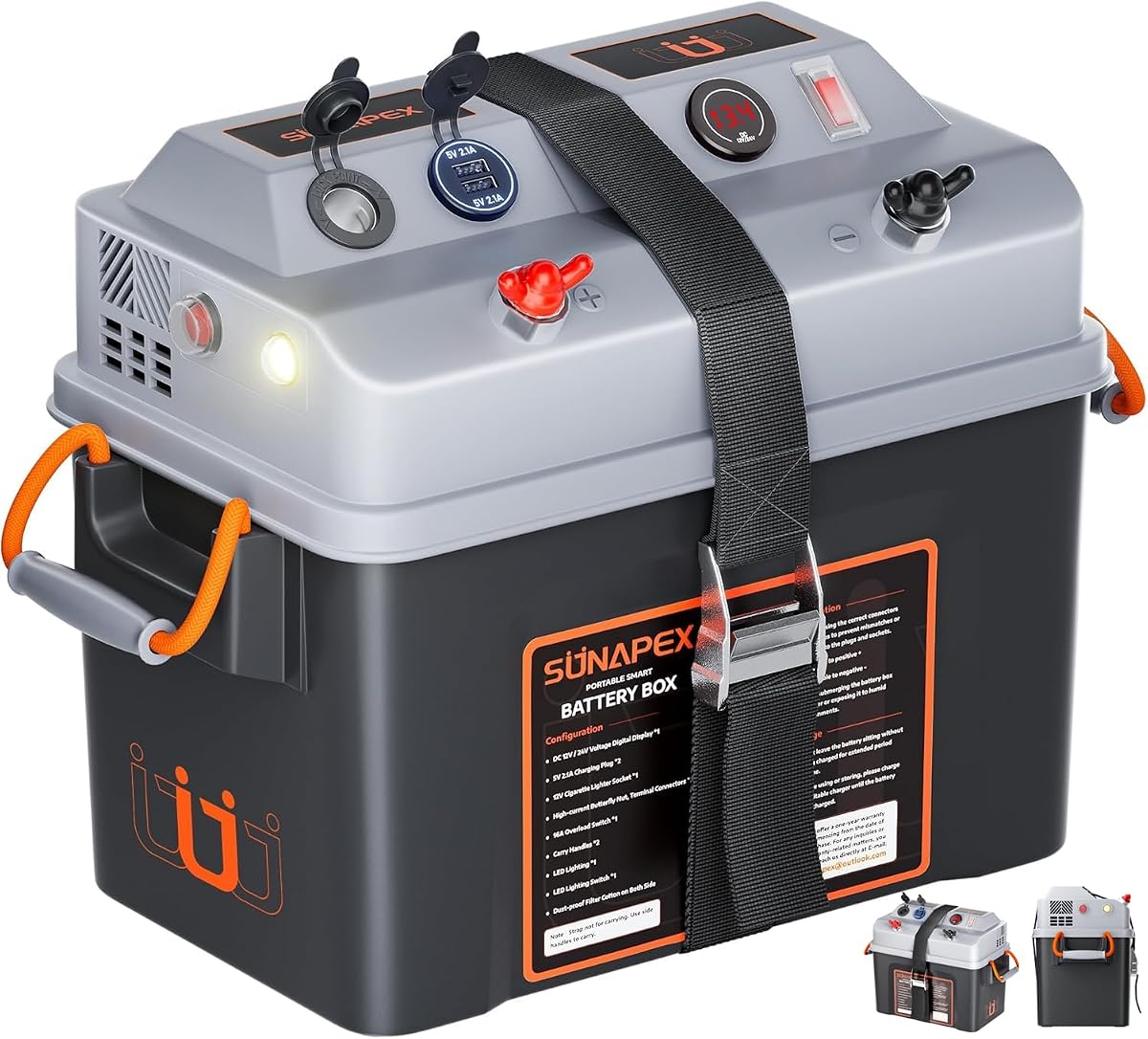
The SUNAPEX Trolling Motor Smart Battery Box 12V/24V Marine Power Center offers a straightforward enclosure for a battery and its connected accessories. Its 4.5 rating reflects a useful combination of portable construction, integrated lighting, a digital voltmeter, and protected outlets.
We may earn a commission when you buy through this link, at no additional cost to you.
The box provides high-current terminals, a 12V cigarette-lighter socket, two 5V 2.1A USB ports, a 16A overload switch, and a digital voltage display. A built-in light on the left side improves visibility during low-light launches, returns, or early-morning fishing. Ergonomic side handles also make the unit easier to move between the boat, dock, or another storage location.
Compatibility extends to Group 24, 27, and 31 AGM or lithium batteries, giving buyers flexibility in battery selection. The dimensions match the larger SUNAPEX PRO model, but this version lacks the higher-current Anderson plugs, QC3.0, and USB-C connectivity. Consequently, it is better suited to standard accessory loads than to the most demanding power distribution requirements.
This battery box is a practical choice for anglers who want a portable, organized home for a compatible battery and need USB charging plus a 12V outlet. It is not a complete trolling motor power system by itself, and the battery must be purchased separately. Check maximum battery dimensions and ensure every attached device is designed for the outlet's rating.
Integrated side lighting offers a practical benefit during early launches and returns. It helps illuminate the immediate area around the box without requiring a separate flashlight.
The carry handles make the enclosure easier to transport between storage and the boat. Paired with protected USB and 12V outlets, it creates a convenient mobile power hub for accessories.
We may earn a commission when you buy through this link, at no additional cost to you.
The OPTIMA Batteries D34M BLUETOP Dual Purpose Boat and RV Sealed AGM Battery combines starting capability with deep-cycle usefulness. It carries a 4.3 rating and is built around SPIRALCELL technology using 99.99% pure lead, a construction intended to improve power delivery, charging behavior, and resistance to vibration.
We may earn a commission when you buy through this link, at no additional cost to you.
Its specifications include 750 cold cranking amps, a 120-minute reserve capacity, and a C20 capacity of 55Ah. The physical measurements are 10.06 inches long, 6.88 inches wide, and 7.94 inches tall, with a listed weight of 43.5 pounds. Both SAE and 5/16-inch stainless steel stud posts provide flexible connection options for different marine cables.
Its dual-purpose design makes it useful when one battery must start an outboard or inboard motor and also support accessories. However, the 55Ah C20 rating is notably lower than the 100Ah ratings of several lithium alternatives in this guide. That difference means users should calculate expected accessory and trolling motor loads rather than assuming similarly sized cases imply similar usable capacity.
The OPTIMA is best for an established marine electrical layout that values a conventional, maintenance-free AGM battery and established deep-cycle construction. It may be less suitable for an angler seeking maximum runtime, remote monitoring, or a lightweight battery. Terminal layout, physical clearance, and charger type should all be checked before installation.
The battery is designed for both deep-cycle accessory demands and engine-starting applications. That versatility can simplify a single-battery arrangement when the outboard or inboard motor requires reliable cranking power.
SPIRALCELL technology is intended to provide consistent power and improved resistance to vibration. The sealed AGM format also removes routine electrolyte servicing, making it convenient for boat and RV owners.
We may earn a commission when you buy through this link, at no additional cost to you.
The Smart Marine Battery Box 12V/24V Power Center with USB-C and QC3.0 combines battery storage, distribution, charging, and monitoring in a portable enclosure. Its 4.6 rating makes it one of the strongest-rated products in this roundup, and its 50A Anderson-style connector is designed with trolling motors and marine equipment in mind.
We may earn a commission when you buy through this link, at no additional cost to you.
Charging options include USB-C Power Delivery up to 30W, QC3.0 USB-A up to 18W, a 12V socket, and an LCD voltmeter. Electrical safeguards include a 10A resettable circuit breaker, fuse protection, secure terminals, and a master switch. These features are useful for creating a consolidated power station for a boat, kayak, RV, or campsite.
The enclosure uses rugged PP housing and supports batteries weighing up to 35 kilograms. Two nano-adhesive attachments help keep the battery from shifting during transport, while the included carrying strap simplifies movement. Unlike some battery boxes, its listed overload protection is centered on a 10A resettable breaker, which should be compared carefully with the actual draw from attached accessories.
This power center is a good fit for owners who want a convenient trolling motor connection and modern charging in a portable package. It is not a battery, so a compatible 12V or 24V unit must be selected separately. Confirm connector polarity, load requirements, breaker behavior, and battery dimensions before installation or use.
The 50A Anderson-style connector provides a dedicated high-current interface for a trolling motor or other marine equipment. This can make connection and disconnection more orderly than working with several loose leads.
Fast-charging USB ports, a 12V outlet, a voltmeter, and a carrying strap make the enclosure useful beyond a permanent battery installation. The adhesive battery restraints and master switch add stability and control during travel.
We may earn a commission when you buy through this link, at no additional cost to you.
Selecting a trolling motor battery requires balancing usable capacity, weight, charging requirements, environmental protection, physical fit, and the electrical demands of the entire boat.
Start by identifying your motor's rated current and the hours you expect to fish. A motor that draws steady power for an entire outing needs more usable capacity than one used intermittently for positioning and navigation. Electronics, livewell pumps, lights, and charging loads should also be added to the expected demand. Comparing a battery's continuous or BMS current rating with the motor's needs helps prevent repeated overload protection events.
A 100Ah label does not guarantee 100Ah of usable energy in every situation. Temperature, discharge rate, age, inverter efficiency, and lithium operating limits can affect the amount available to the trolling motor. For lead-acid batteries, deeply draining a pack also shortens its service life, so many anglers intentionally retain a reserve. In high-capacity lithium systems, usable capacity may be substantial, but the battery's BMS limits and charge state still matter.
LiFePO4 generally offers greater usable capacity by weight, longer cycle life, and less charging time than conventional AGM. It also benefits from Bluetooth monitoring in many modern designs. AGM remains familiar, widely serviceable, and often well suited to dual starting and deep-cycle installations. The tradeoffs include greater weight for AGM and more specialized charging requirements for lithium. Choose the chemistry that matches the boat's charging equipment and loading priorities.
Cold mornings can make charging a lithium battery unsafe if its internal cells are below the permitted temperature. Quality batteries include low-temperature cut-offs, and the stated thresholds vary among the products reviewed. A cut-off may prevent charging but still allow discharge in some models. Anglers operating in freezing conditions should identify both thresholds, allow the battery to warm naturally, and avoid treating a protective cutoff as a charger.
Measure the battery compartment rather than relying only on Group 24 or Group 31 labels. Check length, width, height, terminal orientation, cable clearance, and the space needed to remove the battery safely. A large lithium battery may provide abundant capacity but be difficult to lift into position. The battery itself must also be restrained to prevent movement, especially in rough water or when the boat is transported on a trailer.
A trolling motor battery should have protection against overcharge, over-discharge, short circuits, excessive current, and heat. Bluetooth monitoring is a bonus rather than a substitute for sound fusing and correct wiring. For battery boxes, look for fused high-current outlets, overload switches, protected low-voltage ports, and a clear master disconnect. Corrosion-resistant connections and a suitably enclosed power center help keep wiring organized and protected.
Battery capacity alone does not determine charging speed. Charging time depends on charger output, battery state of charge, temperature, and charging efficiency. A larger lithium bank may require substantially more time and a suitably powerful charger or solar array. Never use an AGM-only charger profile on a lithium battery unless its instructions explicitly allow that chemistry. Verify connector type, charge voltage, and controller compatibility before leaving shore power.
If you expect to add an inverter, larger trolling motor, livewell, or solar system soon, expansion support can preserve the value of the installation. The reviewed lithium batteries support 4P4S configurations, but combining units requires matched batteries, correct series or parallel wiring, appropriately rated cables, and a coordinated charger. Expansion should never be treated as a way to compensate for a poorly sized initial system or overloaded connections.
Install the battery in a clean, dry, ventilated compartment where it can be secured against movement. Use cables and connectors rated for the motor's current, confirm polarity before energizing the circuit, and install appropriately rated fusing close to the battery. Tighten terminals to the manufacturer's recommended level and inspect them periodically for corrosion, heat, looseness, or moisture.
Charge with equipment explicitly approved for the battery's chemistry and capacity. For lithium models, observe low-temperature charging cut-offs and avoid repeated deep discharge unless the design and your power budget support it. AGM users should also follow the charger manufacturer's guidance. Recharge between outings as practical, keep terminals dry, and use the Bluetooth app or voltmeter as a monitoring aid rather than a substitute for physical inspections.
Before and after each trip, check the charge state, wiring, connections, and compartment condition. Remove corrosion with appropriate tools, keep metal away from terminals, and address damaged cables promptly. Do not use a battery box as a substitute for a properly installed battery, and do not exceed the current limits of its breaker, fuse, connector, or integrated protection system.
The correct capacity depends on the motor's rated current, expected runtime, and other electrical loads. Multiply the motor's average current draw by the desired hours of operation, then add capacity for electronics, livewell pumps, lights, and a reasonable reserve. A battery bank that is large enough only on paper may still be inadequate in cold conditions or under sustained high load, so real-world usage patterns matter more than a single calculation.
LiFePO4 usually provides more usable capacity by weight and supports more repeated deep cycles, while AGM offers familiar charging behavior and can serve dual starting and accessory roles. Lithium generally requires a compatible charger and careful protection from charging at unsuitable temperatures. The better choice depends on the boat, available compartment space, electrical system, and how much the owner values weight savings versus conventional serviceability.
Yes, if its capacity, current output, and deep-cycle performance are adequate for the motor and connected electronics. A dual-purpose battery is especially useful when engine starting and accessory power are handled by the same unit. It may need recharging sooner than a dedicated lithium bank, so the trolling motor's expected load should be considered when sizing it.
The SUNAPEX and Smart Marine power centers reviewed here do not include batteries. They are enclosures designed to hold compatible 12V or 24V AGM or lithium batteries and distribute power through terminals and accessory outlets. Buyers must select the battery separately and verify physical dimensions, weight, polarity, charger compatibility, and connector ratings.
A battery box should provide enough room for the actual case dimensions, terminal posts, cable bend radius, and any cover or connector hardware. Group labels provide only a general guide because manufacturers can vary dimensions within a nominal group. Measure both the battery and the compartment, and check whether the battery's weight remains safely within the enclosure's support limit.
Parallel connection can increase usable amp-hour capacity, but the batteries should be of compatible type, age, and condition. Proper cables and a BMS designed for parallel operation are important. Series connection produces a higher nominal voltage and requires compatible equipment, balanced cells, correct fusing, and a charger set for the resulting system. Follow the manufacturer's configuration instructions rather than improvising connections.
Bluetooth monitoring is not essential, but it can make voltage, current, temperature, capacity, and fault information easier to check. That visibility is helpful on boats with several active electronics. It does not replace correct cable sizing, fusing, secure mounting, regular inspections, or a suitable charger, and users should ensure that the app is available and practical for their device.
Charging after each outing helps maintain a dependable starting state and reduces prolonged time spent at a partial charge. Use a charger approved for the battery's chemistry and observe temperature restrictions, especially for lithium. If extended storage is planned, follow the manufacturer's recommended charge state and periodically check the battery for self-discharge or loss of capacity.
The 12V 320Ah LiFePO4 Smart App Battery stands out for high capacity, trolling-motor-focused design, and useful Bluetooth monitoring. The Interstate Group 31 AGM offers a more conventional route with strong cranking performance and dual-purpose capability, while the 12V 100Ah Bluetooth Marine Battery combines a marine-oriented 1280Wh design with app-based control and extensive BMS protection.
Prioritize motor load, usable capacity, charging compatibility, physical fit, and safe restraint before focusing on secondary features. Lithium is attractive for weight-sensitive boats and frequent charging, AGM remains practical for familiar dual-purpose installations, and battery boxes can improve cable organization and protected accessory distribution without supplying energy themselves.
Current product details, ratings, and market conditions may change, so buyers should review the latest listing before purchasing. Confirm the battery's dimensions, weight, terminal arrangement, charger requirements, and protection ratings, and compare those specifications with the boat's electrical demands and available compartment space.