
TESMEN TLP-528A
4.9Editor score
RJ45 and RJ11 support
Crimp quality verification
Detachable remote design
Network Cable Tester buying guide comparing ten models for wire mapping, fault detection, PoE checks, cable tracing, length measurement, and portability.
A network cable tester helps reveal wiring faults that can otherwise cause slow connections, intermittent drops, and confusing troubleshooting sessions. The most useful model combines accurate wire-map results with clear fault identification, dependable tone tracing, and a display that remains readable in awkward workspaces.
We compared these ten testers by examining their supported connectors, fault-detection capabilities, tracing functions, cable-length measurements, PoE testing, displays, power options, and included accessories. The list covers compact continuity testers, professional diagnostic kits, and multifunction tools with optical power meters.
Each review explains the strongest reasons to consider the model, along with practical limitations based on its listed functions. The top three selections receive focused awards, while the full roundup helps identify the right tool for home repairs, structured cabling, and field maintenance.
4.9Editor score

4.8Editor score

4.9Editor score
The comparison below highlights each model's core capabilities, from basic wire mapping and fault detection to PoE measurement, cable tracing, port flashing, optical testing, and portability.




The Klein Tools VDV526-200 LAN Scout Jr is a focused, professional-style Ethernet cable tester with a 4.8 rating and an emphasis on straightforward diagnostics. Its large backlit LCD presents pin-to-pin wire-map results clearly, making it a strong choice for technicians who need to inspect installed Ethernet cables without navigating a complex menu.
We may earn a commission when you buy through this link, at no additional cost to you.
The most impressive feature set is its fault coverage. The tester can identify opens, shorts, miswires, split pairs, crossovers, and shield conditions. That makes it more informative than a basic pass-and-fail tool, particularly when a cable appears physically intact but still produces unreliable network performance. Its three-button interface also keeps operation relatively approachable.
For tracing, the multiple-style tone generator can target one wire, a wire pair, or all eight conductors using solid or warble tones. The required Cat. No. VDV500-123 analog probe is not included, which is the main drawback for anyone who needs out-of-box cable tracing. It also focuses on RJ45 data cables rather than telephone or coax connectors.
The automatic shutoff after inactivity is helpful for conserving battery life, and the compact enclosure suits mobile repair kits. Overall, the VDV526-200 is our top general recommendation for users who prioritize readable results, detailed Ethernet fault detection, and a reputable professional tool design. It is particularly well suited to network installers and IT support technicians.
The large backlit LCD is especially valuable in basements, server closets, and other poorly lit work areas. Clear wire-map output lets an installer compare pin connections rapidly, while dedicated fault categories help narrow the problem before replacing a cable or connector.
The selectable tone styles make it easier to follow a specific conductor or group through a bundle. Because the compatible analog probe is sold separately, buyers who require tracing should plan to purchase that accessory when needed.
We may earn a commission when you buy through this link, at no additional cost to you.
The FNIRSI LPM-10A combines a conventional network cable tester with port finding, digital tracing, PoE checks, length measurement, and non-contact voltage detection. Its 4.2 rating reflects a less universally praised experience than the leading products, but its specification set is notably broad for installation and maintenance work.
We may earn a commission when you buy through this link, at no additional cost to you.
Its strongest contribution is the ability to check RJ45 continuity and crimp quality while also diagnosing opens, shorts, miswires, couplers, and patch cords. The tester can verify 10, 100, and 1,000Mbps performance and automatically detect standard or non-standard PoE, which makes it more useful for camera, access-point, and switch installations than a simple wire-map tool.
Adjustable sensitivity improves tracing in noisy bundles, while the rechargeable transmitter and receiver reduce recurring battery interruptions. A low-battery warning and built-in flashlight add practicality on long shifts. NCV detection is another useful safety-oriented feature, although users must still apply appropriate electrical precautions around live wiring.
This kit is best for installers who want one portable device to handle cabling, PoE, and port-location tasks. It is less attractive for someone who only needs a quick continuity check, but the expanded diagnostic coverage gives it considerable value for field technicians and advanced home-network projects.
Port identification, speed verification, and PoE detection address problems that a basic continuity tester cannot diagnose. These functions are particularly helpful when commissioning newly installed access points, cameras, switches, and patch cables.
Rechargeable components, a low-battery reminder, and an integrated flashlight suit field use. The adjustable tracing sensitivity also helps when identifying the correct conductor in crowded cable routes.
We may earn a commission when you buy through this link, at no additional cost to you.
The Klein Tools VDV501-851 Scout Pro 3 handles more connector types than a dedicated Ethernet tester, supporting RJ11 and RJ12 voice cables, RJ45 data cables, and coax cables with F-connectors. It carries a 4.7 rating and is designed for comprehensive testing on unenergized cabling.
We may earn a commission when you buy through this link, at no additional cost to you.
Its extended length measurement reaches up to 2,000 feet, which is useful for verifying longer structured-cabling runs. The backlit screen can display wire-map information, cable length, cable ID, and fault results. Open, short, miswire, and split-pair detection provides a practical level of detail for everyday installation troubleshooting.
Tone generation can trace cables, wire pairs, or individual conductors, but the required Cat. No. VDV500-123 analog probe is sold separately. More importantly, the tool is explicitly not designed for PoE testing, so it should not be treated as a complete solution for modern powered network installations.
The Scout Pro 3 is a strong fit for technicians who maintain mixed voice, data, and coax infrastructure. Its connector range and generous measurement distance distinguish it from simpler pocket testers, while the absent PoE function and separate probe prevent it from being the most complete all-in-one diagnostic solution.
RJ11, RJ12, RJ45, and F-connector support makes the tester useful for offices, homes, and security installations that still contain legacy voice or coax wiring. That versatility reduces the need to switch among separate devices for basic continuity checks.
The extended measurement range helps installers confirm long cable runs rather than merely checking connectivity. Cable identification and backlit reporting further improve usability during structured-cabling documentation and troubleshooting.
We may earn a commission when you buy through this link, at no additional cost to you.
The NOYAFA NF-8209 is a comprehensive copper-cable diagnostic kit with a 4.3 rating. It supports digital cable tracing, continuity and fault testing, length measurement, PoE analysis, port flashing, link testing, and non-contact voltage detection, making it more capable than a basic mapper.
We may earn a commission when you buy through this link, at no additional cost to you.
PoE is the standout area. The tester identifies IEEE 802.3af and 802.3at power, handles standard and non-standard configurations, and displays the power method, voltage, and polarity. It also provides 10M, 100M, and 1000M port flash and link tests, enabling users to verify whether a connected port is active.
Cable tracing can extend up to 600 meters, while length measurement covers each twisted pair from 2.5 to 200 meters. Shielded and unshielded eight-pin cables are supported, along with nine-pin shielded cables. The kit includes a transmitter, receiver, remote adapter, cable set, tool bag, 9V battery, and Type-C cable.
The rechargeable transmitter is convenient, but the receiver's separate 9V power requirement adds maintenance. Nevertheless, the NF-8209 is a strong fit for network installers handling PoE switches, cameras, access points, and long structured-cabling runs. Its breadth makes it more useful than a simple continuity tester for professional field work.
Showing voltage, polarity, and the applicable PoE method helps distinguish power problems from ordinary wiring faults. These details are especially useful when deploying VoIP phones, cameras, access points, and other powered network devices.
Digital decoding and selectable anti-interference modes support tracing in complex bundles. The extended tracing range and per-pair length measurements make the kit practical for buildings and other installations that exceed short patch-cable dimensions.
We may earn a commission when you buy through this link, at no additional cost to you.
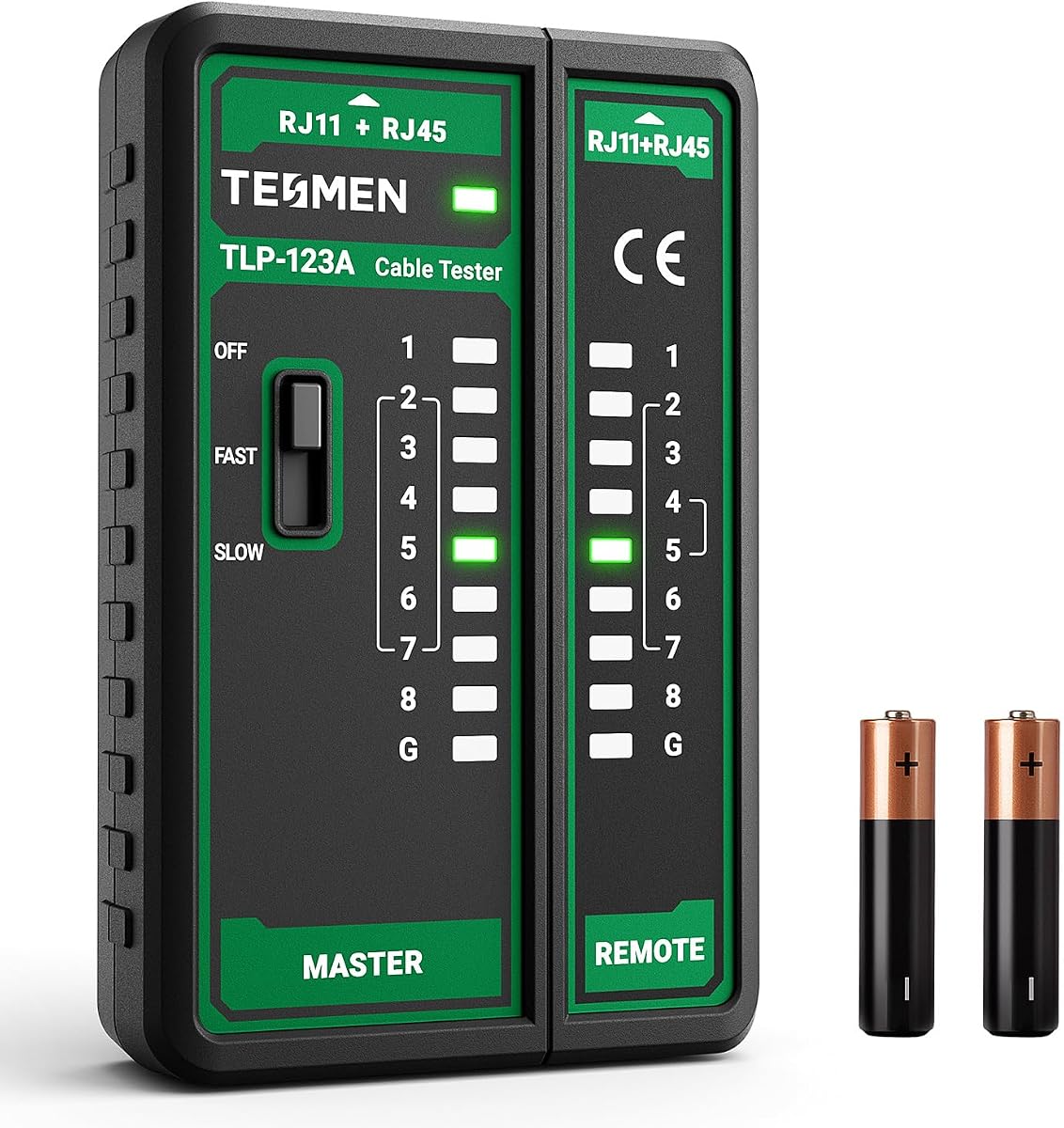
The TESMEN TLP-123A is a compact continuity tester for RJ45 and RJ11 connections, with a 4.6 rating and support for common categories including CAT5 through CAT7 and both UTP and STP constructions. It focuses on quickly identifying open circuits, short circuits, miswiring, and shield status.
We may earn a commission when you buy through this link, at no additional cost to you.
One-button operation and a speed adjustment control make the tool approachable. LED indicators present the result directly, which can be faster than navigating menus on more advanced devices. The main and remote units detach, allowing both ends of a long cable to be reached easily, including wall-mounted ports.
Its limitations reflect the simplicity of the design. There is no detailed numerical screen, advanced tone tracing, or PoE analysis. Users who need to distinguish a nuanced fault or measure cable length will need a more specialized model. Even so, the tool covers the essential requirements for fast cable maintenance.
The TLP-123A is best for home users, IT staff, and installers who routinely need a dependable pass-and-fail continuity check. Its broad cable-category compatibility, detachable remote, and uncomplicated indicators make it a convenient addition to a small maintenance toolkit.
The one-button workflow and straightforward LEDs keep routine testing efficient. Adjustable test speed provides useful flexibility when working across different jobs or under changing conditions.
Separating the main and remote units lets a technician test cables that are already installed and difficult to reach. This is particularly helpful at wall outlets, patch panels, and other fixed endpoints.
We may earn a commission when you buy through this link, at no additional cost to you.
The Network LAN Cable Tester is a compact, dedicated option for technicians who want to carry a small continuity checker without carrying a larger diagnostic kit. It has a 4.7 rating and tests RJ11, RJ12, and RJ45 terminated voice and data cables with a single button.
We may earn a commission when you buy through this link, at no additional cost to you.
Compatibility extends from CAT3 through CAT5e, CAT6, and CAT6A. Fast LED responses identify pass, miswire, open fault, short fault, and shield conditions. These results cover the most common installation questions without requiring a display, menu, or separate remote unit for routine use.
The remote stores securely inside the tester body, improving portability and reducing the chance of losing it. Automatic power shutoff conserves the included 9V battery, while a low-battery indicator helps prevent confusing results from weak power.
This tester is best for quick bench checks, patch-cable sorting, and basic field troubleshooting where simplicity matters more than advanced diagnostics. It cannot measure cable length, detect PoE, or provide sophisticated tone tracing, but its dedicated construction and pocket-friendly proportions make it a dependable routine tool.
Single-button testing and immediate LED feedback make it well suited to sorting collections of patch leads. Shield status and common fault categories help identify the small percentage of cables that need further attention.
The remote fits inside the main body, reducing loose parts in a tool pouch. Automatic shutoff and the low-battery warning help the tester remain ready for intermittent use.
We may earn a commission when you buy through this link, at no additional cost to you.
The NOYAFA Network Cable Tester with Optical Power Meter and VFL is an advanced all-in-one kit carrying a 4.9 rating. It combines copper-cable diagnostics, PoE testing, port flashing, QC testing, cable scanning, length measurement, NCV detection, an optical power meter, and a visual fault locator.
We may earn a commission when you buy through this link, at no additional cost to you.
Its optical power meter is the defining feature. It measures seven wavelengths—850, 1300, 1310, 1490, 1550, 1625, and 1650 nanometers—across a range from minus 70 to plus 10 dBm while supporting FC, SC, and ST connectors. This allows users to assess fiber signal strength and investigate attenuation issues.
The visual fault locator uses a 650nm source to help identify fiber breakpoints, poor connections, bending, or cracking. Copper diagnostics support up to 350 meters, PoE analysis, wire mapping, tracing, and testing of phone and BNC cables. A 1,500mAh rechargeable battery, Type-C charging, color display, and flashlight suit extended field work.
This is the most comprehensive premium option for installers who genuinely need both copper and fiber tools. Its size and broad feature set are unnecessary for casual users, but professionals maintaining mixed networks can consolidate several tasks into one durable kit. The included adapters, case, probes, and charging cable make it a particularly complete package.
Most network testers focus only on copper wiring. Adding optical power measurement and a visual fault locator allows the same kit to support fiber inspections, making it valuable for technicians responsible for mixed infrastructure.
The color display presents more information without relying entirely on tiny LEDs. An integrated flashlight and rechargeable battery with Type-C charging improve operation in dark racks, ceiling spaces, and long service days.
We may earn a commission when you buy through this link, at no additional cost to you.
The NOYAFA NF-8209PRO is a 4.8-rated seven-in-one tester that expands on basic wire mapping with tracing, length measurement, PoE detection, port flashing, crimp testing, and NCV voltage detection. It is designed for both network cabling work and routine maintenance.
We may earn a commission when you buy through this link, at no additional cost to you.
Digital signal technology is used to reduce false indications while checking opens, shorts, and cross connections on RJ45, RJ11, CAT5, and CAT6 cables, including shielded and unshielded constructions. PoE testing identifies power type, voltage, and wire pairs, while port flashing helps match a cable to the correct switch port.
The crimp-quality function checks eight-core RJ45 connector workmanship, helping reduce unnecessary rework. Cable length and breakpoint testing cover 5 to 350 meters. A built-in polymer lithium battery, Type-C charging, automatic shutoff, low-battery reminder, and flashlight make the tool practical for field work.
The NF-8209PRO is a strong choice for installers who want broad copper-network diagnostics without a dedicated optical meter. The package includes the transmitter, receiver, 8P and 6P test cables, an alligator-clip line, charging cable, and manual, making it ready for varied jobs.
Tracing, mapping, length testing, PoE analysis, port flashing, crimp inspection, and NCV detection cover several stages of installation and maintenance. That breadth reduces the need to carry separate tools for each task.
The Type-C rechargeable system is convenient for technicians who use the tester frequently. Automatic shutoff and low-battery reminders help preserve operating time, while the flashlight supports work in poorly illuminated areas.
We may earn a commission when you buy through this link, at no additional cost to you.
The NOYAFA NF-8508 combines nine network-maintenance functions in a portable device, earning a 4.2 rating. Its feature set includes continuity testing, cable scan, port flash, length measurement, PoE testing, QC checks, an optical power meter, a visual fault locator, and NCV detection.
We may earn a commission when you buy through this link, at no additional cost to you.
The optical meter supports FC, SC, and ST connectors and measures seven standard wavelengths from 850 through 1650 nanometers. Its stated detection range is minus 70 to plus 10 dBm. The 650nm visual fault locator helps locate breaks, poor connections, and damaged fiber sections before further troubleshooting begins.
Port flashing is unusually informative, displaying operating speed, duplex mode, and negotiation information along with the port-light pattern. PoE testing checks mapping, polarity, and voltage, while copper cable measurement extends to 200 meters. A rechargeable 1,500mAh battery supports Type-C charging and an automatic shutdown.
The NF-8508 is best for network maintenance teams that work with both fiber and copper systems. Its rating is lower than several alternatives, and its maximum copper length is shorter than that of the newer premium NOYAFA kit, but its mix of optical, port, PoE, and tracing functions remains impressive for a maintenance-focused tool.
Showing speed, duplex, and negotiation information makes port flashing more useful than a simple on-and-off test. This can help users understand what a switch port is reporting before diving into more advanced diagnostics.
The optical meter and visual locator support fiber signal assessment and physical break identification. These functions make the device useful for technicians who need basic fiber capability in the same kit as copper-cable testing.
We may earn a commission when you buy through this link, at no additional cost to you.
The TESMEN TLP-528A is a straightforward cable-maintenance tester with a 4.9 rating, RJ45 and RJ11 support, and an added connector-crimping QC function. It covers CAT5, CAT6, and CAT7 cables, making it useful for both Ethernet and telephone-line checks.
We may earn a commission when you buy through this link, at no additional cost to you.
Its most useful distinction from many similarly simple testers is the ability to check connector crimp quality. That helps installers identify a poorly terminated plug, while continuity and shielding checks cover the most common installation errors. Clear LED indicators make the result easy to read without learning a complicated interface.
Fast and slow modes provide some control over the testing workflow, and the main and remote units can be detached and used independently. The compact housing, high-quality plastic shell, and non-slip silicone make the device comfortable to carry and handle. A storage box, manual, and two AAA batteries are included.
The TLP-528A is the best budget choice for routine cable sorting, home network setup, and basic professional maintenance. It does not measure length, detect PoE, or provide advanced tone tracing, but for straightforward continuity, shielding, and crimp inspection, it covers the essentials in a durable, easy-to-use design.
Checking a connector's crimp can reveal a problem that simple end-to-end continuity may not expose. This makes the tester useful during cable assembly, patching, and routine quality-control work.
The lightweight enclosure, non-slip exterior, and selectable test speeds make the TLP-528A well suited to repeated testing. Its detachable remote simplifies access to both ends of installed or long cables.
We may earn a commission when you buy through this link, at no additional cost to you.
The right network cable tester depends on the faults you need to diagnose, the connectors you work with, and the level of detail required during installation or maintenance.
A useful cable tester must verify that each connector reaches the corresponding conductor at the other end. Look for models that report opens, shorts, miswires, split pairs, and cross-connections rather than only displaying a generic pass or fail. Detailed pin-to-pin results are especially helpful when a cable has been assembled by hand or pulled through a tight pathway.
For routine patch-cable sorting, a simple LED tester can be enough. For commissioned networks, a backlit wire-map display provides much faster interpretation and creates a clearer record of the fault.
Prioritize reliable wire mapping and understandable fault labels above every other feature.
RJ45 is essential for Ethernet, while RJ11 and RJ12 remain relevant for telephone and legacy communication lines. Some testers also support coax F-connectors, shielded wiring, eight-pin or nine-pin variants, and broader categories such as CAT6A and CAT7. Compatibility should reflect the cables already in your installation rather than an aspirational list of standards.
Check whether the remote or probe connects directly to the cable or requires adapters. A detachable remote is convenient for long runs and wall-mounted outlets, while a dedicated adapter set can broaden supported cable types.
Match every connector and cable category you currently use before deciding on a model.
PoE testing becomes important when powering access points, IP cameras, VoIP phones, or other network devices over Ethernet. A capable model may identify standard and non-standard PoE, display voltage and polarity, and show which wire pairs carry power. Some also include link and port-flash functions that make it easier to find the correct switch port.
For basic home networks without powered Ethernet, these functions may add little. Installers working with switches and active equipment gain more value from a tester that can distinguish an ordinary Ethernet link from a PoE connection.
Choose PoE diagnostics when your network includes powered devices or enterprise cabling.
A continuity test confirms what is connected, but tracing helps identify which cable belongs to which port or conductor. Digital tracing can work in crowded bundles and may offer adjustable sensitivity. Tone generators may support solid or warble signals, a single wire, a pair, or all eight conductors. Check whether the required probe is included, because some professional tools require a separately sold accessory.
Port finding can complement tracing when the remote end is connected to a live switch. A tester with both functions gives technicians more ways to identify routes in office, residential, and distribution environments.
Verify probe inclusion and tracing modes before buying for bundle-heavy installations.
Length measurement can help verify an installed run, estimate a break's location, and distinguish a damaged cable from a configuration problem. Measurement ranges differ considerably, with compact units generally remaining practical for patch cords and professional models supporting longer structured-cabling runs. Per-pair or per-conductor readings can also reveal an uneven or interrupted run.
Fiber and copper tools may use different maximum ranges, so review the specification carefully. Accuracy claims and usable minimum lengths should be considered alongside the headline maximum.
Pick a measurement range that comfortably covers the longest cable you expect to diagnose.
LED indicators are effective for simple pass-and-fail work, while an LCD or color display provides greater detail without forcing users to decode a row of lights. A backlight matters in basements, closets, and under desks. Screen size, menu complexity, and the consistency of labels should be considered along with raw resolution.
For dark spaces, an integrated flashlight is useful. A detachable remote also improves access at fixed endpoints. The most capable device is not necessarily the most convenient if its interface demands repeated steps for basic jobs.
Choose the simplest display that still provides the diagnostic detail your work requires.
Optical power meters and visual fault locators extend a tester beyond copper wiring. A visual fault locator helps reveal breaks, tight bends, and poor fiber connections, while an optical power meter measures signal strength at supported wavelengths. Connector support, such as FC, SC, or ST, must match the fiber hardware in the field.
These features are essential for fiber technicians but unnecessary for users dealing only with Ethernet patch leads. They also make the device larger and more complex, so a dedicated copper tester may remain more practical for a specific task.
Add optical functions only when your maintenance responsibilities genuinely include fiber.
Consider how often the tester will be used and whether a replaceable battery or rechargeable system fits the work environment. Rechargeable models are convenient for frequent use, while included disposable batteries can be practical for occasional jobs. Low-battery warnings, automatic shutoff, charging cables, storage cases, and spare test leads all affect long-term usability.
The main and remote units should feel durable enough for repeated transport. A compact design is valuable in a crowded tool bag, but excessive size can make one-handed operation uncomfortable. Accessories should support the actual tasks you perform rather than adding unnecessary bulk.
Favor reliable power management and a complete, task-appropriate accessory set.
Begin by disconnecting the cable from active equipment. A safe continuity check should use unenergized cabling unless the tester and procedure explicitly support powered or PoE testing. Connect the appropriate main and remote units, or attach the supplied probe, and select the mode for the connector and diagnostic you need.
For a basic wire-map test, connect both ends, initiate the test, and compare the displayed or illuminated pin sequence. If the tester reports a fault, inspect the connectors for bent or poorly crimped contacts, then examine the cable for crushing, sharp bends, or strain. For tracing, connect the transmitter to the intended line, adjust sensitivity, and use the receiver or probe to follow the signal.
After use, switch the tester off, remove exposed test leads, and store the remote and accessories together. Clean connector ports gently with an appropriate lint-free tool, avoid moisture and extreme heat, and follow the manufacturer's battery guidance. Recharge rechargeable units regularly if they will sit unused, and periodically check a known-good cable to confirm the tester continues to provide expected results.
A basic tester usually checks continuity, opens, shorts, miswiring, and sometimes shielding through LEDs. An advanced network tester may add detailed wire mapping, length measurement, tone tracing, port flashing, PoE detection, crimp inspection, and NCV functions. The advanced model is more useful for commissioning and maintenance, while a basic model is often sufficient for quick patch-cable checks.
Yes, but only models that explicitly support split-pair testing can identify it reliably. A split pair can pass a simple end-to-end continuity check because the correct pin-to-pin conductors remain connected, yet the cable may fail to support 1,000Mbps networking. Choose a tester that reports split-pair faults rather than assuming a generic pass result guarantees high-speed performance.
PoE detection is valuable if your network powers access points, cameras, VoIP phones, or other devices through Ethernet. It can reveal power type, voltage, polarity, and affected wire pairs. For a basic home network without powered Ethernet, the feature may be unnecessary, but it becomes important for modern commercial installations and switch commissioning.
A visual fault locator is primarily associated with fiber testing, where light can reveal breaks, bends, and poor connections. For copper Ethernet, tone tracing, length measurement, and wire-map fault detection are usually more relevant. A tool combining both copper and fiber functions is convenient for mixed maintenance work, though it may be more complex than necessary for one cabling type.
Only use a tester that specifically supports live or PoE-related testing for that purpose. Many standard continuity testers are intended for unenergized cables, and connecting unsupported equipment could produce misleading results or create safety concerns. For standard wire-map checks, disconnect the cable from switches, routers, access points, and other powered devices first.
Check both the maximum and minimum usable range, along with whether the measurement applies to the entire cable or individual twisted pairs. Professional models may cover long structured-cabling runs, while compact continuity tools often do not measure length at all. Choose a range that covers the longest installed run you expect to troubleshoot with some margin.
The remote connects to the opposite end of the cable and allows the tester to evaluate continuity, wire mapping, and faults across the entire run. Detachable remotes are particularly useful for long installed cables, wall outlets, patch panels, and locations where both ends cannot be reached at the same time. Some remotes also support remote-adapter functions for additional fault isolation.
Test a known-good patch cable and confirm that every pin maps correctly. Then test a deliberately open or damaged cable if available and verify that the expected fault appears. If results are inconsistent, inspect the remote connection, test battery or recharge state, and clean the ports. Following the manufacturer's self-test or calibration instructions is also important for models with advanced measurement functions.
The Klein Tools VDV526-200 is the strongest all-around choice for users who want a clear backlit wire map and detailed Ethernet fault reporting. The TESMEN TLP-528A stands out as a budget-friendly maintenance tool with crimp inspection, while the NOYAFA OPM and VFL Tester is the premium selection for combined copper and fiber diagnostics.
Prioritize the functions your work actually requires. A simple tester is enough for routine continuity and patch-cable sorting, while installers should look for length measurement, tone tracing, PoE detection, port flashing, and crimp testing. Fiber technicians should consider an optical power meter and visual fault locator, paying close attention to supported wavelengths and connector types.
Ratings, included accessories, available probe options, and product configurations can change over time, and current prices also fluctuate. Check the latest listing details before purchasing to confirm compatibility with your connectors, cable categories, accessories, and intended testing environment.