
RIOWOIS Passive Bookshelf Speakers
4.8Editor score
Four-inch warm, clear woofer
Horn-loaded silk dome tweeter
Gold-plated flexible terminals
Built-in wall-mount brackets
Discover the best passive speakers for turntable listening in our expert guide, comparing drivers, power, inputs, connectivity, room fit, and sound.
A turntable can produce beautifully detailed records, but its cartridge and tonearm need the right speakers to reveal their full character. Passive speakers offer a direct, traditional route from record grooves to amplification, provided you match their impedance, sensitivity, and power requirements to a suitable stereo receiver or amplifier.
This guide compares ten compact and full-size bookshelf speakers marketed for home audio, including models that require external amplification, powered alternatives with built-in amplification, and wireless speakers that can work only with certain turntables. We evaluated driver design, connection methods, placement flexibility, dimensions, and practical turntable compatibility.
Each recommendation reveals what the speaker is best suited to, from simple two-channel listening to larger systems that may later grow into a home-theater setup. Product configurations and availability can change, so confirm the specifications, particularly output type, impedance, and included accessories, before making a final purchase.
4.8Editor score
4.6Editor score
4.8Editor score
The table below compares all ten speakers by driver configuration, amplification requirements, connection options, and physical design, making it easier to identify the model that fits your turntable and listening space.





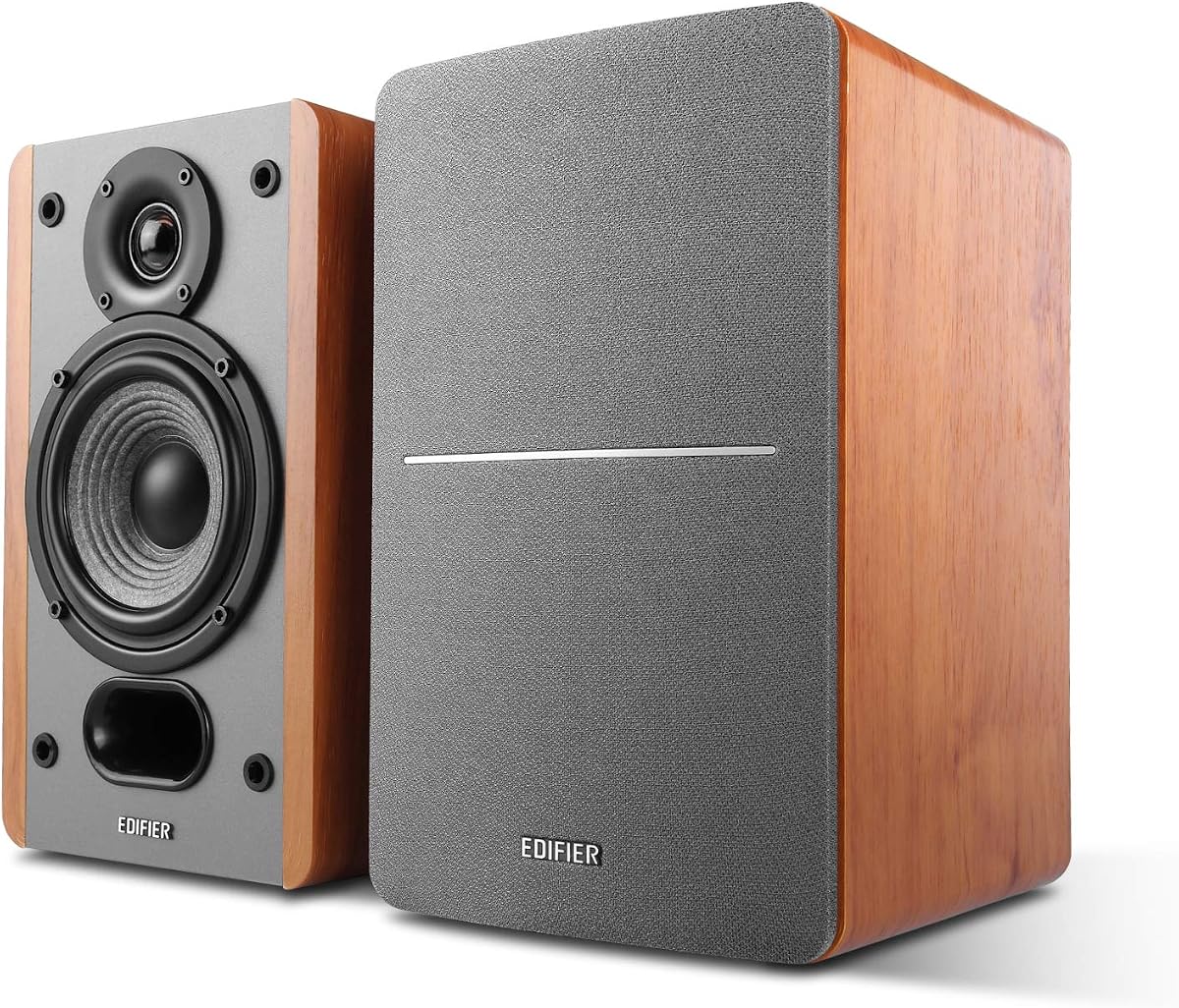
The Edifier P12 combines a compact two-way bookshelf design with a 4.6 rating, making it a practical starting point for listeners connecting a turntable to a conventional stereo amplifier or receiver. Its 19mm silk dome tweeter handles high frequencies, while a four-inch driver and rear bass reflex port provide the foundation for balanced music playback.
We may earn a commission when you buy through this link, at no additional cost to you.
One particularly useful detail is the included wiring and built-in mounting hardware. The pair can sit on shelves or stands near the listening position or be mounted on a wall as rear surrounds in a home theater. The wood color also gives the speakers a traditional appearance that blends naturally with turntable furniture and other traditional audio components.
The main limitation is that these are passive speakers, so a receiver or amplifier is not optional. Their four-inch drivers also prioritize clarity and convenience over the deepest low-frequency extension. Viewed as compact nearfield or secondary-room speakers, these trade-offs are reasonable, especially for records whose vocals, instruments, and percussion matter more than subterranean bass.
Choose the Edifier P12 when you want a straightforward passive system, need a compact pair for a modest room, or want the option to expand into surround sound later. It is an especially sensible match for a turntable that includes a built-in phono preamp and outputs a conventional line-level signal through an amplifier.
The P12 connects to an amplifier or receiver rather than directly to a turntable's phono-level output. Route the turntable through its line output or an external phono preamp, then use the receiver to handle source selection, volume, and speaker power.
Built-in wall-mount brackets make the pair unusually versatile. They can serve as rear channels in a home theater or be positioned above ear level when a dedicated pair of stands is unavailable.
We may earn a commission when you buy through this link, at no additional cost to you.
The RIOWOIS Passive Bookshelf Speakers hold a 4.8 rating and are explicitly positioned for home stereo and record-player use. Their warm, clear four-inch woofer and silk dome tweeter offer a simple way to hear vinyl through a conventional receiver or amplifier without adding powered electronics to the chain.
We may earn a commission when you buy through this link, at no additional cost to you.
The horn-loaded tweeter is intended to improve high-frequency clarity and broaden the perceived soundstage. A rear-mounted bass reflex port supports greater low-end extension and efficiency, while gold-plated zinc-alloy terminals accept banana plugs, U-type connectors, and bare wire. Rounded edges and a furniture-grade cabinet also make the speakers visually appropriate for a living room setup.
As with every passive model, the absence of a built-in amplifier is the central trade-off. Buyers must already own compatible amplification or add one separately. The four-inch woofer is best suited to close or nearfield listening rather than a large room where substantial low-frequency output is required.
This is a strong choice for a first turntable system built around a modest stereo receiver. It offers more clearly documented driver characteristics and flexible terminals than many entry-level alternatives, while the included wall-mount brackets add placement options for smaller rooms.
These speakers work best with a straightforward signal path: turntable, external phono preamp if needed, stereo receiver, and passive bookshelf pair. That architecture preserves control over level matching and leaves room to upgrade either component later.
The terminal design accommodates several connector formats, which can make installation easier. Mounting brackets add another placement option, although rear-wall placement may change the bass response compared with stands positioned away from boundaries.
We may earn a commission when you buy through this link, at no additional cost to you.
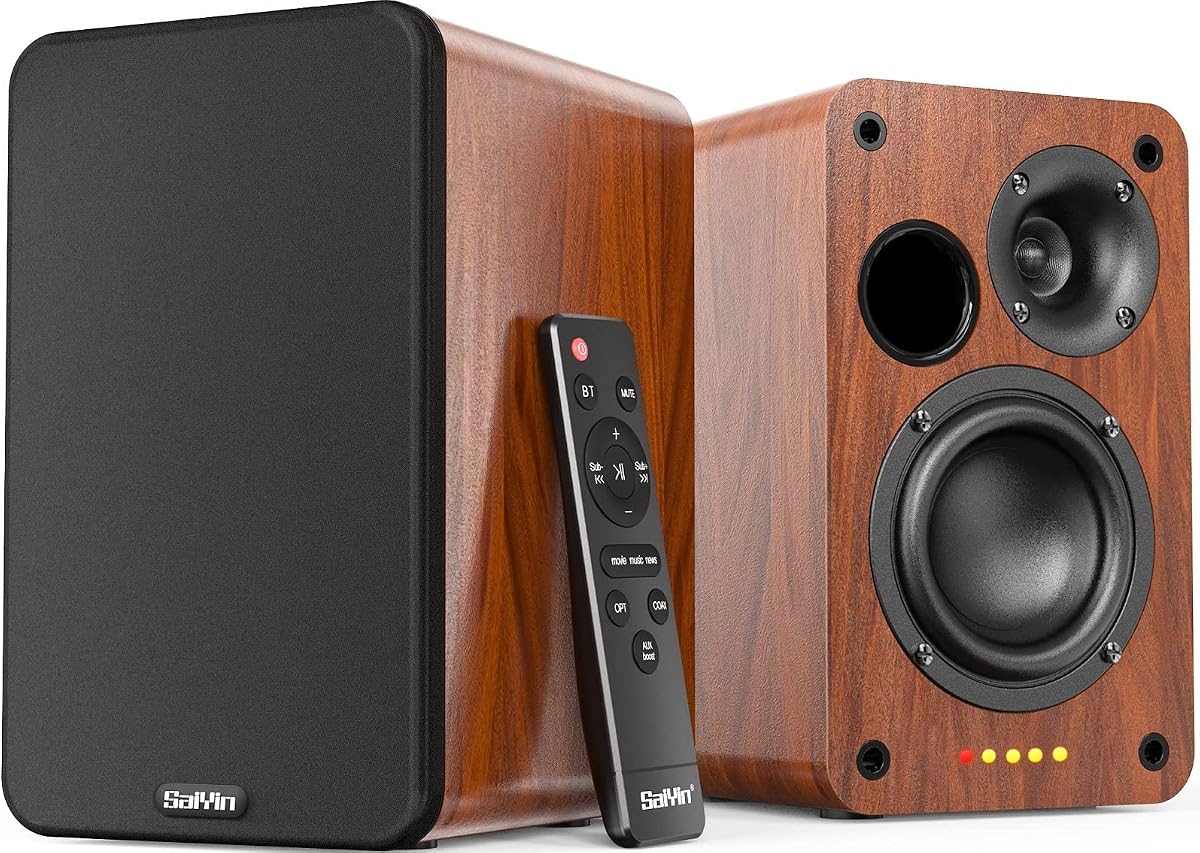
Although this Saiyin model is powered rather than passive, it deserves attention for turntable listeners who want fewer external components. Its 4.4 rating reflects a flexible package that combines four-inch woofers, 0.5-inch silk dome tweeters, Bluetooth 5.3, optical and coaxial inputs, and a remote control.
We may earn a commission when you buy through this link, at no additional cost to you.
A turntable with a line output can connect directly to the speakers through an appropriate line input. A turntable with only a phono output requires a preamplifier to raise the signal to a usable level. Wireless use is possible only if the turntable includes a Bluetooth transmitter; a Bluetooth receiver for connecting phones to the turntable is not the same thing.
The included subwoofer output can add low-frequency reinforcement, but it does not make these passive speakers. Their powered design integrates amplification with the drivers, which simplifies setup while also limiting future changes to the power stage. A 4.4 rating reflects a capable package, though it does not surpass the ratings of the leading passive options.
Select this model if a turntable already provides line-level RCA output and you value Bluetooth, digital inputs, remote operation, and minimal setup complexity. For the most authentic passive-speaker experience, however, choose one of the dedicated passive models in this guide and connect it to a suitably capable receiver.
The distinction between line out and phono out is crucial. Line output can feed the speakers directly, while phono output needs a preamplifier because its signal level and equalization are designed for a phono input.
Bluetooth, optical, coaxial, and analog line inputs allow the speakers to serve phones, computers, televisions, and a turntable. A subwoofer output offers an optional path to stronger bass without changing the main speaker connection.
We may earn a commission when you buy through this link, at no additional cost to you.
The Edifier R1280T is a powered bookshelf system with a 4.6 rating, built around a four-inch full-range unit and 13mm silk dome tweeter. It is designed for nearfield listening and can provide a simple endpoint for a turntable with line-level output.
We may earn a commission when you buy through this link, at no additional cost to you.
Two AUX inputs make it possible to keep a turntable and another analog source connected at the same time. Volume, bass, and treble controls are accessible on the active speaker, while the remote handles volume. The wood-effect vinyl finish gives the speakers a familiar furniture-friendly appearance.
The principal caveat is that no phono preamplifier is documented. A turntable with only a phono output therefore needs an external preamp or a receiver with a built-in one. Because amplification is integrated, this model is not directly comparable with passive speakers, which accept power from a receiver or amplifier.
The R1280T is most useful for a compact setup with limited space and no desire to operate a separate stereo receiver. It is also attractive as a nearfield monitor for record listening. Those who want to expand into a traditional component system should favor a genuinely passive pair.
Dual AUX inputs eliminate constant cable swapping when a turntable and another analog device share the speakers. The active-speaker controls then provide quick access to level and tonal adjustments.
Compact dimensions and a nearfield monitor concept suit close listening at a desk or turntable shelf. Positioning the speakers near the listener can improve perceived detail and reduce the impact of room reflections.
We may earn a commission when you buy through this link, at no additional cost to you.
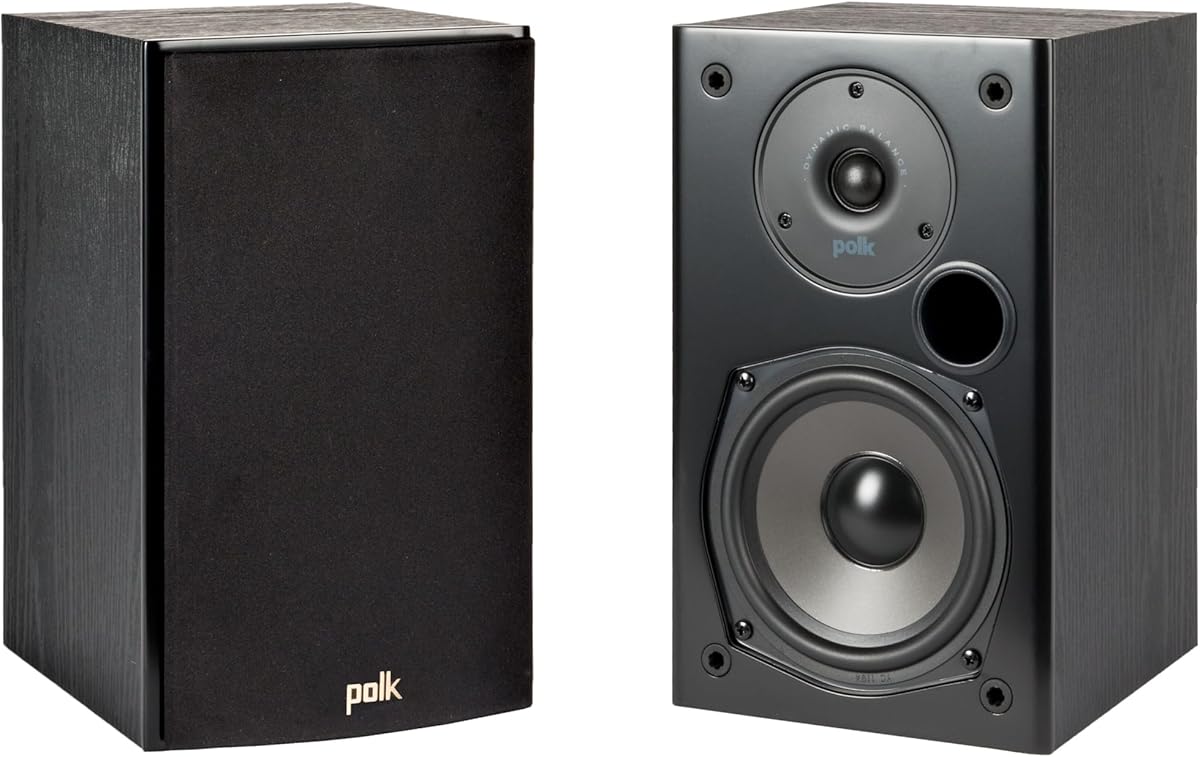
The Polk Audio T15 pair earns a 4.7 rating and uses larger 5.25-inch Dynamic Balance drivers with 0.75-inch tweeters. These passive speakers can serve as the front pair in a two-channel vinyl system or as part of a larger home-theater arrangement.
We may earn a commission when you buy through this link, at no additional cost to you.
Their larger drivers offer more potential low-frequency scale than the four-inch models in this guide, while the stated emphasis on clear, balanced sound supports intelligible vocals. They can operate as front left-right speakers or rear surrounds, and Polk describes a path toward a complete surround system with compatible matching components.
They still require an AV receiver or stereo amplifier, and those devices must be able to handle their power demands. A separate stand is not specified, so buyers should plan for suitable supports or a wall-mounted arrangement. Their home-theater orientation may be broader than some listeners require, but it adds long-term flexibility.
The T15 is a good match for a turntable owner who may eventually add surround speakers and a center channel. For dedicated music only, the simple goal remains connecting the pair to a competent receiver with balanced left and right speaker outputs.
The T15 can begin as a straightforward stereo pair and later serve within a 5.1-style setup. This makes it a practical choice when the primary goal is vinyl now but home theater is a possible future addition.
A 5.25-inch Dynamic Balance driver can move more air than a compact four-inch woofer. That additional physical size is useful for producing a fuller sense of scale in music and clearer effects in films.
We may earn a commission when you buy through this link, at no additional cost to you.
The Saiyin 3-Way Passive Bookshelf Speakers use a true three-way design with a 5.25-inch paper woofer, one-inch elliptical midrange driver, and 20mm silk dome tweeter. Their 4.4 rating and dedicated frequency drivers make them particularly interesting for listeners who want vocals and instruments separated from low bass.
We may earn a commission when you buy through this link, at no additional cost to you.
The listed frequency response begins at 48Hz, and removable foam plugs let listeners reduce the output of the bass reflex port. Gold-plated terminals accept several common connector types. A four-ohm nominal impedance and a stated range of five to 50 watts per speaker give useful guidance for amplifier matching.
The size and complexity of a three-way crossover can make a pair more demanding to drive than a simple two-way bookshelf. Speaker wires are not included, and the four-ohm load should be considered when comparing the speakers with an amplifier's minimum impedance. The removable port plugs are a useful tuning tool, but they also require extra attention to placement.
This model is well suited to dedicated stereo listening, particularly for jazz, classical, and acoustic records where vocal clarity matters. It is also appropriate for critical listening or a home-theater front or center position if its amplification requirements fit the rest of the system.
The woofer, elliptical midrange, and tweeter divide the workload among three drivers. That arrangement is intended to reduce frequency blending and keep vocals and instruments distinct from the bass region.
Removable foam plugs provide a simple way to restrain bass near a wall or in a small room. Leaving the ports unobstructed allows more low-frequency output in a larger or more open placement.
We may earn a commission when you buy through this link, at no additional cost to you.
This compact Saiyin powered pair offers a 4.4 rating and combines 3.75-inch woofers with 0.5-inch silk dome horn tweeters. It supports Bluetooth 5.3, optical and coaxial digital inputs, and analog connections, giving a turntable setup more source options than a basic powered stereo.
We may earn a commission when you buy through this link, at no additional cost to you.
A turntable with line output can connect to the speakers, while a turntable with only a phono output still needs a preamplifier. Bluetooth operation requires the turntable to transmit audio to headphones or speakers. The fact that a turntable can receive phone audio through Bluetooth does not mean it can transmit that audio onward.
The active-speaker architecture eliminates the need for a separate amplifier or receiver, which can be helpful in a small room. The trade-off is less control over the power stage, and the product is unsuitable for anyone specifically seeking a passive system with a separate component amplifier.
The pair is most appealing as a compact, multi-source audio hub for a turntable, television, computer, and phone. Vinyl enthusiasts seeking the direct control and upgrade path of a traditional system should select a dedicated passive model instead.
Optical and coaxial inputs let the speakers serve digital sources as well as a turntable. This makes them a convenient central pair when the same cabinet or shelf supports both record playback and television viewing.
One speaker houses the electronics while the other is connected by a dedicated speaker cable. This arrangement preserves a conventional stereo appearance while keeping external amplification out of the setup.
We may earn a commission when you buy through this link, at no additional cost to you.
The Audio-Technica AT-SP3X is a compact powered bookshelf pair with a 4.8 rating. Its defining feature is flexibility: dual RCA jacks provide a conventional wired path, while Bluetooth technology enables wireless playback and multipoint pairing with two devices.
We may earn a commission when you buy through this link, at no additional cost to you.
A turntable with a line output can use the RCA connection, while a phono-only model requires a preamp. The included six-and-a-half-foot speaker cable connects the two enclosures, while an AC adapter and three international plug adapters support operation in different locations.
The product data does not provide the same detailed driver specifications offered by several passive models in this guide. Its appeal therefore rests on compact dimensions, straightforward operation, and a combination of wired and wireless connectivity rather than a published three-way or two-way driver breakdown.
The AT-SP3X is a strong choice for a small listening area where space is limited and a turntable is only one of several audio sources. Listeners seeking a traditional passive system should compare the dedicated passive options and their published impedance and driver specifications.
Dual RCA inputs support a stable wired connection from a turntable with line output, while Bluetooth covers compatible phones, tablets, and computers. The choice depends on the turntable's outputs and whether convenience outweighs a fully wired signal path.
Multipoint pairing allows the speakers to remain connected to two Bluetooth devices at once. That makes it easier to move between a phone and computer without repeatedly disconnecting and pairing the audio system.
We may earn a commission when you buy through this link, at no additional cost to you.
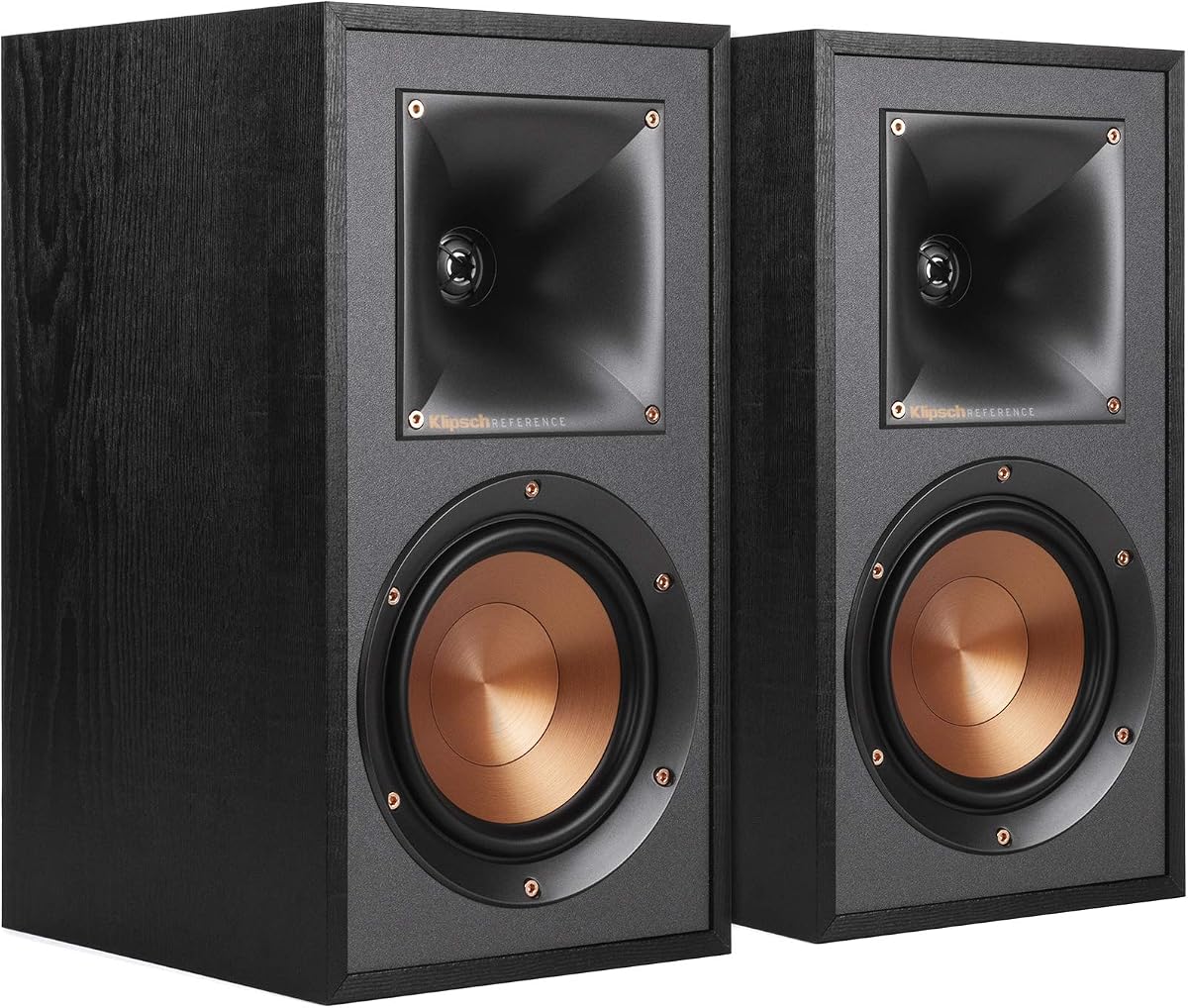
The Klipsch R-51M is a passive two-way bookshelf pair with a 4.8 rating. It combines a one-inch aluminum LTS tweeter loaded into a 90-by-90-degree Tractrix horn with dual 5.25-inch spun-copper IMG woofers, creating a design optimized for high efficiency, dynamics, and a prominent sense of presence.
We may earn a commission when you buy through this link, at no additional cost to you.
The horn can improve the directivity of the high frequencies, helping focus the speaker's output toward the listening position. Dual 5.25-inch woofers provide more cone area than a typical compact two-way, supporting greater scale and impact for records with prominent drums, bass, and orchestral passages.
Because the speakers are passive, they need a suitable amplifier or receiver. Horn-loaded high frequencies also produce a house-style presentation that some listeners enjoy and others find too assertive. Placement away from walls and tweeters directed toward the listening area can help refine the balance.
The R-51M is an excellent choice for listeners who value lively dynamics, articulate vocals, and the ability to play music at healthy levels without making the system feel demanding. It also suits a growing home-theater system because the pair can serve as front or surround speakers.
The horn-loaded tweeter and dual copper woofers are engineered for strong output and controlled dispersion. A suitably capable amplifier can drive the pair confidently, while its scale is useful for both large-scale records and home-theater use.
Tractrix horn geometry directs treble more precisely than a conventional dome alone. Careful toe-in can improve imaging and central tonal focus, helping the pair sound more integrated with a turntable placed in a stereo setup.
We may earn a commission when you buy through this link, at no additional cost to you.
The Polk Audio Signature Elite ES20 pair is a substantial passive bookshelf speaker with a 4.8 rating. Its 1-inch Terylene tweeter, 6.5-inch woofer, precision crossovers, and Dynamically Balanced Acoustic Array are designed to create clear, spacious sound for music, films, and games.
We may earn a commission when you buy through this link, at no additional cost to you.
The large woofer and patented Power Port technology aim to provide greater bass impact than conventional ported designs while reducing turbulence and distortion. High sensitivity and compatibility with both four- and eight-ohm amplifiers broaden the range of receivers and stereo amplifiers that can drive the pair effectively.
These are physically substantial speakers, so shelf and stand dimensions should be checked before ordering. They require external amplification and are better suited to medium or large listening spaces than very compact desktops. Their tonal consistency also makes them a logical foundation for a larger Polk Signature Elite theater system.
The ES20 is ideal for a serious turntable setup in a dedicated listening room or multipurpose media space. It prioritizes full-range scale, cinematic impact, and future surround expansion over the smaller footprint and simpler integration offered by compact bookshelf models.
A 6.5-inch woofer and Power Port design give the ES20 a larger physical foundation than most compact bookshelf speakers. The result is better suited to filling a room with music and cinematic dynamics without requiring multiple subwoofers for basic low-frequency support.
The speakers can sit on stands, work as side or rear surrounds, or use their mounting inserts and keyhole slots for wall placement. Their matched-series design also makes them a practical starting point for a coordinated home-theater build.
We may earn a commission when you buy through this link, at no additional cost to you.
The right turntable speakers depend on the turntable's output, the available amplification, room size, musical preferences, and willingness to build a flexible system. These factors determine whether a passive, powered, or wireless model is the most practical choice.
In short, check the output labels and manual before selecting a speaker. The right connection prevents underwhelming volume and unnecessary troubleshooting.
Choose passive speakers for a traditional system and powered speakers for simplicity. Match the choice to the equipment you already own.
Do not rely on the connector fit alone. Verify impedance and amplifier compatibility before installing a passive pair.
For easier operation, favor a speaker and amplifier combination with clear compatibility guidance. For better control, evaluate the phono stage carefully.
Choose a driver size that suits the room rather than simply selecting the largest model. Leave enough space for proper positioning and airflow.
More drivers are not automatically better. Choose the tonal character and crossover design that suit the music and listening preferences.
List the outputs on the turntable and inputs on the speaker before ordering. The shortest compatible path usually provides the simplest setup.
Choose a speaker that works today and remains useful in a future stereo or surround layout. Check both its current placement needs and upgrade path.
Start by placing both speakers at an equal distance from the listener and the turntable, forming a symmetrical stereo triangle. Keep the cabinets upright, leave room around rear-facing bass ports, and use stands or stable furniture that will not resonate. Connect the turntable's line output to an amplifier's line input, or its phono output to a phono input, then connect the amplifier's left and right speaker outputs to the corresponding passive speakers.
Begin with a moderate listening level and check the channel balance, tone controls, and placement one change at a time. If the bass becomes exaggerated near a wall, move the speakers forward or use removable port plugs if the model includes them. Small changes in distance and toe-in can improve imaging, but large adjustments should be made gradually to avoid overcompensating for a room anomaly.
Handle the cabinets gently, keep drivers and ports free of dust, and do not push the amplification to clipping. Use the manufacturer's guidance for cleaning the finish, and avoid placing the turntable directly on top of a speaker if vibration is transmitted into the tonearm. For wireless operation, confirm that the turntable can transmit audio rather than merely receive it, and keep the source in PCM stereo mode for the most reliable playback.
Only if the turntable has a line-level output and the passive speakers are accompanied by an external amplifier. Passive speakers contain no internal power amplifier, so they cannot operate directly from a turntable's output. A phono output requires a phono preamplifier or a receiver with a phono input before the signal reaches the amplifier and speakers.
A passive speaker requires an external amplifier or receiver to power its drivers. A powered speaker contains a built-in amplifier and can usually connect directly to a line-level source. Powered models offer simpler setup and sometimes wireless or digital inputs, while passive models provide more freedom to select and upgrade external amplification.
Only when the turntable can transmit Bluetooth audio to headphones or another Bluetooth device. A turntable with a Bluetooth receiver may accept music from a phone but may not be able to send that music to external speakers. Check the specifications for Bluetooth transmitter output rather than assuming that every Bluetooth-enabled turntable supports Bluetooth playback.
The requirement depends on the turntable and system, not on the passive speaker itself. If the turntable has a built-in preamp and a line output, that output can feed an amplifier's line input. If it offers only a phono output, use either a receiver with a phono input or an external phono preamp before the signal reaches the power amplifier.
A four-inch two-way bookshelf speaker is often sufficient for a small room or nearfield setup. Five-and-a-quarter-inch drivers can provide more scale, while 6.5-inch models suit larger rooms. Driver size is only one consideration; amplifier compatibility, sensitivity, room placement, and bass-port tuning also shape the result.
They can be, but shelf or stand placement often provides more consistent stereo imaging. Wall mounting is useful for rear surrounds, secondary rooms, and installations where stands are impractical. Because a wall can reinforce bass, leave adequate clearance from the rear port and adjust placement if the low end becomes excessive.
Connect the left speaker to the amplifier's left output and the right speaker to the right output, observing polarity. Before doing so, confirm that the amplifier supports four-ohm loads and can supply the speakers' recommended power. If the amplifier has restrictions, select a compatible speaker or use an appropriately rated external power amplifier.
A well-designed two-way speaker can reproduce records accurately and is often simpler to drive. A three-way speaker adds a dedicated midrange driver that may improve vocal and instrument separation. The better choice depends on crossover quality, amplifier suitability, room conditions, and the listener's tonal preferences rather than the number of drivers alone.
The Edifier P12 offers a balanced, compact passive package with included wiring and wall-mount brackets, while the RIOWOIS pair brings a higher-rated four-inch design, horn-loaded tweeter, and flexible terminals. The Klipsch R-51M stands apart with dual 5.25-inch woofers and an efficient, lively horn-loaded character suited to dynamic listening.
Prioritize the turntable's output first, then choose between passive and powered architecture based on the equipment already in your possession. Check impedance and amplifier capability, consider the room and speaker dimensions, and listen for a tonal presentation that suits your records rather than choosing solely by driver count or rating.
Finally, review the latest manufacturer specifications, included accessories, and current product listings before ordering. Turntable compatibility depends on exact output labels, amplifier limitations, and the way the speakers will be placed, so careful setup planning can prevent the most common connection problems.

