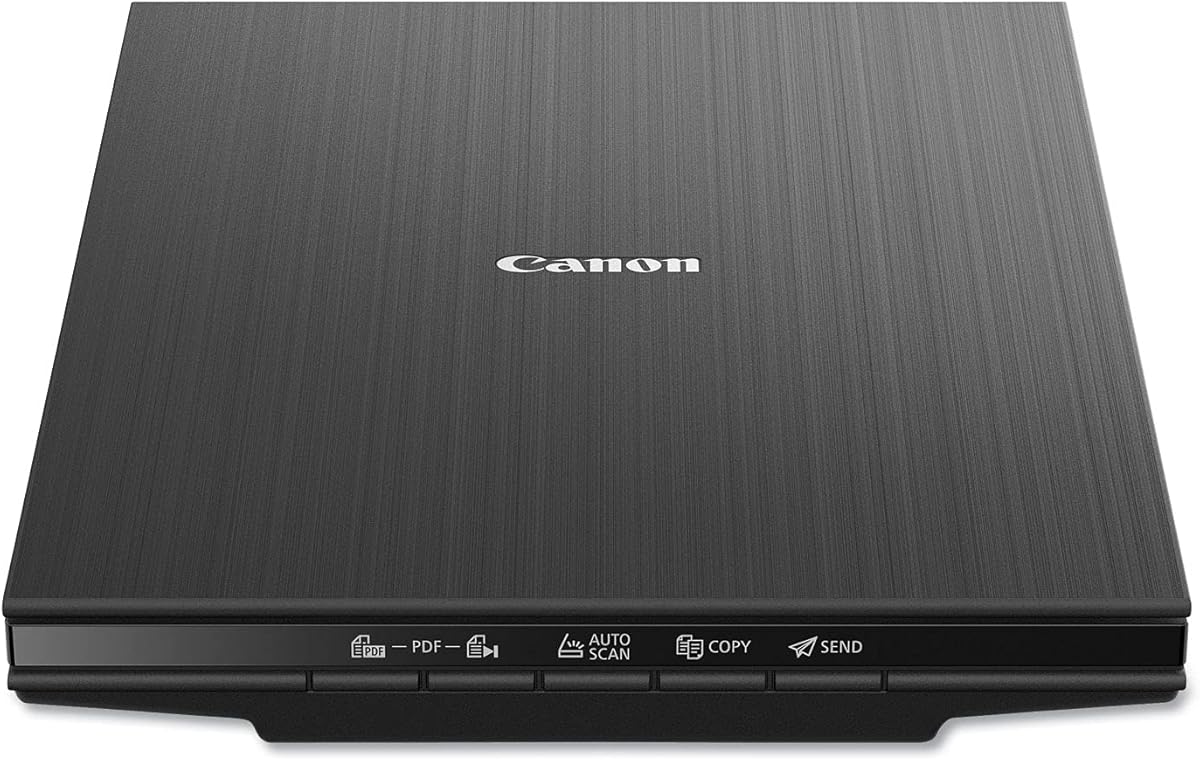
Canon CanoScan LiDE 400
4.1Editor score
4800 x 4800 dpi resolution
Automatic document detection
Color restoration and dust removal
A scanner for archiving photos should simplify the conversion of printed memories into organized digital files without exposing delicate images to unnecessary handling. The most useful models combine accurate color capture, automatic corrections, practical photo feeders, and software that makes naming, editing, and storing scans straightforward.
We compared these scanners by considering their stated resolution, supported photo sizes, document features, restoration tools, connectivity, capacity, and included accessories. The list covers automatic document feeders, compact sheet-fed models, flatbeds, and wireless systems designed to handle everything from loose prints to large archival batches.
Each review explains where a model stands out, what trade-offs accompany its design, and which type of collector it suits best. Product configurations, bundle contents, software behavior, and availability can change, so readers should verify current specifications and prices before purchasing.
4.1Editor score

4.5Editor score

4.5Editor score
As an Amazon Associate we earn from qualifying purchases.
The table below compares the essential physical, media-handling, resolution, and connectivity features of all ten scanners, making it easier to identify the model that matches a particular archive.


The Epson FastFoto FF-680W is the most balanced choice in this guide, combining a 4.5 rating with a scanner built specifically around high-volume photo archiving. It can process a photo in as little as one second at 300 dpi and batch as many as 36 prints, making it well suited to albums, envelopes, and decades of loose snapshots.
We may earn a commission when you buy through this link, at no additional cost to you.
Its standout advantage is single-step duplex capture. The scanner records the photograph and any writing on its reverse in one pass, preserving context that ordinary one-sided scans would miss. Automatic enhancement, color restoration, red-eye reduction, cropping, deskewing, and rotation further reduce the manual effort required to prepare finished files.
Resolution choices align neatly with different goals: 300 dpi for convenient sharing, 600 dpi TIFF for archiving, and 1200 dpi for enlargement. A carrier sheet and microfiber cloth add protection for delicate prints, while USB and wireless connectivity make it easier to choose where the scanner operates. The FastFoto app can also add text and voice content or create slideshows.
The principal compromise is that this is a specialized feeder-based system rather than a general-purpose flatbed. Users who need to scan books, artwork, or unusual three-dimensional items may prefer a flatbed model. Even so, families and dedicated photo archivists who want quick batches, duplex records, and a direct digital workflow will find the FF-680W especially compelling.
A 36-photo feeder capacity can dramatically reduce the interruption of placing one print at a time on a glass bed. The stated speed of one photo per second at 300 dpi also makes this model more practical for collections that are already sorted into manageable stacks.
Single-pass duplex scanning captures a photo and its reverse together. That is especially valuable for prints with captions, dates, names, or other handwritten notes that would otherwise be separated from the image during digitization.
We may earn a commission when you buy through this link, at no additional cost to you.
The Canon CanoScan LiDE 400 offers an approachable flatbed option with a 4.1 rating, a slim profile, and a stated 4800 x 4800 dpi resolution. It is a practical choice for digitizing smaller runs of photographs, snapshots, documents, and mixed paper collections without investing in a feeder-equipped system.
We may earn a commission when you buy through this link, at no additional cost to you.
Automatic scan detection lets the Canon recognize what is on the glass, reducing the number of manual selections required. Its image enhancements include color restoration and dust removal, both relevant when older prints have lost some tonal richness or carry small particles that would otherwise be captured as image defects.
The 0.4-inch-thick body is easy to store and move, while the included USB Type-C cable handles both data and power. Built-in controls support scanning and editable, searchable PDF creation. However, the scanner does not automatically feed a stack of photos, and each item must be placed and scanned manually.
This makes the LiDE 400 best for occasional archivists, students, and households wanting a simple dedicated scanner at a relatively modest outlay. It is less suitable for a box containing hundreds of loose photographs because its flatbed design cannot match the throughput of automatic models. For controlled, one-at-a-time work, however, it remains easy to understand and capable.
A 4800 x 4800 dpi sensor provides ample resolution for enlarging small prints and capturing fine details. While useful resolution does not guarantee perfect color accuracy, the specification gives this model a strong foundation for preserving fine photographic detail.
The auto scan mode identifies the material on the glass, simplifying common workflows. This is particularly helpful for mixed archives containing photographs, receipts, documents, and pages that are not scanned often enough to warrant memorizing every software setting.
We may earn a commission when you buy through this link, at no additional cost to you.
The HP WorkScan HPPS100 is built for portability and flexible one-sided scanning, earning a 4.2 rating in the supplied data. Its slim body, USB 2.0 power, and 15-pages-per-minute speed make it useful for travel, compact offices, and temporary workspaces where a large desktop scanner is inconvenient.
We may earn a commission when you buy through this link, at no additional cost to you.
Resolution reaches 1200 dpi, while the supported sheet dimensions extend from 2 by 2.9 inches to 8.5 by 14 inches. The scanner can produce PDF, JPG, and other formats, giving users freedom to create image files for long-term storage or document-oriented output for everyday records.
HP WorkScan software includes auto-scan, size detection, previewing, zooming, cropping, image optimization, background cleanup, and edge and hole cleanup. The principal limitation for a photo archivist is that it uses simplex rather than duplex feeding, so the reverse of every print requires a separate pass.
This model makes sense for small prints, receipts, cards, and modest collections that need to be digitized away from a permanent desk. It is less suitable for large albums or batches that benefit from automatic feeding. Buyers should also consider whether a flatbed would serve their less conventional materials better.
The scanner's low weight and small footprint support use in a briefcase or travel bag. USB power means it can operate without a nearby outlet, provided a suitable computer is available for the capture and storage workflow.
HP WorkScan provides practical corrections such as cropping, background cleanup, and image optimization. These features can reduce the time spent manually cleaning scans after a batch has been captured.
We may earn a commission when you buy through this link, at no additional cost to you.
The AMBIR Photo Scanner Bundle has a 4.3 rating and emphasizes an end-to-end photo workflow rather than general document handling. It supports 300 and 600 dpi capture, automatic cropping and deskewing, and multiple common print sizes ranging from tiny images to 8-by-10-inch photographs.
We may earn a commission when you buy through this link, at no additional cost to you.
Its Picture Studio by AMBIR software can import images from Apple Photos, Google Photos, cameras, and memory drives, allowing physical and digital collections to be brought together. Custom albums, tags, favorites, notes, filters, borders, and detailed adjustments support organization after capture, while auto-enhance and restoration tools address faded prints.
The included photo cleaning kit is a meaningful addition for delicate material. A bellows blower, microfiber cloth, and anti-static brush help prepare prints, and a protective carrier sheet reduces direct contact with the scanning surface. Single-cable USB power and connection keep setup straightforward on Mac or PC.
The main limitation is that the 600 dpi maximum provides less enlargement latitude than 4800 dpi flatbeds. It also cannot scan 8-by-10-inch prints beyond the stated maximum size. Even so, collectors who prioritize organization, common snapshot formats, and physical print preparation will find this bundle particularly well aligned with their needs.
Dust, fingerprints, and static can affect both the scan and the print itself. The included blower, cloth, and anti-static brush help users clean photographs before placement, while the carrier sheet provides a protective barrier during scanning.
Importing files from phones, cameras, and existing photo services can eliminate the need to maintain separate archives. Albums, notes, tags, favorites, and editing tools then provide a consistent structure for browsing the combined collection.
We may earn a commission when you buy through this link, at no additional cost to you.
The Epson Perfection V19 II is a compact 4800 dpi flatbed with a 3.9 rating, offering high nominal detail in a light, USB-powered design. It can scan photographs, artwork, books, documents, and illustrations, making it useful when an archive includes more than conventional prints.
We may earn a commission when you buy through this link, at no additional cost to you.
Easy Photo Fix restores color to faded photographs with one click, while Epson ScanSmart supports searchable PDFs and editable Word, Excel, and PowerPoint files through optical character recognition. The removable high-rise lid improves access to pages in books and photo albums that a standard flatbed lid might obstruct.
At 3.1 pounds, the scanner is easier to reposition than a large station-based unit. One-touch controls reduce the number of steps required, and a letter-size document can be scanned in about 10 seconds. A built-in kickstand allows vertical placement and storage when the device is not in use.
Its 3.9 rating is lower than those of the leading models, and the manual process is inherently slow for large archives. Nevertheless, the combination of 4800 dpi resolution, OCR, restoration, portability, and a modest footprint makes the V19 II a credible option for home archivists who scan selectively rather than continuously.
Easy Photo Fix provides an accessible way to improve faded color. It does not replace professional restoration, but it can make older prints more appealing when used as an initial enhancement before saving archival files.
Searchable PDF and editable Office document outputs make the V19 II useful for family records as well as pictures. The removable high-rise lid and manageable weight also help when working through albums, illustrated books, or mixed paper files.
We may earn a commission when you buy through this link, at no additional cost to you.
The Epson Perfection V39 II combines a 4800 dpi optical sensor with photo restoration and document-oriented software, though its 3.7 rating is the lowest among the products reviewed. It is aimed at users who want a single flatbed for photographs, artwork, illustrations, books, and everyday documents.
We may earn a commission when you buy through this link, at no additional cost to you.
Easy Photo Fix restores faded color with a single click, while ScanSmart can stitch oversized images together and send scans to cloud storage. One-touch controls streamline the basic workflow, and a letter-size document can be scanned in approximately 10 seconds.
Like the V19 II, the removable high-rise lid helps accommodate pages from books and albums. USB power eliminates the need for a separate power supply, contributing to a relatively portable footprint. Nevertheless, the device relies on manual placement and lacks an automatic feeder.
The V39 II is most appropriate for a mixed home archive where high resolution and occasional restoration are priorities but large-volume photo capture is not. Its lower rating suggests a more measured recommendation than the top-ranked models, so buyers should compare the included software and physical features against the similarly capable V19 II.
The ability to stitch oversized images expands the range of work possible beyond a single sheet. This is useful for panoramas, wide artwork, and unusually large printed images that do not fit comfortably in one capture.
Sending scans to cloud storage through Epson ScanSmart can simplify the movement of finished files. Buyers should still maintain their own backup strategy because cloud convenience should complement rather than replace independent preservation.
We may earn a commission when you buy through this link, at no additional cost to you.
The ScanSnap iX2500 is a high-speed, connectivity-focused scanner with a 4.3 rating. It handles up to 45 pages per minute, offers duplex scanning, and includes a 100-sheet feeder, making it attractive for archives that combine photographs with documents, receipts, and business cards.
We may earn a commission when you buy through this link, at no additional cost to you.
A large touchscreen supports personalized profiles and allows users to select destinations such as a PC, Mac, mobile device, or cloud service. Wi-Fi 6 and USB-C provide flexible placement, and the Quick Menu can move scans into preferred computer applications.
Paper handling is a major strength. A brake roller system supports smooth feeding, a multi-feed sensor identifies stuck pages, and skew detection helps reduce damage and missing data. Automatic optimization, file naming, and sorting reduce the post-processing burden.
The standard iX2500 is not the photo-specialized bundle, although it can organize and manage scanned photos. Its higher purchase tier may not be necessary for an archive containing only a few dozen prints. For users who also digitize large document collections or want a genuinely wireless touchscreen workflow, it remains a capable and distinctive option.
The scanner can send output to computers, mobile devices, and cloud services without requiring a wired connection. Personalized touchscreen profiles make repeated workflows faster by reducing the need to navigate general-purpose software for every task.
The 100-sheet feeder and 45-pages-per-minute rate are well suited to mixed archives. Skew detection, a multi-feed sensor, and a brake roller system help protect source material and reduce the need to rescan damaged or incorrectly captured stacks.
We may earn a commission when you buy through this link, at no additional cost to you.
The Epson Workforce ES-50 is a compact, lightweight document scanner with a 4.3 rating. It can scan a single sheet in as little as 5.5 seconds and accepts documents up to 8.5 by 72 inches, making it a practical option for receipts, identification cards, and unusually long records.
We may earn a commission when you buy through this link, at no additional cost to you.
Automatic feeding lets each new sheet be inserted as the previous one is processed, while ScanSmart can combine multiple pages into one file. Nuance OCR creates searchable PDFs and editable Word and Excel documents, and cloud destinations are supported through the included software.
Its one-cable USB 2.0 power arrangement eliminates the need for batteries or an external supply. This helps the scanner fit mobile workflows, although the computer remains necessary for most supplied software functions. The scanner also has no duplex mechanism, so front and back content must be captured separately.
For a photo-only collection, the ES-50's document-first design is less specialized than the FastFoto or ScanSnap Photo Edition. It becomes considerably more useful for families preserving a mixed archive of photographs and paperwork, particularly when portability and OCR matter more than photo-specific accessories.
Support for sheets up to 72 inches expands the scanner's usefulness beyond standard pages. It can handle receipts, narrow strips, and long documents that would be inconvenient to capture in multiple flatbed passes.
USB power and automatic sheet acceptance reduce the setup required between documents. The absence of batteries or an external power supply also simplifies packing the scanner for use in temporary offices or while traveling.
We may earn a commission when you buy through this link, at no additional cost to you.
The ScanSnap iX2500 Photo Edition is the premium photo-focused choice in this guide, carrying a 4.5 rating and a dedicated set of features for preserving printed memories. It scans up to 100 photos per minute and accepts up to 36 photos in its automatic document feeder.
We may earn a commission when you buy through this link, at no additional cost to you.
Three photo carrier sheets support delicate prints and help establish repeatable scanning profiles. The large touchscreen lets users customize output behavior, choose destinations, and use Quick Menu to move finished files into preferred computer applications.
Wi-Fi 6 allows operation without a wired computer, while USB-C provides a direct alternative. The system can send scans to PCs, Macs, mobile devices, and cloud services. Automatic optimization, naming, and sorting simplify the organization of photos, receipts, business cards, and documents.
Its premium tier makes it most relevant to serious collectors, family historians, or institutions processing large quantities of photos. The included accessories improve the physical workflow, while the touchscreen reduces dependence on a computer for routine setup. Buyers should ensure their chosen destinations and preferred file formats fit their long-term archive plan.
The stated ability to scan up to 100 photos per minute and hold 36 in the feeder is designed for substantial print collections. These specifications can reduce the time spent cycling through albums or large groups of loose snapshots.
The included carrier sheets are intended to support delicate photographs and create repeatable scanning profiles. They help bridge the gap between general-purpose feeder equipment and a workflow designed specifically for printed images.
We may earn a commission when you buy through this link, at no additional cost to you.
The Brother DS-640 is a notably compact mobile scanner with a 4.3 rating. Its body is under one foot long and weighs about 1.5 pounds, allowing it to fit in a bag or other small carrying space without occupying much of a desk.
We may earn a commission when you buy through this link, at no additional cost to you.
It scans up to 16 pages per minute, and color scanning is stated to run at the same rate as monochrome capture. The included micro USB 3.0 cable provides data and power, allowing operation without a nearby outlet as long as a compatible computer is available.
Brother iPrint&Scan supports destinations including a PC, network, cloud services, email, and OCR. The system also works with Windows, Mac, and Linux through the listed TWAIN, WIA, ICA, and SANE options. Automatic color detection, rotation, bleed-through prevention, background removal, text enhancement, and color-drop controls aid document cleanup.
The DS-640 is a document-first option and does not provide the photo-specific feeders or carrier accessories found in the higher-ranked products. It remains useful for a modest collection of small prints, cards, and receipts, especially for users who prioritize portability and cross-platform compatibility over high-volume archival throughput.
The DS-640's body length and low weight make it easy to carry between home, office, and travel locations. That flexibility is valuable for users who need occasional scans but do not want a permanently installed desktop device.
Windows, Mac, and Linux compatibility expands the device's potential audience. Scan-to options for cloud storage, email, OCR, network locations, and the computer create several routes for organizing captured files.
We may earn a commission when you buy through this link, at no additional cost to you.
The right archival scanner depends on the size and condition of the collection, the desired image quality, and how much organization and automation the workflow requires. These factors help narrow the field before comparing individual models.
An automatic feeder is usually the better choice for large collections because it reduces the time and effort involved in handling individual prints. Photo-specific feeders may hold dozens of images, while document feeders can also capture letters and mixed records. A flatbed is more flexible for books, albums, artwork, and unusual shapes, but every item must be placed manually and repositioned as needed.
Choose a feeder for volume, a flatbed for variety. If the archive contains both loose prints and bound material, a flatbed may handle the latter while a dedicated photo scanner tackles the former.
Resolution determines how much fine detail the scanner can record. The 300 dpi option offered by several photo scanners is generally suitable for ordinary viewing and sharing, while 600 dpi provides a stronger basis for preservation and moderate enlargement. Flatbed models advertising 4800 dpi can capture very fine detail from small prints, but the actual benefit depends on source quality, optics, file size, and storage capacity.
Match resolution to the final use. More data is not automatically better when the goal is routine viewing, so archive files should be large enough for future use without needlessly burdening storage.
Automatic color restoration, fade correction, dust removal, red-eye reduction, deskewing, cropping, and rotation can improve old prints before they are saved. These features are especially valuable for albums and snapshots that have been handled for decades. They should be viewed as useful enhancements rather than a substitute for careful cleaning and physical preservation of fragile originals.
Prioritize correction tools that can be disabled or adjusted. Restraint is valuable when a scan already has a specific appearance that should not be altered.
Archive scanners vary considerably in the dimensions they can accept. Standard snapshots and postcards are widely supported, but panoramic images, 8-by-10-inch prints, long strips, and small mounted photographs may require specific capabilities. Flatbeds generally provide more size flexibility, while feeder models can be constrained by the carrier sheet and feed path.
Measure the collection before buying. A model that handles most common prints but cannot accommodate a meaningful subgroup may be less useful than a slightly less automated but more adaptable alternative.
USB provides a direct and predictable route to a computer, while wireless connectivity can make a scanner more flexible when it is shared or positioned away from a workstation. Mobile-device and cloud destinations can simplify access, but a sound archival plan should also include local storage and more than one copy of important files. Check operating-system requirements before choosing a wireless workflow.
Favor connections you can maintain. A simple direct workflow that you understand is generally preferable to a sophisticated service that does not meet your long-term storage requirements.
Old prints can curl, tear, lose pigment, or attract dust during processing. Carrier sheets, microfiber cloths, anti-static brushes, and soft blowers help reduce physical risks. The scanning path also matters: a gentle feeder and software that detects multiple or skewed pages can prevent a small stack from becoming a damaged or incomplete batch.
Handle originals carefully regardless of scanner features. Clean them according to their condition, avoid forcing brittle edges through narrow feeders, and test the workflow on representative photographs before processing an entire collection.
A successful archive needs more than clear images. Look for software that can automatically crop, deskew, clean backgrounds, create searchable files, name documents, and send scans to selected locations. Photo-oriented applications may also offer albums, tags, notes, favorites, and restoration controls, while document suites may emphasize OCR and multipage PDFs.
Compare the complete software workflow, not just the hardware. Preview, editing, naming, and export should be comfortable on your primary computer and compatible with the file structure you intend to maintain.
Feed capacity, page speed, and batch size determine how much attention a collection demands. A model that scans 15 or 16 pages per minute may suit occasional work, while systems rated at 45 pages per minute or as many as 100 photos per minute address sustained batches. The right choice should match the real size of the archive rather than an aspirational future project.
Estimate the number of prints, how often you intend to scan them, and whether mixed documents will be included. Select the least complicated model capable of completing that workload comfortably.
Before scanning, sort a small representative sample and inspect each print for dust, sticky surfaces, tears, curls, and faded areas. Remove loose debris with an appropriate soft brush or microfiber cloth, and avoid aggressive cleaning on photographs with unstable surfaces. Test the selected resolution, color mode, file format, and correction settings before processing the collection.
For automatic models, load only the number of prints the feeder is designed to support and ensure the carrier sheet sits correctly when required. Keep fingers away from the scanning glass, and do not force a print if it catches. For flatbeds, align the image carefully, close the lid gently, and leave space around items that extend beyond the glass.
After capture, inspect representative files for cropping, orientation, color, and legibility. Save archival copies in a stable, lossless or high-quality format, then create at least one independent backup. Store originals in a clean, dry, acid-free environment, and avoid placing the scanner near direct sunlight, excessive heat, dust, or moisture.
A 300 dpi scan is generally suitable for viewing and sharing, while 600 dpi provides more detail for preservation and moderate enlargement. Higher-resolution flatbed specifications can be helpful for tiny prints or further enlargement. The best choice depends on the original quality, intended uses, and available storage rather than resolution alone.
A photo scanner is generally better when an archive contains large batches of loose prints, mixed print sizes, or delicate photographs. A document scanner is more useful for letters, receipts, and mixed office records. Photo models often add specialized feeders, carrier sheets, restoration tools, and higher batch throughput.
Some document scanners can scan photographs, but their feeding path, pressure, and software may not be designed for fragile prints. Flatbeds usually offer gentler handling because the image remains stationary. For valuable or brittle photographs, verify the feeder's weight, use a carrier sheet when approved, and test a small sample first.
Duplex scanning can be valuable because many prints have captions, dates, names, or other notes written on the back. Capturing both sides in one pass preserves that context and reduces handling. If reverse-side text is not needed, a lower-cost single-sided model may be sufficient for the collection.
Automatic restoration can make faded scans more vivid and easier to view, but it may also alter the historical appearance of an image. Archivers often benefit from saving a corrected working copy while retaining the original scan as faithfully as possible. Manually reviewing adjustments is wise for important collections.
Use a consistent folder structure, meaningful file names, and dates or event labels that reflect the physical archive. Dedicated software can add albums, tags, favorites, and notes, while searchable PDFs and OCR help with mixed document collections. Keep a catalog of the original album or box sequence so provenance is not lost.
Important scans should exist in at least two separate locations, ideally using different storage systems. A connected computer or external drive can provide one copy, while a second service or drive can add protection from device failure. Cloud delivery is convenient, but it should complement rather than replace a deliberate backup plan.
Inspect and clean prints before scanning, use a suitable carrier sheet, and avoid repeatedly bending curled corners. Feed only the recommended number of items, and stop if the scanner struggles with a print. For extremely brittle material, a flatbed allows gentler placement and can reduce the risk of feeder damage.
The Epson FastFoto FF-680W stands out as the strongest all-around option because it combines quick 36-photo batches, single-pass duplex capture, restoration tools, multiple resolutions, and flexible connectivity. The Canon CanoScan LiDE 400 serves as an approachable flatbed, while the ScanSnap iX2500 Photo Edition leads the premium group with exceptional stated photo throughput and purpose-built carrier sheets.
Prioritize the workload and condition of the collection. Automatic feeders suit large batches, flatbeds handle books and unusual objects, and mixed archives may benefit from a document scanner with strong OCR. Resolution should be matched to enlargement plans, while restoration and organization features should support a workflow you will actually use.
Before purchasing, verify current specifications, included accessories, software compatibility, and availability. Prices and promotions change, so compare the current cost of the scanner, any required accessories, and adequate backup storage rather than choosing solely from the initial purchase listing.
