
MOZA SRP2 Pedals
4.5Editor score
100 kg load cell brake
Twenty-five brake configurations
Adjustable pedal geometry
This guide compares the best racing wheel with load cell pedals for SIM Racing, covering braking accuracy, construction, adjustment, and compatibility.
A racing wheel with load cell pedals can transform how closely a simulator reproduces real braking. Instead of relying on a spring position alone, load cell systems measure applied force, helping drivers modulate trail braking, emergency stops, and subtle pressure changes with greater consistency.
The products in this guide were compared using the supplied specifications, focusing on sensor technology, brake-force capacity, adjustability, construction, platform support, and included accessories. The list covers two-pedal and three-pedal sets, standalone pedal upgrades, and complete wheel-and-pedal systems for different racing budgets.
Each review explains who the product best suits, what stands out in its design, and where its compromises may matter. Ratings and specifications reflect the supplied product information, while prices and bundle contents can change, so readers should confirm current details before making a purchase.
4.5Editor score

4.7Editor score

This side-by-side comparison covers pedal force, sensor technology, adjustment options, construction, compatibility, and whether each product is a standalone set or a complete driving package.




The Fanatec CSL Elite Pedals V2 carry a 4.6 rating in the supplied product data and offer one of the clearest combinations of braking precision and ecosystem flexibility. A load cell measures up to 90 kg of force on the brake plate, while contactless Hall sensors serve the throttle and clutch positions. This makes the set appealing to drivers who value consistent inputs and plan to connect it to a compatible Fanatec base.
We may earn a commission when you buy through this link, at no additional cost to you.
The most important feature is the new load cell brake system, which uses an elastomer stack alongside the sensing element to create a progressive brake feel. Supplied elastomer springs at 65, 75, and 85 Shore hardness can be changed without tools, while an alternative metal spring allows a stiffer preload. That range makes it possible to move between restrained road-car braking and more aggressive performance-car characteristics.
There are practical trade-offs. This configuration is a two-pedal set, so it does not provide a clutch input for manual-transmission cars. USB operation as a standalone device is limited to Windows PC, and full console use depends on the corresponding licensed Fanatec base. Buyers who only need brake and throttle can embrace those constraints, while manual racers will need to look elsewhere.
This is a strong recommendation for PC, PlayStation, and Xbox drivers already invested in compatible Fanatec hardware, especially those seeking a refined load cell upgrade without choosing a full standalone pedal chassis. It combines measurement, feel, and adjustability in a focused package, making it one of the most convincing premium pedal choices in the guide.
Measuring up to 90 kg on the pedal plate gives the brake input a direct physical basis rather than relying only on a preset spring position. The result is a more usable braking curve for drivers who need to hold a narrow line or modulate pressure during a corner.
The three supplied elastomer hardnesses and optional metal spring let the owner tune initial resistance, progressive feel, and preload. Tool-free elastomer changes make it easier to compare setups without arranging a specialized installation.
We may earn a commission when you buy through this link, at no additional cost to you.
The MOZA SRP2 Pedals receive a 4.5 rating in the supplied data and provide a well-balanced entry into force-sensitive braking. The 100 kg load cell is paired with a standard elastomer and multi-hardness spring arrangement that supports 25 brake-feel configurations. A performance kit can expand that selection considerably, making the set appealing for both new and experienced simulator drivers.
We may earn a commission when you buy through this link, at no additional cost to you.
Its construction combines CNC-machined aerospace-grade aluminum with high-strength steel, a useful balance for a product expected to withstand repeated heel-to-toe transitions and hard braking. Sensor fusion combines angle and force data, while two-stage pedal-face adjustment, adjustable spacing, and a broad height range help position the pedals beneath a seated driver without moving the entire chassis.
The main limitation is that the advertised 25 configurations are the standard, and the broader range requires the separately sold performance kit. This is also a brake-and-throttle set rather than a three-pedal layout, so manual-transmission drivers will need a separate clutch solution. Those constraints are understandable for the category, but they should influence the final decision.
The MOZA SRP2 is a compelling budget-focused recommendation for PC racers who want genuine load cell measurement and extensive physical adjustment without moving immediately to a complete wheel bundle. It offers the technical essentials of a premium brake system in a more accessible standalone package.
The 100 kg sensor and 25 standard configurations give owners meaningful control over pressure response. Optional hardware expands the range further, allowing the pedal to evolve as the driver learns different braking techniques.
Two-stage face angles, spacing adjustment, and a 36 mm height range make it possible to refine pedal ergonomics. These controls can reduce ankle strain and help create a more natural driving position, especially on an adjustable cockpit.
We may earn a commission when you buy through this link, at no additional cost to you.
The SIMSONN PRO X Ultra P3-H3 has a 4.7 rating and stands out as the most comprehensively equipped three-pedal set in the guide. It includes brake, throttle, and clutch, with load cell components across all three channels. The package does not include a baseplate, but its extensive hardware and software adjustments make it a serious foundation for a dedicated sim-racing setup.
We may earn a commission when you buy through this link, at no additional cost to you.
Its adjustable hydraulic resistance rod provides eight brake settings, while 60HA, 70HA, and 80HA elastomers and ten spacers create additional feel combinations. Multi-dimensional positioning allows the pedal face, travel, angle, and individual pedal placement to be adjusted. On the software side, SIMSONN Manager supports nonlinear curves, dead zones, brake curves, and saved profiles for use across simulator titles.
The control system is unusually ambitious. Six chips include two 32-bit processors, a dedicated 16-bit high-resolution ADC, and three fully differential amplification chips, while three-channel sampling monitors the pedals simultaneously. The stated design also aims to resist interference from motion platforms and other peripherals. These details do not guarantee a particular result for every driver, but they provide a strong foundation for stable force input.
The lack of an included baseplate and the emphasis on PC use make this set most appropriate for builders with an existing frame or mounting plan. For those who want brake, throttle, and clutch, extensive tuning, and a technical control architecture in one product, it is a compelling editor's choice.
Load cell measurement on the throttle, brake, and clutch gives each pedal a direct relationship between physical pressure and simulator input. The simultaneous sampling architecture is intended to keep those inputs stable and synchronized during rapid transitions.
Nonlinear curves, dead zones, and saved brake configurations make it possible to create separate profiles for different cars or simulator games. This reduces the need to rebuild the same calibration whenever the driver changes discipline.
We may earn a commission when you buy through this link, at no additional cost to you.
The Thrustmaster Raceline Pedals III have a 3.9 rating in the supplied data and offer a different route into the category. The included pedals use frictionless H.E.A.R.T. hall effect sensors for braking, throttle, and clutch commands, while the modular structure allows owners to add a pressure-sensitive load cell brake later. It is therefore a platform for gradual upgrades rather than a ready-made load cell solution.
We may earn a commission when you buy through this link, at no additional cost to you.
Three pressure-adjustment notches and multiple springs provide control over the starting resistance of each pedal. The fully metal construction is designed for aggressive heel-to-toe use, and non-slip support pads help maintain stability on hardwood, carpet, or tile when the pedals are used outside a dedicated cockpit. Platform labeling covers PS5, Xbox, and PC.
The central compromise is that the product does not include the load cell brake mentioned in its description. Buyers seeking immediate force measurement must purchase the separate upgrade kit and install it. That adds cost and assembly work, while the lower supplied rating indicates some variation in customer satisfaction. The system also serves as an entry point rather than a finished premium pedal solution.
This set makes sense for a driver who wants robust Thrustmaster-compatible hardware, may upgrade later, and does not need force-sensitive braking immediately. For anyone specifically shopping for a load cell brake, the additional purchase is essential to achieving the intended configuration.
The modular brake design gives users time to learn the fundamentals of pedal control before committing to load cell hardware. Once the separate upgrade is installed, the platform can support a more pressure-sensitive braking style.
Non-slip support pads reduce movement on common household flooring. That makes the set more practical for a temporary simulator arrangement, although a rigid cockpit still offers the most consistent long-term positioning.
We may earn a commission when you buy through this link, at no additional cost to you.
The SIMSONN Plus X P3-H3 carries a 4.4 rating and is built around a three-pedal hydraulic system intended to reproduce progressive, nonlinear braking. It includes brake, throttle, and clutch but no baseplate. The emphasis is on natural pedal travel and realistic pressure feedback rather than simply maximizing the number of hardware options.
We may earn a commission when you buy through this link, at no additional cost to you.
The updated damping system uses 60HA, 70HA, and 80HA elastomers with thirteen spacers to vary the feel. An upgraded control box is designed for stronger anti-interference performance and stable transmission, while three vibration module ports support SIMSONN VAM, VAM RPO, and VAM Neo vibration motor hardware. High-strength steel and dual-bearing construction support consistent movement.
As with the PRO X Ultra, the lack of a baseplate means users need an existing mounting solution. Compatibility is stated for Windows 11 and earlier PC versions, so this is not the appropriate standalone choice for a console-only driver. The 24-month component warranty provides some reassurance, although specific damage and misuse are excluded.
The Plus X P3-H3 is recommended for PC racers who prioritize a natural hydraulic brake progression, a full clutch-equipped layout, and possible integration with external haptics. It offers fewer tuning details than the PRO X Ultra but provides a focused three-pedal experience for manual-transmission and endurance racers.
The hydraulic system is intended to slow pedal travel and restore a progressive response as pressure increases. That characteristic can help drivers distinguish light trail braking from a hard stop without relying solely on visual feedback.
Three dedicated vibration ports open a path to compatible SIMSONN haptic hardware. This is especially relevant to builders who want brake vibration and other physical effects to reinforce simulator events.
We may earn a commission when you buy through this link, at no additional cost to you.
The SIMSONN PRO X Ultra P2-H2 has a 5.0 rating in the supplied product data and delivers the technical core of the PRO X Ultra line in a focused brake-and-throttle arrangement. Both pedals use load cell components, and the brake includes an adjustable hydraulic resistance rod with eight levels. It omits the clutch and baseplate, concentrating the design on the controls used in many automatic-transmission and GT racing setups.
We may earn a commission when you buy through this link, at no additional cost to you.
The controller uses the same ambitious six-chip design as the three-pedal version, including two 32-bit processors, a dedicated 16-bit high-resolution ADC, and three differential amplification chips. The system supports three-channel simultaneous sampling and 16-bit HID axes under Windows. SIMSONN Manager adds nonlinear curves, dead zones, and adjustable braking profiles, while RGB lighting can visualize pedal pressure.
Its main limitation is the lack of a clutch, which rules it out for drivers who want a complete manual transmission setup. There is also no baseplate, so buyers must already have a compatible rig or plan to mount it securely. Those limitations reduce versatility, but they also explain why this version can focus on the core brake-and-throttle experience.
This is an excellent recommendation for an automatic-transmission PC racer who wants a technically sophisticated load cell brake without carrying an unused clutch pedal. It is particularly compelling for owners already invested in the SIMSONN ecosystem or for drivers who value precise curves and high-resolution input processing.
The dedicated high-resolution converter and differential amplification components are designed to improve signal acquisition and noise immunity. For pressure-sensitive controls, stable input is valuable because small braking corrections can significantly affect vehicle balance.
Keeping the set to brake and throttle reduces footprint and avoids a spare clutch input. It is a sensible arrangement for many modern GT, endurance, and road-racing simulations where automatic transmission is common.
We may earn a commission when you buy through this link, at no additional cost to you.
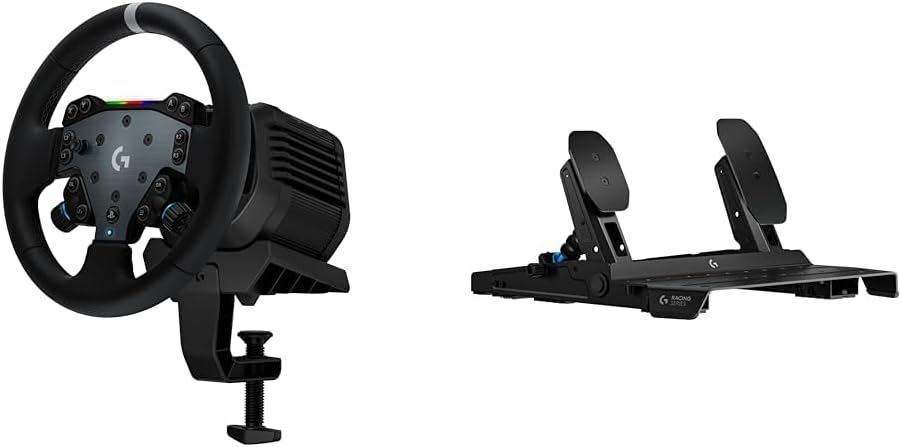
The Logitech G RS50 Racing Wheel System has a 4.7 rating and is the most complete conventional wheel-and-pedal package among the products featured. It combines an eight newton-meter direct drive base, an interchangeable wheel hub, an 11-inch round wheel, and pedals with a 75 kg load cell brake. That makes it a practical starting point for PC and PlayStation drivers who want a coordinated system rather than assembling every component separately.
We may earn a commission when you buy through this link, at no additional cost to you.
The round wheel's fuller grip profile and silicone-leather covering suit drifting, rallying, and drivers who prefer rapid hand-over-hand steering. Adjustable paddle shifters accommodate wheel rims up to 12 mm wide, and the integrated quick release simplifies swapping compatible Logitech G RS or PRO wheels. Thirteen console-specific buttons provide access to game functions without relying entirely on keyboard shortcuts.
At the pedals, the load cell brake registers applied force for more consistent trail braking and car-balance control. Hall effect sensors serve the accelerator and clutch positions, while adjustable pedal positions allow the owner to refine spacing and reach. The package does not explicitly list Xbox support, and the included round wheel is not the only possible wheel format despite the modular hub.
The RS50 is recommended for racers who want a ready-to-build direct drive setup with force-sensitive pedals included. It offers broad appeal for drift, rally, and general sim racing, while wheel enthusiasts can take advantage of the quick-release design to explore other compatible rims.
The 11-inch round rim provides a familiar grip shape for drivers moving from road or rally cars to a simulator. Its full profile supports large steering inputs without encouraging the flat, constrained hand position found on some smaller GT-style wheels.
The hub accepts compatible Logitech G RS or PRO wheels and uses a quick-release mechanism. Drivers can therefore change rim size and style without replacing the complete base.
We may earn a commission when you buy through this link, at no additional cost to you.
The MOZA SR-P Pedals have no customer rating in the supplied data, but their headline specifications place them clearly within the modern load cell category. The two-pedal set includes a 100 kg load cell brake and a hybrid brake mechanism, complemented by an organ-type accelerator and 15-bit magnetic encoders. It is designed specifically for PC use and offers a focused alternative to larger three-pedal systems.
We may earn a commission when you buy through this link, at no additional cost to you.
The hybrid brake concept is intended to combine different mechanical characteristics within the braking action. The 15-bit encoders are a notable detail because higher-resolution position sensing can complement load cell force data, helping the system represent both pedal travel and applied pressure with finer granularity.
The biggest limitation is that the supplied product information contains only a brief description, so there is less detail about materials, adjustment ranges, included springs, and mounting options than for the leading alternatives. The absence of a customer rating also makes it harder to gauge long-term consistency from the available evidence. Buyers should examine the current listing closely for exact contents and compatibility.
The SR-P is a worthwhile option for a PC driver who specifically wants a two-pedal set, a 100 kg load cell, and modern encoder technology without paying for a clutch pedal. It may be especially relevant to those interested in MOZA's current generation of compact racing hardware.
The hybrid mechanism is intended to deliver a more nuanced progression than a basic fixed spring pedal. Drivers can compare the feel directly and decide whether the 100 kg measurement produces the control they need.
Fifteen-bit magnetic encoders provide a high-resolution view of pedal position. Combined with load cell sensing, they support a more complete representation of how the driver is pressing and releasing each control.
We may earn a commission when you buy through this link, at no additional cost to you.
The MOZA SRP2 Racing Simulator Pedals have a 5.0 rating in the supplied information and combine a 100 kg load cell with a 15-bit angle sensor. Their sensor-fusion approach measures both force and pedal position, providing a more complete input profile than a setup that relies on one measurement type. The standard package supports 25 brake-feel configurations and can be expanded through an optional performance kit.
We may earn a commission when you buy through this link, at no additional cost to you.
CNC-machined aerospace-grade aluminum and high-strength steel provide a premium material specification without requiring a full wheel bundle. The two-stage face-angle options, adjustable spacing of plus or minus 15 mm, and 36 mm height range make it easier to align the pedals with a driver's natural leg position. These are practical refinements that can improve both comfort and consistency.
The two-pedal format excludes a clutch, so the set is best suited to automatic-transmission racing or separate manual setups. The full 1,000-plus configuration range mentioned in the description requires the optional performance kit, while the standard 25 configurations remain available from the base product. The listing also does not provide the same depth of platform information as some competitors.
This SRP2 listing is an excellent recommendation for racers who prioritize sensor fusion, a high-capacity brake, and extensive ergonomics. It is particularly appealing when paired with a separate MOZA wheel base and suitable cockpit, creating a focused two-pedal system with a high degree of physical control.
The 15-bit angle sensor and 100 kg load cell provide complementary information about travel and pressure. This fusion can give the driver a more responsive representation of pedal intent than either measurement would provide alone.
CNC-machined aluminum reduces unnecessary mass while high-strength steel handles structural demands. The combination supports a premium feel and makes the set suitable for repeated hard braking and heel-to-toe transitions.
We may earn a commission when you buy through this link, at no additional cost to you.
The MOZA R21 Sim Racing Bundle is a complete high-end package containing the R21 Ultra direct drive base, CRP2 load cell pedals with clutch, and a GS V2P racing wheel. No customer rating is supplied, but the specifications position it as one of the most capable systems in the guide. It is intended for racers building a serious, integrated cockpit rather than assembling components incrementally.
We may earn a commission when you buy through this link, at no additional cost to you.
The R21 base supplies a constant 21 newton-meters of industrial-grade torque, with the next-generation flat-wire motor intended to reduce cogging and maintain smooth force feedback. Its new force-feedback algorithm and software-based tuning give the driver control over how the base communicates vehicle behavior. The included 300 mm GS wheel is a full-featured GT-style design intended for immersion and esports use.
At the pedals, the CRP2 set combines a 200 kg load cell with a 15-bit angle sensor and up to 1,764 customization options. CNC aerospace-grade aluminum and a carbon fiber heel plate support a premium construction. The major trade-off is scale: this is a much larger platform commitment than a standalone pedal set, and buyers should ensure their cockpit, floor space, and computer setup can support it.
This bundle is recommended for committed sim racers who want matched wheel, base, and load cell pedals from one ecosystem. It is the strongest premium choice for drivers seeking high torque, three-pedal control, extensive brake tuning, and a complete GT-oriented package.
The 21 newton-meter motor and flat-wire design focus on smooth, consistent force feedback over extended sessions. A strong motor also has the authority to reproduce demanding braking, curb impacts, and traction changes without the limited movement associated with entry-level belt systems.
The 200 kg load cell, 15-bit angle sensor, and extensive configuration count support fine-grained brake setup. Owners can adapt the pedal to different vehicle classes, from road cars to open-wheel racers, as their technique improves.
We may earn a commission when you buy through this link, at no additional cost to you.
The right pedal set depends on how you race, which platforms you use, and how precisely you want to control braking. Sensor type, force range, mechanical construction, adjustment, software support, and mounting requirements should all be considered before buying.
Prioritize a capacity that suits your braking technique and the simulator's calibration. Do not assume the largest number automatically feels best.
Choose two pedals for convenience and three pedals for comprehensive manual-control simulation.
Favor direct force measurement, high-resolution encoding, and stable multi-channel processing.
Choose multiple damping options when you want to compare car types or refine your technique over time.
Adjust the pedals to your body and cockpit rather than adapting your driving posture to a fixed layout.
Confirm platform, operating system, base, and software support before ordering.
Favor rigid metal construction and secure mounting, whether the baseplate is included or supplied by your cockpit.
Buy a bundle for coordinated setup and convenience; choose standalone pedals to preserve existing hardware.
Begin by mounting the pedals to a rigid cockpit or suitable floor structure, then connect them using the recommended connection method. Power on the control electronics, open the corresponding calibration or configuration utility, and confirm that brake, throttle, and clutch axes respond independently. If the set includes USB-only operation, check that the simulator recognizes it as a controller before calibrating maximum travel and released positions.
Set the brake resistance, spring preload, elastomer configuration, pedal spacing, and angle before establishing software curves. Most drivers benefit from a firm but controllable initial brake resistance followed by a progressive section. Keep early acceleration inputs small, learn where the load cell begins registering pressure, and avoid repeatedly moving the pedal outside its intended range while calibrating or making mechanical adjustments.
Clean the pedal faces with a soft damp cloth and keep dirt, oil, and metal debris away from pivots and bearings. Inspect fasteners and carbon or aluminum parts periodically, especially on a high-contact brake assembly. Do not apply aggressive chemicals to coated surfaces or sensors. When changing elastomers, springs, or load cell hardware, follow the included instructions, recalibrate afterward, and confirm that the brake still returns cleanly to its released position.
A load cell brake pedal measures the physical force applied to the pedal and converts it into a simulator input. Unlike a basic spring pedal that primarily communicates through position and resistance, it can represent partial braking more accurately. This makes trail braking, threshold control, and small pressure corrections easier to practice.
Most modern load cell pedals appear as standard controller inputs and work with widely used PC simulators, but compatibility should still be checked. Some sets offer additional configuration software for curves, dead zones, and saved profiles. Console compatibility can be more dependent on the wheel base and platform licensing.
Not automatically. A higher capacity provides more measurement range, but the pedal's spring, damping, travel, and calibration determine how that range feels in use. A well-adjusted set is more useful than one with an impressive specification but brake resistance that does not suit the driver.
Choose two pedals if you race mainly with automatic transmissions or want a compact setup. Choose three pedals if you need clutch control for manual gearbox cars, launches, and heel-to-toe shifting. A clutch can also improve engine-speed control in some endurance and road-racing scenarios.
Many quality pedal sets do not include one because compatible cockpits already provide a rigid mounting platform. The missing baseplate is not an issue if you have an appropriate cockpit and the correct mounting hardware. It is important to confirm the fit and attachment method before ordering a standalone set.
That depends on the electrical and physical connection. RJ12-equipped sets may work with compatible bases from the same or supporting ecosystem, while USB sets can often operate independently on PC. Check connector type, calibration support, base compatibility, and whether the base can pass through the pedal signals.
First set the pedal angle, spacing, height, and mechanical resistance so the legs remain relaxed. Then identify the fully released and maximum-travel positions in the game's axis settings, confirm that the brake registers smoothly under light pressure, and create a game-specific curve if the control software supports one. Recalibrate after changing springs, elastomers, or pedal travel.
Standalone pedals are usually more practical when you already own a compatible wheel base and cockpit. A complete bundle can be more convenient because the wheel, base, and pedals are designed to work together. The right choice depends on your existing hardware, preferred wheel shape, platform, and upgrade priorities.
The SIMSONN PRO X Ultra P3-H3 stands out for comprehensive three-pedal load cell measurement, extensive hardware adjustment, and configurable software profiles. The MOZA SRP2 is the strongest budget-oriented standalone choice for two-pedal racing, while the MOZA R21 and CRP2 bundle represents the most complete premium system with a high-capacity brake, clutch, wheel, and direct drive base.
Prioritize compatibility before features. Check the required base or cockpit, operating system, console support, connector type, and included baseplate. Then choose a brake range and feel that fit your technique, and make sure pedal spacing, angle, and travel can be adjusted to support a natural leg position rather than merely maximizing specifications.
Prices, ratings, bundle contents, and availability can change, so confirm the current listing before ordering. Taking the time to compare the exact package with the type of car you race will lead to a more satisfying and durable simulator setup.